
14 Cozy Fall Living Room Decor Ideas for a Warm & Inviting Autumn Home
14 Cozy Fall Living Room Decor Ideas for a Warm & Inviting Autumn Home
Most fall living rooms fail in the same quiet way: someone buys a pumpkin, a plaid throw, and a scented candle, puts all three on the coffee table, and wonders why the room still feels like summer with props. The problem is not effort or budget. It is order. A room that feels warm in October is built the way you dress for cold weather — in layers, starting at the floor and working up. Build it in the wrong order and you end up moving the rug three times and returning pillows that clash with a sofa you forgot was cool gray.
This guide builds one ordinary living room — a sofa, two chairs, a coffee table, and a TV wall — from the floor up, in five layers, with fourteen ideas spread across them, each with the sizes and prices that make it work in a real room. You do not need all fourteen: six or seven from different layers will change a room more than fourteen objects crowded onto two surfaces. At the end is a budget ladder — the same room at about $75, $200, and $450 — because layer order matters far more than the total.
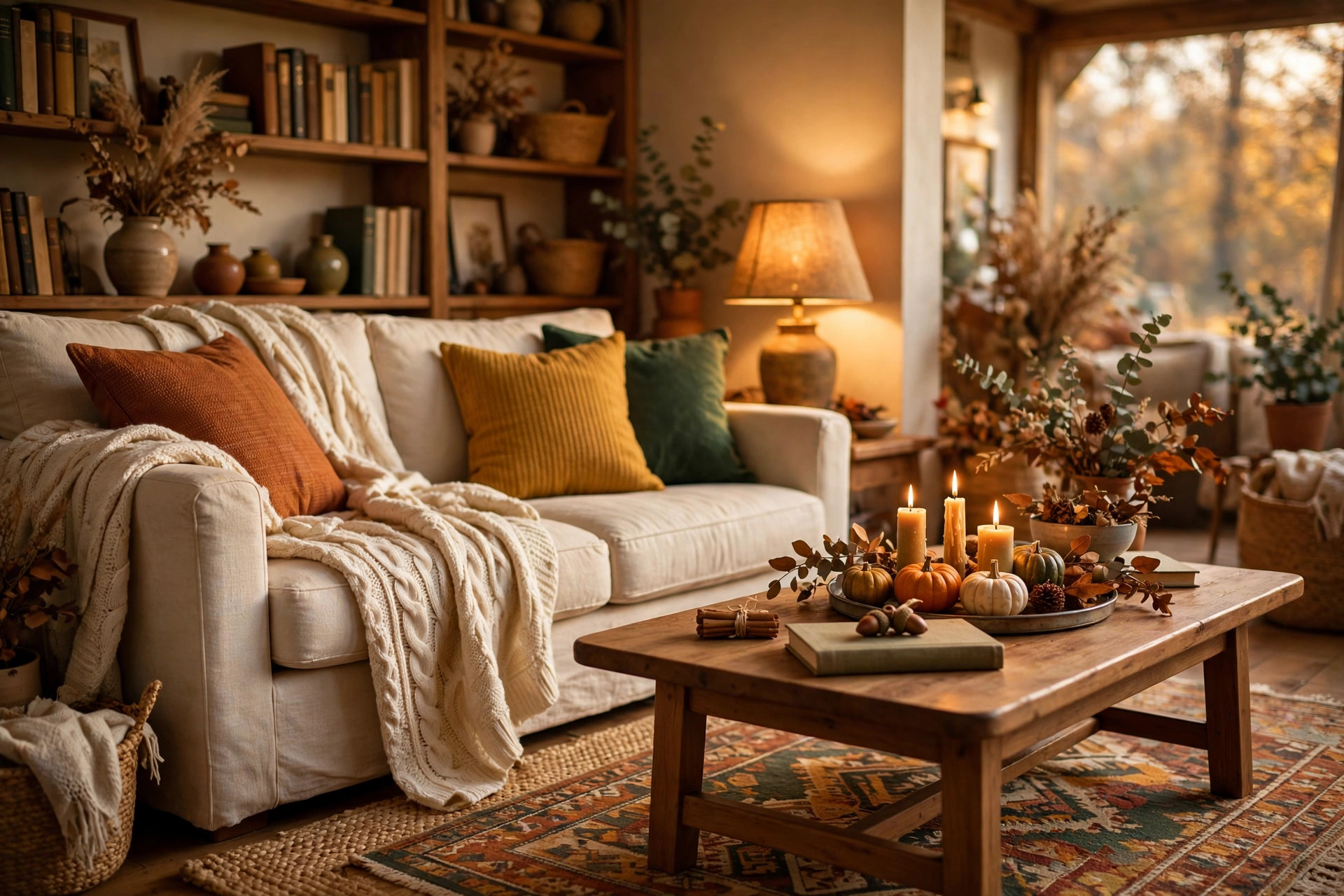
Layer one: the floor sets the temperature
1. Anchor the seating with a rug that is actually big enough
The most common living room mistake, in any season, is a rug that is too small. A 5x8 ft rug floating in front of a standard 84-inch sofa leaves every piece standing on bare floor, and the seating reads as scattered instead of gathered. For a standard sofa layout, start with an 8x10 ft rug. The rule: at least the front legs of the sofa and both chairs sit on the rug, ideally by 6 to 8 inches. That overlap locks the furniture into one conversation area. Leave a border of bare floor — 12 to 18 inches in a medium room, as little as 8 inches in a small one — so the rug reads as an island, not missed wall-to-wall carpet.
For a small room, under about 10x12 ft, a 5x8 ft rug is the honest choice — keep the same front-legs rule and a sofa no wider than about 72 inches so the proportions hold. Before ordering, tape the rug's outline on the floor for a day; you will spot a floor vent, a door swing, or a tight walkway before it becomes a return. For fall, look for a warm base — rust, camel, deep olive, warm ivory with a pattern — in low pile, under about 1/2 inch, so doors clear it and table legs sit level. A wool blend or washable synthetic 8x10 runs roughly $120 to $260.
2. Layer a smaller vintage-look rug or a washable runner over hard floors
If a new large rug is not in the budget, layering is the workaround designers actually use. Keep your existing neutral rug as the base and lay a smaller 4x6 ft or 5x7 ft vintage-look rug in rust and burgundy on top, centered under the coffee table. The top layer carries the season; the base carries the size. Expect $35 to $70, and choose a non-slip backing or add a pad — layered rugs creep, and a curled corner in the main walkway is a genuine trip hazard. On hard floors, a washable runner, 2.5x8 ft, in a warm pattern does the same job for $30 to $55 and goes straight in the machine after a muddy week.
3. Warm the floor itself: a basket of slippers and a hearth-side log holder
Cold floors undo warm decor the moment someone sits down. Two cheap fixes live at floor level. First, a woven basket, 14 to 16 inches across, near the doorway holding two or three pairs of house slippers or thick socks ($15 to $25) — guests read it as hospitality, and it keeps cold feet off your textiles. Second, if you have a fireplace, a steel or leather log holder ($25 to $45) stocked with split logs adds a texture no fabric can fake; keep it at least 12 inches to the side of the firebox, never in front of it. This is also where a no-cost fall living room refresh honestly starts: pulling seating 4 to 6 inches closer together on the rug you already own costs nothing and changes the feel more than most purchases.

Layer two: textiles do the seasonal work
4. Drape one good throw, correctly sized
The standard throw size, 50x60 inches, is not arbitrary: it covers a seated adult from chest to feet and folds lengthwise into a tidy 12 to 15 inch band over a sofa arm. Go smaller, 40x50 inches, and it reads as a lap blanket that slid off someone. One substantial throw beats three thin ones — chunky knit, brushed wool blend, or heavy woven cotton in rust, mustard, or deep plaid, roughly $25 to $45. Drape it over the arm nearest the entrance, folded in thirds, fringe showing. For the fuller playbook — basket folds, ladder displays, the armchair corner drape — these fall throw blanket styling ideas walk through each one. Watch-out: keep throws at least 3 feet from a lit fireplace or space heater, and never drape one over a radiator. The cozy layer and the heat source should never touch.
5. Change pillow covers, not pillows
Buying whole new pillows every season is how decor budgets quietly die. Buy covers instead, and keep one set of inserts year-round. The two sizes that cover almost every sofa are 18x18 inches and 20x20 inches. For a three-seat sofa: two 20x20 inch covers in a warm solid (rust corduroy, camel velvet, deep olive linen-look) at the outer corners, two 18x18 inch covers in plaid one step in, and one lumbar, about 12x20 inches, in the center. Five pillows — an odd number, which the eye reads as arranged rather than matched. Covers run $8 to $16 each, so the set lands around $45 to $70, and they store flat in a drawer in January.
Two details separate a good result from a lumpy one. Size inserts 2 inches larger than the cover — a 20 inch insert in an 18 inch cover — for the full, plump look; an exact-fit insert leaves the corners empty. And check color against your sofa in daylight before ordering: rust against cool blue-gray can vibrate unpleasantly, and warm cream and camel will do more for you than orange ever will.
6. Swap one set of curtains or add a warm liner panel
Windows are the largest cold surface in most living rooms, visually and literally. Change just the pair on the main window to a heavier, warm-toned fabric — linen-look in flax or clay, or a subtle plaid — and the whole wall reframes. Standard panels are 84 inches long for an 8 ft ceiling, 96 inches for 9 ft; hang them so the hem kisses the floor or breaks 1/2 inch above it, rod 4 to 6 inches above the frame. A pair runs $30 to $60. Renters can layer instead: clip a $15 to $22 thermal liner behind existing panels for the weight and draft control — the rare decor item that also helps a heating bill.

Layer three: light the room like evening is the point
7. Bring every bulb to 2700K — all of them
Nothing undoes fall decor faster than mixed color temperatures. One 5000K daylight bulb will make rust pillows look pink and turn the room faintly blue, no matter what else you do. Standardize on 2700K in every source — ceiling, lamps, smart bulbs. A four-pack of LEDs runs $8 to $12, and this change routinely outperforms a $100 decor purchase. Brightness matters too: a reading room wants roughly 1,500 to 2,500 lumens total across its lamps, and a $10 plug-in dimmer on the main lamp lets you drop to an evening glow without swapping anything.
8. Set lamp heights so the light lands where people sit
Warm bulbs in the wrong fixtures still fail. For a table lamp beside a sofa, the bottom of the shade should sit at seated eye level — in practice, a lamp 24 to 30 inches tall on a 22 to 25 inch side table. Taller glares into seated eyes; shorter pools uselessly on the table. A floor lamp beside a reading chair should put its shade at about 40 to 48 inches. Aim for three separate sources — near the sofa, across the room, one low — rather than a single overhead. Three points of light at different heights is the entire secret behind rooms that photograph as "cozy." Warm linen or cream shades, $12 to $20 each, soften it further.
9. Use candles in clusters — and choose flameless where fabric is near
Candlelight is the cheapest warmth there is, but it needs grouping and honesty about safety. Three pillars in staggered heights — roughly 3, 4, and 6 inches — on a metal or ceramic tray read as a centerpiece; a single candle reads as a power outage. A real trio costs $12 to $20. The safety line is not negotiable: keep real flame at least 12 inches from throws, fringe, curtain hems, and dried arrangements, and never leave it burning in an empty room. With small children or cats, flameless candles with real wax shells ($15 to $25 for three, many with timers) give most of the effect with none of the risk — set the timer for 5 to 10 p.m. and the room lights itself.
Layer four: walls and shelves carry the season up
10. Build one shelf vignette with the tall-medium-low rule
Open shelves go flat when everything on them is the same height. Pick one shelf near eye level, about 48 to 60 inches from the floor, and build a single vignette: something tall (a vase with dried stems, 12 to 16 inches), something medium (two or three warm-toned books laid flat), and something low (a small bowl, a mini pumpkin, a framed photo). Leave a third of the shelf empty. Dried pampas, eucalyptus, or wheat in a ceramic vase costs $10 to $18 and lasts the season with no water. Keep dried arrangements away from candle flame and fireplace heat, and give them a cool hairdryer blast monthly to clear dust.
11. Swap one piece of art, or fake it with a printable in a warm frame
You do not need a gallery wall. One larger piece over the sofa, swapped for an autumn landscape or botanical, changes the wall the room faces. Art should span roughly two-thirds of the sofa's width — about 55 inches for an 84 inch sofa — usually one 24x36 inch piece or a pair of 18x24 inch frames, center at about 57 inches from the floor, bottom edge 6 to 8 inches above the sofa back. The budget route is genuinely good: a downloaded printable ($0 to $8) in a warm wood frame ($15 to $30) looks intentional, as long as you do not stretch a small file to 24x36 inches and pixelate it. Renters can hang it from the existing nail and store the old print behind the new one in the same frame.
12. Dress the fireplace, if you have one — and fake the focal point if you do not
A fireplace needs less than people think: a garland along the mantel, two taller pieces at the ends, and something at the hearth to ground it. Detailed proportions, safety clearances, and twelve complete looks live in this guide to cozy fall fireplace mantel decor — follow its 12-inch clearance rule near the firebox. No fireplace? Build the focal point on the wall you face from the sofa: a console or low bookcase, the idea 10 vignette scaled up, flameless candles, and the art from idea 11 above it. A room needs one wall finished on purpose while the others stay quiet.

Layer five: scent and the last ten percent
13. Choose one scent system — and only one
The fastest way to make a beautiful room unpleasant is to run a scented candle, a diffuser, a plug-in, and a wax warmer in four competing fragrances. Pick one system. Three that work: a single candle in cedar, amber, or apple-cinnamon ($12 to $22; soy blends burn cleaner than cheap paraffin); a reed diffuser ($14 to $20) away from direct sun, reeds flipped weekly; or a simmer pot — orange slices, two cinnamon sticks, a teaspoon of cloves, water — which costs almost nothing and scents the whole floor for an evening. Keep it subtle: guests should notice the room smells good, not be able to name the product. With asthma or migraines in the household, test the mildest option first.
14. Finish with the touch layer: books, a tray, and something alive or once-alive
The last layer makes a styled room feel inhabited rather than staged. Put a tray, roughly 12x18 inches, on the coffee table to corral the remote, coasters, and candle cluster — it turns the same clutter into a composition and lifts off in one motion. Add two real books you actually own, warm spines out. Then add one irregular natural element: a wooden bowl of pinecones ($6 to $10), a small plant suited to your light, or a single branch in a heavy vase. Perfection is the enemy here. A room where everything is new looks like a store; a room where the new rust throw sits next to a chipped favorite mug looks like a home in October.
The same room at $75, $200, and $450
About $75 — the textile-and-light pass. Standardize the bulbs to 2700K ($10), buy two pillow covers in a warm solid and one plaid ($30 to $35 total, using your existing inserts), add one 50x60 inch throw in rust or camel ($25), and make a simmer pot from kitchen spices ($0 to $5). Nothing here is structural, everything stores flat, and the room will read unmistakably warmer at dusk, which is when a living room earns its keep.
About $200 — add the floor and the focal wall. Everything above, plus a vintage-look layer rug ($45 to $60) over your existing base, a flameless candle trio with a tray ($22), and one framed autumn printable over the sofa ($30). Spend the remainder on dried stems and a vase for the shelf vignette ($18). At this level the room works in daylight too, not just by lamplight, because the floor and the main wall are now carrying the season.
About $450 — the full build. Everything in the $200 version, upgraded: a proper 8x10 ft low-pile rug in a warm pattern instead of the layered workaround ($180 to $240), the full five-pillow cover set ($60), a heavier curtain pair for the main window ($50), and a log holder or slipper basket for the hearth and entry ($35). This is the version that survives January gracefully — remove the pumpkins and plaid, and the rug, curtains, and warm lighting simply become a cozier winter room.
- Buy in layer order. Bulbs and textiles first, rug and curtains last — expensive pieces should match the cheap ones you have lived with for a week.
- Keep receipts for two weeks. Color lies online; a few evenings in your own light is the only honest test.
- Stop one layer early. A room finished to 90 percent and used happily beats one finished to 100 percent and never sat in.
Build from the floor, keep the light warm and the flame honest, and let each layer be simple enough to undo in January. That is why a room done this way still looks good in the third week of October, long after the pumpkin on the coffee table has given up.


Comments
Post a Comment