
12 Small Bathroom Shower Storage Ideas With No Drilling
If bottles are lined up along the tub edge, the best small bathroom shower storage ideas do not need a drill at all. Good storage in a small shower is about using the corner, the wall, and the space under the showerhead — without a single hole your landlord can charge you for. These 12 ideas cover tension poles, hanging caddies, adhesive shelves, and suction helpers, with the sizes and load limits that decide whether each one stays up.
Before You Buy: Measure These Four Things First
Most failed shower storage was the wrong size, not the wrong product. Measure before you order anything, and write the numbers on your phone.
- Stall or tub width. A standard tub is about 60 inches long and 30 to 32 inches wide; a small stall is often just 32 x 32 or 36 x 36 inches. Anything you add should steal no more than 8 to 10 inches from one corner.
- Ceiling height. Tension poles need it exactly. Most showers are 84 to 96 inches floor to ceiling, and common poles adjust from roughly 47 to 124 inches — check your height sits inside the range, not at either end.
- Bottle height. Family pumps are 10 to 12 inches tall, so allow 13 to 14 inches between shelves for them, and 9 to 10 inches for standard 8-ounce bottles.
- Wall surface. Adhesive and suction only grip smooth, non-porous surfaces: glazed tile, glass, acrylic, and smooth metal. Textured tile, stone, painted drywall, and grout lines under the pad will all let go.
One honest load rule: plan for about half the printed rating. A shelf rated at 40 pounds on perfect tile should carry 15 to 20 pounds of real, wet bottles at home. That habit prevents almost every crash. For tested picks, guides such as Bob Vila's guide to the best shower caddies and The Spruce's shower storage ideas are worth a look before you spend.
12 Small Bathroom Shower Storage Ideas With No Drilling
1. The Tension-Pole Corner Caddy
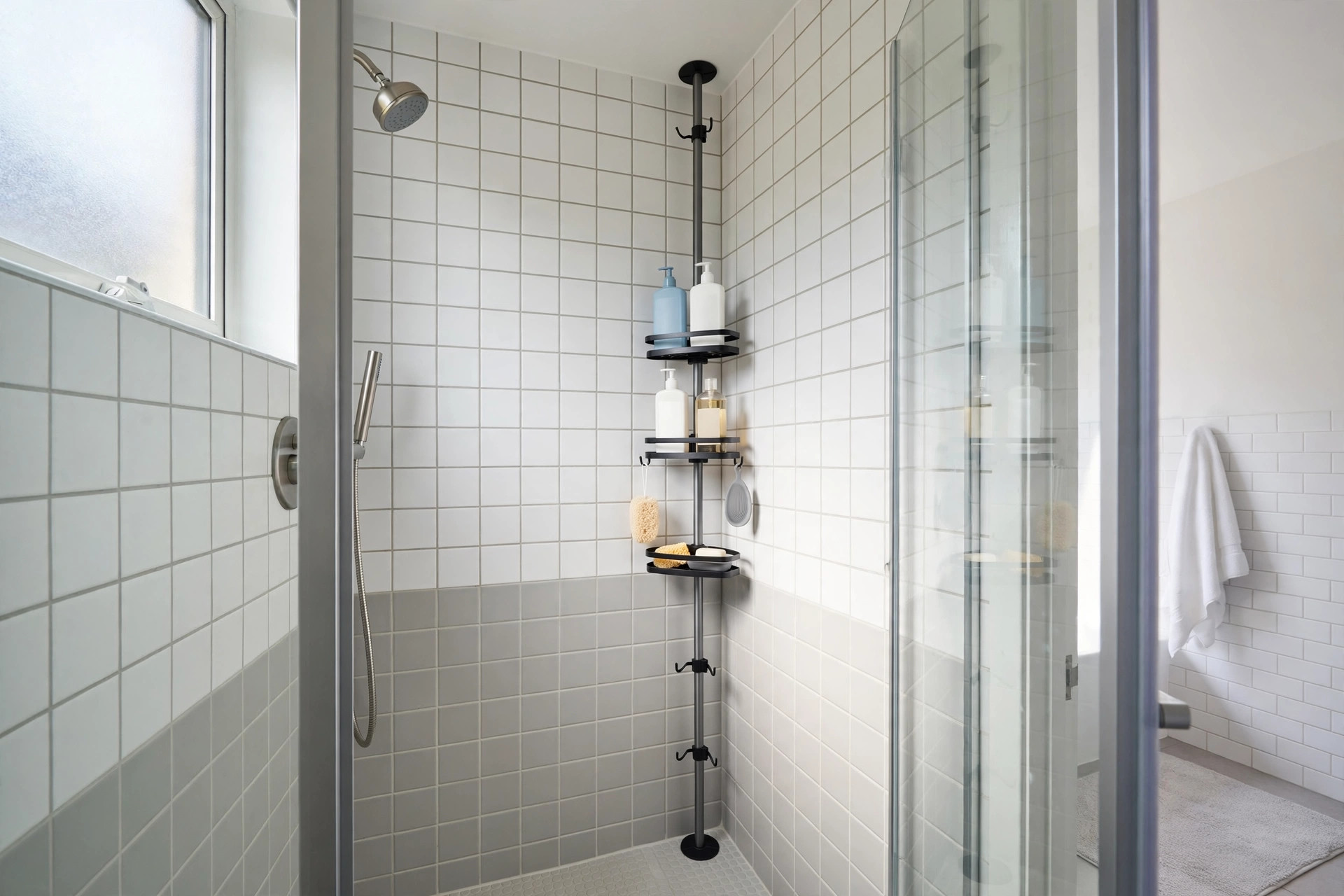
This is the highest-capacity no-drill option, and the best first buy for a shared shower. A spring-loaded pole wedges between the tub ledge or shower floor and the ceiling, carrying three or four shelves in the dead corner. Look for rustproof stainless steel, shelves around 9 to 10 inches across, and a rating near 20 pounds per shelf. Set the lowest shelf about 14 inches above the tub edge for tall pumps, then space the others 10 to 12 inches apart. It needs a flat, solid ceiling — skip it for sloped ceilings — and expect to re-tighten it every few months.
2. The Over-Showerhead Hanging Caddy
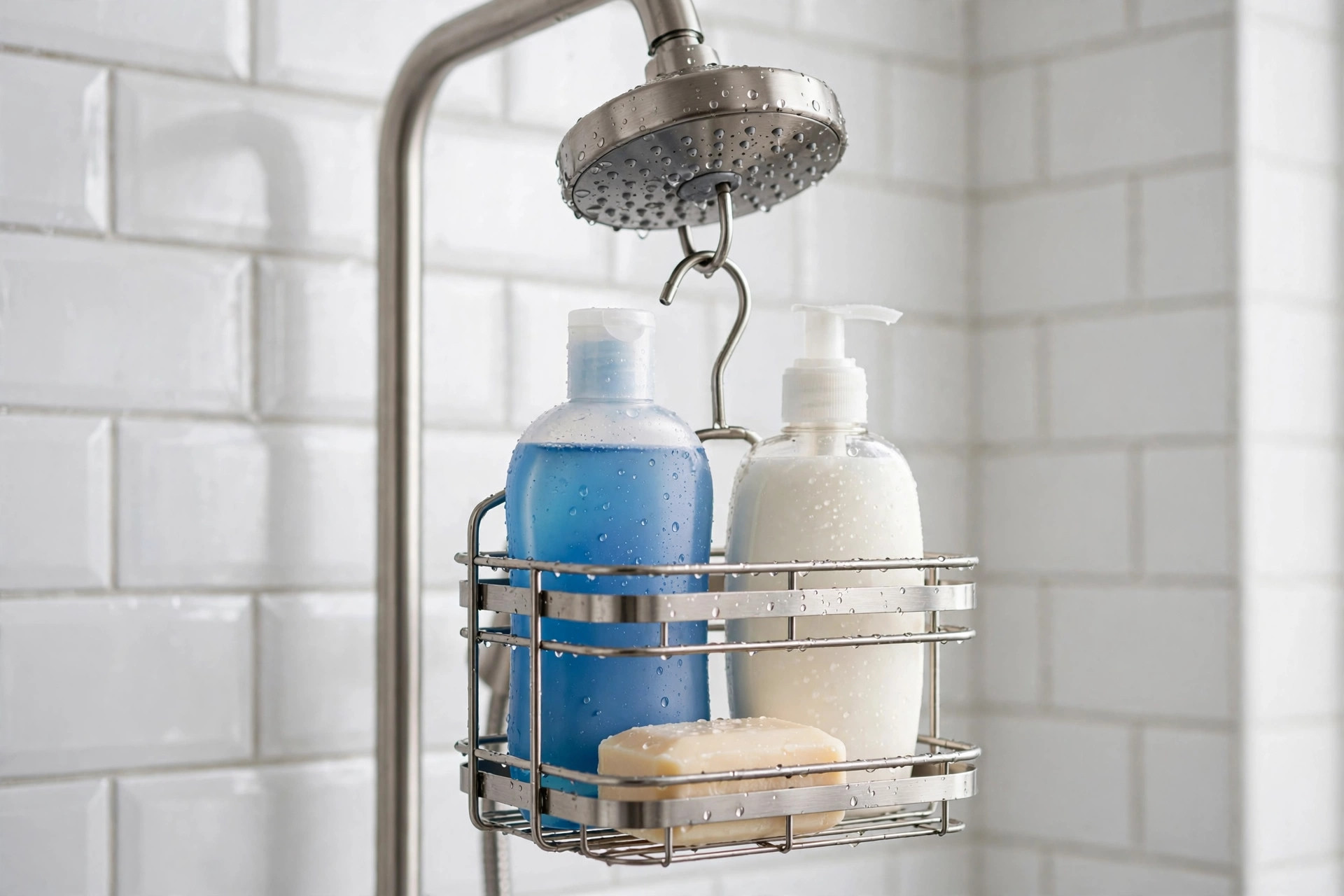
The fastest install on this list: it hooks over the shower arm in under a minute. Choose a wide, flat hook, two baskets at least 4 inches deep, and a stabiliser — a suction cup or adhesive pad at the back — so it hangs straight instead of swinging. Better models in 304 stainless steel hold two family bottles per basket without sagging. If you have a handheld shower on a hose, check the hose still moves freely. Keep heavy glass bottles out; this is a home for plastic pumps and tubes.
3. Adhesive Corner Shelves
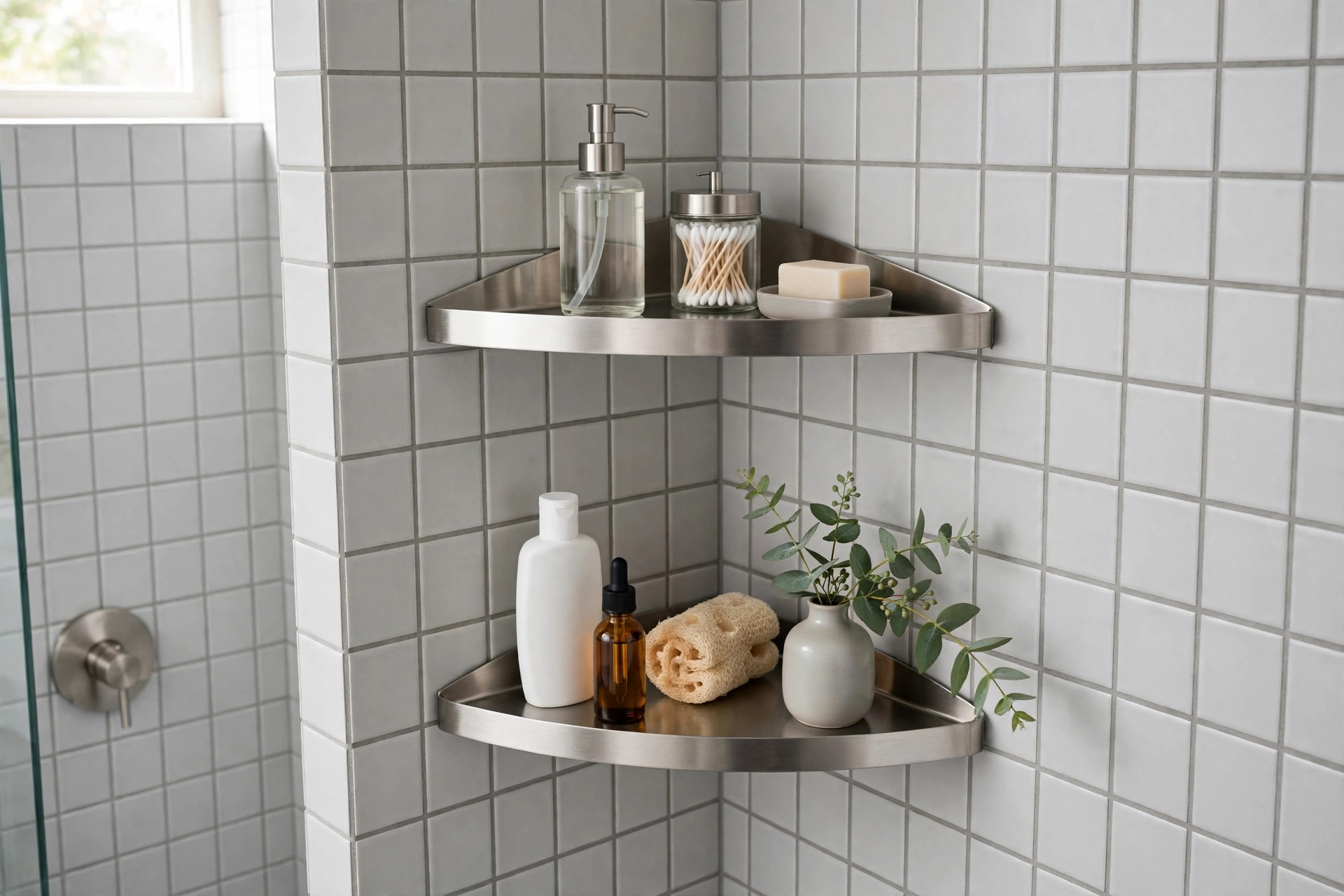
Triangular adhesive shelves turn a 90-degree corner into two or three neat levels. A typical shelf is about 9 to 10 inches on each side — enough for three standard bottles. Clean the tile with rubbing alcohol, press the pads on firmly, then wait the full 24 hours before loading them. That cure time is not a suggestion; loading at hour two is how shelves fail in week one. Stick to smooth tile or glass, keep each shelf to four or five bottles, and choose open-grid bases so water drains instead of pooling.
4. Adhesive Straight Shelves for the Long Wall
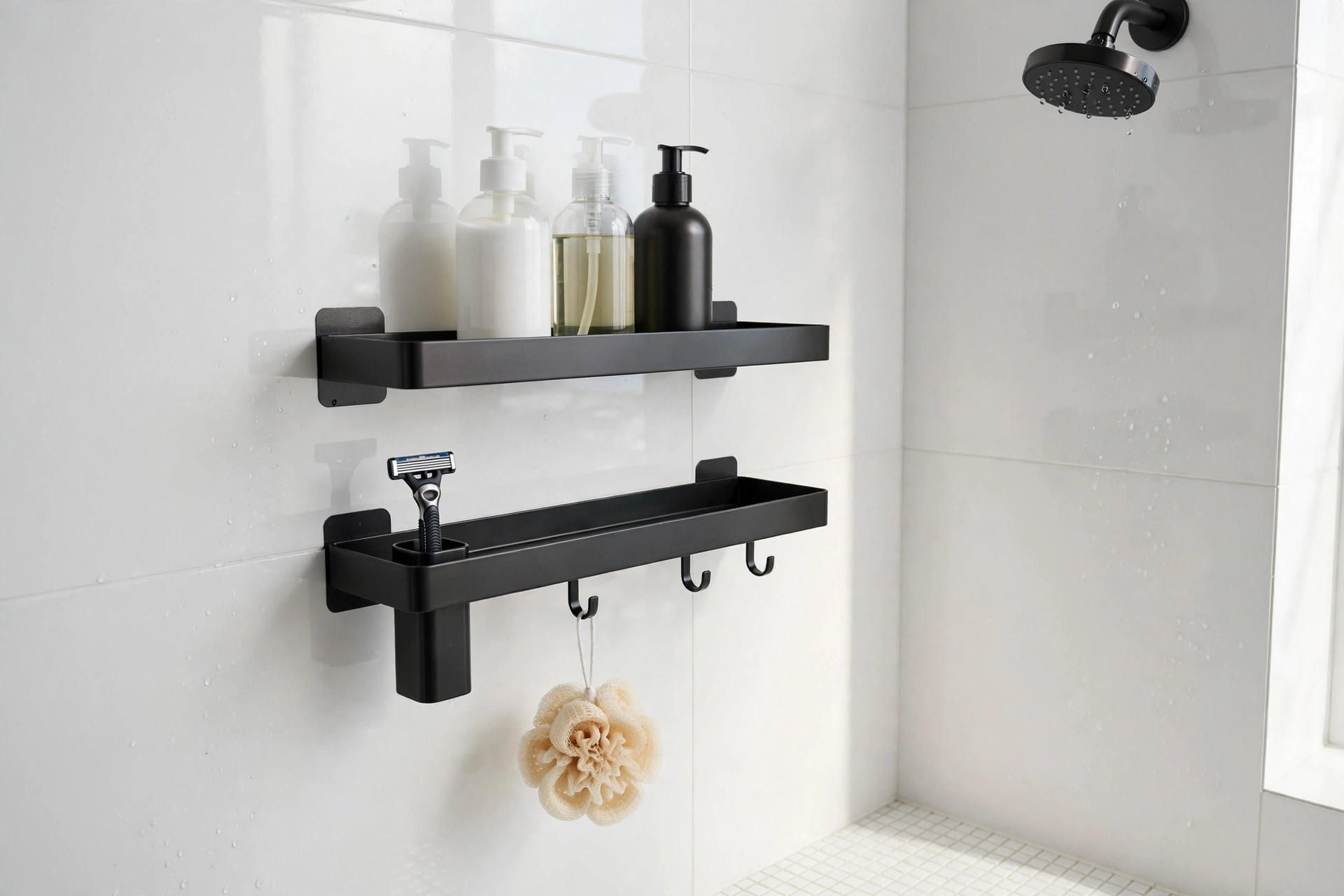
If your corner is taken by plumbing, run two rectangular adhesive shelves along the long wall instead. Shelves around 12 to 13 inches long and 4 to 5 inches deep suit a tub shower best: shampoo and body wash on the higher shelf at roughly chest height, daily items below. Add the matching razor holder and hooks from the same set — mixing brands usually means mixing finishes, and the set costs little more.
5. Suction Shelves — for Light Things Only
Suction works, within limits. Treat a suction shelf as a 5 to 10 pound helper for a razor, a small bottle, or a soap dish — never for a row of litre bottles. Locking suction cups with an indicator button are genuinely better than old press-on cups: you can see when one is losing grip. Press them onto clean, dry, smooth tile, not across a grout line, and re-seat them monthly. If one falls twice in the same spot, the surface is the problem — move it or switch to adhesive.
6. A Second Tension Rod With Hanging Baskets
Here is the trick renters miss: a spare tension rod fitted high across the back of the shower becomes a rail. Fit it between the side walls, about 6 to 8 inches out from the back wall, and hang two or three S-hook baskets from it. Each basket, roughly 8 x 4 x 4 inches, corrals the small clutter — razors, hair ties, kids' toys — that shelves handle badly, and everything drip-dries. Keep the total load around 10 to 15 pounds, and check the end caps monthly.
7. The Over-the-Door Shower Rack
Glass-door showers often have nowhere for a hanging caddy. A rack that hooks over a frameless glass door solves it: two or three tiers inside, flat hooks that fit glass about 10 to 12 millimetres thick, and silicone pads so metal never grinds on glass. Check the door still closes fully and clears the wall when it opens — measure that swing first. It is also the easiest storage to take when you move: lift it off, and the shower looks exactly as it did on move-in day.
8. A Slim Rolling Cart Beside the Tub
Not every solution belongs inside the shower. If your stall is truly tiny, store overflow just outside it: a slim cart 6 to 8 inches wide fits the gap between tub and vanity in many small bathrooms. Top tier for this week's products, lower tiers for backups and cleaning spray. Choose rust-resistant coated metal or plastic, not bare steel. Once the shower only holds what you use daily, even two adhesive shelves feel like plenty.
9. The Stick-On Niche Look, Without the Build
Built-in niches are lovely — and off the table without construction. Get most of the effect with a deep adhesive basket, about 5 to 6 inches deep, at shoulder height on the wall opposite the showerhead. That spot takes less direct spray, so adhesive lasts longer, and a deep basket reads like a recess: bottles in one contained box instead of scattered on shelves. One deep basket plus one small soap shelf is the calmest-looking setup on this list.
10. Hooks, Done Properly
Half of shower clutter is not bottles. It is the loofah on the tap, the razor on the ledge, and the squeegee on the floor. Two or three bathroom-rated adhesive hooks fix all of it: one at about 48 inches for loofahs, one lower for the squeegee, and a small razor holder beside your main shelf. Respect their small limits — usually 2 to 5 pounds each. Hung up, everything dries between showers, the simplest anti-mildew move you can make.
11. A Corner Pole for the Tub Deck, Not the Ceiling
No solid ceiling for a full pole? Shorter tub-deck poles stand on the wide end of the tub, carrying two shelves in the corner above the taps. They hold less — standard bottles only, nothing family-size — but they suit older bathrooms with low or uneven ceilings. Add a non-slip mat under the base if your tub is glossy. If your towels also live wherever they land, pair this fix with our guide to bathroom towel storage ideas.
12. Decant, Shrink, and Set a One-In, One-Out Rule
The cheapest storage idea is fewer, smaller bottles. Decant shampoo, conditioner, and body wash into matching 8 to 12 ounce pumps and store the big refills outside the shower. Three slim pumps take about 6 inches of shelf; three family bottles take 12 or more, and they are what overload caddies. Then set the rule: a new product comes in only when an old one goes out. In a 32-inch stall, that is the difference between storage that works and storage you fight every morning.
Materials That Survive a Wet Shower
Material decides lifespan. 304 stainless steel is the safe buy: rust-resistant in constant steam and easy to wipe clean. Anodised aluminium is lighter and also rustproof, good for hanging caddies. Powder-coated steel looks smart in matte black, but rust starts at any chip — inspect edges every few months. Plain chrome-plated steel is the budget trap, often spotting with rust within a year. Whatever the frame, choose drainage slots or an open grid over a solid tray.
Keeping It Up: A Five-Minute Monthly Check
- Tension poles: push each shelf gently sideways. Any wobble means re-tighten the pole that day.
- Adhesive shelves: look for pads lifting at the corners. A lifting pad is a warning, not a failure — unload, replace the pad, cure 24 hours.
- Suction: re-press every cup and check indicator buttons while you clean.
- Rust: wipe shelves with a dry cloth after the last shower of the week. Soap film left sitting is what stains finishes and feeds mildew.
Shower storage works best as part of a whole small-bathroom system. If your counter is also crowded, our small bathroom vanity organization ideas use the same measure-first, no-clutter approach outside the shower, and you can browse everything in our Bathroom ideas collection for the next small fix. The cabinet under the sink deserves the same treatment: our bathroom under-sink organization ideas map the pipes first, then fit shelves and bins around them.
The Bottom Line: Which Setup Fits Your Shower?
For one person, start simple: one over-showerhead caddy or two adhesive corner shelves, plus two hooks. For two people sharing, go bigger: a tension-pole caddy gives each person a shelf, or run adhesive shelves on the long wall. Renters should favour tension and over-door options, which leave no residue, and keep adhesive for smooth tile only. Measure once, respect the load limits, cure the adhesive properly — and your shower stays organised with zero holes in the wall.


Comments
Post a Comment