
12 Small Bedroom Shoe Storage Ideas That Clear the Floor
Shoes are the first thing a small bedroom runs out of room for. They are bulky, pairs separate, and they land exactly where you walk. The best small bedroom shoe storage ideas are not about one magic rack. They are about sorting honestly, giving the few pairs you wear daily a tiny accessible home, and sending everything else into dead space the room already has: under the bed, behind the door, and up the wall.
You do not need a bigger closet. You need a sort, a tape measure, and the discipline to keep only three to five daily pairs within reach. Below are twelve ideas with real lengths, depths, costs, and watch-outs that clear the floor — and keep it clear.
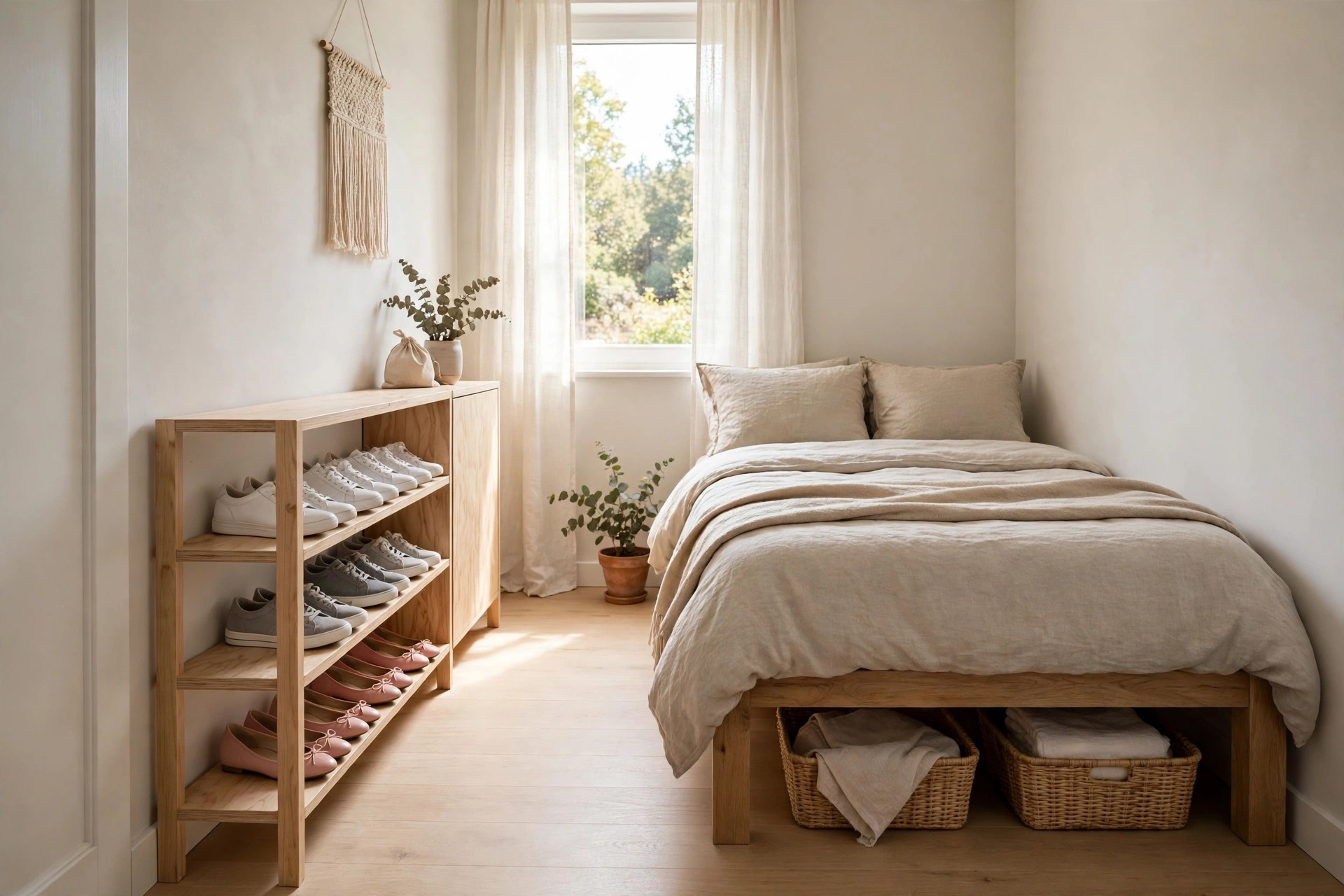
Start with the biggest hidden footprint in the room, using our guide to under-bed storage ideas for small bedrooms — the space under the bed is a closet lying on its side, and shoes belong in it before they belong on the floor.
Sort First: Daily, Seasonal, Rarely-Worn — and the 12-Inch Rule
Rule one: sort before you store. Divide every pair into three groups: daily, seasonal, and rarely-worn. Most people own fifteen to twenty-five pairs but actually rotate five. That gap is the whole problem — the floor is storing shoes your feet never visit.
Rule two: keep only three to five daily pairs accessible. Seasonal pairs go into closed, protected storage, and rarely-worn pairs go to the hardest-to-reach spot you have. Guides like Nest Sorted on shoe storage ideas for small spaces and Homes & Gardens on how to hide shoe clutter in small spaces land on the same fundamentals: edit first, hide the bulk out of sight, and use vertical and dead space before buying furniture.
Rule three: respect the 12-inch rule. An adult sneaker is about 11 to 12 inches long. Any shelf, bin, or cabinet shallower than that cannot hold a pair straight — toes overhang or the door will not close. On shallow storage, shoes must sit angled or toe-to-heel. Measure your largest pair before buying anything. Finally, think up, not out: the door back, the lower closet, and a 24-inch strip of wall going up are usually empty, and every idea below uses one of those free zones.
12 Small Bedroom Shoe Storage Ideas That Clear the Floor
Work in order: the sort first, then the daily zone, then hidden storage for everything else. Most of this costs nothing, and the priciest item here is still under $90.
1. Sort Into Daily, Seasonal and Rarely-Worn First
Before any product, do the twenty-minute sort. Line up every pair on the bed: daily means worn in the last two weeks, seasonal means worn this season last year, rarely-worn means weddings and one holiday a year. Anything damaged or unworn for a full year leaves the room entirely — donate it the same day. Cost: $0. Watch-out: sort by how often a pair is on your feet, not how much you like it. Sentimental favourites you never wear are rarely-worn pairs, and they get your least accessible storage.
2. Keep Only 3 to 5 Daily Pairs in One Accessible Zone
Give your three to five daily pairs — and only those — one small, obvious home: a short 24-inch rack by the door, one cabinet shelf, or a basket beside the dresser. When daily shoes have one landing spot that takes two seconds to use, they stop spreading. Everything else lives in the closed storage below. Cost: $0 to $25. Watch-out: if the daily zone holds eight pairs by month's end, the system has already failed; audit it whenever a new pair tries to move in.
3. Slide Slim Divided Bins Under the Bed
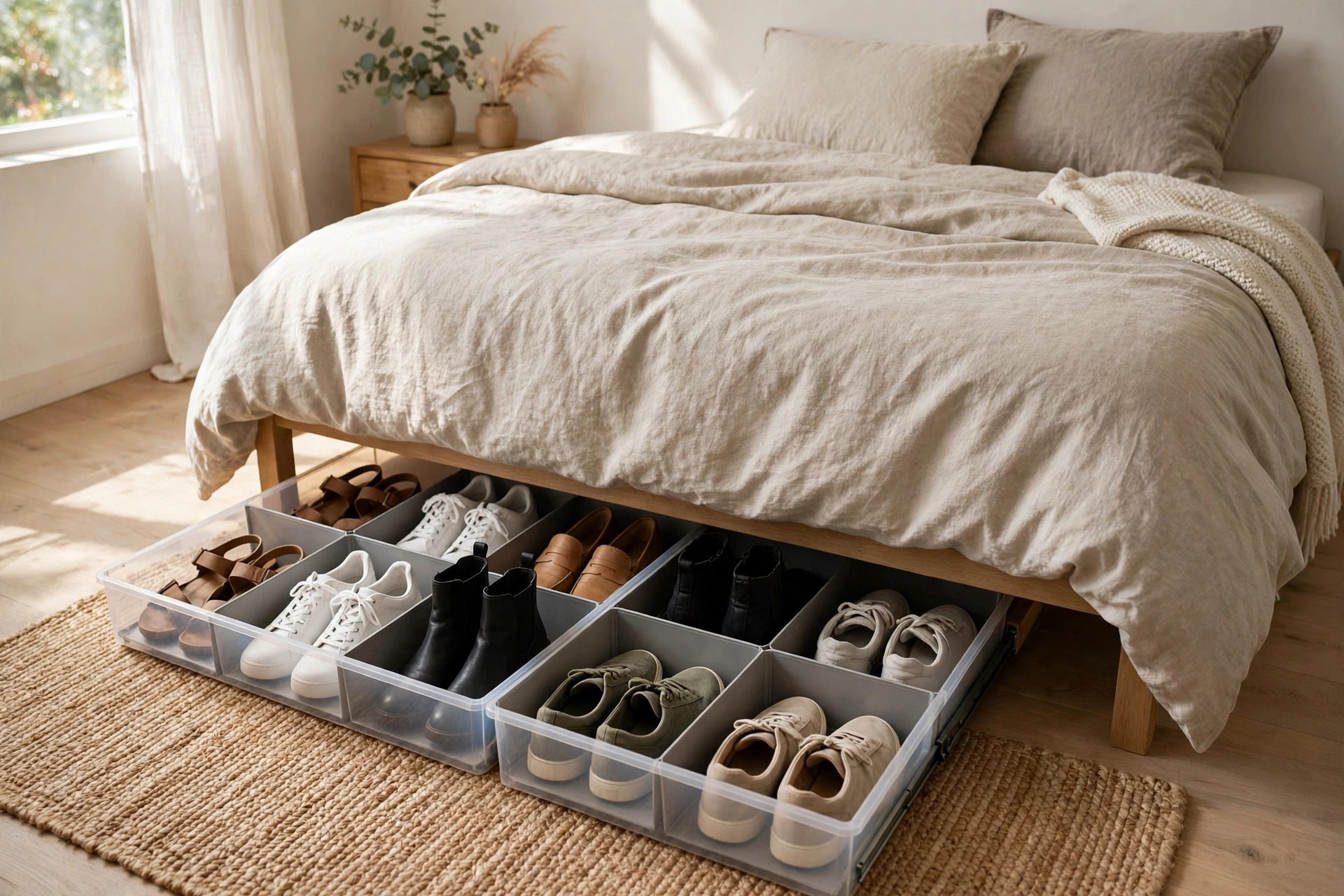
The footprint under a queen bed is roughly 30 square feet, and shoes are the perfect height for it. Choose slim divided bins about 4 to 6 inches tall — measure your frame clearance first — with compartments around 12 to 13 inches long, so each pair stays together and visible. Two bins along the side you dress on hold eight to twelve seasonal pairs. Divided organizers cost $20 to $40. Watch-out: skip soft fabric bags for pairs you swap often; they collapse, hide what is inside, and turn a swap into a dig.
4. Put the Back of the Bedroom Door to Work
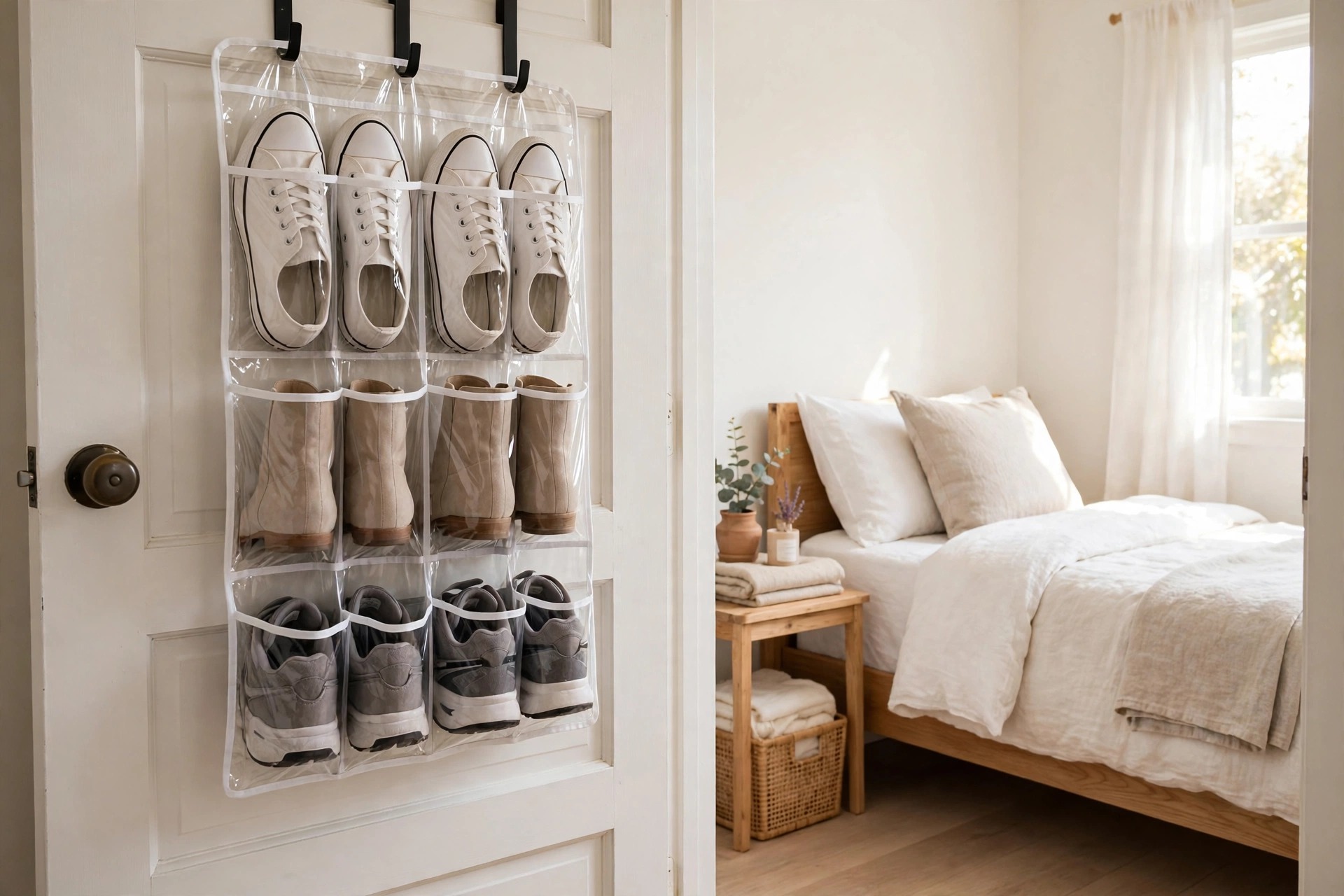
The back of the door is a wall you already own — about 12 square feet holding nothing. A clear-pocket over-door organizer, roughly 22 inches wide and 60 inches long, holds ten to twelve pairs of flats, sneakers, and sandals where you can see every pair at once. Clear pockets beat fabric ones because visibility is the point. Organizers cost $15 to $30, on hooks that need no drilling. Watch-out: check the door still closes fully, add felt pads to stop swinging and scuffing, and keep heavy boots out — weight warps the fabric and strains the hinges.
5. Angle Shoes Toe-to-Heel on Shelves Under 12 Inches Deep
This trick makes shallow storage work. Because a sneaker runs 11 to 12 inches long, a shelf only 8 to 10 inches deep cannot take a pair side by side pointing forward. Instead, place one shoe toe-out and its partner heel-out, nested toe-to-heel. The pair then needs only about 7 to 8 inches of depth and still reads as a tidy row. It works on slim bookcase shelves, wardrobe shelves, and narrow racks otherwise useless for adult shoes. Cost: $0. Watch-out: be consistent — if half the pairs face one way and half the other, the shelf looks messy again.
6. Choose a Skinny Tilt-Out Cabinet Over an Open Rack
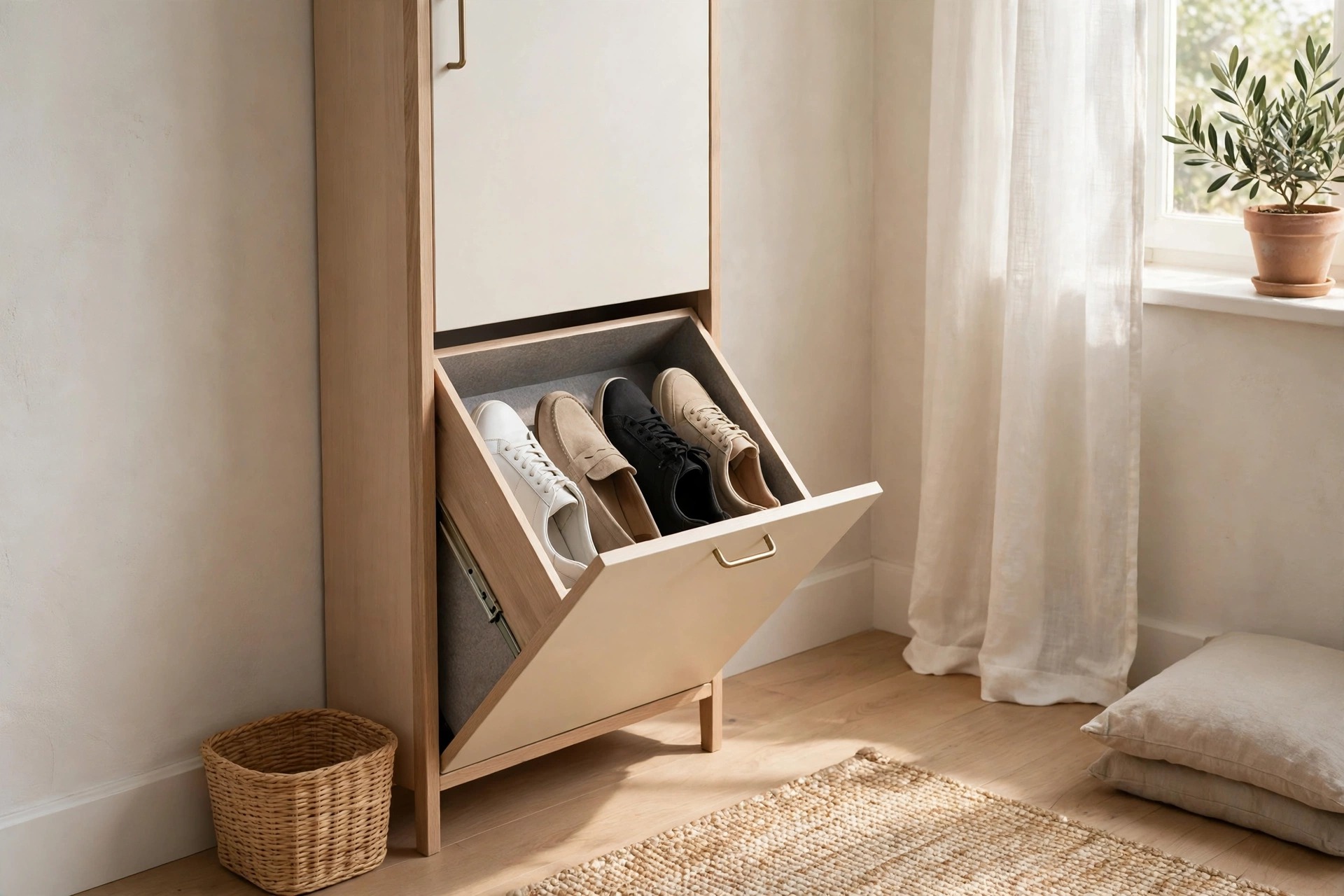
An open rack shows every scuff; a tilt-out cabinet hides the collection behind a flat front like a slim console. Useful models are only about 6 to 7 inches deep, because shoes sit angled inside the tilting compartments — that angle is how a 12-inch sneaker fits a 7-inch-deep cabinet. A two or three-tier cabinet 24 to 32 inches wide holds eight to twelve pairs and costs $60 to $90. Watch-out: anchor it to the wall, since it can tip when a compartment opens, and check your largest size first — chunky boots often do not fit.
7. Hang a Shoe Shelf From the Closet Rod
If clothes cover only part of your closet rod, the empty air below the short hanging section is wasted. A hanging fabric shoe shelf hooks over the rod and drops about 40 to 50 inches, with eight to ten compartments each roughly 6 inches wide and 12 inches deep — one pair of flats or sneakers per compartment, stored vertically instead of across the floor. They cost $15 to $25 and install in a minute. The same zoning logic drives our small bedroom closet organization ideas — rod, door, and floor each get one clear job. Watch-out: hanging shelves sway under heavy shoes, so reserve them for lighter pairs.
8. Go Up, Not Out, With a Tall Narrow Shoe Tower
When floor space is gone, the only direction left is up. A tall, narrow tower — about 24 inches wide, 10 to 12 inches deep, and 48 to 60 inches tall — holds ten to fifteen pairs on five or six levels in the footprint a small rack wastes on three. Corners beside the wardrobe are its natural home. Slim towers cost $35 to $70. Keep daily pairs between knee and shoulder height, seasonal pairs up top. Watch-out: use the toe-to-heel trick from idea 5 for adult sneakers, and anchor tall units.
9. Stack Clear Drop-Front Boxes for Seasonal Pairs
Seasonal shoes need dust protection, not daily access, which makes stackable drop-front boxes ideal. Each box, about 13 to 14 inches long and 5 to 6 inches tall, holds one pair; the front drops open so you can pull a pair from mid-stack, and clear sides make the stack its own label. Boxes run $5 to $9 each, or $30 to $50 for six — a stack of six swallows the whole off-season rotation. Watch-out: choose ventilated boxes — airtight plastic traps moisture — and add a cedar block or silica packet with leather pairs.
10. Use the Gap Beside the Wardrobe With a Skinny Rolling Shelf
Most small bedrooms have one strange gap: 6 to 8 inches between the wardrobe and the wall, currently collecting dust. A slim rolling shelf built for that gap — around 6 inches wide and 30 to 40 inches tall, on castors — pulls out like a drawer and holds four to six pairs of flats and sandals stored toe-to-heel. Units cost $30 to $55. The same assign-every-inch-a-job habit is what makes our small bedroom dresser organization ideas last. Watch-out: measure the gap at its narrowest point, skirting included; a shelf half an inch too wide is a shelf you do not own.
11. Send Boots and Rarely-Worn Pairs to the Top Shelf
Every system needs a far corner, and in a bedroom it is the top shelf of the closet or the top of the wardrobe. That high zone — usually 12 to 18 inches of clearance above the rod shelf — suits the rarely-worn group: occasion heels, formal shoes, and tall boots laid in a low box about 20 to 24 inches long so the shafts do not fold. A lidded boot box costs $15 to $25. Label the front, because out of sight at height becomes forgotten. Watch-out: keep a stable step stool in the room; climbing on a bed to reach shoes is how tidy systems end in accidents.
12. Run a One-In, One-Out Rule and a Two-Minute Weekly Reset
Storage fills at the door, not in the cabinet. The rule that keeps this system alive is simple arithmetic: a new pair comes in, an old pair leaves — donated, sold, or demoted to the rarely-worn box. Then once a week, spend two minutes returning strays to their assigned homes before they become a pile. Cost: $0. Watch-out: the reset only works if every pair genuinely has a home; a shoe with nowhere to go will live on the floor.
Mistakes That Put Shoes Back on the Floor
Buying storage before sorting. A rack bought for twenty unsorted pairs is sized for shoes you should not be storing at all. Sort first, count what survives, then buy — the order matters more than the product, a point our closet organization guide makes for clothes and that applies twice over to shoes.
Ignoring the 12-inch rule. Storage bought by width alone fails on depth: doors that will not close over sneaker toes, bins that will not slide under the frame. Measure your longest pair and your under-bed clearance before anything goes in a cart. And let the daily zone grow, and three to five accessible pairs quietly become nine — a floor with extra steps. Keep the bulk closed, hidden, or high, and browse the rest of the Bedroom collection for the systems that keep the rest of the room working the same way.
Questions People Ask
How many pairs of shoes should stay out in a small bedroom?
Three to five daily pairs — the ones you genuinely rotate each week — in one small zone by the door or dresser. Every other pair belongs in closed or vertical storage: under-bed bins, door pockets, the closet, or high shelves.
How do shoes fit on shelves less than 12 inches deep?
Angle them. An adult sneaker is 11 to 12 inches long, so on an 8 to 10 inch shelf, store each pair toe-to-heel — one shoe forward, its partner back and nested alongside. The pair then fits in about 7 to 8 inches of depth. Tilt-out cabinets use the same angled principle behind a closed front.
What is the best shoe storage for a bedroom with no closet space?
Combine the three free zones: a skinny tilt-out cabinet or tall narrow tower for daily pairs, slim divided bins under the bed for seasonal pairs, and a clear over-door organizer for flats and sandals. Together they hold twenty or more pairs without taking any walkway floor.
How do I stop shoes from smelling in closed storage?
Only store shoes that are fully dry, choose ventilated boxes rather than airtight ones, and add a cedar block, charcoal bag, or silica packet to each closed zone. Rotate daily pairs so the same pair is not worn two days running — a rest day is the cheapest deodorizer there is.
Start with the sort, not the shopping. Divide every pair into daily, seasonal, and rarely-worn, keep three to five pairs within reach, and send the rest under the bed, behind the door, and up the wall — and the floor you forgot you had will be clear by tonight.


Comments
Post a Comment