
13 Patio String Light Ideas for Small Backyards (Cozy Glow)
13 Patio String Light Ideas for Small Backyards (Cozy Glow)
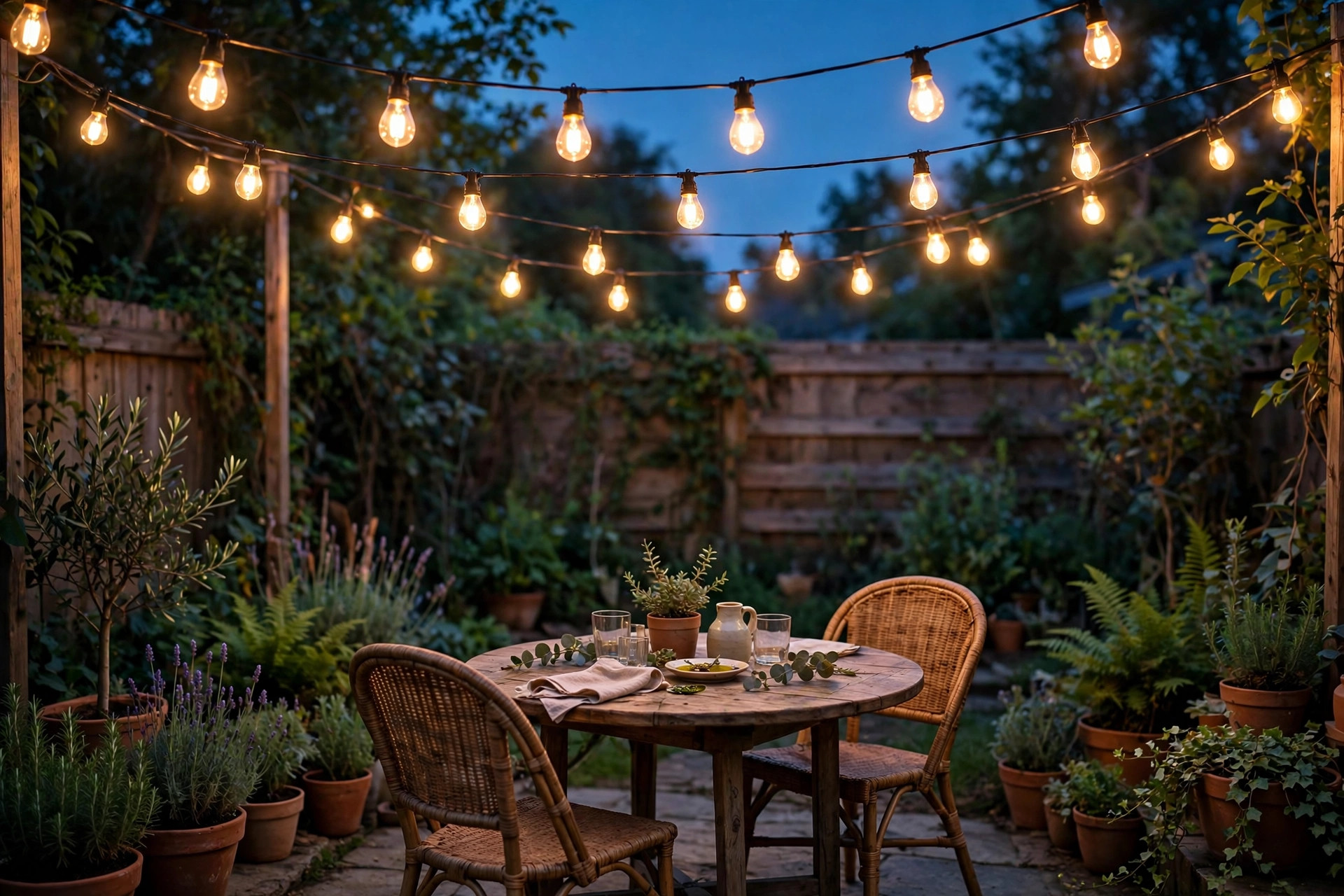
Few things change a backyard after dark like string lights do. The right patio string light ideas can make even a tiny backyard feel like a warm, glowing outdoor room — and you don't need a huge patio or a complicated setup to pull it off. Whether you're lighting a small rental patio, a narrow side yard, or a compact balcony, these 13 string light ideas come with the real how-to details most roundups skip: the hanging heights, the sag that looks natural, the bulb spacing, and the weatherproofing that keeps everything safe season after season.
Before we get into the ideas, here is the planning advice that saves every small-backyard lighting project:
- Measure first, buy second. Measure the spans you plan to hang across and add 10–15% for sag. A 15-foot span needs about a 17-foot strand once the natural droop is included.
- Aim for bulbs 8–10 feet off the ground over seating and dining areas — high enough to walk under comfortably, low enough that the glow feels intimate. Over walkways, keep the lowest point at least 7 feet up.
- Warm white (2700–3000K) is the sweet spot for patios. Cool white looks clinical outdoors.
1. The Classic Overhead Canopy of Patio String Lights
The canopy is the most popular of all outdoor string light ideas for a reason: strands run parallel across your seating area and meet at anchor points, turning the open sky into a glowing ceiling. In a small backyard, two or three strands are plenty.
How to hang it: Anchor one end to the house (an eye hook in a fascia board or fence top rail works) and the other to a freestanding pole, tree, or the far fence. Commercial patio string lights usually have bulbs spaced 24–48 inches apart, which suits this layout. Let the strand sag slightly between anchors — a gentle catenary curve of about 3–4 inches of drop per 10 feet of span looks natural and relaxed, like a bistro terrace.
2. Fan Them in a Zigzag V-Pattern
If your yard is narrow, skip the parallel lines and run strands in a zigzag from one high anchor point down to the fence line — a V or fan pattern. This patio string light idea is made for small backyards because it needs only one sturdy high point (a tall pole or a tree branch) and fans the light outward instead of needing two tall structures.
How to hang it: Set a tall wooden or metal pole (8–10 feet) at one corner. Run the first strand from the top of the pole to the fence; the second from a point a foot lower on the pole to the next fence anchor, and so on. The result looks like a glowing sail.
3. Drape String Lights Along Pergola Beams
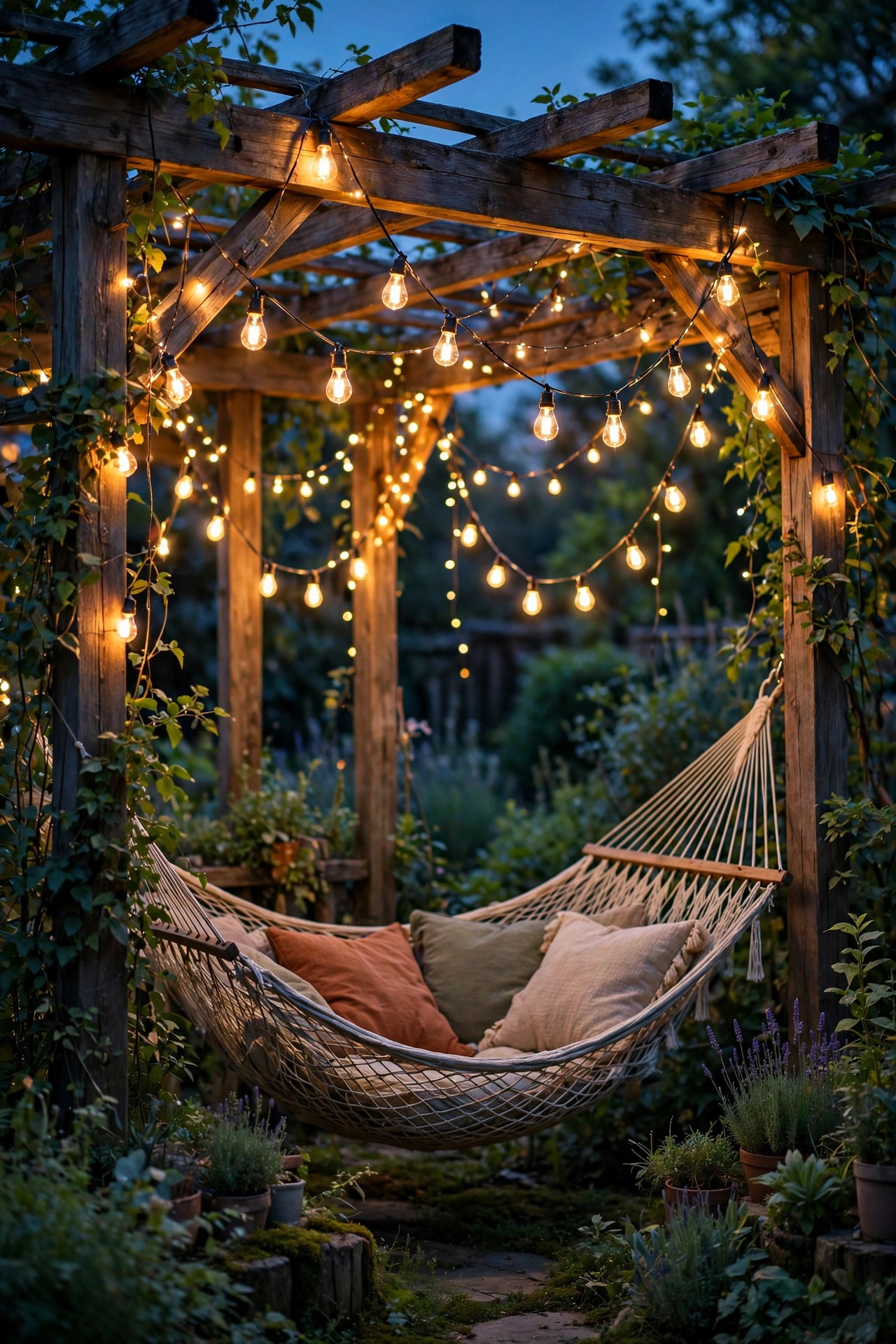
A pergola is practically built for string lights. Draping strands along the beams defines the space and adds a romantic glow over your lounge chairs — no poles required.
How to hang it: Run the strand along one beam, then let it swoop down to the next beam in a soft swag. Aim for swags that drop about 12–18 inches between beams — deeper than the overhead-canopy sag, because this time the drape is the feature. Secure with cable clips or small screw hooks every couple of feet so the weight stays evenly distributed.
Pair this with our other screened porch decorating ideas if your pergola sits against a covered structure — the layered shelter reads beautifully at night.
4. Weave Fairy String Lights Along a Balcony Railing
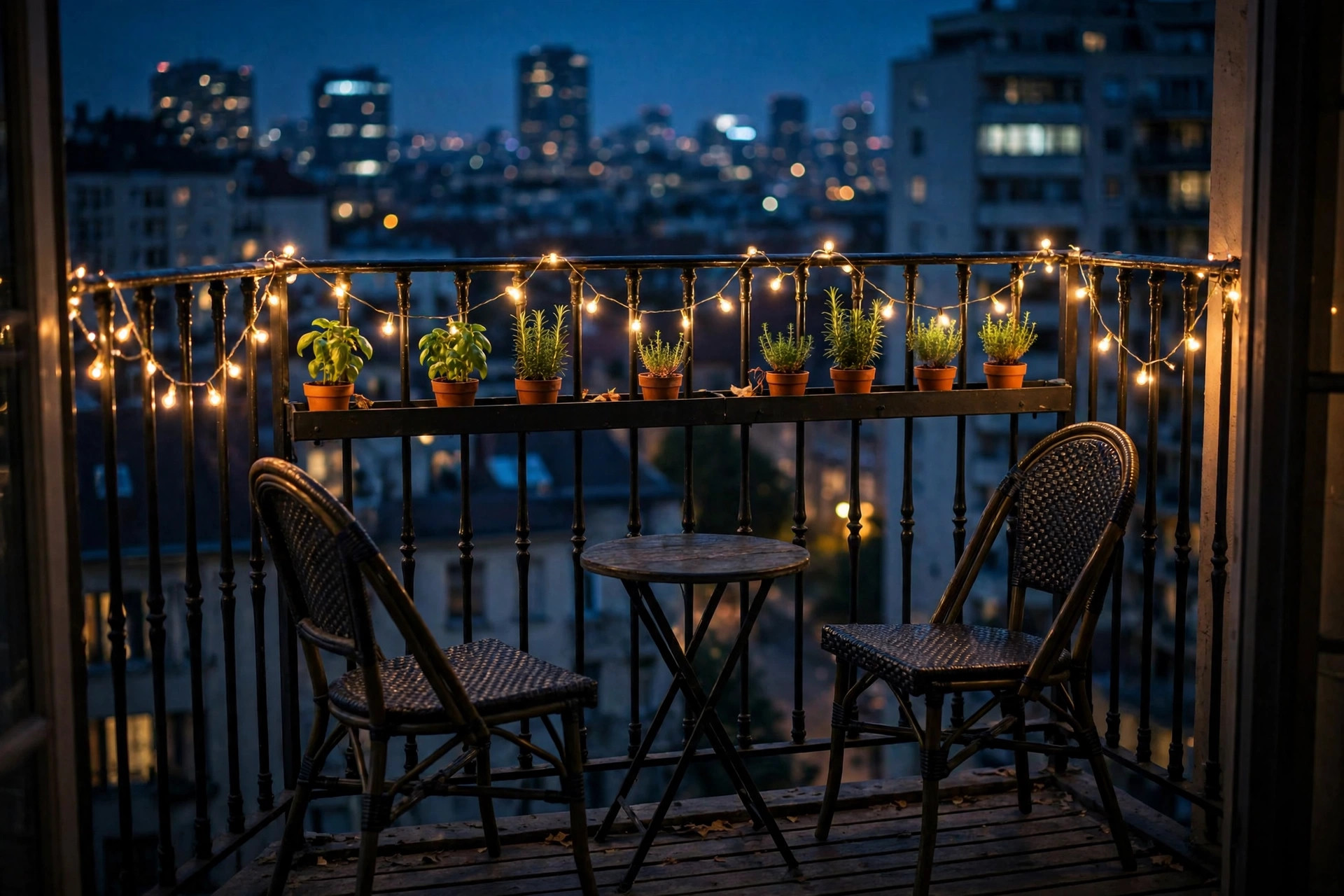
Small backyard, apartment patio, or balcony — the railing is free real estate. This is one of the simplest patio string light ideas for small backyards: weave a strand of globe or fairy lights through the railing slats or along the top rail for a soft boundary that highlights your space without a single pole or hook.
How to hang it: Start at one end of the railing and weave the cable in and out of the balusters, or drape it loosely along the top rail and fix it with small adhesive cable clips. For a balcony, a 15–25 foot strand usually covers one side. Solar-powered string lights shine here — there is often no outlet within reach.
5. Hang a String-Light Chandelier Over the Table
For the dining corner, gather one strand into a loose loop or cluster above the table — an instant chandelier. This works beautifully over small bistro sets where an overhead canopy would feel like too much.
How to hang it: Drape a strand in a circle around a wire wreath frame or a simple tomato cage turned upside down, then hang the whole thing from a single hook or branch 2–3 feet above the table surface. Leave enough slack that the loop hangs naturally. This is the patio string light idea guests photograph.
6. Wrap Trunks and Lower Branches
Even one small tree transforms your yard after dark. Wrapping the trunk and a few lower branches in string lights turns a plain tree into a glowing anchor for the whole space — and it frames the patio nicely from inside the house, too.
How to hang it: Start at the base of the trunk and spiral upward, spacing each loop 4–6 inches apart, then extend onto two or three low branches. Choose lights rated for wet locations since tree lighting stays up through rain. A 50-foot strand covers a slim trunk up to about 8 feet; measure the trunk circumference first and multiply.
7. Swag Them Along the Fence Line
Your fence is the biggest surface a small backyard has — use it. Running string lights in gentle swags along the fence top turns a plain boundary into a glowing backdrop.
How to hang it: Place screw hooks on the fence top rail every 6–8 feet and let the strand dip 8–12 inches between hooks. The repeated swags read as intentional design rather than a sagging line. This patio string light idea pairs beautifully with potted plants lined along the fence — the light spills down and shows off the foliage.
8. Line a Path With Low String Lights
String lights aren't just for overhead. Mounting short strands low along a garden path or the edge of a patio adds both charm and practical guidance for guests after dark.
How to hang it: Push shepherd's hooks or short stakes into the ground along the path every 4–5 feet, then drape a strand between them so it hangs about 12–18 inches off the ground. Battery or solar string lights are the practical choice here — no cords crossing the walking area.
9. Fill Mason Jars With Fairy Lights for Table Glow
For tabletops and steps, nothing beats a cluster of jars glowing from within. Drop a short strand of LED fairy lights into a few mason jars and you have portable lanterns that work on the table, along the steps, or hanging from branches.
How to hang it: Coil a 6–10 foot strand of battery-operated fairy lights inside each jar — leave the battery pack tucked under the lid or in a pouch. For hanging jars, wrap wire around the neck and suspend from a shepherd's hook or tree branch at varying heights. Keep the strands low-heat LED only, never glass bulbs in an enclosed jar.
10. Create a Curtain of Light Against a Wall
If your patio backs onto a wall or tall fence, hang strands vertically — a curtain of light. It creates a glowing backdrop behind your seating that photographs beautifully and makes a small patio feel deeper.
How to hang it: Mount a horizontal cable or a piece of trim along the top of the wall, then hang vertical strands every 8–12 inches. Keep the drops a few inches off the ground so they don't collect rainwater or sit in puddles. This is the most dramatic of these patio string light ideas and the easiest to take down after a gathering.
11. String Lights Under a Patio Umbrella
Your umbrella already has the perfect frame for lights. Wrapping a strand around the umbrella ribs gives you an instant glowing canopy right over the seating you already have — ideal for truly tiny backyards.
How to hang it: With the umbrella open, wrap one strand around the ribs in a spiral from the pole to the edge, securing with twist ties or zip ties at a few points. Leave the strand plugged into the same outdoor outlet you use for the umbrella area. Keep the wrap loose enough that the umbrella can still close without crushing bulbs — shatterproof bulbs are the right call here.
12. Go Solar Where Outlets Can't Reach
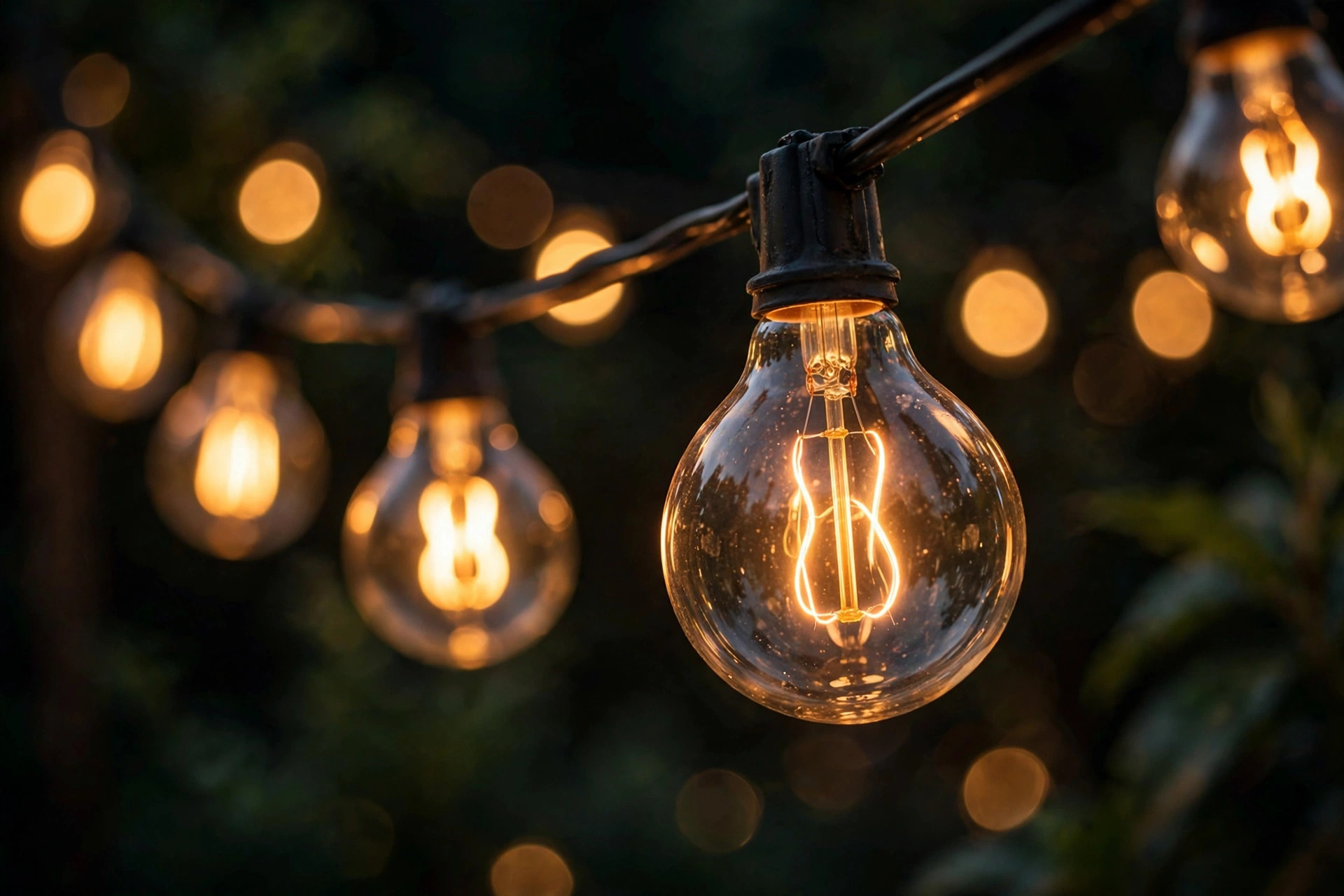
Solar string lights have become one of the most practical outdoor string light ideas for small backyards: no cords, no outlets, no timers to remember. They charge during the day and switch on automatically at dusk.
What to know before you buy: A solar panel needs 6–8 hours of direct sun to deliver a full night's glow. Hang the panel where it actually gets sun — south-facing fence tops and railing edges work well; don't tuck it under the pergola it is meant to light. Expect 6–10 hours of runtime from a well-charged set, with brightness fading in the last hours. They are dimmer than plug-in strands, so use solar for accent areas (railings, trees, paths) and plug-in for the main canopy over your dining area.
13. Layer Two Styles for a Designer Look
The prettiest patios rarely use one kind of light. Layering does the heavy lifting: big warm globe bulbs overhead for the main glow, plus tiny fairy lights woven through plants or along the railing for sparkle.
How to hang it: Start with the primary layer (the overhead canopy or fence swags from ideas 1 or 7) in warm white globes. Then add the second layer: fairy lights in a contrasting warm tone, tucked into planters, wrapped around a tree, or threaded through a trellis. Keep both layers the same color temperature (2700–3000K) so they blend instead of clash. Add a simple outdoor timer so both layers switch on together at dusk.
Patio String Light Safety & Weatherproofing Checklist
Pretty matters, but staying powered and safe through the seasons matters more. Before you leave any of these patio string light ideas up long-term, run through this checklist:
- Buy outdoor-rated lights only. Look for an IP44 rating (splash-proof) at minimum; IP65 is better for strands that will face direct rain. Indoor-rated strands yellow and fail fast outdoors.
- Plug into a GFCI outlet. Every outdoor connection should go through a ground-fault outlet or a GFCI adapter — non-negotiable near any water feature or irrigation.
- Make a drip loop. Where the cord meets the outlet, let the cord dip below the outlet first, then rise up. Water follows the cable down the loop and drips off instead of traveling into the socket.
- Choose shatterproof bulbs for exposed areas. Plastic LED globes survive storms and curious pets far better than glass Edison bulbs. Save glass for sheltered spots.
- Leave slack at every anchor. Cables contract in cold weather; a strand pulled drum-tight in summer can snap its anchors in winter. A little extra sag is structural, not sloppy.
- Bring novelty strands in during storms. Your main canopy can stay, but take down anything hanging from trees or lightweight poles before high winds.
Solar vs. Plug-In: Which Belongs in Your Small Backyard?
Both have a place — they just do different jobs. Plug-in strands are brighter, run all night at full strength, and pair well with timers and dimmers. They need an outdoor outlet and a weatherproof extension run. Solar strands go anywhere the sun reaches, install in minutes, and cost nothing to run, but they dim as the night wears on and go dark on cloudy stretches.
For most small backyards, the winning combo is plug-in for the overhead canopy (where you need real light for dinner and conversation) and solar for the accents — railing weaves, tree wraps, and path lights. That split keeps the project cheap and cord-free where it counts.
Frequently Asked Questions
How high should outdoor string lights hang on a small patio?
Hang the bulbs 8–10 feet off the ground over seating and dining areas. Over walkways, keep the lowest point of the sag at least 7 feet so nobody brushes the bulbs. If your anchors are lower than that, shorten the span so the sag stays shallow.
How many string lights do I need for a small backyard?
Measure each span and add 10–15% for sag, then buy strands that cover that total. For a typical 12×12-foot patio, two or three 25-foot strands usually create a full canopy; one 50-foot strand handles a fence line up to about 40 feet.
Can outdoor string lights stay up all year?
Yes, if they are commercial-grade, outdoor-rated strands with weatherproof sockets — check for an IP44 or IP65 rating. Budget novelty strands do better coming down after the season. Either way, take strands down from trees and lightweight poles before major storms.
Do solar string lights actually work in small shaded backyards?
They work if the solar panel gets 6–8 hours of direct sun — the strands can be in shade as long as the panel isn't. If your whole yard is shaded, use solar for a south-facing fence or railing edge, and plug in the main canopy.
String lights are one of the few upgrades where a small backyard is an advantage — a few strands go a long way, and the glow feels cozier precisely because the space is compact. For more ideas to round out your outdoor space, browse our Outdoor & Porch archive, or see how we styled cozy fall patio decor for these same crisp October evenings.


Comments
Post a Comment