
15 Small Bedroom Storage Ideas That Actually Free Up Space
15 Small Bedroom Storage Ideas That Actually Free Up Space
A cluttered small bedroom is rarely a "too much stuff" problem — it is a "no designated home for stuff" problem. These small bedroom storage ideas for cluttered rooms are built around one principle: every category of thing you own needs a specific container in a specific spot, or it ends up on the floor. Each idea below frees real, measurable space, and most take under an hour to set up.
Once the clutter is contained, make the room feel finished — our cozy fall bedroom decor ideas layer warmth over the same small footprint.
Small Bedroom Storage Ideas That Use Hidden Space
The best storage in a small bedroom is the kind you cannot see. These ideas harvest the square footage you already own but never use: under the bed, behind the door, inside furniture.
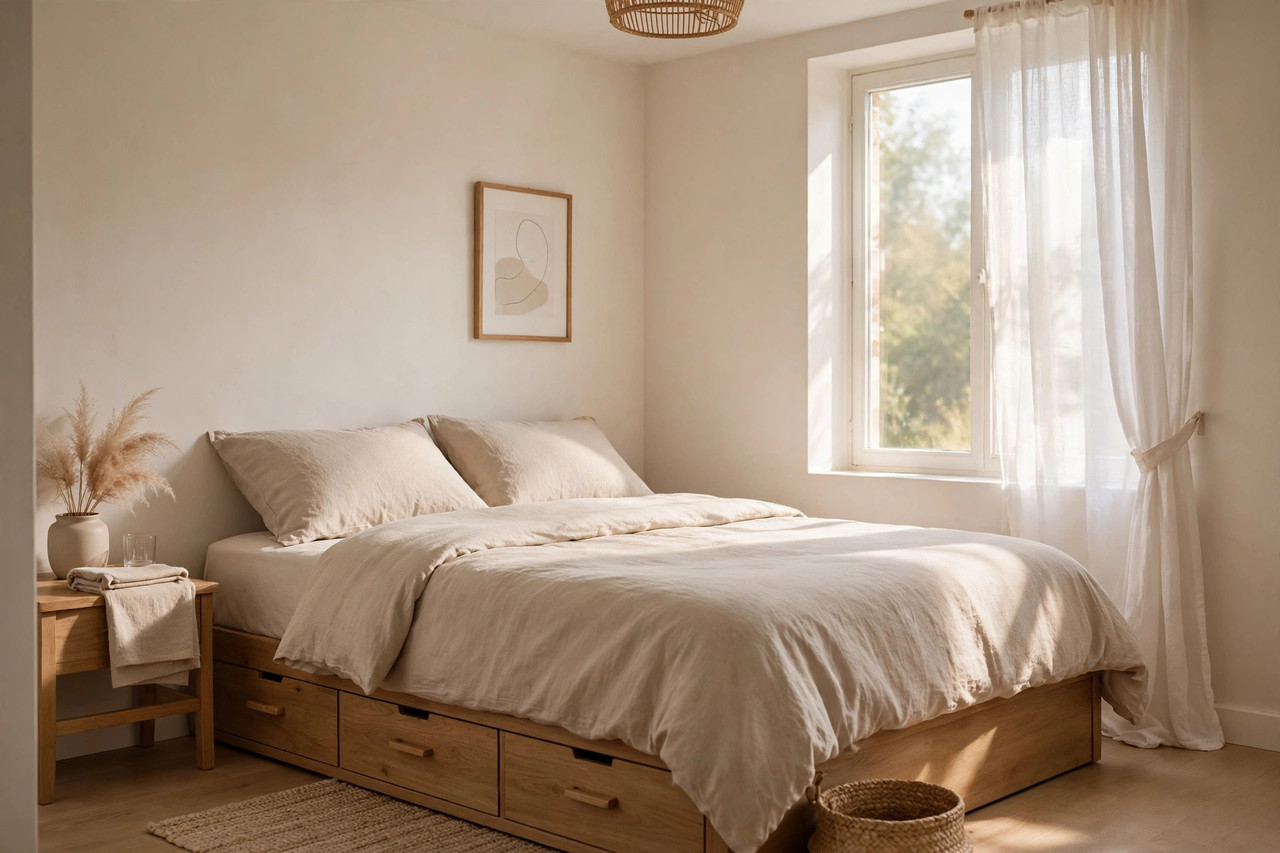
1. Switch to a storage bed with drawers (or lift-up ottoman)
A queen storage bed with four drawers replaces an entire dresser — roughly 12–16 cubic feet of storage you previously walked past every night. Drawer storage beds run $250–600; lift-up ottoman beds (the whole mattress lifts on gas struts) run $400–900 and swallow suitcases, winter coats, and bulky bedding whole. Measure your under-bed clearance first: you need at least 25 inches of room on each side to pull drawers open. How-to: sort the clothes currently in your dresser by season, move the off-season half into the bed drawers first, then decide whether the dresser still earns its floor space — most people find it does not.
2. Use slim under-bed bins with lids and wheels
No budget for a new bed? Standard beds hide 6–7 inches of clearance — enough for low-profile under-bed bins ($12–20 each for a 2-pack of 41-quart bins). Buy bins with lids and wheels so they slide out without scratching floors, and label the end facing out: "Winter sweaters," "Gift wrap," "Shoes." Two to four bins fit under a queen. How-to: vacuum the dust out first (it is always worse than you think), lay a cheap flat sheet on the floor under the bed as a dust shield, then slide bins in.
3. Mount an over-the-door organizer on the bedroom door
The back of the bedroom door is roughly 20 square feet of free wall. A fabric over-the-door shoe organizer ($12–25, 24 pockets) holds shoes, scarves, belts, chargers, and toiletries — whatever currently migrates to the dresser top. For a sturdier option, an over-door hook rack with 5–10 hooks ($15–30) handles tomorrow's outfit, robes, and bags. How-to: hang it, then do a "pocket audit" after one week: anything still homeless gets assigned a pocket, anything never used leaves the room.
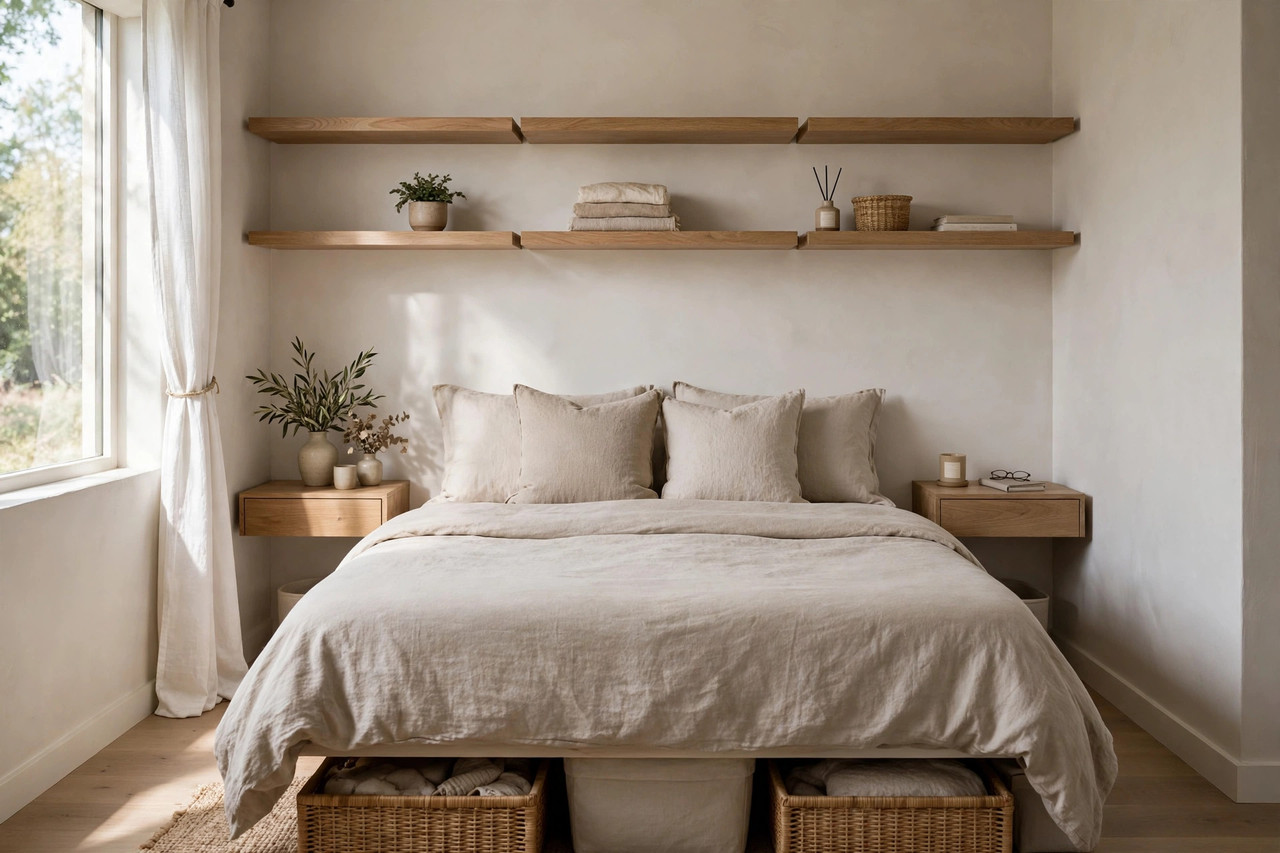
4. Hang floating shelves above the bed
The 24–30 inches of wall above your headboard is dead space in most small bedrooms. Two floating shelves (24–36 inches wide, $15–30 each) hold books, a plant, an alarm clock, and framed photos — replacing a nightstand's worth of surface on one side. Mount them at least 20 inches above the mattress so you never sit up into them. How-to: find the studs (a $10 stud finder pays for itself), level both shelves together before drilling, and keep the lower shelf at least 8 inches above your head when sitting up in bed.
5. Replace bulky nightstands with floating nightstands
A traditional nightstand eats about 4 square feet of floor. A floating nightstand — a wall-mounted shelf or small drawer unit ($25–60 each) — holds the lamp, phone, and water glass while leaving the floor visible underneath, which makes the room read bigger. Wall-mount them 24–28 inches off the floor (mattress height) and 2–3 inches from the bed frame. How-to: mount with the same stud-finding care as the shelves above, and run the lamp cord down the wall with a paintable cord cover ($8–12) so it looks built-in.
Closet and Wardrobe Storage for Cluttered Bedrooms
In most small bedrooms, the closet is the single biggest storage asset — and the single biggest wasted one. A single rod and a bare shelf waste about half the closet's volume. These ideas double it.
6. Double the hanging space with a second rod
A tension or screw-mounted second closet rod ($15–25) hung 40 inches below the top rod instantly doubles hanging capacity for shirts, blouses, and folded-over pants. Standard closets have a rod at 66 inches; adding one at 40 inches gives you two full rows. How-to: measure your closet width first (rods come in 18–72 inch adjustable sizes), hang the second rod, then move all short-hang items (shirts, jackets) to the new double section and keep dresses and coats on the full-length section.
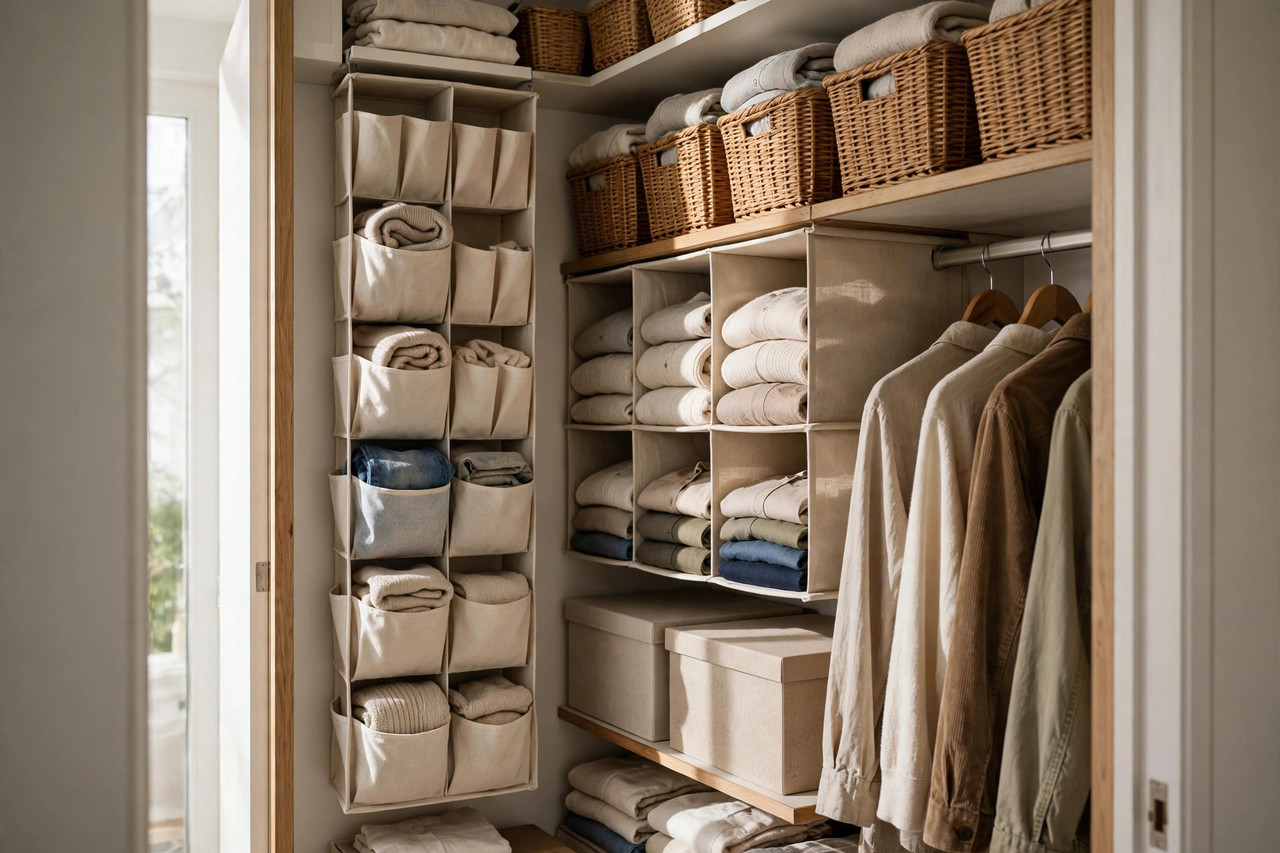
7. Add a hanging closet organizer for folded clothes
Folded stacks on a closet shelf topple; folded stacks in a 6-shelf hanging organizer ($12–22) stay put. Each shelf is roughly 12x12 inches — one shelf per category: t-shirts, jeans, workout clothes, pajamas, underwear overflow. Hang it in the center of the closet where it is easiest to reach. How-to: roll, do not fold, t-shirts and jeans for the shelves — rolled clothes take less height and you can see every item from the front.
8. Put the closet floor to work with stacked bins
The 2–3 feet of closet floor below the hanging clothes is prime real estate. Two stackable 30-quart bins ($10–16 each) hold shoes, handbags, or seasonal accessories, and because they are in the closet, they never visually clutter the room. Add a small shoe rack ($20–40, holds 10–20 pairs) if shoes are the main floor offender. How-to: sort shoes by "worn weekly" vs. "occasionally" — weekly shoes live at the front of the rack, occasional shoes go in the bins, and anything unworn for a year leaves the house.
9. Install a wall-mounted valet rod or fold-down hanger
A pull-out valet rod ($12–20, mounts inside the closet or on the bedroom wall) gives you a dedicated "tomorrow's outfit" spot so clothes stop draping over the bed, the chair, and the floor. It extends about 12–14 inches when in use and pushes flat when empty. How-to: mount it at shoulder height near the closet, and make the rule: nothing drapes anywhere except this rod. One rod, one outfit, zero chair-drobe.
10. Use the inside of the closet doors
Adhesive hooks ($8–12 for a multi-pack) or an over-door wire rack on the inside of closet doors holds belts, necklaces, hats, and bags — items that otherwise tangle in drawers. Command-style hooks hold 3–5 pounds each and come off clean. How-to: group by type (all belts on one hook row, all necklaces on another) so getting dressed in the morning is grab-and-go instead of dig-and-untangle.
Small Bedroom Organization Ideas That Tame Surfaces
Cluttered rooms are usually surface problems: the dresser top, the floor by the bed, the chair. These ideas give every surface-dweller a home.
11. Corral dresser-top clutter with a divided tray
A divided tray or valet ($20–40) on the dresser turns "piles" into "places": watch and wallet in one section, keys in another, lip balm and hand cream in a third. The tray is the landing pad — anything not in the tray does not belong on the dresser. How-to: empty the entire dresser top into a box, put back only what fits in the tray plus one decorative item (a candle, a small plant), and find homes for everything else within the hour.
12. Add a storage bench at the foot of the bed
A storage bench (40–48 inches wide, $60–150) at the foot of the bed holds blankets, extra pillows, or off-season clothes inside — and gives you a seat for putting on shoes. In a room too small for a bench, a lidded ottoman ($40–80) in the corner does the same job in 4 square feet. How-to: store the bedding you actually swap (the second duvet, the summer quilt) inside — not "someday" items. If you have not opened it in six months, it moves to the attic or out.
13. Mount a pegboard wall for jewelry, bags, and hats
A 2x3-foot pegboard panel ($15–25 plus hooks) on an empty wall section turns accessories into decor while getting them out of drawers. Space hooks 4–6 inches apart for bags, tighter for jewelry. Paint the pegboard to match the wall so it reads as intentional, not dorm-room. How-to: lay out the arrangement on the floor first, photograph it, then mount — moving pegboard hooks after the fact leaves extra holes.
14. Go vertical: floor-to-ceiling corner shelving
Corners are the most wasted inches in small bedrooms. A narrow corner shelf unit or ladder shelf (12–16 inches deep, $40–90) holds books, baskets, and plants without jutting into walking space. Top it with a basket ($15–25) for the category that always ends up on the floor — laundry, returns, "to file." How-to: anchor any shelf over 3 feet tall to the wall (anti-tip kits are $8–12) — a loaded ladder shelf in a bedroom you walk through half-asleep is a safety issue, not a style choice.
15. Do the 15-minute reset system (the maintenance idea)
Storage only works if things go back. The 15-minute nightly reset: set a timer, return everything to its labeled home, done. Pair it with the "one in, one out" rule for clothes and the "tray rule" from idea 11 for surfaces. How-to: do it right before bed for one week — by day seven it takes under 10 minutes, and the room stays at the "after" level instead of sliding back. For the soft side of the reset, our fall bedding layer formulas show how a made bed makes the whole room look twice as tidy.
Quick-Start Budget Guide: Small Bedroom Storage
- Under $50: over-door organizer ($18) + 2 under-bed bins ($24) — the two highest-impact cheap wins.
- $50–150: add a hanging closet organizer ($18) + second closet rod ($20) + divided dresser tray ($25) — the closet doubles in capacity.
- $150–400: add floating nightstands ($100/pair) + storage bench ($120) — floor space opens up visibly.
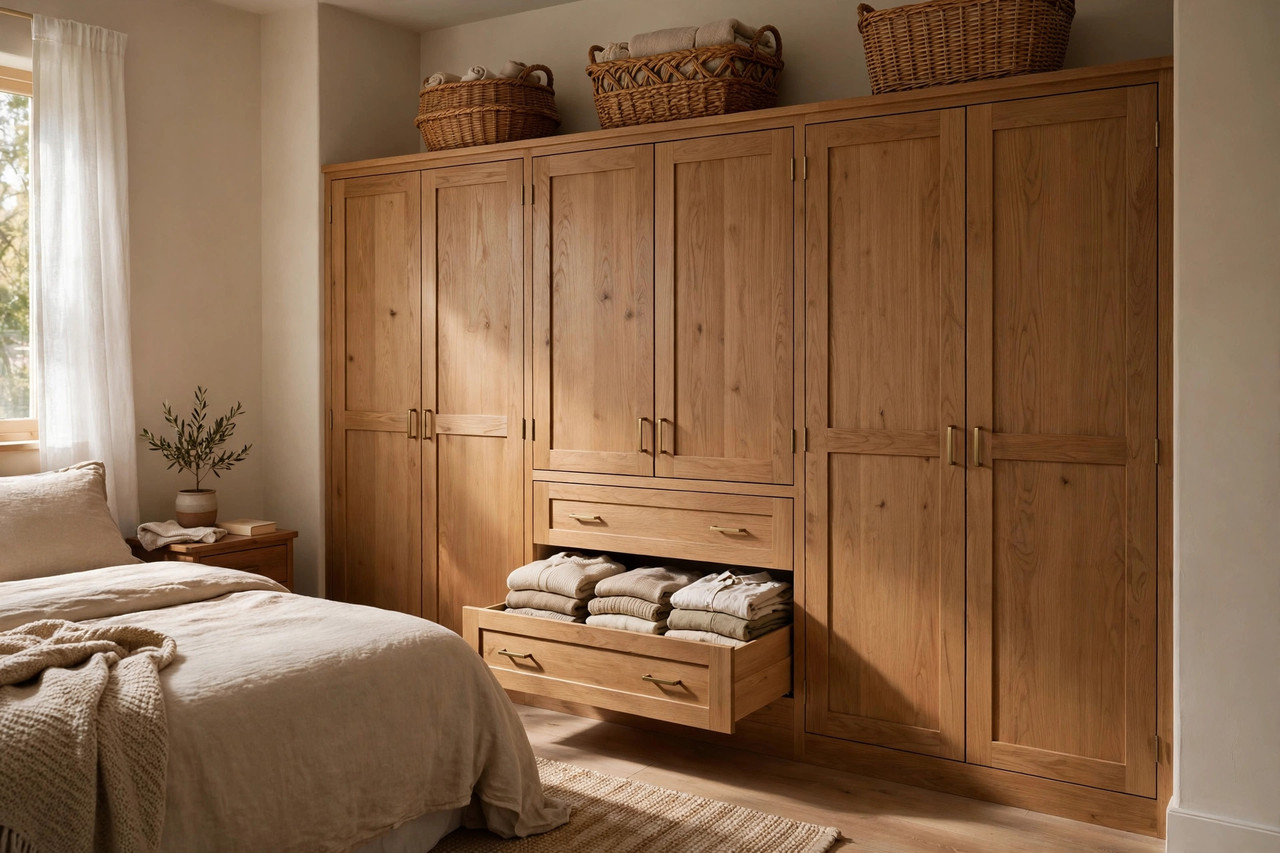
- $400+: storage bed with drawers ($350+) — replaces the dresser entirely and reclaims its footprint.
Before buying anything, walk the room with a trash bag and a donation box — most "cluttered" bedrooms are 20% storage problem and 80% stuff-without-a-home problem. Our chocolate brown bedroom ideas show how rich, dark color can make a newly organized small bedroom feel intentional and cozy rather than just empty.
Frequently Asked Questions
Where do I start decluttering a really messy small bedroom?
Start with surfaces, not closets: clear the dresser top, nightstand, and floor in one pass (trash bag + donation box + "relocate" box). Visible progress in 30 minutes builds momentum; closets come second, once you can see the room again.
How can I add storage to a small bedroom without buying furniture?
Under-bed bins, an over-door organizer, a second closet rod, and adhesive hooks inside closet doors — all under $60 total, no furniture, no drilling beyond one rod. These four harvest the hidden space you already own.
What is the best bed for a small cluttered bedroom?
A storage bed with drawers, because it replaces a dresser (roughly 8–10 square feet of floor) while keeping clothes accessible. If buying a bed is not in the budget, low-profile wheeled bins under your current bed capture about 70% of the benefit.
How do I keep a small bedroom from getting cluttered again?
Three rules: every category has a labeled home (ideas 1–14 build these), the 15-minute nightly reset (idea 15), and one-in-one-out for clothes. Clutter returns when new things arrive without assigned homes — the rules stop that at the door.
Fifteen ideas, one principle: in a small bedroom, storage is not about buying more containers — it is about assigning every thing a home and making the hidden space work. Start with the under-bed bins and the door organizer this weekend, and the room will feel twice its size by Sunday night.


Comments
Post a Comment