
13 Small Home Office Lighting Ideas That Actually Fix a Dark Desk
13 Small Home Office Lighting Ideas That Actually Fix a Dark Desk
If your workspace feels like a cave by 3 PM, you are not imagining it. Most small home offices rely on a single overhead bulb, which leaves the desk surface dim while the screen blazes — a contrast that causes eye strain and headaches. The good news: small home office lighting ideas do not require rewiring or a big budget. With a few targeted fixes — the right lamp at the right height, the right color temperature, and a simple layered plan — you can bring a dark desk up to a comfortable 300–500 lux without giving up a square inch of space you need.
This guide skips vague decorating advice. Every idea below gives you real numbers: lux targets, mounting heights, bulb color temperatures in Kelvin, and honest cost ranges so you can fix your light this weekend.
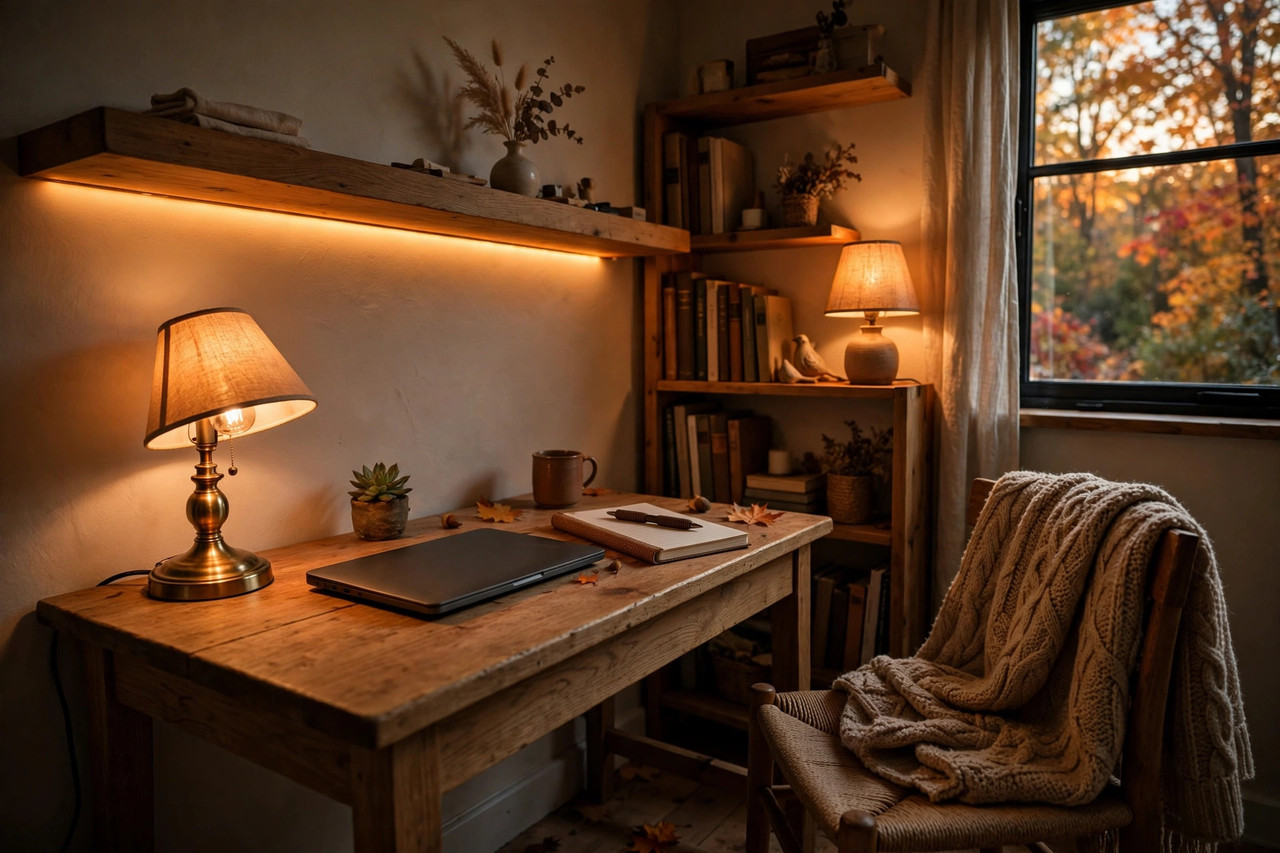
Know Your Target: The Numbers That Matter
Before you buy anything, learn two numbers. For desk work — reading, writing, laptop tasks — aim for 300 to 500 lux on the work surface itself. General room lighting only needs about 100 lux. When your desk gets 400 lux from a lamp while the rest of the room sits at 100, you get depth and comfort instead of a harsh spotlight-in-a-cave effect.
Your phone can check this. Free lux meter apps use the phone's light sensor and are accurate enough to compare spots around your room, so you can verify a fix actually worked instead of guessing. Measure at desk height, where your keyboard sits.
13 Small Home Office Lighting Fixes That Actually Work
1. Mount a Clamp Desk Lamp at the Edge of the Desk
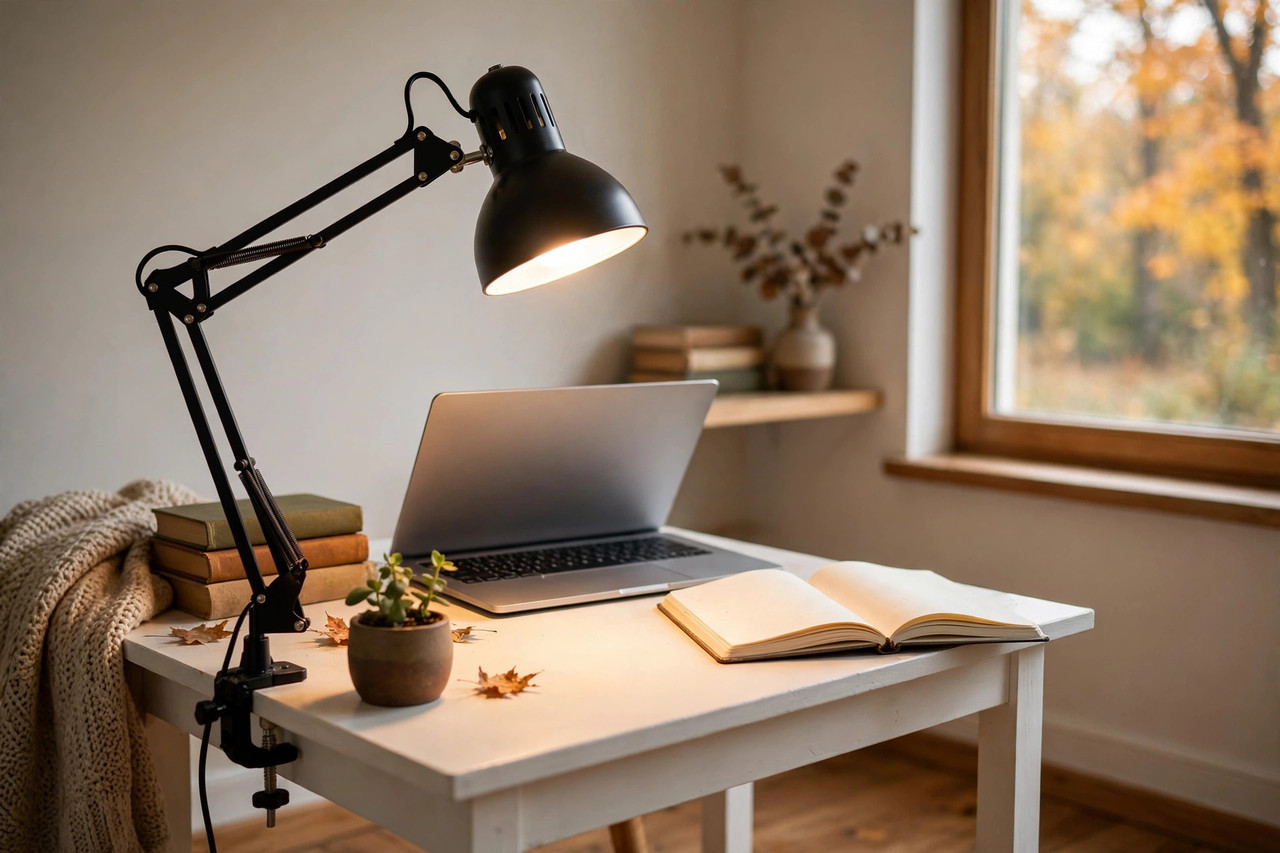
A clamp desk lamp is the single best fixture for a small office because its base lives off the desk. The clamp grips the desk edge or a shelf, freeing the full work surface for your keyboard and papers. Choose one with an adjustable arm and a 2700K–3000K LED bulb, and position the shade 15–20 inches above the desk surface so light pools evenly over your work area instead of glaring into your eyes.
Expect to pay $25–$60 for a solid LED clamp lamp with dimming. This is the fix to try first — one lamp, zero footprint lost, and most dark desks go from ~100 lux to 400+ lux in minutes.
2. Layer Three Kinds of Light: Ambient, Task, Accent
Pair the lamp with an ambient layer: a warm floor lamp or wall sconce fills the room so the desk doesn't sit in a cave of darkness around a bright pool. Budget $30–$70 for a simple torchiere or arc lamp that bounces light off the ceiling.
3. Match Bulb Color Temperature to the Task (2700K–4000K)
Color temperature changes how your brain reads a room. For a cozy, calm home office, 2700K–3000K (warm white) is the sweet spot — it feels like late-afternoon sun and is easy on the eyes for long sessions. For focused work or video calls, 3500K–4000K (neutral white) gives crisper contrast and keeps you alert.
Avoid 5000K+ daylight bulbs at a small desk — they feel clinical next to a warm fall interior and can make a small room look harsh. Pick one temperature and keep every bulb in the room consistent so the light feels like one environment, not three.
4. Put the Lamp on Your Non-Dominant Side
Shadows are the hidden reason desks feel dark even with a lamp on. If you write right-handed, place the task lamp on the left side of the desk so your hand never casts a shadow over what you are writing. Left-handed? Mirror it. Angle the lamp head so light hits the work surface at roughly a 30–45 degree angle, which spreads the beam and keeps the shade out of your eyeline.
5. Add a Monitor Light Bar or Bias Lighting
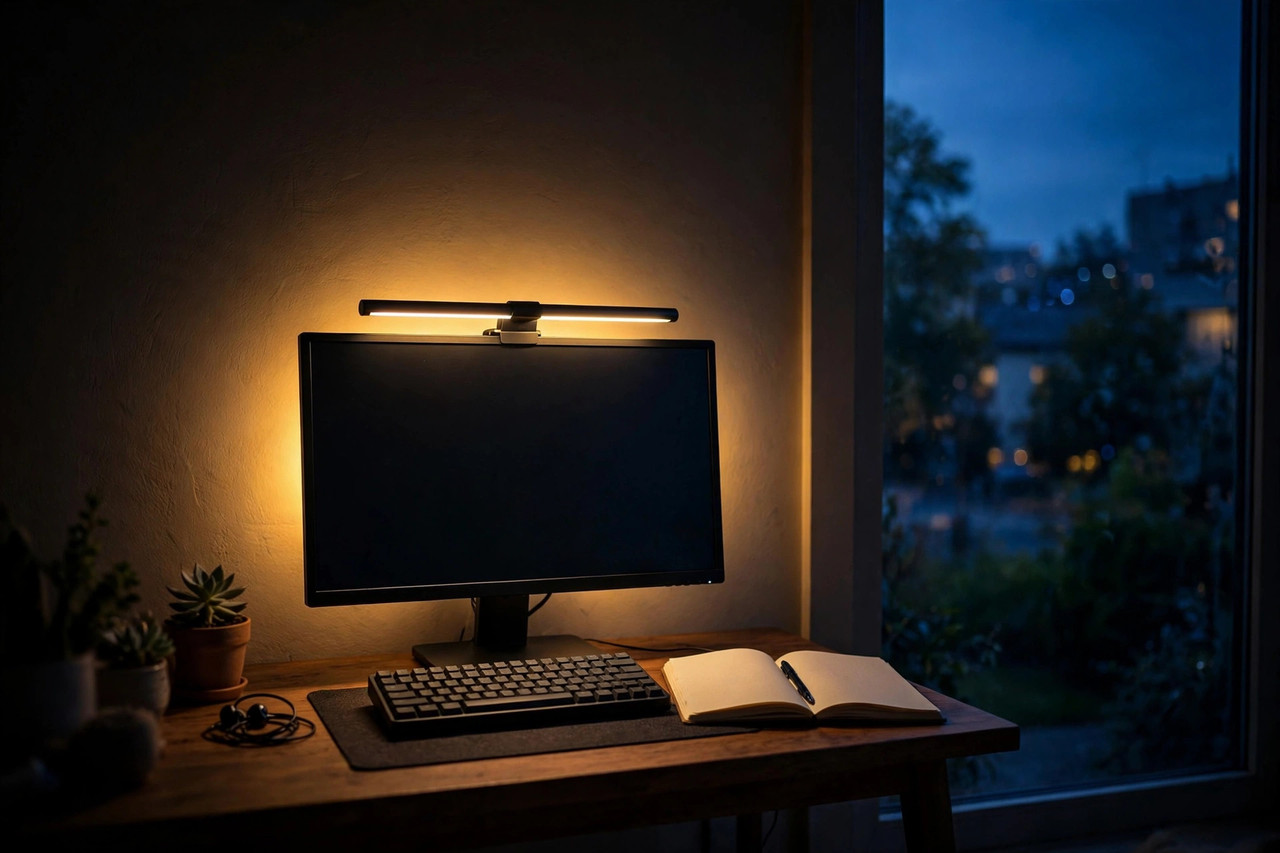
If you work at a screen for hours, the brightest object in a dim room becomes the problem. A monitor light bar — a slim LED bar that clamps onto the top bezel of your monitor — throws warm 2700K light down onto the keyboard and desk in front of you without touching desk space or glaring on the screen. Prices run $40–$100 for a good dimmable model.
For evening work, add bias lighting: a strip of warm LEDs stuck behind the monitor so the wall glows softly around it. This lowers the contrast between the bright screen and the dark room, which is the single biggest cause of nighttime eye fatigue. A USB-powered strip costs $15–$30 and installs in minutes.
6. Fix Window Glare Without Losing the Fall Light
Glare on a laptop screen is not just annoying — it makes your eyes work harder all day. The best desk position is perpendicular to the window: side light illuminates your work without shining straight into your eyes or reflecting off your screen. Never sit with the window directly behind you (your back blocks it) or directly in front of you (it outshines everything).
If you cannot move the desk, tame the light instead of blocking it. Sheer white curtains, a frosted window film, or a simple pull-down shade diffuse harsh fall afternoon sun into soft, even illumination. This keeps the warm seasonal glow while dropping screen reflections to zero.
7. Install a Plug-In Wall Sconce — No Wiring, No Desk Space
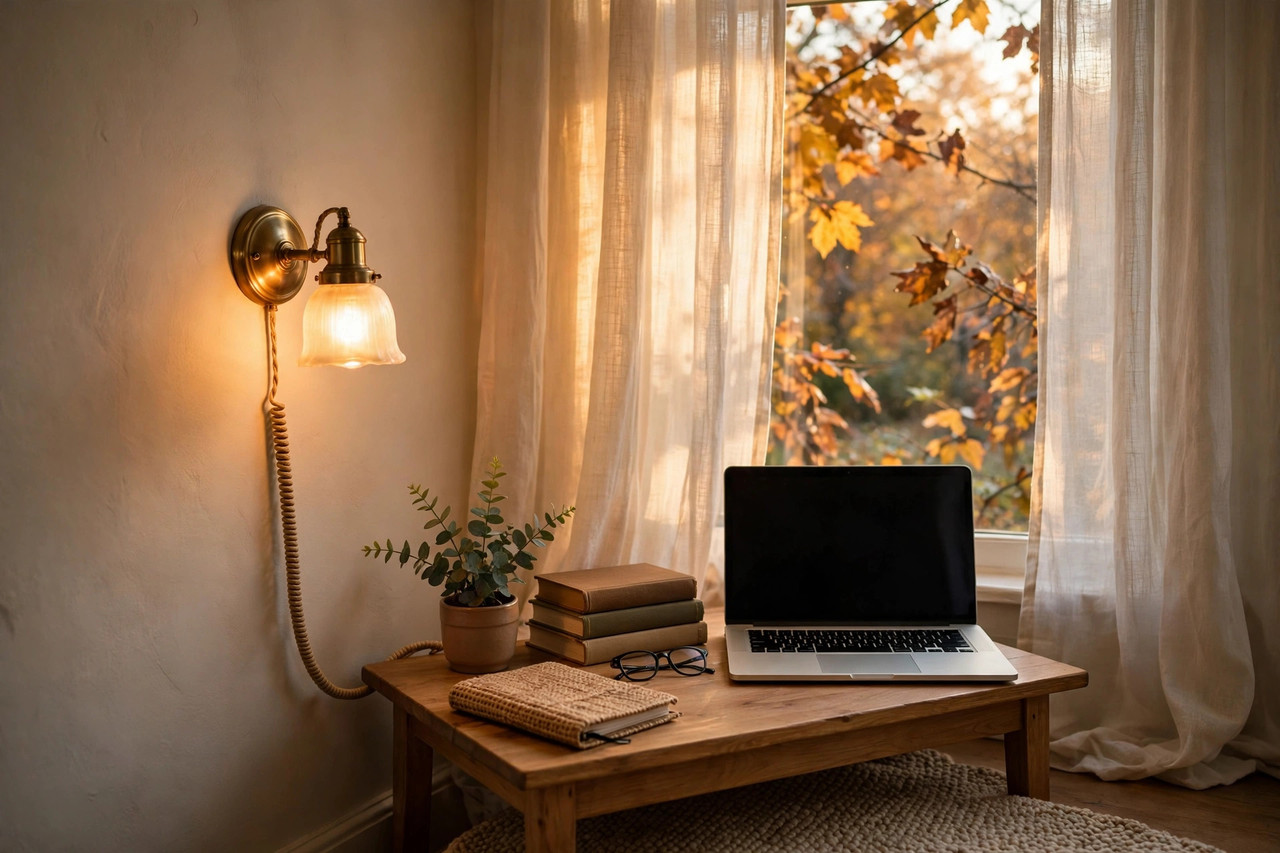
A plug-in sconce gives you a beautiful wall light with zero electrical work and zero desk footprint — the cord drops down the wall to an outlet. Mount it at 60–66 inches from the floor (roughly eye level when standing), or about 40–45 inches above the desk surface if it sits directly over the workspace, with a swing arm you can pull toward yourself for task light.
Brass or matte-black swing-arm sconces cost $35–$80.
8. Run LED Strips Under Shelves and Cabinets
Accent lighting is what makes a small office feel designed rather than just lit. A self-adhesive warm-white LED strip ($15–$35 for a 16-foot reel) tucked under a floating shelf or wall cabinet washes the wall and desk below in a soft glow, adding the accent layer your room is missing. Choose 2700K–3000K with a dimmer so it stays a gentle highlight, not a second task light.
Mount the strip toward the front edge of the shelf so the diodes face down and the light pools on the surface below — diodes facing the wall create uneven hotspots.
9. Reach Over with an Arc Floor Lamp
An arc floor lamp solves a layout problem: its weighted base sits in a corner or beside the desk while the curved arm swings the shade directly over the work area. In a tight office this means the light source hovers above the desk but the base occupies floor space you were not using anyway.
Look for an arc lamp with a dimmer and a fabric shade ($60–$150). Hang the shade 60–72 inches from the floor so it clears your head when you lean back but still delivers focused light to the desk.
10. Upgrade the Overhead Light to a Dimmable Flush Mount
The boob light or bare bulb most rental offices come with is the enemy of good lighting: one unshielded source creates deep shadows and uneven pools. A flush-mount or semi-flush ceiling fixture with a frosted diffuser spreads light evenly across the room, raising the whole space toward that 100-lux ambient baseline.
Swap in a dimmable fixture ($40–$120) with a 3000K LED and add a dimmer switch or smart bulb. Being able to turn the overhead down to 30% in the evening while your desk lamp carries the load is what makes a small office feel warm instead of interrogation-bright.
11. Put Everything on Dimmers or Timers
Static lighting never matches how a room is used across a day. A plug-in dimmer ($12–$20) or a smart plug with scheduling ($15–$25) turns an ordinary lamp into a lighting system: full brightness for morning deep work, warmer and dimmer for evening admin, and automatic on/off so the room is lit when you sit down.
Simple routines work best: bright task light 9 AM–12 PM, a midday break from the desk, warm ambient light after 5 PM. Your eyes — and your evening energy — will notice the difference within a week.
12. Bounce Light Off Walls and Ceilings Instead of Adding Fixtures
You can raise light levels without buying another lamp by using surfaces. A torchiere uplight (a floor lamp that aims up, $30–$70) bounces light off a white or light-colored ceiling, filling a small room with soft, shadowless ambient light. Lighter wall paint near the desk does the same job passively — matte finishes scatter light better than glossy ones.
Swap dark lampshades for light fabric ones, too. An opaque dark shade blocks 50–70% of a bulb's output; a white linen shade diffuses it into the room and can visibly brighten the whole space with the same bulb.
13. Follow a Budget Priority Plan: $50, $100, $200
You do not need all thirteen ideas — you need them in the right order. Under $50: a clamp desk lamp plus a sheer curtain fixes 80% of dark desks. Around $100: add bias lighting behind the monitor and an LED strip under a shelf for the layered look. Around $200: add a plug-in wall sconce or arc floor lamp and a dimmer for the full three-layer setup.
Quick Recap: Your Fix Checklist
- Measure the desk with a phone lux meter — target 300–500 lux on the surface, ~100 lux room-wide.
- Clamp desk lamp at 15–20 inches above the desk, on your non-dominant side.
- One color temperature throughout (2700K–3000K for warmth, 3500K–4000K for focus).
- Monitor light bar or bias lighting for screen-heavy evenings.
- Desk perpendicular to the window; sheers to kill glare.
- Sconce, LED strip, or arc lamp for the missing ambient and accent layers.
- Dimmers or timers so the light changes with your day.
The lumens cheat-sheet (lux targets, translated to bulb boxes)
Lux is what lands on the desk; lumens are what the bulb box prints. The bridge between them: your desk surface is roughly 0.7–1 square metre, so delivering the 300–500 lux target means getting about 250–450 lumens to actually land on the work surface. A clamp lamp rated 450–800 lumens, mounted 15–20 inches above the desk as in idea 1, does exactly that after shade and distance losses. Distance rule of thumb: light falls off fast — moving a lamp from 15 inches to 30 inches above the desk cuts the lux on the surface to about a quarter, which is why a pretty lamp across the room never fixes a dark desk. Room total: the 100-lux ambient baseline in a 10×10-ft office (about 9 m²) needs roughly 900–1,000 lumens of total light output — one 800–1,100-lumen ceiling bulb or a torchiere bouncing the same amount gets you there. Monitor light bars are typically rated 300–500 lumens aimed straight down, which is why they feel bright at the keyboard while using less output than a desk lamp. For video calls (the gap most home offices notice last): put a soft light source in front of you, at or slightly above eye level, about 2–3 feet from your face — a 400–800-lumen lamp with a fabric shade, or a ring/panel light at 30–50% brightness. Light from behind or directly overhead is what makes callers look tired; the same lamp you already own, moved in front, fixes it for free.
FAQ: Small Home Office Lighting Ideas
How bright should a small home office desk be?
Aim for 300–500 lux on the work surface where your keyboard and papers sit, with the rest of the room at roughly 100 lux. Use a free phone lux meter app to check — if your desk reads under 200 lux, it will feel dim and cause eye strain no matter how good the lamp looks.
What color temperature is best for a home office desk lamp?
2700K–3000K for a warm, relaxing office feel; 3500K–4000K for sharper focus and better video-call quality. Avoid 5000K+ daylight bulbs in a cozy small office — they look harsh against warm fall interiors. Keep every bulb in the room at the same temperature.
What is the best small-space light that takes no desk room?
A clamp desk lamp, a plug-in wall sconce, or a monitor light bar. All three deliver task light with zero desk footprint — the clamp grips the desk edge, the sconce mounts on the wall, and the light bar sits on top of your monitor.
Fix the light first, and the whole room follows: a well-lit desk feels bigger, warmer, and more inviting — exactly what a small home office needs as the afternoons grow shorter.


Comments
Post a Comment