
15 Vintage-Inspired Fall Decor Ideas That Feel Collected, Not Store-Bought
15 Vintage-Inspired Fall Decor Ideas That Feel Collected, Not Store-Bought
These vintage inspired fall decor ideas are for anyone tired of decor that looks like it arrived in a single shopping bag. The collected look — tarnished brass, amber glass, books with cracked spines, copper gone soft with age — can't be bought new, because its whole beauty is time. The good news: it's also the cheapest way to decorate for fall, since every piece below is a thrift-store, estate-sale, or flea-market find at a fraction of retail. Each idea includes what to pay, what to look for, and how to style it, plus a thrifting guide at the end so you can source the whole look yourself. For the simpler side of the season, our simple fall decor ideas cover the easy wins first.
Vintage-Inspired Fall Decor: The Collected Formula
The collected look follows a simple formula: aged metal + warm glass + something organic + something with a story. Aged metal means brass, copper, or iron with real patina — not the faux-distressed finish from a big-box store. Warm glass means amber, honey, or smoked tones that glow in low autumn light. The organic piece is dried, not fresh: wheat, hydrangeas, grasses. And the story is whatever caught your eye at the estate sale — the thing with no practical purpose that you loved anyway. Repeat those four elements through every room and the whole house feels gathered over years, even if you thrifted it all last weekend.
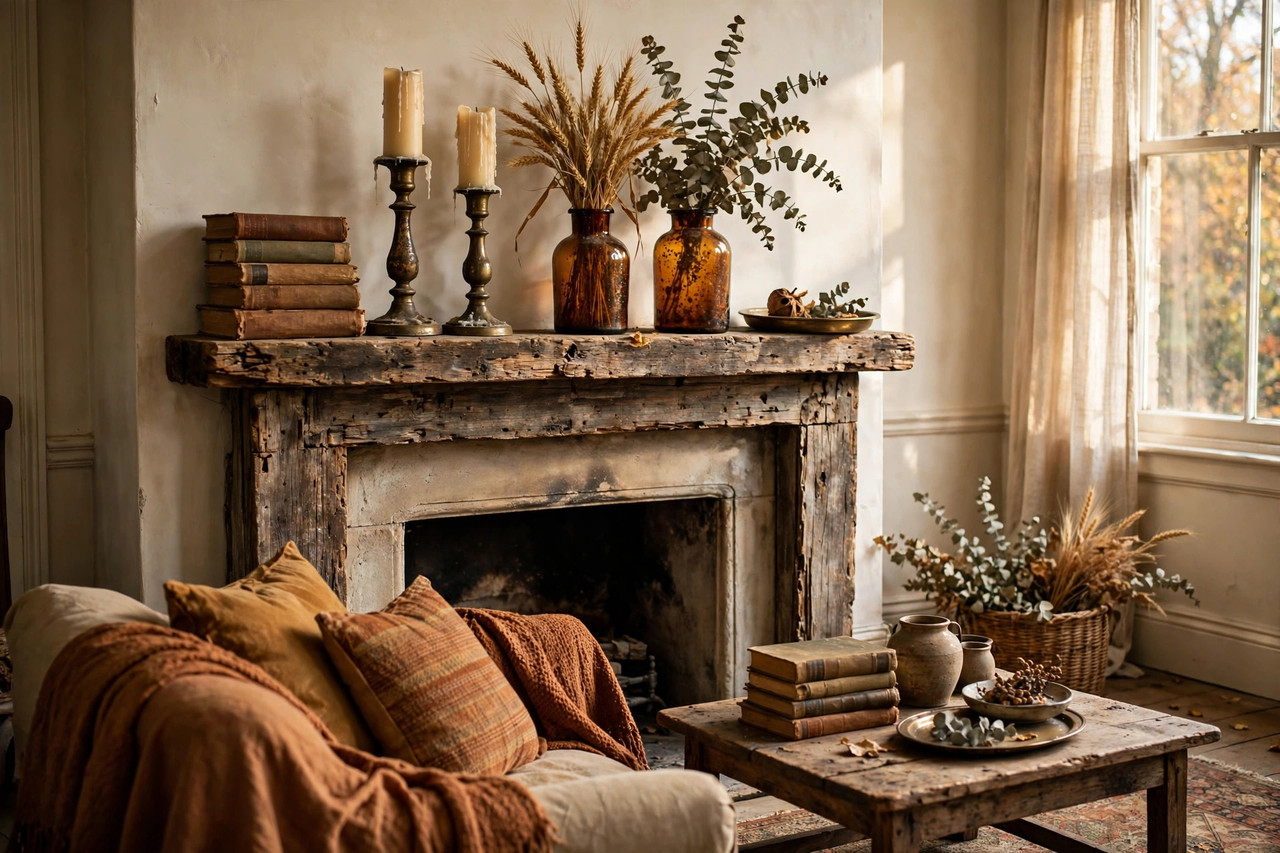
1. Tarnished brass candlesticks in mixed heights
The single most collected-looking object in fall decor. Real brass candlesticks at thrift stores run $2–8 each — look for solid weight, seams along the sides (a sign of old casting), and a deep golden tone under the tarnish. Buy them in odd numbers and mixed heights: a 12-inch, a 9-inch, and a 6-inch grouped on a mantel or dining table instantly look inherited rather than purchased.
Leave the patina alone — polishing vintage brass to a mirror shine erases exactly the age you're paying for. Fit them with ivory or beeswax taper candles ($8–12 for a box of 12); dripless tapers keep the brass clean. Our fall mantel decor guide shows this exact grouping styled three different ways.
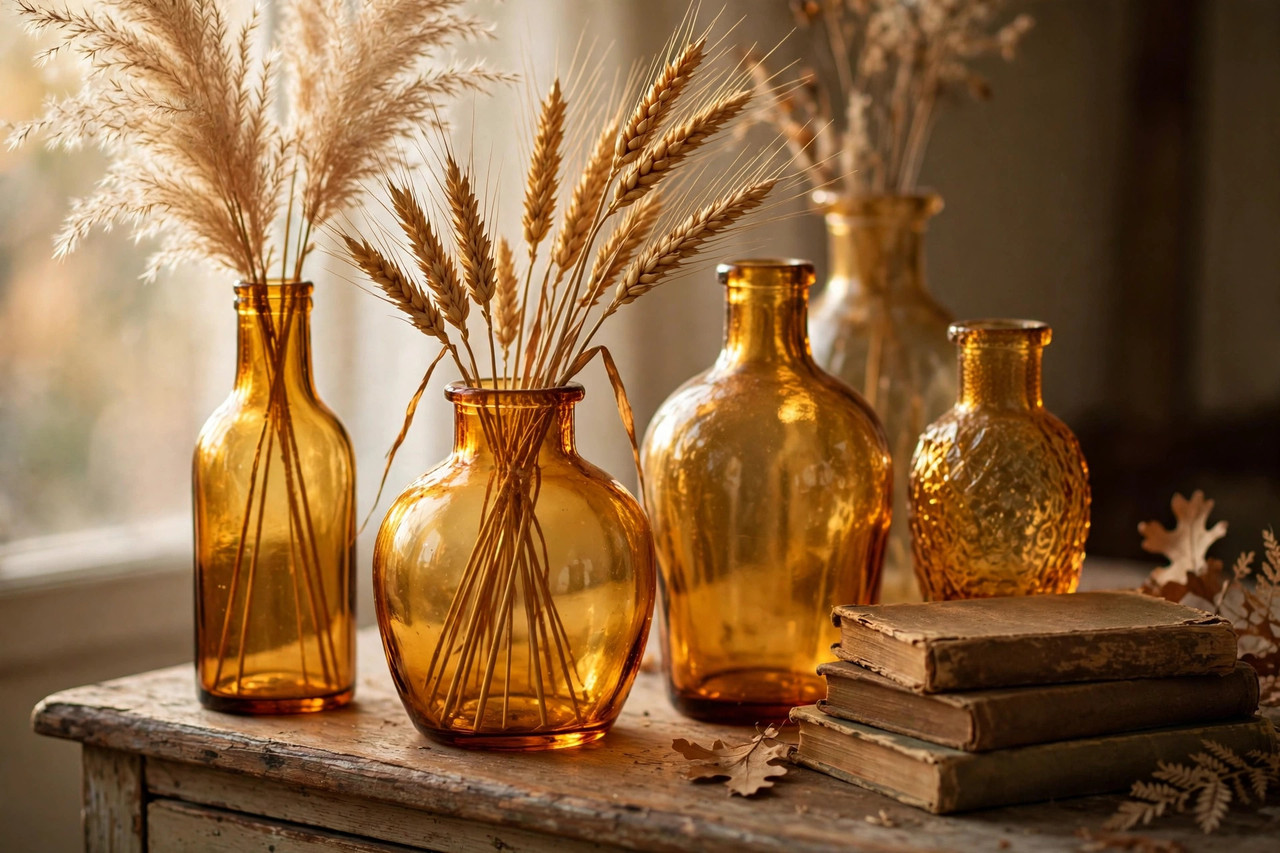
2. Amber glass bottles and vases
Amber glass is fall's perfect material: it holds October light like honey and costs almost nothing secondhand. Old medicine bottles, apothecary jars, and mid-century vases in amber and honey tones sell for $1–5 at thrift stores and flea markets. Group five to seven pieces of different heights on a windowsill or sideboard — the light passing through the glass does all the decorating work.
Fill one tall bottle with dried wheat stems, leave the rest empty; the shapes themselves are the display. Check the bottoms for maker's marks — Owens-Illinois diamonds, "Duraglas" script — which date pieces to the 1940s–60s and make great conversation.
3. Stacks of clothbound vintage books
Old books with cloth covers in rust, ochre, olive, and brown are fall color in object form. Thrift stores sell them for $1–3 each, often in a dedicated "vintage books" section. Stack three to five horizontally as a riser for a candle or small pumpkin-free arrangement — the stack adds height and color that a bare table lacks.
Choose by spine color first, title second; nobody will read them, but everyone will see them. Remove dust jackets (they're usually garish) and wipe covers with a dry cloth. A stack of old Reader's Digest condensed books — the ones everyone mocks — actually works beautifully because the spines are uniformly sized.
4. An aged copper pitcher
Copper with a soft brown patina is brass's moodier cousin and pure autumn. Vintage copper pitchers, jugs, and coal scuttles run $10–25 at estate sales — far less than the $60+ reproductions. Fill a pitcher with dried hydrangeas or leave it empty on open shelving; either way the metal's warmth anchors the vignette.
Test before you buy: real copper is non-magnetic and heavy for its size, and old pieces often show hammer marks. Skip anything lacquered bright orange — that's new copper pretending. Like brass, the patina is the point; never polish vintage copper to new.
5. Dried hydrangeas in a brass bowl
Cut hydrangea heads in late summer, hang them upside down for two weeks, and you have dried blooms in dusty mauve, sage, and cream that last for years. A low brass or copper bowl ($8–15 thrifted) mounded with dried hydrangeas is the vintage-fall centerpiece that never wilts, never needs water, and costs nearly nothing.
Our low fall centerpieces guide has five more dried-flower arrangements in the same spirit, all sized for small tables where a tall bouquet would overwhelm.
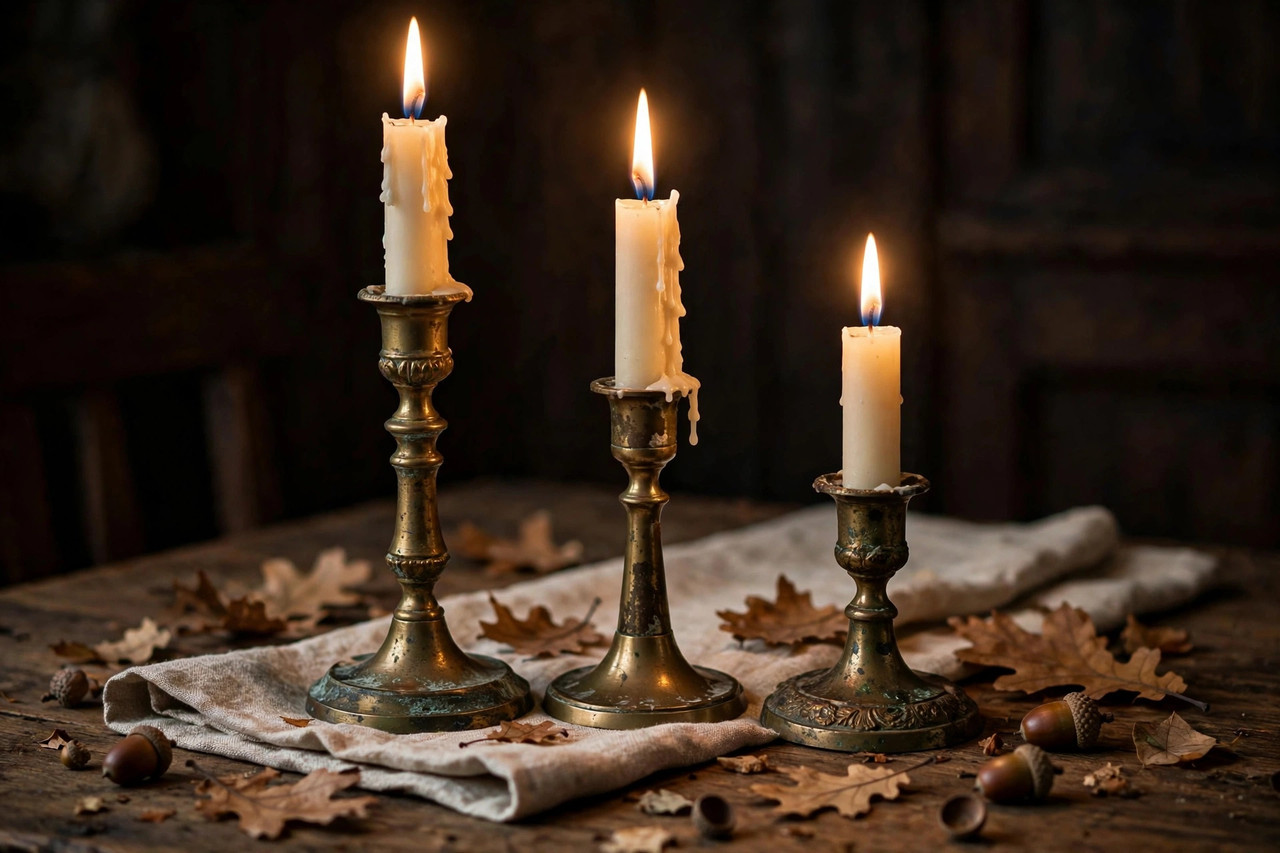
Collected Fall Decor for Tables and Shelves
The middle of the house — coffee table, console, open shelves — is where the collected look lives or dies. These six ideas are all about layering thrifted pieces the way you'd layer clothes: metal, glass, paper, textile, repeat.
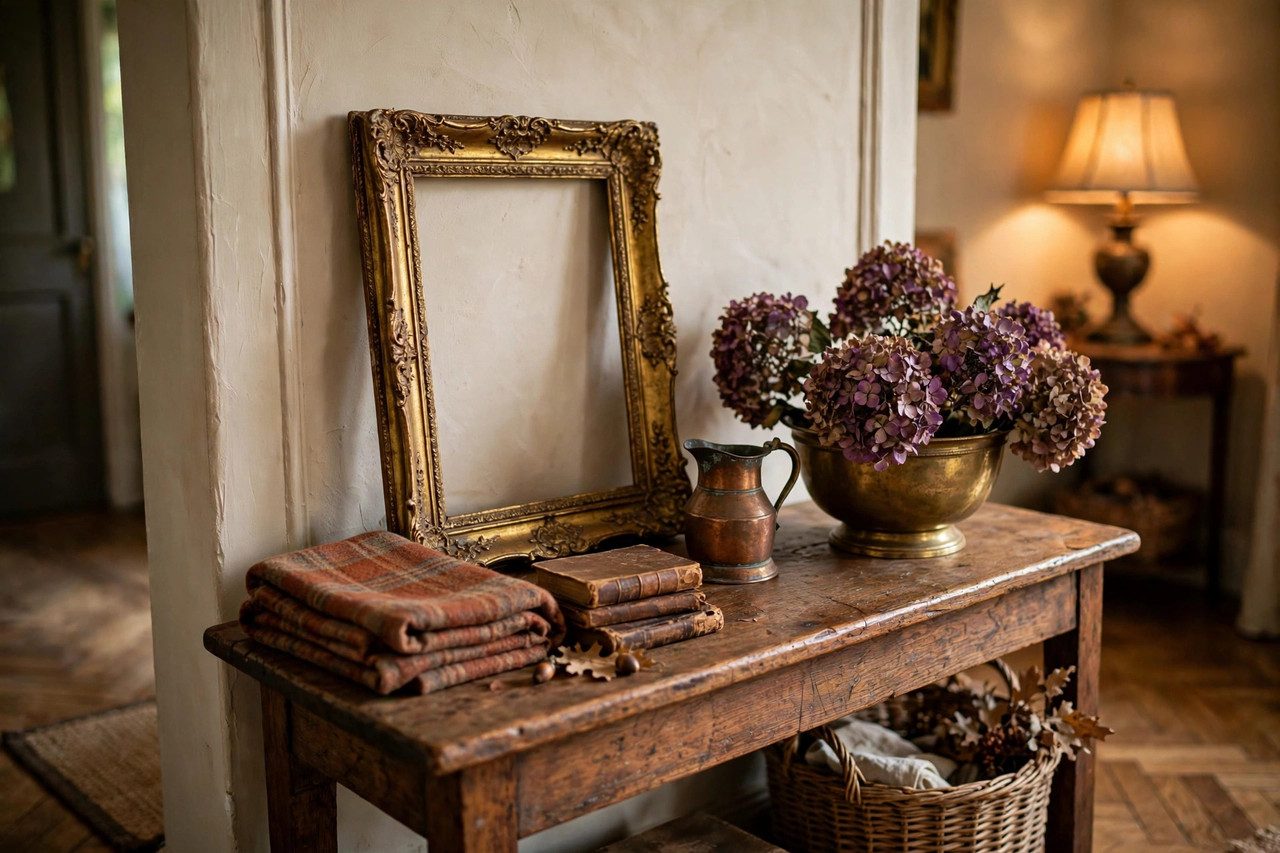
6. A gilt frame leaning, not hanging
An old ornate frame with its painting long gone — or with a faded print still inside — propped on a console table behind smaller objects creates instant depth. Thrift stores price empty gilt frames at $5–15; look for real wood (heavy, with plaster or gesso ornament) over plastic resin copies, which feel light and hollow. The worn gold finish picks up candlelight beautifully.
Layer it: frame at the back, a brass candlestick in front of one corner, a small stack of books at the other. The asymmetry is what makes it look collected rather than staged.
7. A vintage brass tray as a styling base
Every collected vignette needs a boundary, and a tarnished brass tray ($8–20, often etched with patterns) corrals candles, small gourds, and dried stems into one intentional composition on a coffee table or ottoman. Without the tray it's clutter; with the tray it's a still life.
Choose trays with raised edges and some heft — thin tourist-brass trays from the 1970s dent if you look at them. An 18-inch oval or rectangular tray handles a three-candle grouping with room for seasonal extras.
8. An antique oil or hurricane lamp
Nothing says "gathered over generations" like a glass oil lamp with a brass font — and they still work. Complete antique lamps run $10–30 at flea markets; check that the chimney isn't cracked and the wick mechanism turns. Burned with lamp oil ($8 a bottle that lasts months), they give the warmest, steadiest glow of any candle alternative.
Even unlit, the amber glass font and brass burner are beautiful objects on a bookshelf. Keep one filled and ready for power outages and it earns its place twice over.
9. Dried wheat and grasses in a stoneware crock
A salt-glazed stoneware crock ($10–25 thrifted, often stamped with a maker's name and capacity number) filled with dried wheat, pampas plumes, or bunny tails is the tall vertical element that balances all the low brass and books. Wheat bundles cost $6–10 at craft stores in fall; one bundle fills a 2-gallon crock generously.
Place it on the floor beside the fireplace or console — crocks are floor-scale objects, and putting them on tables wastes their presence. The stamped capacity number ("2" for two gallons) facing outward is the detail collectors notice.
10. A plaid wool throw, visibly worn
A wool throw in rust, camel, and forest plaid, softened by years of use, draped over a chair arm or sofa back is textile patina — the fabric equivalent of tarnished brass. Vintage wool throws run $15–40 at estate sales; check for moth damage (small holes, usually along folds) and give them a gentle wool wash before use.
Drape, don't fold: a throw tossed casually over one arm reads collected, while a perfectly folded throw reads retail. The slight imperfection is doing real decorative work.
11. Wooden crates as risers
Old wooden crates — apple crates, soda crates, military boxes — at $5–15 each are the risers that give vignettes their height variation. Stack two beside the front door with dried arrangements on top, or use one on a mantel to lift a small lamp above the candlesticks. Stenciled lettering ("Orchard," "Dairy") facing out adds the vintage typography for free.
Sand rough splinters lightly and wipe with a damp cloth, but don't refinish them — the worn wood is the entire appeal. Line the inside with a folded cloth if you're setting anything damp on top.
The Finishing Layer: Patina, Bells, and Bowls
These last four pieces are the jewelry of the collected fall home — small, specific, and the things guests actually pick up to look at.
12. A foxed mirror
"Foxing" — the dark spots and cloudy edges where old mirror silvering has aged — is damage that became desirable. A foxed mirror in a wood or brass frame ($10–30 thrifted) reflects light softly instead of sharply, which is exactly what you want in candlelit fall rooms. Hang it where it catches window light or candle glow, never where you need a true reflection.
Don't try to clean foxing off; it's behind the glass and it's permanent. That's the point — you're buying the age, and age can't be faked convincingly.
13. A strand of brass bells
Small solid-brass sleigh bells or temple bells strung on a leather cord ($8–20 for a strand of 6–12 at flea markets and import shops) draped over a stack of books or along a mantel add the one thing fall decor usually lacks: sound. A gentle chime when the door opens is a sensory detail no mass-produced garland offers.
Keep them to autumn-neutral use — draped with dried stems, not with anything holiday-specific — and they read as harvest, not Christmas. Real brass bells are heavy and ring true; tin copies sound dull and feel light.
14. A dough bowl of dried gourds
A hand-carved wooden dough bowl ($5–15 at flea markets — look for knife marks and uneven edges that prove hand work) filled with dried mini gourds, acorns, and pinecones is the centerpiece that costs less than a takeout dinner. Dried gourds run $1–3 each at farm stands in October; gather pinecones and acorns free.
Keep it to one bowl per room. The dough bowl's low, long shape suits dining tables and consoles; overfill it slightly so the contents mound above the rim — abundance is the aesthetic.
15. A silver-plate tray with pillar candles
Tarnished silver plate — trays, compotes, and footed bowls at $8–18 — has a moody gray patina that photographs beautifully and glows under candlelight. A large silver-plate tray holding three ivory pillar candles of different heights ($10–15 for the set) is a dining-table centerpiece with genuine old-soul presence.
Like brass, leave the tarnish; unlike brass, keep silver plate dry — water spots etch it. A quick wipe with a dry cloth after candlelit dinners is all the maintenance it needs.
Vignette dimensions: the sizes and heights that make groups work
Candle sizes first, because holders are picky. Standard taper candles are ⅞ inch in diameter at the base — that is the size vintage candlestick cups were made for; a 1-inch taper will not seat, and a loose one wobbles and drips. If a thrifted holder's cup is oversized (many European ones are), a $3 pack of candle-adapter wax dots or a wrap of foil fixes the fit. Pillar candles for the silver-plate tray in idea 15 are the standard 3 inches in diameter; buy heights of 4, 6, and 8 inches for the staggered grouping. The three-height rule for every vignette: compose each group from one tall piece (18–24 inches — the crock of wheat, the tall bottle, the 12-inch candlestick with its taper lit reaches about 20), one mid piece (9–12 inches), and one low piece (3–6 inches — the book stack, the dough bowl). Groups built to those bands look collected from across the room; groups of same-height objects look like a shelf at the store. Crock sizes. The stamped number is gallons: a 1-gallon crock is about 7–8 inches tall, a 2-gallon about 9–10 inches tall and 9 inches across — the 2-gallon is the floor-scale size idea 9 assumes; a 1-gallon belongs on a hearth or table instead. Dough bowls run 18–24 inches long and 3–4 inches deep; longer than 24 inches overwhelms a standard 36–48-inch console. Oil-lamp safety numbers: a standard lamp chimney is 8–10 inches tall, and the whole lit lamp wants at least 12 inches of clearance from anything above or beside it that can burn — shelves of books included. Trim the wick to about ⅛ inch exposed for a clean, smoke-free flame.
How to Thrift Vintage Fall Decor: A Sourcing Guide
The look is only as good as the sourcing. Here's how to find it without overpaying or getting fooled:
- Where to look, in order: estate sales (best prices on real brass, copper, and silver plate — go on the last day for half-price), flea markets (best for crocks, crates, and frames — haggle politely), thrift stores (best for books, glass, and trays — visit weekly, stock turns fast), Facebook Marketplace (best for furniture-scale pieces — search "brass," "copper," "stoneware").
- The magnet test: carry a small magnet. Real brass, copper, and silver plate are non-magnetic; if the magnet sticks, it's steel with a coating — walk away. Weight is the second test: real metal feels surprisingly heavy.
- Leave the patina: tarnish, foxing, worn edges, and faded gilt are the value. If a piece has been polished to new, it's lost the collected character — and it's often a reproduction.
- Price anchors to remember: brass candlesticks $2–8, amber bottles $1–5, copper pitchers $10–25, stoneware crocks $10–25, gilt frames $5–15, silver-plate trays $8–18. Above these prices at a thrift store, you're overpaying — wait for the next one.
- Cohesion trick: limit every room to three materials — brass, amber glass, and wood, for example — and repeat each at least three times. Repetition is what turns random thrift finds into a deliberate collection.
Frequently Asked Questions
How do I tell real brass from brass-plated metal?
Use the magnet test first — a magnet sticks to steel-based fakes but not to solid brass. Then check the weight (solid brass is heavy), and look at high-wear spots like edges and handles: plating wears through to gray steel underneath, while solid brass shows the same golden metal all the way through. When in doubt at $3, just buy it — the styling value exceeds the risk.
Should I polish vintage brass or leave the patina?
Leave it. The darkened crevices and soft sheen are exactly what make vintage brass look collected rather than new — polishing erases the age you went thrifting for. The only exception: sticky residue or active green corrosion, which you can spot-clean with a paste of lemon juice and baking soda without polishing the whole piece.
Where are the best places to find vintage fall decor cheap?
Estate sales first (last-day half-price sales are the sweet spot for brass, copper, and silver), then flea markets for haggling, then thrift stores for weekly turnover finds. Search Facebook Marketplace with material keywords — "brass candlesticks," "copper pitcher," "amber glass" — rather than "fall decor," which mostly returns new mass-produced items.
How do I make random thrifted pieces look cohesive?
Constrain the palette and repeat materials. Pick three materials maximum per room — say brass, amber glass, and worn wood — and make sure each appears at least three times. Group objects in odd numbers, vary heights within each group, and give every vignette a tray or stack as its base. Cohesion comes from repetition, not from matching sets.
Fifteen ideas, one rule: buy the age, not the object. Start with brass candlesticks and amber glass this weekend — they're the cheapest, the easiest to find, and the fastest way to make a room feel like it was gathered over decades instead of decorated in a day.


Comments
Post a Comment