
12 Outdoor Curtain Ideas for a Small Porch That Add Privacy and Shade
If you are hunting for outdoor curtain ideas for a small porch that actually give you privacy and shade without swallowing the whole space, start here. A small porch is unforgiving. One panel that is too wide, too long, or too dark can turn a cozy 6-by-8-foot spot into a closed tent. The good news: curtains are one of the cheapest, fastest fixes for the two problems almost every small porch has — a neighbor who can see straight in, and afternoon sun that makes the chairs too hot to use. Done well, they soften hard posts, cut glare, and turn an exposed slab into a room you will sit in every day.
Below are 12 distinct ideas sized for a small porch, not a big veranda. For each you get the right fabric, the exact panel width and height to buy, how to hang it, and what it honestly costs. Most panels run $10 to $45, and a full small-porch setup usually lands between $35 and $120. Several ideas need no drill at all. Read the sizing notes first, because measurements matter more than color.
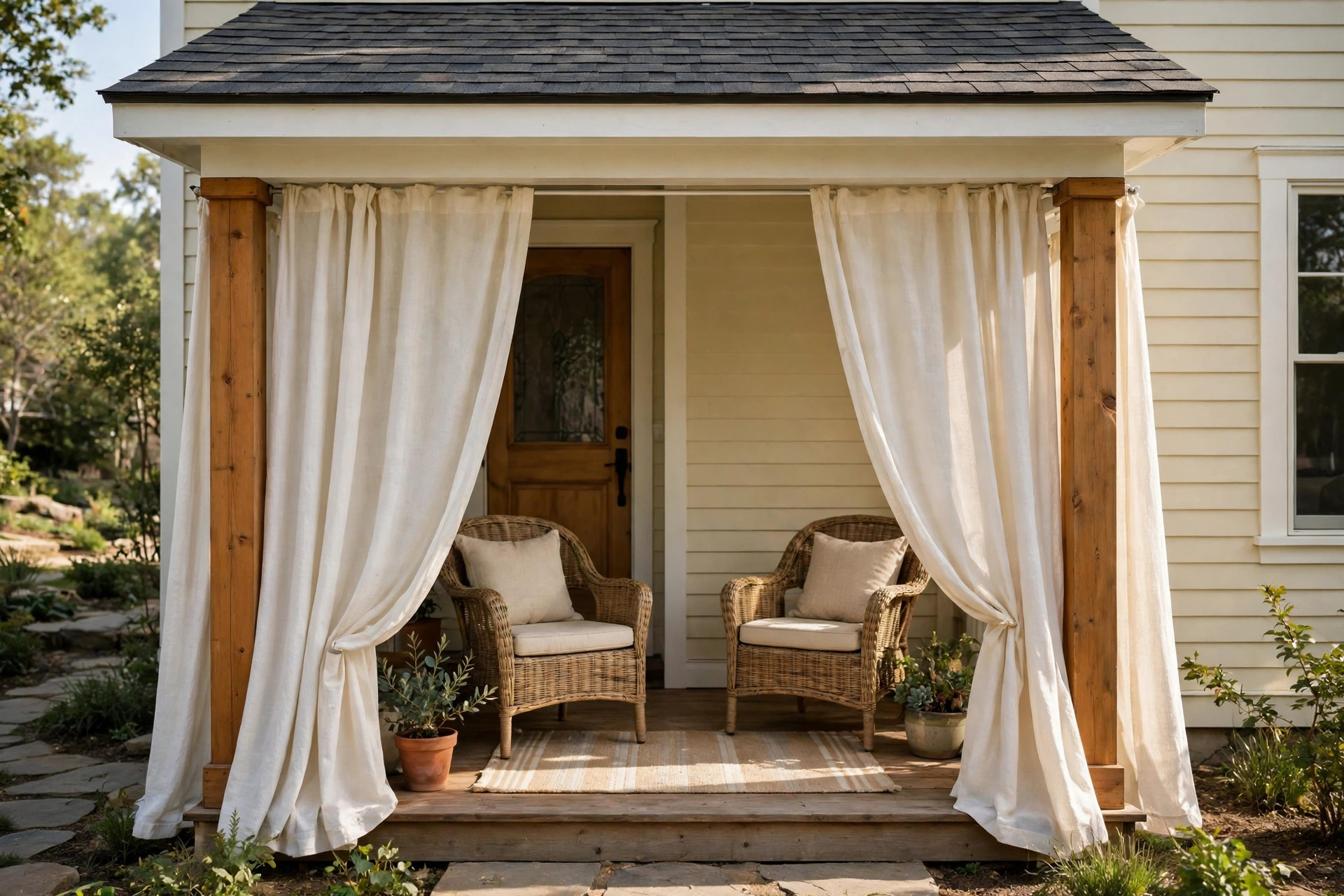
Before You Buy: Sizing, Fabric, and Cost Basics
Measure the opening, not the whole porch. Most small porches need cover on one open side, usually 6 to 10 feet wide. Note the width between posts and the height from where the rod will sit to the floor. Then follow this rule: total panel width should be 1.5 to 2 times the opening width. That fullness creates soft folds instead of a flat sheet. For a 72-inch opening, buy 108 to 144 inches of panel width in total — two 54-inch panels, two 72-inch panels with gentle fullness, or three 48-inch panels if wind is a problem and you want to open one section at a time.
Height is where small porches go wrong. Hang the rod as high as you sensibly can, just under the ceiling or beam, and let the panel end half an inch to one inch above the floor. An 84-inch panel suits a rod at about 7 feet. If your rod sits at 8 feet, choose 96-inch panels and hem or clip them up. Fabric that drags sits in puddles, wicks up dirt, gets heavy, and mildews from the bottom up. A clean clearance keeps the hem dry and lets air move underneath.
For fabric, remember two names. Solution-dyed acrylic is the premium choice: color runs through the fiber, so it resists fading for years, shrugs off mildew, and still feels like real cloth, at $30 to $55 per panel. Outdoor polyester is the workhorse most people buy — lighter, cheaper at $14 to $35 per panel, fast-drying, and good for two to four seasons in a decent weight. Avoid indoor cotton and linen-look panels. They absorb water, fade in weeks, and smell musty after the first wet spell. If a listing does not say fade-resistant and mildew-resistant, skip it.
Think about light in three levels. Sheer panels filter light and cut glare but give very little privacy, especially at night with a porch light on. Semi-opaque panels, the most common outdoor weight, block a clear view in daylight and give real shade. Blackout or triple-weave panels are for serious sun, such as a west-facing porch that bakes from mid-afternoon. They are heavier and need a stronger rod. Finally, budget for hardware too: tension rods $12 to $28, outdoor rods with brackets $22 to $45, clip rings $8 to $14 a pack, tiebacks $9 to $18 a pair, and hem weights $10 to $16. If you are working on shade more broadly, our guide to small patio shade ideas that actually cool the space down pairs well with curtains, because curtains work best as one layer in a simple shade plan.
12 Outdoor Curtain Ideas for a Small Porch
1. Classic Cream Panels on a Single High Rod
The safest starting point, and the look in most porch photos for a reason. Two cream or warm-white semi-opaque polyester panels, each 52 to 54 inches wide and 84 inches long, on one rod just under the beam will cover a 6- to 7-foot opening with pretty fullness. Cream reflects heat better than dark colors and hides dust and pollen. Choose grommet tops if you will slide them daily, because grommets glide without snagging. Cost: $35 to $70 for both panels, plus $22 to $40 for an outdoor rod. Screw brackets into posts or the header beam, not thin trim, and use stainless or coated screws so rust does not streak the post.
2. Sheer White Panels for Light Without the Glare
If your porch faces east, gets gentle morning sun, or looks onto your own garden, sheers may be all you need. They soften sunlight and move in a breeze, making a small porch feel bigger, not boxed in. Buy them wide — two 54- to 72-inch sheers for a 6-foot opening — because sheers look best with generous gathering. Be honest about the trade-off: almost no privacy after dark and only light shade at noon. Many owners layer a sheer behind a solid panel, sheers closed in the morning and solids pulled across later. Cost: $10 to $22 per panel, the cheapest idea here and a low-risk test.
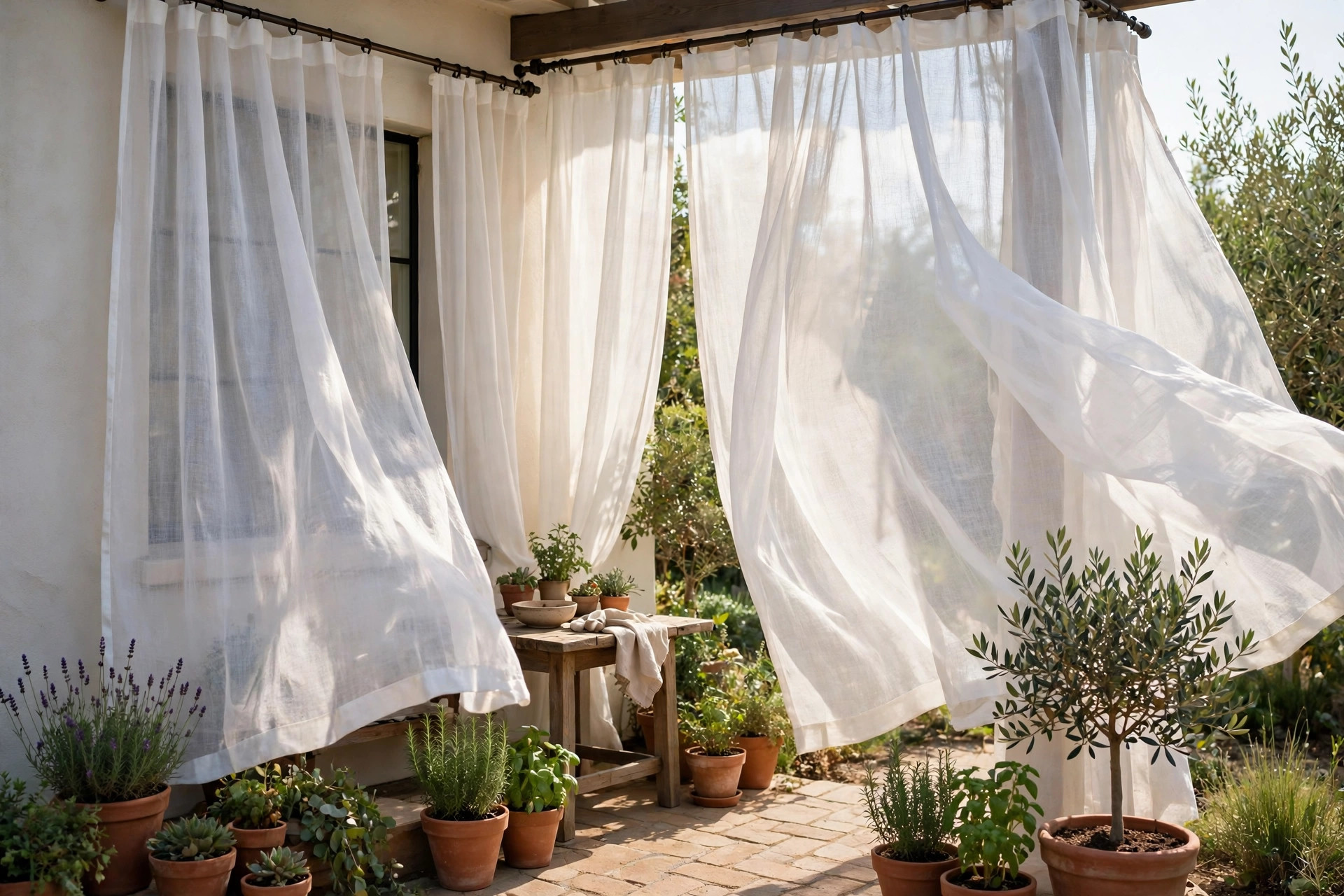
3. Tension Rod Panels With No Drilling at All
Renters, this one is yours. A heavy-duty tension rod wedged between two posts holds a surprising amount of fabric, with no holes and no tools beyond a level. Measure post to post carefully, buy a rod rated for that exact span, then go one strength level up, because outdoor fabric plus wind weighs more than a shower curtain. This works best with lightweight polyester or sheers, one or two 54-inch panels on spans up to about 7 feet. On wider spans over 8 feet a tension rod will bow, so split the run if a middle post exists. Cost: $12 to $28 for the rod and $20 to $45 for panels. For more small-space planning, see our small front porch seating ideas for when space is really tight, because curtain and chair placement have to work together.
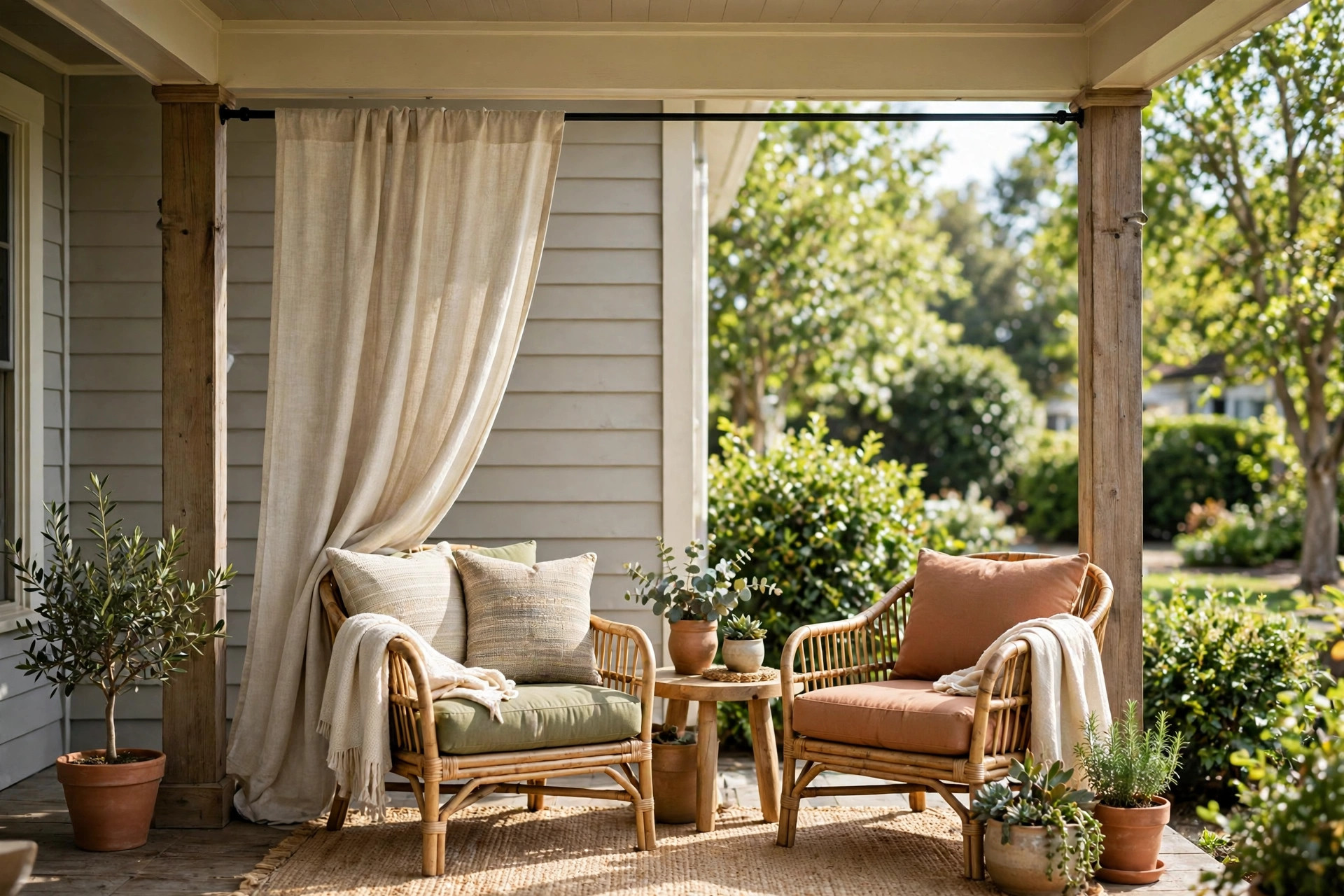
4. Blackout Panels for a West-Facing Porch That Bakes
Some porches do not have a glare problem, they have an oven problem. If sun hits yours straight on for three or more hours and the floor gets too hot for bare feet, step up to blackout or triple-weave panels. They cut the heat you feel dramatically and give complete privacy, which also suits a porch facing a busy street. Choose lighter outer colors — sand, light gray, soft sage — because a dark panel absorbs heat on its outer face even while it shades you. Hang them on a bracketed rod screwed into solid wood, never a tension rod, and leave a gap at one end so air still flows in the morning. Cost: $28 to $48 per panel.
5. Canvas Drop Cloths as Budget Panels That Look Expensive
The best-known budget trick, and it works because paint-aisle canvas drop cloths have a natural texture that reads like linen from six feet away. A 6-by-9-foot drop cloth costs $10 to $16 and makes one generous panel. Hang it with clip rings, no sewing needed: fold the top to your length and clip every 8 to 10 inches. Plain cotton canvas is not solution-dyed, so it fades slowly and needs outdoor fabric protector, about $10 a can, to resist mildew. Bring them in for the wettest months. In a covered porch, a set can look great for a season or two for under $40 total.
6. Tieback Panels That Frame the View Instead of Hiding It
Curtains do not have to close off the world. They can work like a picture frame. Hang a panel at each post, keep them tied back most of the time with rope, fabric, or magnetic tiebacks, and you get softness and structure with no loss of view or breeze. When sun swings round or neighbors settle out in the evening, release the ties and pull them across. This is also the most forgiving idea for sizing, because a tied-back panel looks good even if it is a little long. Use holdback hooks at waist height, or wrap tiebacks if you rent. Cost: a standard pair of panels, plus $9 to $18 for tiebacks in a material that can get wet.
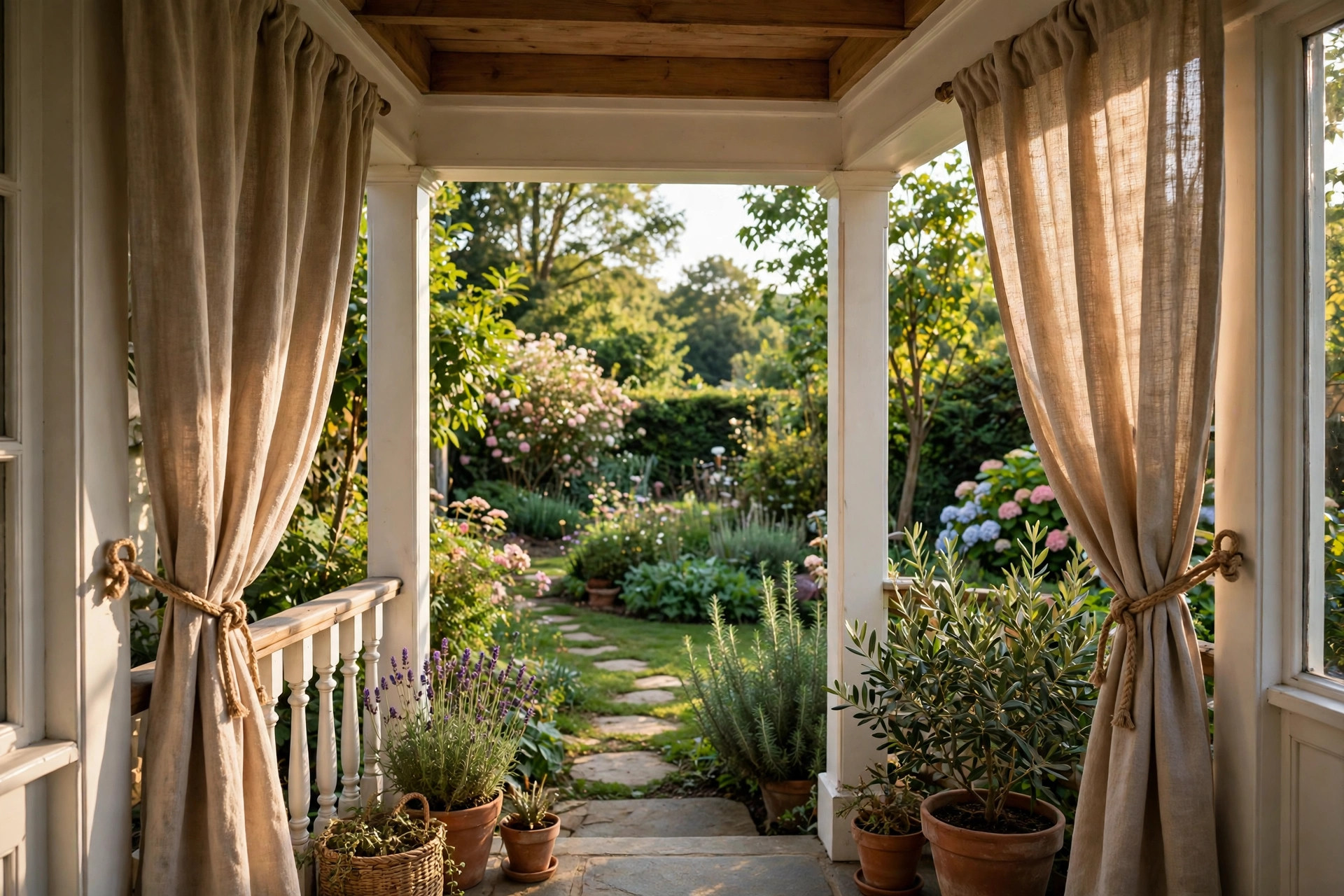
7. One-Side Curtain for Corners and L-Shaped Porches
Not every porch needs a wall of fabric. If sun and the sightline both come from one direction, a single run of panels on that side solves the problem and leaves the rest open. This is common on corner porches where the west side bakes but the front is shaded by a tree. Two panels on a 5- to 6-foot side are usually enough, and the cost is roughly half, often $30 to $60 all in. Sit in your usual chair at the time you actually use the porch, note where the sun lands and what you can see, and cover that slice well instead of wrapping the whole porch by habit.
8. Striped or Patterned Panels That Hide Real Life
Solid cream is beautiful for a week, then real life arrives: pollen, splash marks near the hem, a coffee drip. A classic outdoor stripe — navy and white, sage and cream — or a subtle tone-on-tone pattern hides all of that far better and adds the one bit of pattern a small porch can handle. Keep stripes medium, about 3 to 6 inches wide — tiny prints look frantic and very wide stripes overwhelm a small space. Patterned solution-dyed acrylic is worth the small premium here, since a faded stripe looks tired fast. Cost: $24 to $50 per panel. Pair with plain cushions and a plain rug.
9. Layered Curtains Over a Roller Shade or Screen
If you need different things at different hours, layer. A roller shade or mesh screen handles daily sun and bugs, and a curtain in front handles privacy and looks. At sunset, when low sun slides under most shades, the curtain does the work. This suits porches used for reading or a laptop, where glare is the enemy. It costs more — roughly $70 to $120 for a small opening — so treat it as the problem-solver, not the starter. Keep both layers on separate rods.
10. Clip-Ring Panels You Can Swap Through the Year
Clip rings are the most flexible method there is. With rings you can hang heavier panels in the hottest months, swap to sheers in milder weather, and take everything down in ten minutes before a storm or for washing. Rings also fix awkward lengths: clip higher or lower to adjust the hem without sewing. Space clips every 8 to 12 inches, use rust-resistant rings only, and plan on one pack of 12 to 14 rings per panel. Cost: $8 to $14 per pack, on top of any panels, including drop cloths with no rod pocket at all.
11. Weighted-Hem Panels for Porches That Catch the Wind
A curtain that whips, snaps, and wraps around a chair is worse than no curtain. If your porch catches a regular breeze, plan for wind from the start. Look for panels with a weighted hem, or add hem weights or a chain weight yourself for $10 to $16 a set. Weights keep the bottom hanging true without making the panel stiff. Combine them with tiebacks or a light cord run between posts at floor level that the hem tucks behind on very breezy days. Choose a mid-weight fabric rather than the lightest sheer, which sails the most, and consider two narrower panels instead of one wide one. Smaller panels move less and are easier to tie off.
12. Floor-Length Panels Paired With a Rug to Make a Real Room
Curtains make a porch feel like a room fastest when the floor is defined too. Panels hung high, a weatherproof rug under the chairs, and one small side table will read as an outdoor living room even in 50 square feet. Keep the rug smaller than the curtained area so the hem never sits on a damp rug edge. Our roundup of small patio outdoor rug ideas that hold up outside will help you match sizes, since an oversized rug pushes chairs into the curtain line. Cost: $25 to $60 for a 4-by-6 or 5-by-7 outdoor rug, plus your panels. Copy this idea if you entertain on the porch, because guests instantly understand where to sit.
Hanging Methods Compared: Which One Fits Your Porch?
A bracketed outdoor rod is strongest for daily sliding, costs $22 to $45, and needs screws into solid wood — best for heavy panels and wide openings. A tension rod costs $12 to $28, needs no holes, and suits renters and lightweight panels under about 7 feet, but can slip if undersized. Wire cable, $15 to $30, handles corners well, though panels bunch rather than glide. Clip rings work with almost any rod at $8 to $14 a pack. Adhesive hooks are fine for tiebacks and light sheers only, never a full wet panel in wind. For a deeper side-by-side, this overview of outdoor curtain ideas is a useful extra read before you order.
- Measure width and height twice, and write down the rod height, not just the floor height.
- Buy 1.5 to 2 times the opening width in total panel width for soft folds.
- Choose solution-dyed acrylic for longest fade life, or outdoor polyester for best value.
- Match the layer to the job: sheer for light, semi-opaque for privacy, blackout for hard sun.
- End panels half an inch to one inch above the floor, never in puddles.
- Add tiebacks and hem weights if your porch gets any regular breeze.
- Use rust-resistant rods, rings, and screws every time, with no indoor hardware.
- Keep all fabric well clear of heaters, grills, candles, and fire pits.
Wind, Rain, and Fire Safety: The Part People Skip
Wind is the top reason porch curtains get taken down for good. Open or tie panels back before a storm rather than leaving them closed and straining the rod. On breezy afternoons, gather panels to one post. Check brackets after the first few windy days, because small movements loosen screws early. If a panel keeps wrapping around furniture, it is usually too light, too wide, or missing hem weight — all fixable.
Rain is manageable if the hem stays clear of standing water. After a wet spell, open panels fully on the next dry day so folds do not stay damp. Wash outdoor polyester and acrylic with mild soap, rinse, and air dry on the rod. In harsh winter weather, take panels down, wash and dry them completely, and store them indoors in a breathable bag. Stored dry, a good set lasts several seasons. Stored damp, it will spot and smell.
Fire safety is non-negotiable and simple. Keep curtains well away from grills, patio heaters, fire pits, and candles. Fabric, even outdoor fabric, can catch or melt, and a breeze can push a panel toward a heat source you thought was far enough away. Never hang a panel where it can blow across a grill or heater, and tie panels back before you cook or light anything on the porch. Also keep panels clear of door swings, and tieback cords away from children and pets.
Common Mistakes That Make Small-Porch Curtains Disappoint
The most common mistake is buying panels too narrow, so they stretch flat, leak light at the sides, and give no privacy when a breeze lifts an edge. Second is hanging them too low and too long, with hems sitting in water. Third is choosing indoor fabric because the color was perfect, then watching it fade and mildew in one season. Fourth is a weak rod that bows and slips. Fifth is forgetting wind entirely, with no tiebacks and no weights. Sixth is covering every side at once in a dark color, turning a friendly porch into a dim box. Start with one side, a light color, and correct sizing. You can always add more.
The Bottom Line
For most small porches, the winning formula is reliable: two semi-opaque outdoor polyester or solution-dyed acrylic panels, each about 54 inches wide by 84 inches long, hung high on a rust-resistant rod, ending just above the floor, with tiebacks ready. Expect $50 to $95 for that setup, less with drop cloths or a tension rod, more with blackout fabric. Start with the side that gives you the worst sun or the clearest view in from next door, live with it for a week, then decide if you need more. Get fabric, height, and fullness right, and your porch becomes the private, shady room you wanted.


Comments
Post a Comment