
12 Small Bathroom Mirror Ideas That Double Light and Space
12 Small Bathroom Mirror Ideas That Double Light and Space
Small bathroom mirror ideas matter more than any other single choice in a compact bath — because in a tiny bathroom, the mirror isn't decoration, it's architecture. The right mirror bounces light into shadowy corners, visually doubles the square footage, and can even swallow your storage. These small bathroom mirror ideas cover the sizing rules, the placement rules, and 12 concrete setups, so the smallest bath in the house feels like the most considered one.
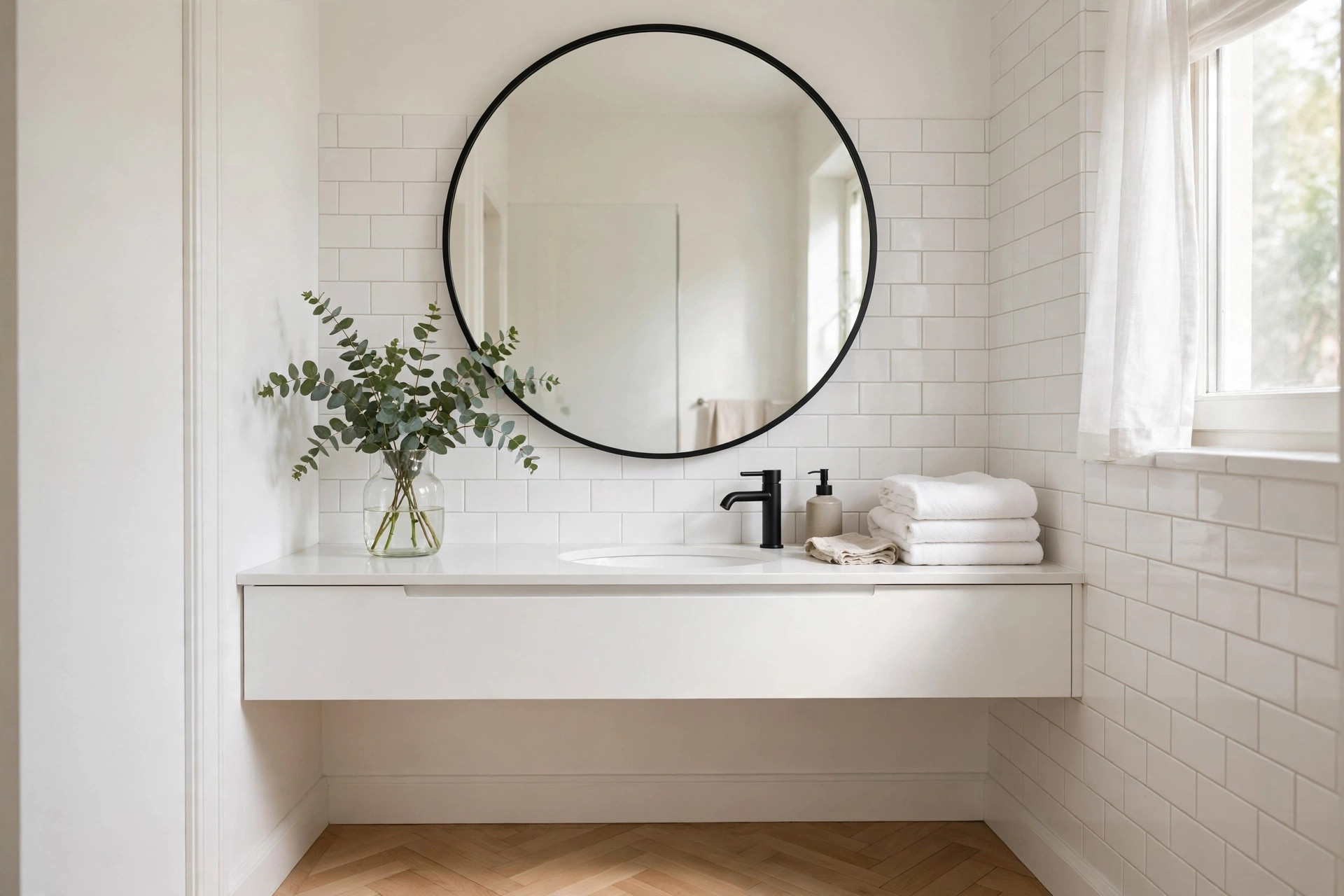
The Mirror Sizing Rules (Small Bathrooms Break the Normal Rules)
Forget "the mirror should match the vanity." In small bathrooms the rules invert — bigger is almost always better.
Width: size the mirror to 70 to 90 percent of the vanity width. A mirror that spans most of the wall above the sink reflects more light and reads as one continuous surface instead of a small object on a big wall.
Height: extend the mirror as close to the ceiling as looks right. Vertical expanse is what makes ceilings feel higher — a tall mirror is a cheap ceiling lift.
Center height: the mirror's center should sit at average eye level, about 57 to 60 inches from the floor. In a shared bath, cheat slightly toward the taller user; tilt/pivot options (idea 7) solve the rest.
Frame weight: frameless or ultra-thin frames keep small baths calm. A heavy ornate frame is fine exactly once per bathroom — as the statement (idea 12) — not on every mirror.
12 Small Bathroom Mirror Ideas
1. The Wall-to-Wall Mirror
Run one mirror across nearly the full width of the vanity wall, edge to edge. It erases the wall visually, doubles every light source in the room, and makes a 5-foot vanity wall read as 10 feet of space. Keep the frame frameless or pencil-thin so the glass reads as architecture, not decor. This is the single most transformative small bathroom mirror idea there is.
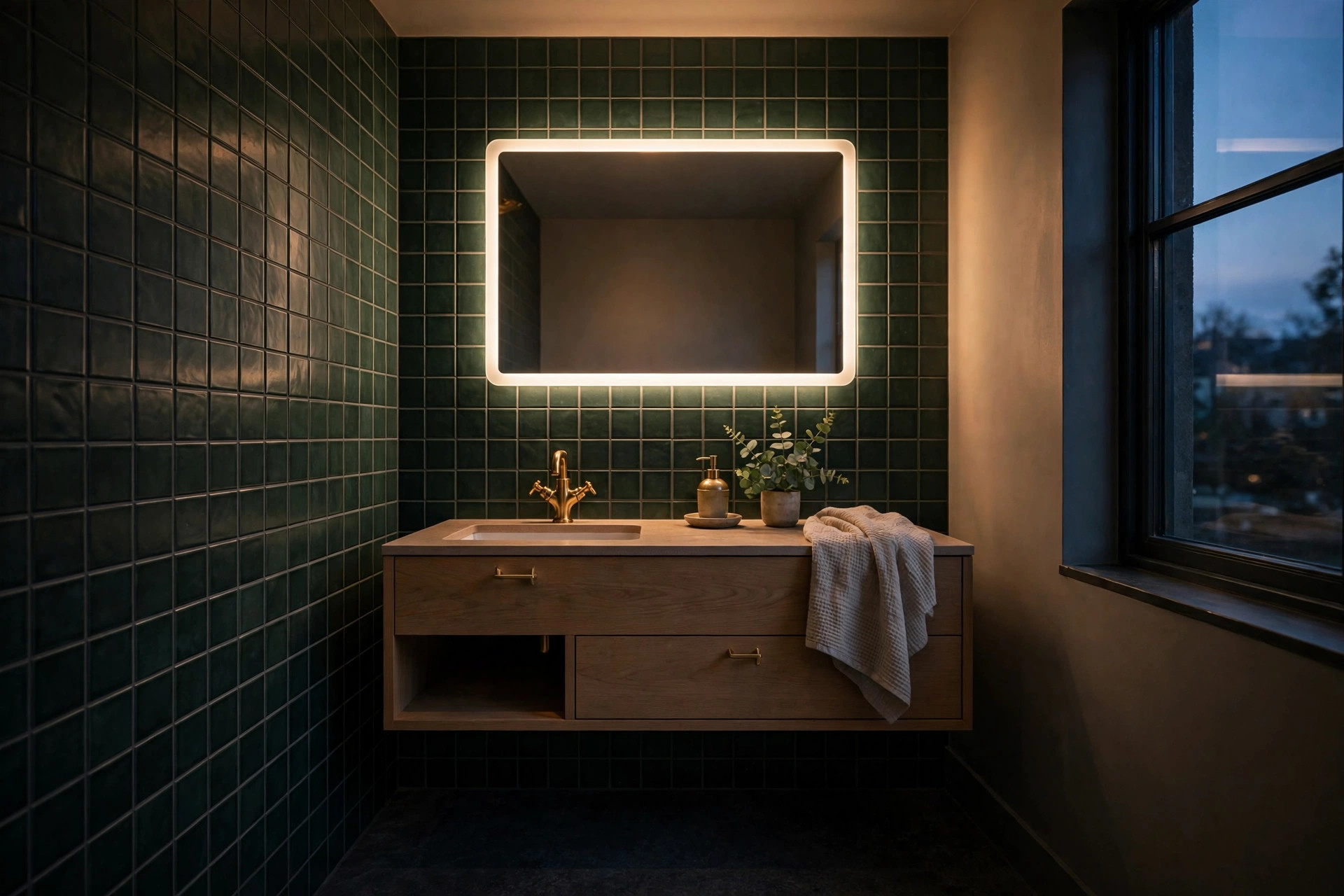
2. The Backlit LED Mirror
A mirror with integrated LED backlighting glows softly around its edges, washing the wall in light and eliminating the need for bulky sconces — precious inches saved on both sides. The even, shadow-free light is also the best grooming light short of a window: no harsh overhead shadows under the eyes. Choose 3000K for a flattering warm-neutral glow. It layers beautifully with the rest of the room's light plan — see our small bathroom lighting ideas for the full layering method.
3. The Round Softener
Bathrooms are all hard rectangles: tile grids, vanity boxes, shower doors. A large round mirror (30 to 36 inches) breaks every one of those lines with a single curve. It works in every style from modern to farmhouse, and the circle reads calm where a rectangular mirror reads utilitarian. Hang it to span 70-plus percent of the vanity width so it still follows the sizing rule.
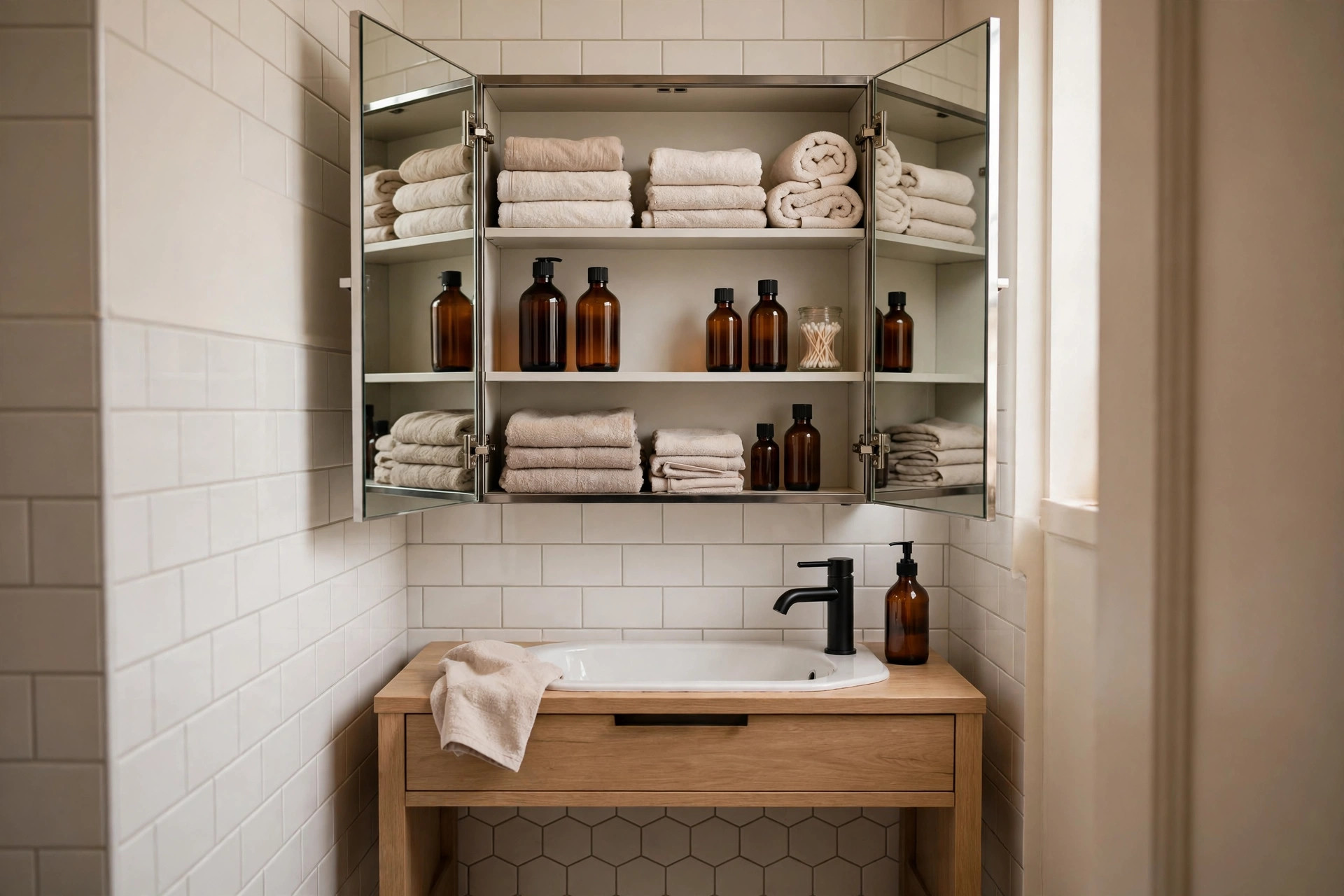
4. The Mirrored Medicine Cabinet
The hardest-working mirror in the small bathroom: a mirrored cabinet gives you full reflection plus hidden storage for the clutter that makes small baths feel smaller — medicines, toothbrushes, skincare. Recess it into the wall between studs and it protrudes barely 4 inches; surface-mount if you can't open the wall. Adjustable glass shelves inside keep tall bottles usable.
5. Double Mirrors Over a Single Sink
Who says one sink gets one mirror? Two smaller matching mirrors hung side by side over a single vanity create symmetry, rhythm, and a designer look — and the gap between them becomes a styling moment for a small sconce or a bud vase. The pair reads wider than one mirror of the same total width, so the wall feels broader.
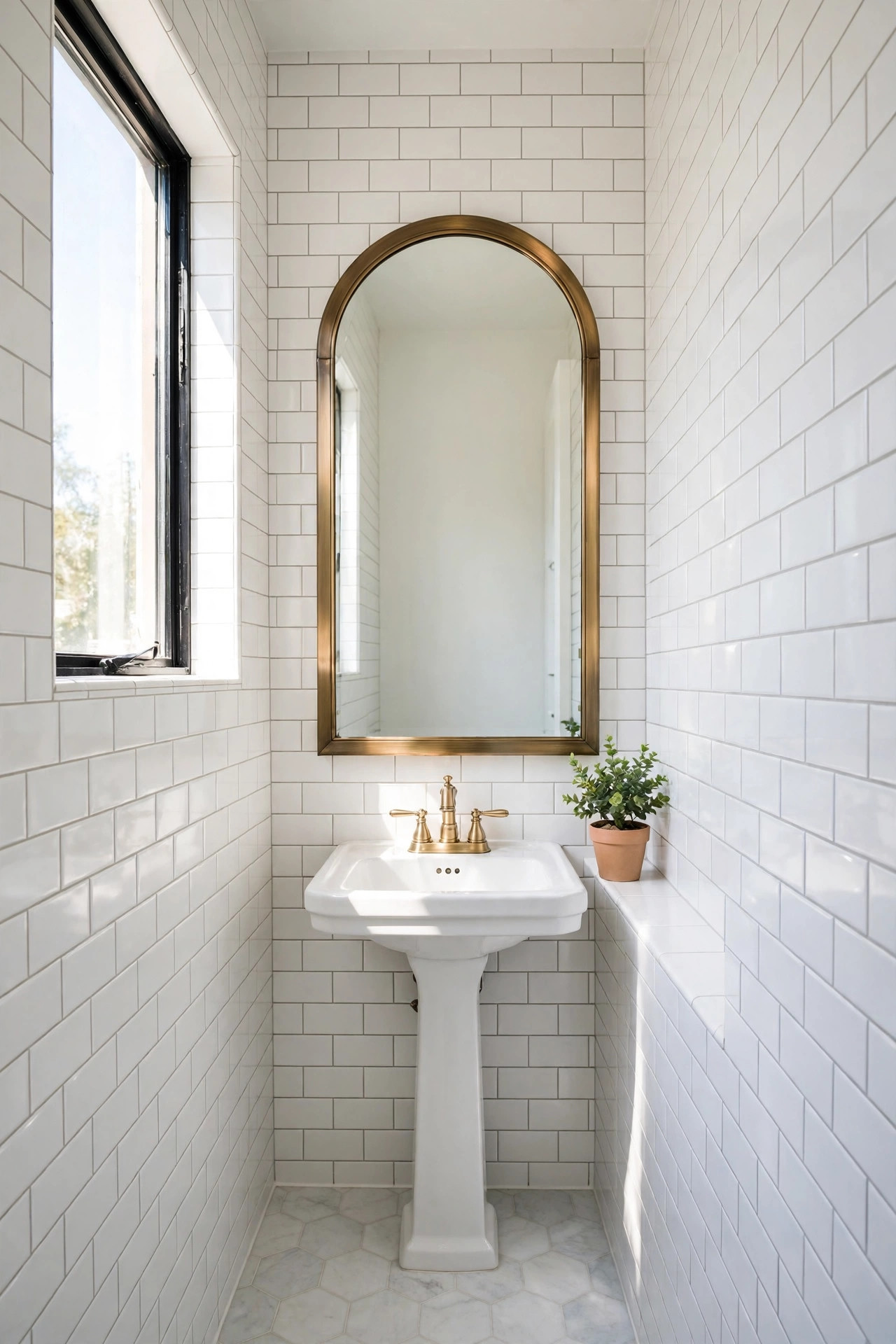
6. The Arched Mirror (Height Illusion)
A tall arched mirror draws the eye straight up, which is exactly what a low-ceilinged bath needs. The arch's curve also softens tile-heavy walls. Go as tall as the wall allows — an arch that nearly reaches the ceiling makes an 8-foot ceiling read as 9. Brushed brass frames are the current classic; black reads modern.
7. The Pivot Mirror (for Shared Baths)
When users differ by a foot in height, a pivot mirror on side brackets tilts to whoever's using it — no more tiptoeing or crouching. The hardware also reads as intentional design, especially in brass or matte black. Mount the brackets at the taller user's eye level; the tilt range covers everyone else. Forgiving on slightly uneven older walls, too.
8. The Tall Vertical Rectangle
A narrow, tall mirror (say 20 by 48 inches) hung vertically beside — not above — the vanity stretches the wall upward and fits where a wide mirror can't: the sliver of wall between the vanity and the shower, or a narrow powder room wall. It won't serve as the grooming mirror, but as the room's space illusion, it's unmatched per square inch.
9. The Corner Mirror
Corner-mounted or angled mirrors unlock reflection angles most layouts waste — especially in L-shaped baths or beside a vanity tucked into a corner. A small triangular or angled mirror in the corner catches light from two walls at once. Keep it simple and frameless; corners already have enough visual business.
10. The Mirror-plus-Shelf Layer
Run a slim floating shelf (3 to 4 inches deep, sealed against moisture) straight across the lower third of a large mirror. It holds the daily essentials — soap, a bud vase, the good hand towel — without touching the counter, and the shelf's reflection in the glass makes it look built in. Give the shelf a tiny raised lip so nothing slides off, and wipe splashes the way you'd wipe the mirror anyway. For styling the shelf itself, our bathroom shelf decor ideas keep it spa-like instead of cluttered.
11. The Anti-Fog Mirror
A heated demister pad behind the mirror (or a factory anti-fog mirror) keeps a clear oval in the steam after hot showers — no wiping, no streaks, no waiting. It's a small luxury that costs less than a dinner out and gets used every single day. Wire it to the light switch so it's on whenever the bathroom is.
12. The Vintage Statement Mirror
One ornate vintage mirror — gilt frame, beveled glass, real patina — above an otherwise simple vanity makes the whole bathroom feel designed. This is the one place the "thin frame" rule gets broken on purpose: the frame IS the decor. Keep everything else quiet (plain tiles, simple faucet) so the mirror owns the room. If the whole bath needs the budget treatment around it, our small bathroom makeover ideas on a budget show where the money goes furthest.
The Reflection Checklist (What Your Mirror Doubles)
Before finalizing placement, stand at the mirror and note what's behind you — that's what the mirror doubles. The winners: a window (second light source), a plant, beautiful tile, a styled shelf. The losers: the toilet, an open shower door, clutter, a blank wall. Angle or relocate until the mirror reflects something worth doubling. Never place a mirror where it catches direct glare from a bare bulb — diffused light flatters, bare bulbs blind.
Prices and installation numbers
What each mirror costs. Wall-to-wall frameless (idea 1): custom-cut plate glass runs about $10–$18 per square foot installed-ready — a 48×36-inch sheet lands around $120–$220; stock frameless mirrors are cheaper at $50–$110. Backlit LED (idea 2): $90–$250 at 24×32 to 32×40 inches, typically 25–45 watts with a built-in demister on better models. Round (idea 3): $45–$120 at 30–36 inches. Mirrored medicine cabinet (idea 4): $80–$200 surface-mount, $120–$300 recessed; interior depth is 4–5 inches, and recessing needs the standard 14½-inch clear bay between studs (16 inches on centre) — check for pipes and wires before cutting. Pivot (idea 7): $60–$150; brackets project the glass 2–3 inches off the wall. Anti-fog (idea 11): a stick-on demister pad alone is $25–$45 and draws roughly 12–25 watts; factory anti-fog mirrors start around $110. Vintage statement (idea 12): $20–$80 thrifted. Glass and weight. Bathroom mirrors are usually 4–6 mm (about 3/16–1/4 inch) glass; a 30×36-inch mirror weighs roughly 15–20 lb, a 36×48 about 25–30 lb — hang the big ones on two fixings into studs or rated anchors (30 lb+ each), never on a single adhesive hook. Leave a 1–2-inch gap between the mirror's bottom edge and the backsplash top so water cannot wick behind the glass and eat the silvering from the edge — the black-edge rot on old bathroom mirrors starts exactly there. Shelf layer (idea 10): that 3–4-inch shelf should be glass or sealed stone rated for the daily load it will actually carry — about 3–5 lb of bottles — and mounted into the mirror's frame line or the wall studs, not glued to the glass.
Small Bathroom Mirror FAQ
Should a small bathroom mirror be bigger than the vanity?
Not wider than the vanity — 70 to 90 percent of the vanity's width is the sweet spot. But it should be as tall as looks right, ideally reaching toward the ceiling. Width respects the vanity; height stretches the room.
Are LED mirrors worth it in a small bathroom?
Yes, for two reasons: they replace side sconces (saving wall inches on both sides of the mirror) and they give the most flattering, shadow-free grooming light available. Choose 3000K, dimmable if the budget allows.
How do I keep a bathroom mirror from fogging?
A heated demister pad behind the mirror is the permanent fix — it keeps the glass above dew point so steam never condenses. Short of that, improving ventilation (a properly sized exhaust fan run 20 minutes post-shower) cuts fogging dramatically.
In a small bathroom, the mirror is the one object that changes how big the room feels, how bright it is, and how calm it looks — all at once. Size it generously, place it to double light, and let it do the architectural heavy lifting. For more bathroom inspiration, browse our full Bathroom collection. Two solid second opinions: Homedecorably's small bathroom mirror tips run through the style options, and Coohom's small-space mirror guide covers the sizing logic from the designer side.


Comments
Post a Comment