
13 Small Bathroom Lighting Ideas That Make It Feel Bigger
13 Small Bathroom Lighting Ideas That Make It Feel Bigger
A small bathroom rarely needs more light. It needs light in more places. Most 5 x 8 foot bathrooms rely on a single overhead fixture, and that single source is exactly what makes the room feel small: it throws shadows down from your brow and chin at the mirror, leaves the corners dim, and flattens every surface into the same grey glare. Layering fixes that. Put modest light at three heights — ceiling, mirror, and one low or accent point — and the same 40 square feet suddenly reads as a room with depth instead of a closet with plumbing.
Start with the numbers, because they are simpler than fixture catalogs pretend. For a small bathroom of 40–50 square feet, aim for roughly 500–800 lumens of ambient light overall, then add dedicated task light at the mirror of about 1,000–1,600 lumens combined across its fixtures — enough to shave or apply makeup without leaning into the glass. Choose bulbs at 2700K–3000K, the warm range that flatters skin and tile alike, and look for a CRI (color rendering index) of 90 or higher so skin tones, makeup, and that supposedly white grout actually look like themselves. Below CRI 80, faces go slightly green-grey and you will blame your foundation instead of your bulbs. One more rule that prevents the most common mistake in this whole guide: every bulb in the room must share the same Kelvin temperature. A 2700K sconce beside a 4000K ceiling light does not average out — it just looks like two different rooms arguing. With those targets set, here are thirteen ways to build the layers, grouped by job, with real heights, spacings, and prices. Good small bathroom lighting design is mostly placement, not wattage — the thirteen ideas below are ordered by the job each layer has to do.
Layer One: Ambient Light That Fills the Room
1. A low-profile LED flush mount
The workhorse swap. Replace a dated dome or boob light with a slim LED flush mount 11–13 inches across, rated 1,000–1,500 lumens — in a small bath, that single fixture can carry the whole ambient target with headroom to dim. Look for models under 2 inches deep so the ceiling feels higher, not lower. Prices run $30–$80 for good integrated-LED models with CRI 90+. On an 8-foot ceiling in a 5 x 8 bath, this fixture alone, centered, eliminates the cave-corner problem that makes the room feel cramped. Choose a frosted diffuser, not a clear cover: exposed diodes at ceiling height create harsh sparkle on wet tile.
2. A semi-flush mount when the ceiling allows
If your ceiling is 9 feet or higher, a semi-flush mount that drops 4–6 inches adds a small note of architecture a flat disc cannot, and it throws light slightly sideways onto upper walls, which visually widens a narrow room. Keep the fixture diameter at or under 13 inches in a small bath — a 20-inch statement fixture in 40 square feet looks like a hat two sizes too big and crowds the mirror wall. Semi-flush fixtures with fabric or opal glass shades run $50–$140. Renters and low ceilings should skip this one and stay with idea 1.
3. Cove or ledge lighting for a ceiling that glows
The most flattering ambient trick of all: hide an LED strip on top of a shower ledge, a high shelf, or a simple piece of trim 6–8 inches below the ceiling, aimed up, so the ceiling itself becomes the light source. There are no shadows because there is no visible point of light. A 6–10 foot waterproof LED strip kit costs $20–$45, plus $10 for an aluminum channel that diffuses the dots into an even wash. This layer alone will not hit task brightness at the mirror, and it is not meant to — pair it with any sconce idea below. It is also the layer guests comment on, every time. What sits on that shelf matters too — our bathroom shelf decor ideas keep the styling calm enough not to fight the light.
4. A brighter, warmer bulb swap before you buy anything
Sometimes the fixture is fine and the bulb is the villain. If your current ceiling light takes a standard bulb, replace whatever cold 5000K bulb is in it with a 2700K–3000K LED at 800–1,100 lumens (the 60–75W equivalent), CRI 90+, for $4–$8. Do the same audit in any existing vanity fixture. This $15 total experiment tells you whether your problem is really fixture placement or just color temperature, and in about a third of small bathrooms, it is mostly the temperature. Match every bulb you touch to the same Kelvin in the same purchase, and keep the receipt: if one bulb in a multi-bulb fixture dies in two years, a spare from the same batch saves you a mismatched replacement.
Layer Two: Task Light at the Mirror — Where Size Is Won or Lost
5. Two sconces flanking the mirror (the gold standard)
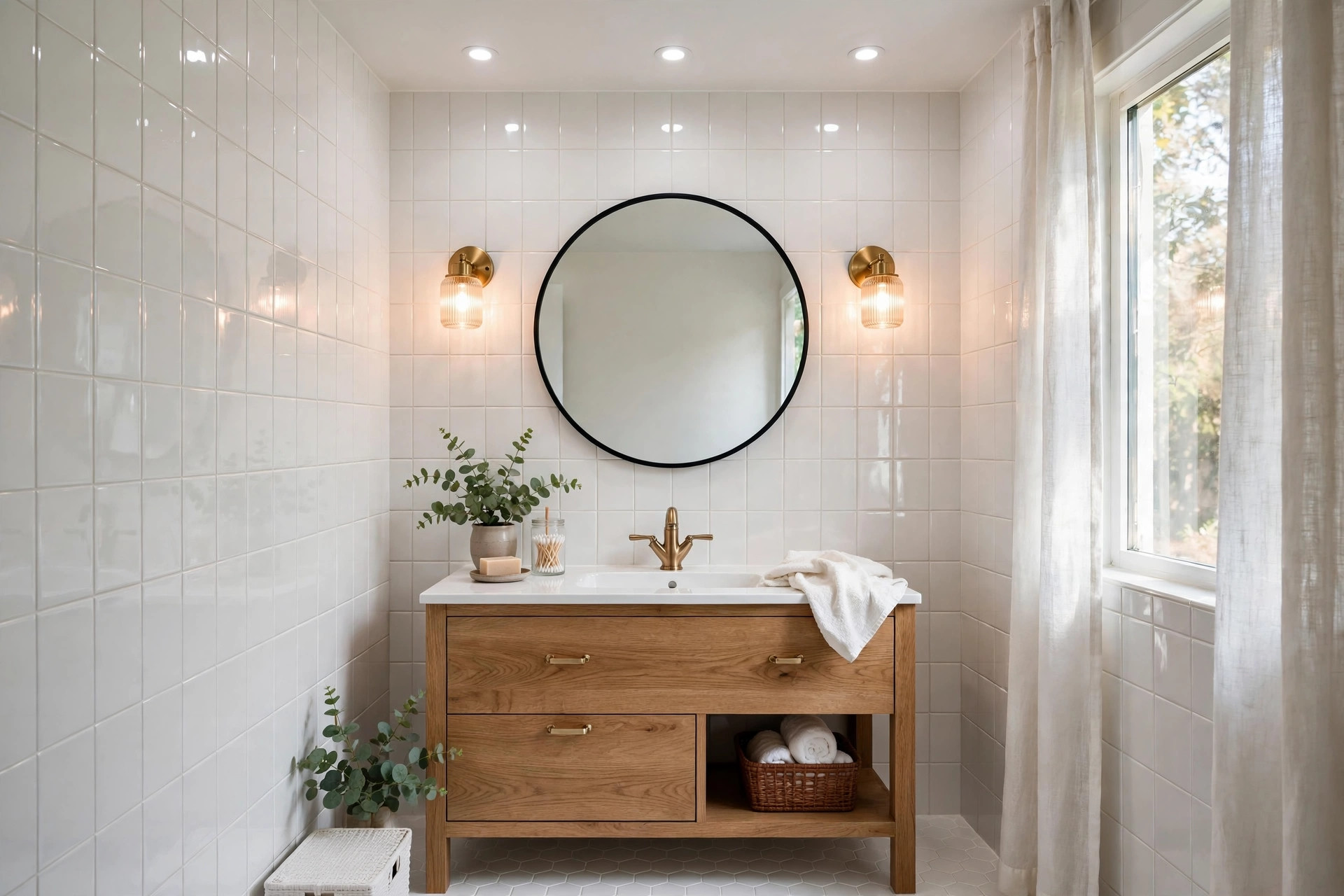
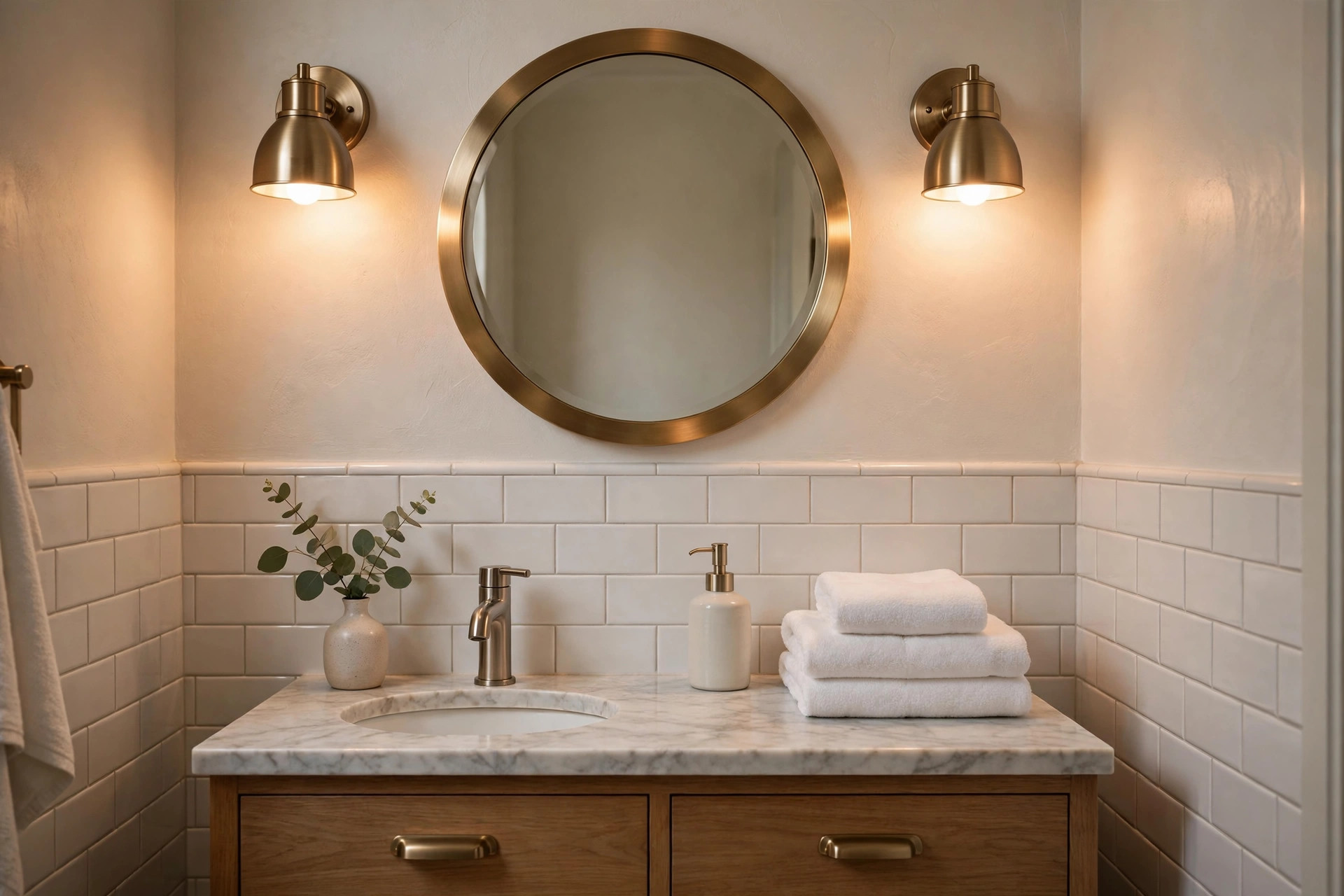
This is the single change professionals name first. Mount one sconce on each side of the mirror so light hits your face from both sides at once and cross-shadows cancel out. The measurements matter: sconce centers at 60–66 inches from the floor (roughly eye level), spaced 36–40 inches apart, and ideally 4–6 inches out from the mirror's edges rather than tight against the frame. Each sconce should deliver 400–800 lumens — so a pair lands in that 1,000–1,600 task range together — behind frosted or opal shades, never bare bulbs at eye height. Decent hardwired sconces run $35–$90 each. If your mirror is wider than 36 inches, keep the 36–40 inch spacing centered on the sink rather than spreading sconces to the mirror's outer edges, because the light belongs on your face, not the wall. For finish ideas that work with this exact setup, the brass tones in these brass bathroom decor ideas show how warm metals keep warm light looking intentional instead of yellow.
6. A vanity bar above the mirror, mounted at the right height
When side walls or a wide mirror leave no room for flanking sconces, a bar above the mirror is the fallback — but mount it at 75–78 inches from the floor, not hugging the ceiling or sitting just above the frame, and choose a fixture that points down or has shades that wash light both down and out. A bar mounted too high recreates the overhead-shadow problem in miniature: bright forehead, shadowed eyes. A 24-inch three-light bar costs $45–$110; a 36-inch four-light version runs $70–$150. Use bulbs totaling 1,200–1,600 lumens and frosted globes. In a powder-room-sized bath under 35 square feet, a two-light bar at the lower end of that height range is plenty.
7. An LED backlit mirror
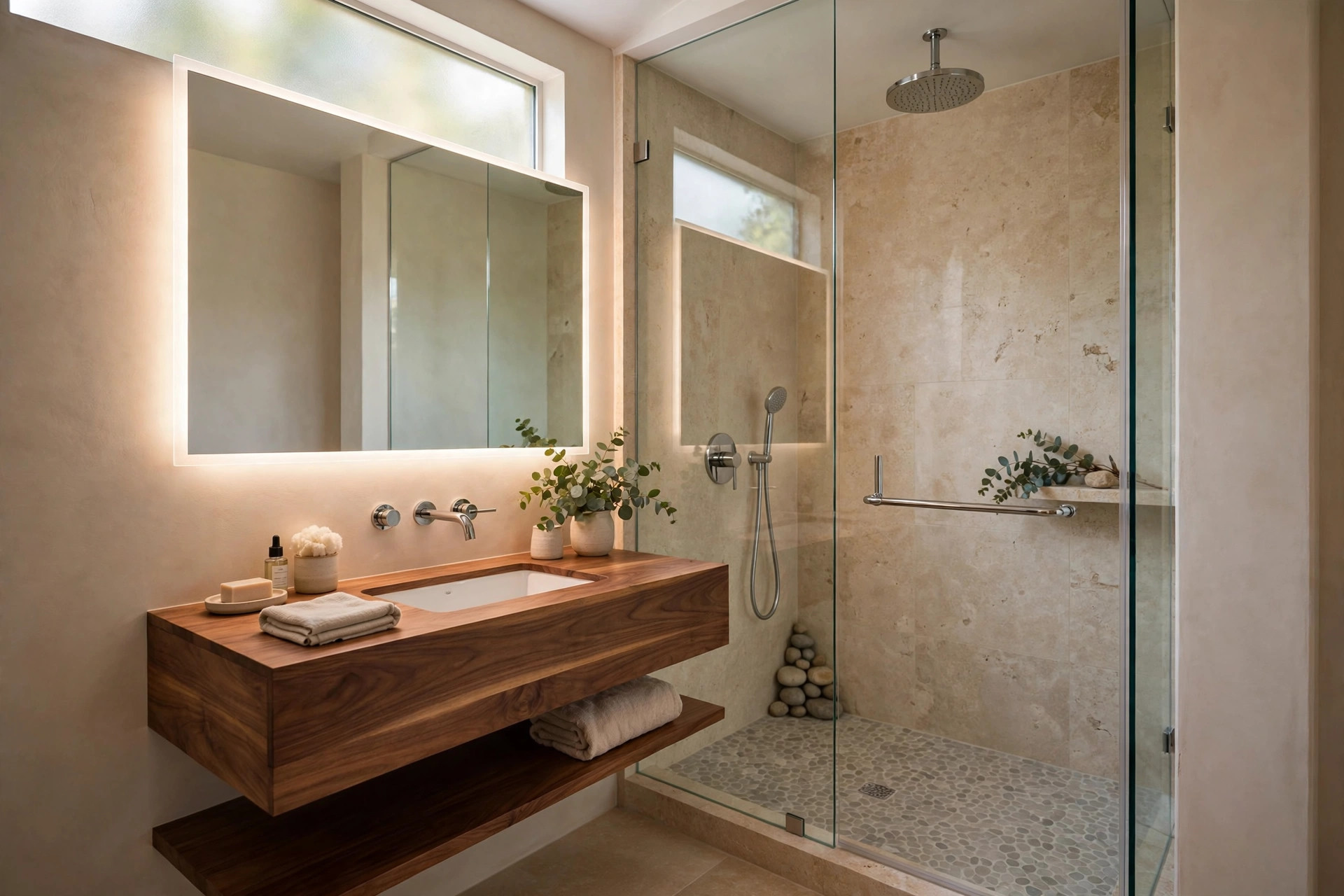
A mirror with a built-in LED perimeter does two jobs in the depth of one: the glow washes the wall behind it, which makes the mirror plane seem to float and the wall recede, and the front light is diffuse enough to be genuinely flattering. Common small-bath sizes are 24 x 32 and 28 x 36 inches, priced $120–$300 for reputable models with defogging pads and dimming. Check three specs before buying: color temperature adjustable or fixed at 3000K (some are locked at a clinical 6000K — avoid), CRI 90+, and a hardwired or plug-in setup that matches what your wall actually offers. Pair it with a modest ceiling fixture only; a backlit mirror plus bright sconces is over-lighting, and the room will feel like an operating theater.
8. A lighted magnifying mirror as a second task source
For makeup, contact lenses, and detail shaving, a small lighted magnifying mirror — 5x or 7x magnification, 7–8 inches across — mounted on an extending arm or standing on the counter adds precision light exactly where the big fixtures cannot focus. Wall-mounted versions run $40–$90; countertop rechargeable models cost $25–$60 and suit renters. Treat it as a supplement, not the main task light: magnification distorts your sense of how makeup will look at normal distance, so finish with a step back and a check in the main mirror under your flanking sconces. This idea pairs naturally with the mirror shapes and placement rules in this guide to small bathroom mirror ideas that make the space feel larger — the mirror and its light should always be planned together, not bought months apart.
Layer Three: Accent and Renter-Friendly Light
9. Battery picture light above the mirror or art
A slim battery-powered picture light, 12–16 inches long, mounted above the mirror or over a small framed print, adds a warm horizontal glow that widens the wall visually and needs no electrician and no wiring at all. Most models cost $25–$55, run 30–60 hours per charge or battery set, and include a remote with a timer. Output is modest — 150–300 lumens — so this is pure accent, never a task source. Rechargeable USB models beat battery-eaters over a year. In a rental, this plus idea 11 below can transform a bathroom without touching a single wire.
10. Plug-in sconces with cord covers
The renter's answer to idea 5: plug-in sconces that mount with two screws (or, in some designs, heavy-duty adhesive rated for painted drywall) and plug into the outlet by the sink, cords tidied with a paintable cord cover for $6. You get true flanking light at the correct 60–66 inch height without opening a wall. Plug-in sconces run $30–$75 each. Two honest watch-outs: the plug must land in a GFCI-protected outlet, which bathroom outlets should already be — test yours with the outlet's own test button before relying on it — and cord covers look clean only if you actually paint them to match the wall.
11. Smart bulbs for scenes you will actually use
One or two smart bulbs ($10–$18 each) in your existing fixtures buy you dimming and warmth-shifting without a dimmer switch install. The genuinely useful bathroom scenes are boring ones: 100% bright warm light for cleaning and makeup, 40% for an evening bath, and a 10% amber night-light level that lets a 3 a.m. trip happen without fully waking you. Set the color range to stay within 2700K–3000K so a helpful household member cannot accidentally scene the bathroom to nightclub blue. Voice control is a bonus; the schedule and the dimming are the point.
12. Under-vanity and toe-kick lighting
A waterproof LED strip under a floating vanity or along the toe-kick of a built-in one, on a motion sensor, does three things at once: it makes the vanity appear to float, which adds perceived floor area; it lights the floor path at night without the main lights; and it gives the room a low, calm layer that makes ceiling light feel less stark by contrast. Kits cost $15–$35, install with adhesive in 20 minutes, and the motion sensor means it costs almost nothing to run. Keep the strip recessed at least 1 inch back from the vanity's front edge so you see the glow, never the diodes themselves.
13. A small warm lamp or candlelight alternative on the counter
Counter space in a small bath is precious, so this idea earns its place only if you have a corner of vanity at least 8 inches deep: a mini cordless rechargeable lamp, 8–10 inches tall, with a warm 2700K setting, costs $20–$40 and turns bath time into something that feels like a soak rather than a wash. The flameless version of candlelight — real-wax LED candles at $12–$18 for three — gives the same low flicker with none of the risk near towels. Either way, keep this layer's job clear in your mind: it exists for mood and for making the room feel furnished, the way a lamp makes a living room feel finished, and it pairs beautifully with the textile and scent layers in these cozy fall bathroom decor ideas for small spaces. Of all small bathroom lamps, a mini cordless rechargeable lamp earns its counter space only if it also works as the room's evening mood layer.
Wet-Zone Safety and the Mistakes That Shrink a Room
Light near water has rules that are not optional. Any fixture inside the shower enclosure or directly above a tub should be rated for wet locations, and look for an IP44 rating or better — the first 4 means it resists splashing from any direction — for anything within the shower and tub zones. Fixtures elsewhere in the room can be damp-rated, which covers steam and occasional splashes. All bathroom outlets should be GFCI-protected; if yours are not, that electrician visit outranks every decorative idea in this article. When in doubt about what your local code requires for a hardwired change, a licensed electrician's one-hour consult ($75–$150 in most areas) is cheap insurance, and most sconce and flush-mount swaps in existing boxes are straightforward work.
One planning habit ties all three layers together: sketch the room's light on paper before you spend anything. Mark the ceiling source, the two points at the mirror, and the one low accent, then check the sketch against how you actually move through the room at 6 a.m. and at night. If all your light still comes from one side, the sketch shows it instantly. Buy in layer order — task light first, because it changes how the room works every day, ambient second, accent last — and test each layer at night with the others off. That ten-minute check costs nothing and regularly saves people from buying a second ceiling fixture they never needed, or sconces two inches too high that cannot be moved once the holes are drilled.
Finally, the three mistakes that undo good fixtures. First, mixing Kelvin temperatures — audited above, repeated here because it is the most common: one leftover 5000K bulb in a warm room will draw your eye every single morning. Second, oversizing: in a 5 x 8 foot bath, keep ceiling fixtures at 13 inches or under, sconce shades at 6 inches or under, and mirrors no wider than the vanity. A fixture that is technically beautiful but scaled for a primary suite makes a small room feel smaller by comparison. Third, glare at eye level: exposed-bulb and clear-glass fixtures are everywhere in catalogs and miserable at a mirror, throwing point glare exactly where your eyes are. Frosted, opal, or shaded every time at face height; save the exposed filament look for a pendant over a dining table. Get the layers right — 500–800 ambient lumens, real flanking task light at 60–66 inches, one low warm accent — and your bathroom will not just photograph bigger. At 6 a.m., half awake, it will simply feel like a better room.
Small Bathroom Lighting: FAQ
What is the best lighting for a small bathroom?
Layered light, not one bright fixture: 500–800 lumens of ambient light, dedicated task light at the mirror of about 1,000–1,600 lumens combined, and one low accent layer. Keep every bulb at 2700K–3000K with a CRI of 90 or higher, and never mix Kelvin temperatures in the same room.
Where should small bathroom light fixtures be placed?
Flanking sconces are the gold standard: centers at 60–66 inches from the floor, spaced 36–40 inches apart, 4–6 inches out from the mirror's edges. A bar above the mirror should sit at 75–78 inches. Keep ceiling fixtures at 13 inches across or under in a 5 x 8 foot bath.
Are LED lamps safe in a small bathroom?
Yes, with the right rating: fixtures inside the shower or above a tub need a wet-location rating of IP44 or better, other fixtures can be damp-rated, and all bathroom outlets should be GFCI-protected. Small rechargeable lamps on the counter (idea 13) stay outside the wet zones.


Comments
Post a Comment