
12 Small Bedroom Over-Door Storage Ideas That Free the Floor
Every small bedroom has one storage surface that almost nobody uses: the back of the door. It is a full-height panel, roughly 15 square feet of vertical space, and in most rooms it holds nothing at all. The best small bedroom over door storage ideas turn that forgotten panel — and the narrow strip of wall above the door frame — into organised storage for the small, daily things that otherwise pile up on chairs, dressers and the floor. No drilling, no new furniture, no floor space lost.
You do not need a bigger wardrobe or another storage box in the corner. You need to match the right door system to the right items: light, flat, frequently used things belong on the door, and heavy or bulky things do not. Below are twelve ideas with real sizes, door measurements, costs and watch-outs, so your door works harder without sagging, rattling or refusing to close.
Before you hang anything, be honest about where your clutter actually lives. If your drawers are the main disaster, start with our guide to small bedroom dresser organization ideas first — door storage works best as the second layer, catching the daily items that never quite make it into a drawer.
Measure First: Door Thickness, Clearance and the Light-Load Rule
Rule one: measure your door before you buy anything. A standard interior door is 1-3/8 inches thick (about 35 mm), while an exterior-style door is 1-3/4 inches. Over-door hooks are sold in both sizes, and a hook made for the thicker door will wobble and rattle on the thinner one. Measure the thickness at the top edge with a tape, and also check the gap between the top of the door and the frame: slim flat hooks need only a few millimetres, but bulky padded hooks can stop the door closing altogether.
Rule two: keep the load light. A bedroom door hangs on two or three small hinges that were never designed to carry a wardrobe. Door storage guides such as Buildify on brilliant small bedroom organization ideas and storage roundups like The Modern Home Journal on small bedroom storage ideas agree on the same fundamentals: the door is for scarves, belts, bags, accessories and tomorrow's outfit — not for books, shoes by the dozen, or anything with real weight. As a working limit, keep the total load on one door under about 10 pounds (roughly 4.5 kg) spread across the hooks, and hang the heaviest item nearest the hinge side.
Rule three: silence and clearance. Metal hooks on a hollow-core door will rattle every time it moves unless you add the small felt or foam pads most racks include — fit them where the rack meets the door before you hang a single item. Then open and close the door through its full swing with the organiser empty: if a pocket organiser swings into the wall or the hooks kiss the frame, fix it now, not after it is full.
12 Small Bedroom Over Door Storage Ideas That Free the Floor
Work in order: measure the door, pick the system that matches your clutter, then assign every hook and pocket a job before you hang it. Most of these ideas cost between $8 and $25, and every one of them is renter-friendly.
1. Start With a Clear-Pocket Organiser, the Hardest-Working $15 in the Room
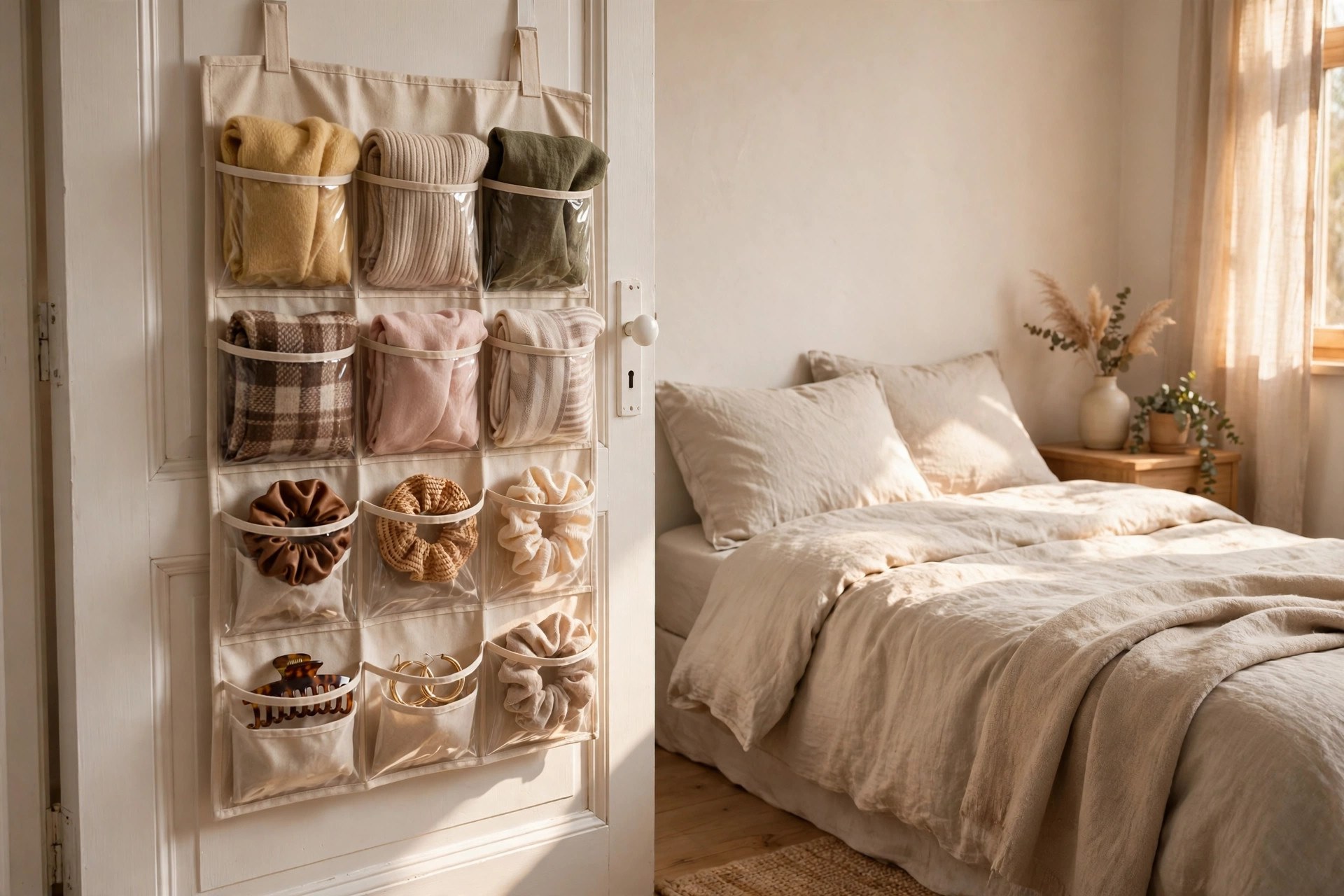
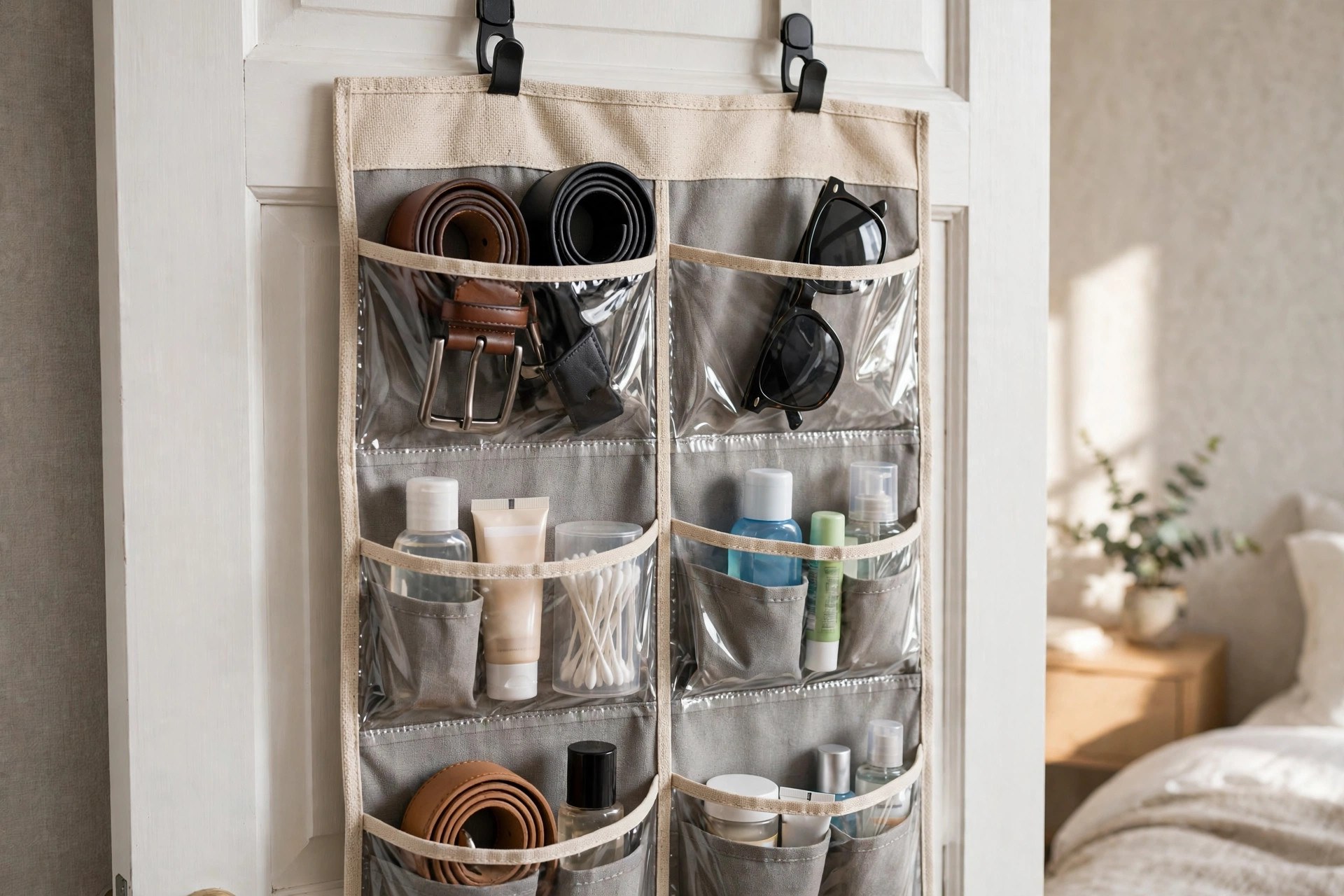
The classic clear-pocket shoe organiser is the single best door purchase for a small bedroom — as long as you ignore the word shoe. A standard organiser is about 15 to 16 inches wide and 54 to 65 inches long, with 20 to 24 clear pockets, and it hooks over any standard door with zero installation. Fill the pockets with the small things that colonise every flat surface: scarves, belts, sunglasses, charging cables, hair accessories, gloves, small toiletries and rolled underwear or socks. Because the pockets are clear, everything is visible at a glance, which is exactly what a drawer never gives you. These organisers cost about $10 to $20. Watch-out: keep heavy bottles out of the bottom pockets, where their swing weight strains the hooks most, and do not overload the top row — a sagging organiser that bows away from the door will catch on the frame.
2. Hang a Simple Hook Rail for Tomorrow's Outfit and the Robe
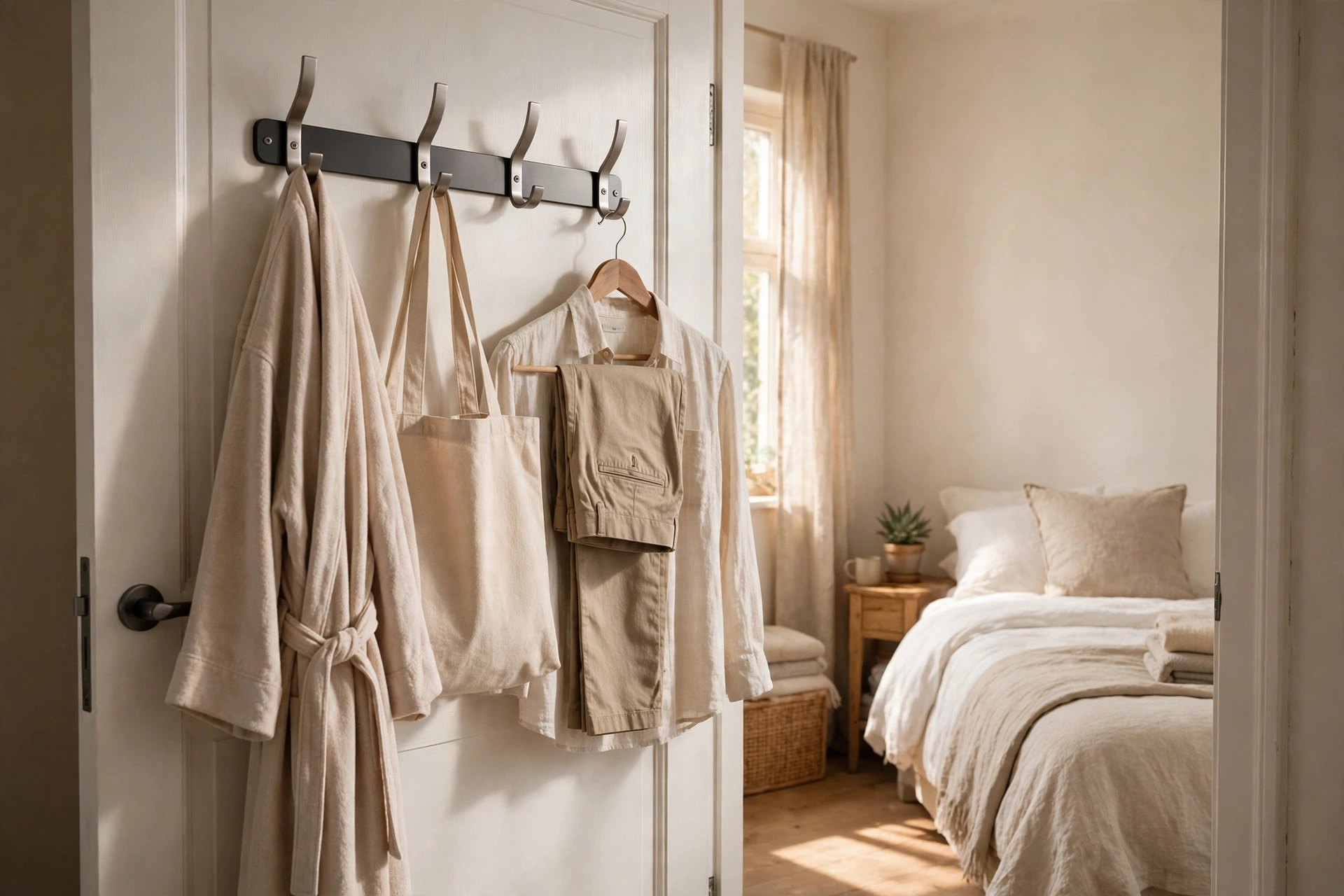
If your bedroom has a chair that exists only to hold clothes, a hook rail is the cure. A basic over-door hook rail with four to six hooks costs from about $8 to $25 — simple individual over-door hooks start even lower, around £6 in UK high-street examples — and it gives every daily item a landing place: the robe, tomorrow's outfit on a hanger, the bag you use every day, a hat. Limit it to four or five items total. A door carrying a week's worth of outfits looks worse than the chair did and overloads the hinges. Place the rail on the bedroom door itself rather than the closet door, so the outfit is where you dress. Watch-out: hang items on the room side, not the hallway side, and check that a loaded hanger does not swing against the wall when the door opens fully.
3. Use the Back of the Closet Door for Accessories and Cables
The closet door is the door everyone forgets, because it spends half its life open against a wall. Its inside face is perfect for a second, slimmer organiser dedicated to one category only: belts and scarves, or the cable-and-charger tangle, or jewellery in a hanging pocket organiser with small clear compartments. Single-category doors stay tidy; mixed doors become junk drawers that stand up. A slim fabric organiser about 13 inches wide suits narrower closet doors and bifold doors where a full-width organiser would foul the fold. Cost is about $10 to $18. This pairs naturally with a full sort-out using our small bedroom closet organization ideas — the door holds the small accessories, the closet holds the clothes. Watch-out: on bifold doors, use adhesive or screw-free slim organisers only in the centre panel, and test the fold before loading it.
4. Add a Shelf Above the Door for the Things You Rarely Touch
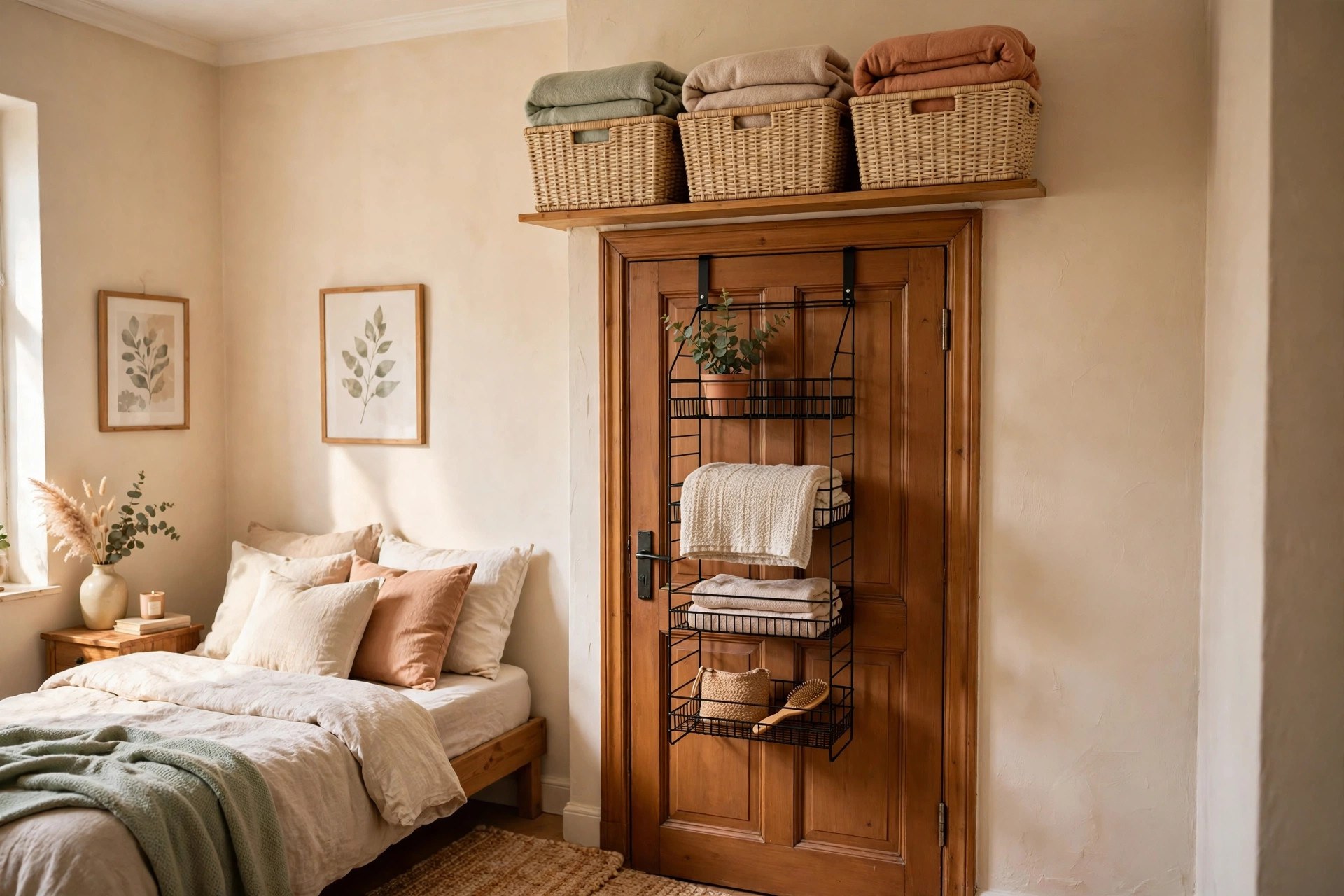
The strip of wall above the door frame is the most ignored storage in the room, and for seasonal or rarely used items it is ideal. One shelf, cut to the width of the door plus a few inches each side and mounted into studs above the frame, holds two or three matching baskets: spare blankets, off-season hats and gloves, the gift-wrap roll, keepsakes. Because it is above eye level and hard to reach, visual calm matters — matching closed baskets in one colour read as architecture, while a jumble of visible objects reads as clutter stored in the sky. A basic shelf and brackets cost about $15 to $30. Watch-out: this shelf is for light, occasional items only, never books or anything you would not want falling from height, and step-stool access should be occasional, not daily.
5. Fit a Hanging Shelf Rack When You Need Real Shelves, Not Pockets
Some things do not belong in pockets: folded knitwear, a small handbag collection, shoe boxes, a stack of caps. A hanging shelf rack — a metal frame that hooks over the door and carries three to five narrow shelves, usually about 12 inches deep in total profile — turns the door into a slim bookcase. Typical units are around 17 to 19 inches wide and 60 to 70 inches tall, and cost about $25 to $45, the most expensive idea on this list but still cheaper than any furniture. Keep shelves to folded soft items and light boxes, heaviest shelf at the bottom. Watch-out: a loaded shelf rack makes the door noticeably heavier to swing; fit the anti-sway pads, keep the total under that 10-pound working limit where you can, and never fit one to a flimsy hollow door that flexes when you press it.
6. Turn One Pocket Row Into a Getting-Ready Station
Steal the top two rows of a clear-pocket organiser and give them a single morning job: the watch, the ring dish alternative, sunscreen, lip balm, hair ties, the lint roller, a small mirror on a hook beside them. In a bedroom without a vanity, this two-row station replaces the nightstand sprawl and puts everything at eye height where you actually get ready. It works because it is limited — two rows, one category, nothing else allowed in. Refill and tidy it weekly when you do laundry, or it will quietly become a junk row like every other. Cost: nothing beyond the organiser you already bought for idea one. Watch-out: keep anything liquid in the lower of the two rows, so a leak never drips onto the items — or the outfit — below it.
7. Hang a Lightweight Laundry Bag and Kill the Floor Pile
A hanging laundry bag on two over-door hooks holds a surprising amount — most are about 15 inches wide and 30 inches tall, roughly a week's worth of light laundry for one person — and it lifts the most demoralising pile in a small bedroom completely off the floor. Choose one with a zip or drawstring bottom or a wide top opening you can toss into without aiming, and a washable fabric you can throw in with the load. Hanging bags cost about $10 to $18. Place it on the back of the bedroom door or the closet door, near where you actually undress, because a laundry system that requires a walk will be ignored by Friday. Watch-out: wet towels are heavy — a soaked towel or two can double the bag's weight, so heavy damp items still belong on a rail or radiator, not the door bag.
8. Give Shoes One Slim Row, Not the Whole Door
Shoes can live on a door, but only under discipline. A hanging shoe organiser filled with twenty pairs of shoes is the fastest way to overload hinges and make a door groan. Instead, dedicate one slim over-door shoe rack — the rail type that holds shoes horizontally, usually four to six pairs across two or three tiers — to the pairs you wear daily, and send the rest under the bed using our under-bed storage ideas for small bedrooms, where weight does not matter. Rail-type door racks cost about $15 to $30 and hold shoes more accessibly than deep pockets. Choose pairs with clean soles only, and put the rack low enough that you are not lifting shoes above shoulder height daily. Watch-out: heels catch in pocket organisers and stretch them out of shape; the rail type is the right door home for anything with a heel.
9. Use Single Hooks as a Bag and Hat Gallery That Earns Its Look
Individual over-door hooks — the single-hook kind that slide over the top edge — let you space storage exactly where the wall of the door is free, and a row of three at staggered heights makes a deliberate display of the bags and hats you use most: the everyday tote, the gym bag, a cap or two. Because each hook is independent, you can place one high for a long-strap bag and one lower for a hat, and remove them in seconds when you move. Singles cost about $3 to $8 each. This is the most renter-friendly idea on the list and the easiest to trial: start with two hooks and live with them for a week. Watch-out: long straps swing; hang bags so the body of the bag rests flat against the door rather than dangling from the strap alone, which stretches leather and creaks at night.
10. Add a Mirror With Storage Hooks for Small Rooms With No Vanity
A hanging over-door mirror with a shallow jewellery or accessory rail behind or beneath it does two jobs on one door: a full-length check before you leave, and a home for necklaces, watches and sunglasses that otherwise tangle in a drawer. Over-door mirrors are typically about 14 to 16 inches wide and 47 to 55 inches long, hang from the same standard hooks, and cost about $20 to $40. In a small bedroom the mirror also bounces window light and makes the room feel larger — a rare storage item that gives space back visually. Mount it on the door that receives the best natural light if you use it for getting ready. Watch-out: a mirror is the heaviest single item on this list, so it goes alone on its door or shares only with a hook or two, and the padded hooks it hangs from must be rated for it.
11. Corral Cables and Chargers in a Door-Mounted Tech Pocket
Every small bedroom has a cable nest beside the bed. A small fabric caddy — the kind made for remote controls, about 12 inches wide with three or four deep pockets — hung on the closet door or the side of the bedroom door nearest the bed, swallows the phone charger, the e-reader, a power bank and the bedtime book, and lifts the whole tangle off the floor and nightstand. These caddies cost about $8 to $15. Run one short charging cable to it from the nearest socket so devices charge inside the pocket, off the floor. Watch-out: never charge a device buried under fabric or inside a closed pocket without airflow — charge on the caddy's open top pocket, and keep the caddy off any door that gets direct hot sun through a window.
12. Do a Seasonal Swap So the Door Never Becomes a Junk Panel
The door that works in October fails by January if it still holds summer scarves. Twice a year, empty every hook and pocket completely — it takes ten minutes — wash the organiser if it is fabric, and refill it only with the coming season's items: gloves, hats and heavy scarves in for winter, caps and sunglasses forward in spring. The off-season load goes to the above-door shelf from idea four or under the bed, not back onto the hooks. This single habit is what separates a door system that lasts from one that becomes a standing junk pile you stop seeing. Cost: zero. Watch-out: while the door is empty, check the hooks for rust or cracked plastic and the door's top edge for paint wear — a strip of clear tape or felt along the contact line prevents the slow paint damage that costs renters their deposit.
Mistakes That Make Door Storage Fail
Overloading. Every failed door system shares one cause: too much weight. Sagging hinges, a door that no longer latches, cracked hook plastic — all of it traces back to treating the door like a wardrobe. Weigh your planned load honestly, keep it light, and move heavy storage to the floor-level systems in our dresser organization guide instead.
Buying before measuring. Hooks for a 1-3/4 inch door rattling on a 1-3/8 inch door, an organiser so long it pools on the floor, a rack so deep the door will not open fully against the wall — every one of these is a two-minute tape-measure check skipped. Measure thickness, length and swing before anything goes in the cart, and browse the rest of the Bedroom collection for the floor-level storage that should carry whatever the door cannot.
Questions People Ask
How much weight can an over-door organiser hold?
Keep the total load on one bedroom door under about 10 pounds (roughly 4.5 kg), spread across the hooks with the heaviest items nearest the hinge side. The organiser fabric itself can usually hold more — the limit is your door's hinges and the hooks, not the pockets.
Will over-door hooks damage my door or stop it closing?
Slim flat hooks made for your door's thickness — 1-3/8 inches for most interior doors — sit in the existing gap and should not stop the door closing. Fit the felt pads where metal meets the door to stop rattling and paint wear, and test the full swing before loading the organiser.
Are over-door storage ideas renter-friendly?
Yes — they are among the most renter-friendly storage there is, because they hook over the door with no drilling, screws or adhesive. Typical costs run from about $8 to $25. Just protect the paint contact points with felt or tape so there is nothing to repair when you move out.
What should never go on the back of a bedroom door?
Anything heavy, wet or valuable-fragile: books, full shoe collections, soaked towels, and bulk toiletries. The door is for light, flat, daily items — scarves, belts, bags, accessories, tomorrow's outfit and light laundry.
Measure the door, hang one clear-pocket organiser and one hook rail, keep the load light and seasonal — and your small bedroom gains a full panel of storage without losing a single inch of floor.


Comments
Post a Comment