
12 Small Front Porch Lighting Ideas for a Warm Welcome
A small porch does not need more space to feel welcoming, it needs better light. The best small front porch lighting ideas work on walls, ceilings, and steps instead of the floor, so nothing competes with the door swing or your one good chair. Warm light beside the door, a soft glow at the steps, and one gentle layer overhead will make even a 4-by-5-foot entry feel finished. These twelve ideas give you the exact heights, color temperatures, and weather ratings behind each choice, so you can buy once and install once.
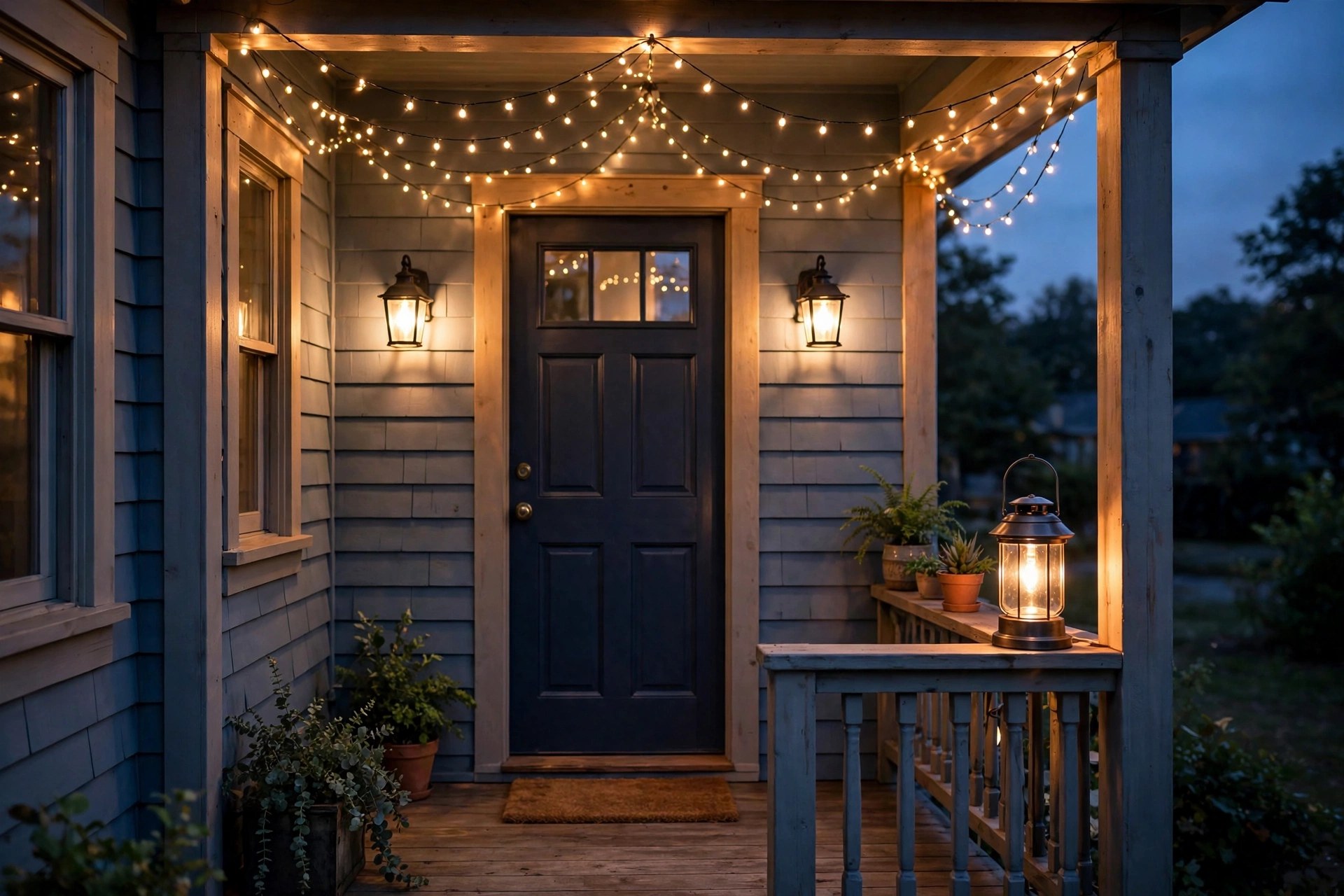
Start Here: The Three Numbers That Make Porch Light Feel Warm
Before you shop for a single fixture, learn the three numbers that decide whether porch light feels welcoming or harsh.
- Color temperature: 2700K warm white. This is the warm, slightly golden light that flatters brick, wood doors, and skin tones. A range of 2700K to 3000K all works. Avoid anything above 4000K beside a front door: it reads blue, flat, and clinical, more parking lot than homecoming.
- Mounting height: 66 to 72 inches above the porch floor. That places the light source just above eye level for most adults, so it lights faces, locks, and the first step without shining straight into eyes. For a pair of sconces, center each one about 6 inches out from the door frame where the wall allows.
- Weather rating: damp-rated under a roof, wet-rated in the open. A covered porch still gets wind-driven rain and morning dew. Choose damp-rated fixtures at minimum, and wet-rated fixtures for any wall, step, or railing that rain can reach directly. On packaged solar lights, look for IP44 for splashes and IP65 if the spot is fully exposed.
Brightness matters too, but in lumens, not watts. Guidance from Dazuma on how many lumens you need for outdoor lighting puts door sconces at roughly 400 to 600 lumens each, and roundups like Materialsix front porch lighting ideas show how they combine with lanterns and string lights in real entries. Aim for 600 to 1,200 lumens in total across all layers, not from one blazing fixture.
12 Small Front Porch Lighting Ideas for a Warm Welcome
1. Frame the Door With a Pair of Wall Sconces
This is the foundation almost every good porch starts with. One sconce on each side of the door, mounted 66 to 72 inches above the floor, lights faces evenly and removes the harsh shadow a single overhead light casts. Size each fixture at roughly one-quarter of the door height: for a standard 80-inch door, that is a sconce about 18 to 20 inches tall, or a compact 10 to 12 inches if your wall space is tight. Choose 2700K bulbs at 400 to 600 lumens each, with frosted or seeded glass to soften glare. If only one side of your door has wiring, a single sconce at about one-third of the door height still looks intentional.
2. Add One Ceiling Light If Your Porch Has a Roof
A flush-mount or semi-flush ceiling fixture fills in the shadow the sconces leave at the threshold. On a small covered porch, a fixture 12 to 14 inches wide is plenty, and it should sit centered over the door swing, not the middle of empty floor. Keep the bottom of any hanging pendant at least 7 feet above the floor so tall guests never duck. Pick the same finish and the same 2700K temperature as your sconces. Mixed color temperatures are the fastest way to make a small porch look patched together.
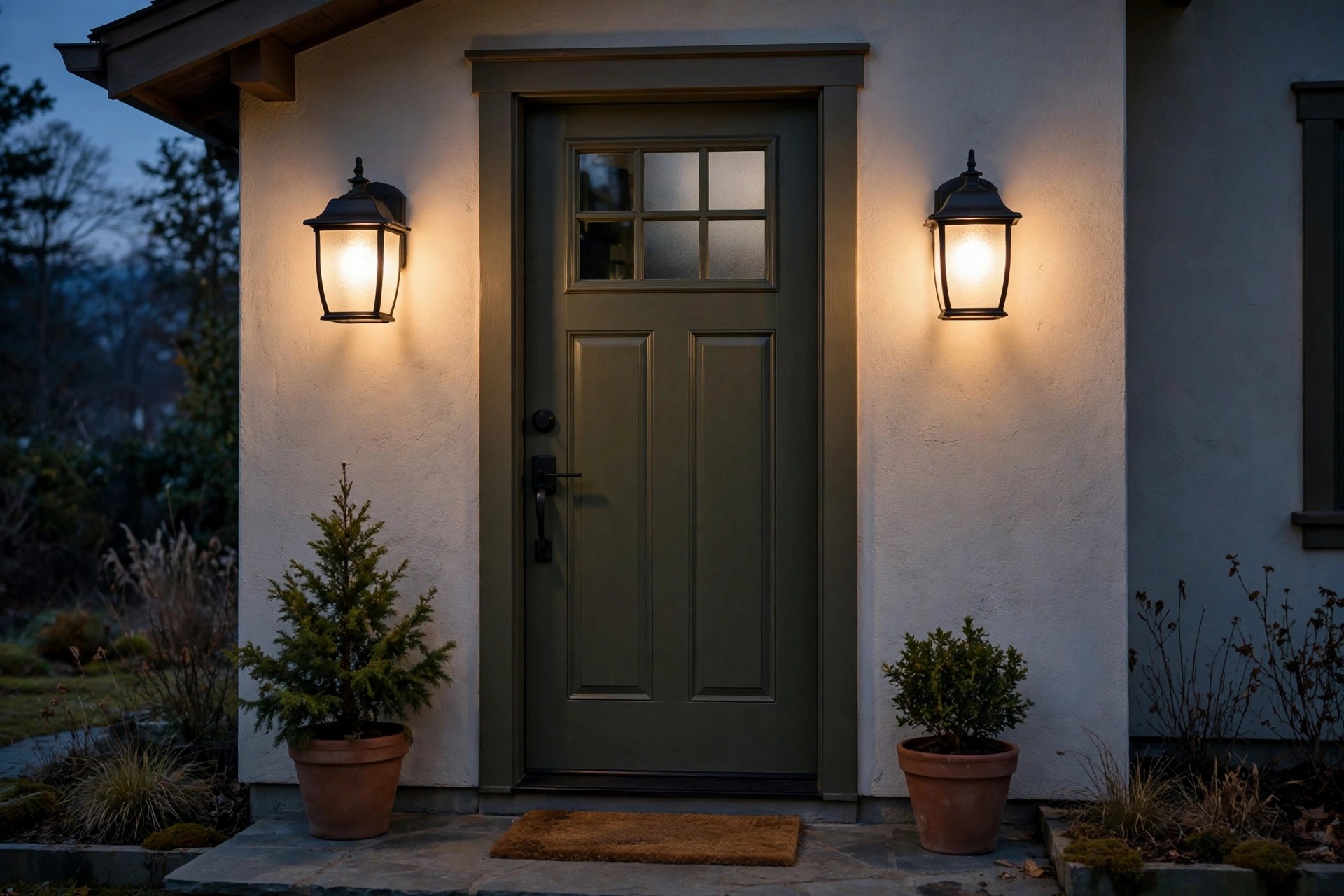
3. Set Solar Lanterns Where Wiring Cannot Reach
Solar lanterns are the renter-friendly, no-electrician layer. Hang one from a ceiling hook, set a pair on the railing, or place a single tall lantern beside the door where a plant used to sit. They charge by day and switch on at dusk on their own. The honest limits matter: most decorative solar lanterns give 20 to 100 lumens, so they are a glow, not task light, and they need 6 to 8 hours of direct sun on the panel to run through the evening. On a shaded north-facing porch, choose lanterns with a separate panel you can place in a sunny spot, or pick rechargeable battery lanterns instead.
4. Drape String Lights Along the Ceiling Edge or Railing
String lights turn a plain ceiling line into a soft canopy, using zero floor space. Run one strand along the front beam or in a gentle swag across a covered ceiling, with screw-in hooks every 3 to 4 feet so it stays neat. Choose outdoor-rated, shatterproof LED bulbs, keep connections under the roof edge, and pick a wet-rated strand if any part hangs in the open. One strand is ambience. Two on a tiny porch is usually glare.
5. Light the Steps So Guests See Every Edge
The most useful light on a small porch is often the lowest one. Step lights, small fixtures recessed into a riser or mounted low on the wall beside the steps, wash each tread with light so edges are easy to read at night. Solar step lights stick on with no wiring and work well on sunny steps; low-voltage wired versions are more reliable on shaded entries. Space them on every step for a single narrow stair, or every other step on a wider one. Aim the light down at the tread, never out at eye level.
6. Line the Path for the Last Few Feet to the Door
Two to four low path lights, spaced 4 to 6 feet apart and staggered rather than lined up like a runway, guide guests without flooding the yard. Solar path lights at 100 to 200 lumens are enough. Keep them 12 inches back from the walkway edge so they light the surface instead of blinding at ankle height, and match the porch's 2700K warmth so the whole approach reads as one place.
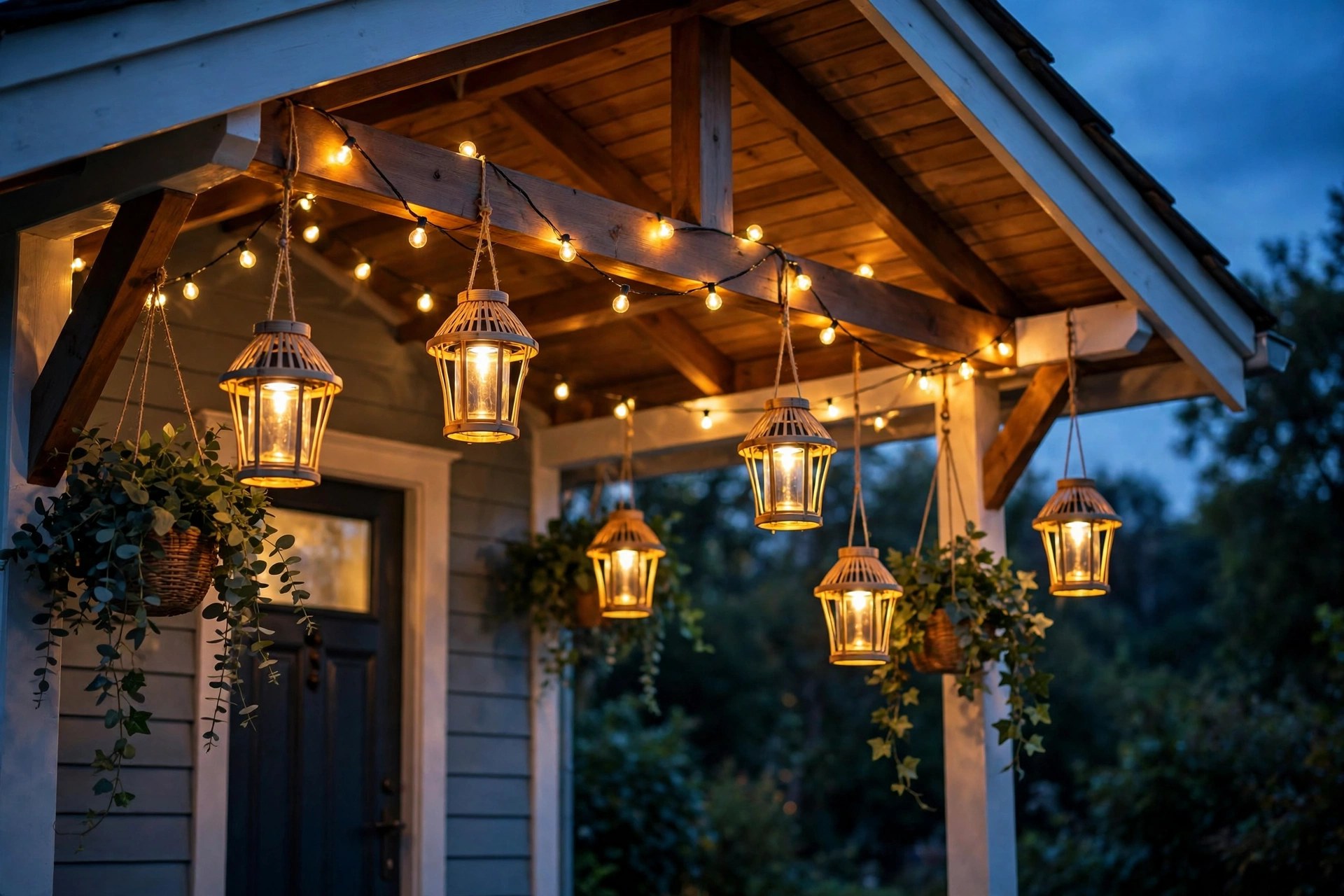
7. Choose a Motion-Sensor Sconce for Light Only When Needed
If your porch light tends to burn all night, a motion-sensor sconce is the fix that pays for itself. It stays dark or dim, then rises to full brightness when someone approaches, which helps with packages, late keys, and a general sense of security. Look for an adjustable sensor: a range of about 10 to 30 feet, a timeout of 1 to 5 minutes, and a dusk-to-dawn setting so it does not trigger at noon. Angle the sensor slightly down and away from the street, or passing cars and swaying plants will set it off all evening.
8. Hang a Single Pendant When the Ceiling Is High Enough
On a porch with a ceiling of 9 feet or more, one hanging lantern centered in front of the door adds presence sconces alone cannot. Size it at one-quarter to one-third of the door height, 20 to 27 inches for a standard door, with the bottom about 7 feet above the floor, clear of heads and the door swing. Damp-rated at minimum, wet-rated if wind reaches it. On lower ceilings, skip this and use idea two: a too-low pendant makes a small porch feel smaller.
9. Use Uplighting Sparingly on One Feature, Not the Whole Porch
A single low uplight aimed at a textured wall, a house number, or one potted tree adds depth that flat front light cannot. One is the key word on a small porch. Place a small solar or low-voltage spot at the base of the feature, angled up at about 30 degrees, and check from the street that it does not shine into windows. House numbers should be at least 4 inches tall and readable from the curb, with light falling across them, not behind them.
10. Put Everything on a Timer or a Smart Plug
The warmest porch is the one already lit when you come home. An outdoor timer, a dusk-to-dawn bulb, or a smart plug on the string lights removes the nightly switch hunt. Set lights on at dusk and off around 11 p.m., or run LED sconces dusk to dawn cheaply: a 6-watt LED on for 10 hours uses about as much power as a phone charger. Timers also make a home look lived in while you travel.
11. Layer Three Heights: High, Middle, and Low
Here is the idea the other eleven build toward. Professional-looking porches layer light at three heights: high, a ceiling fixture or string lights at the top; middle, sconces or lanterns at door height; and low, step and path lights near the ground. A small porch does not need all seven fixture types in this article, just one from each height. That layering is what removes flat shadows and makes a tiny entry feel deep. For seasonal styling that works with this lighting plan, see our guide to warm fall porch decor ideas, and browse more in our Outdoor & Porch ideas archive.
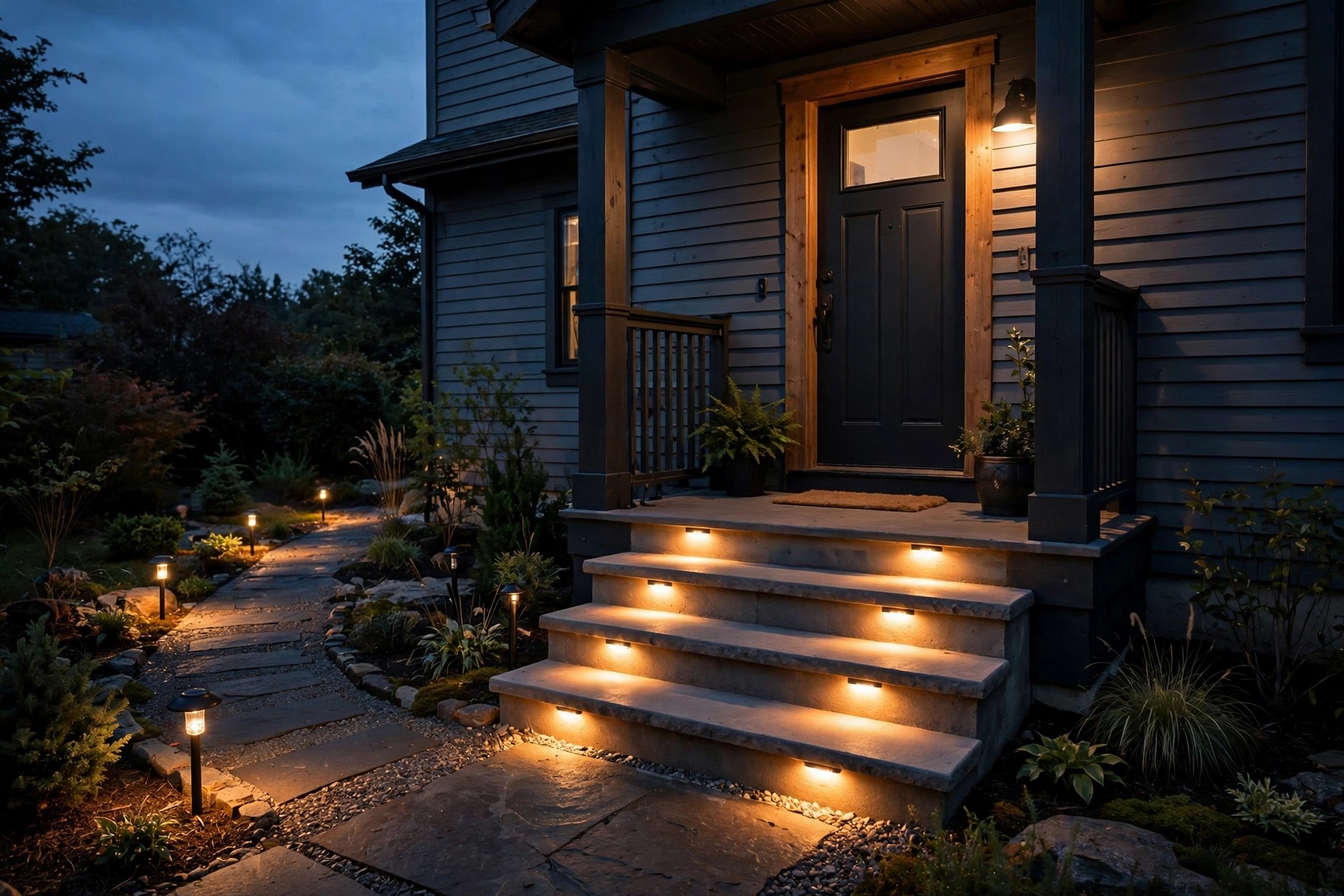
12. Finish With Matching Finishes and One Warm Bulb Temperature
The last idea is a discipline, not a purchase. Pick one finish, matte black, oil-rubbed bronze, or brushed nickel, and carry it across sconce, lantern, and house numbers. Then hold every bulb and solar fixture to the same warm family, 2700K to 3000K. Three warm lights in one finish look designed. A blue-white security bulb, a yellow lantern, and mixed metals look accidental, however much each piece cost.
Quick Picks: Match the Light to Your Porch
Not sure where to start? Match the fix to your situation. With wiring beside the door, start with idea one: a matched pair of 2700K sconces at 66 to 72 inches does more for welcome than anything else here. If you rent, start with ideas three, four, and five: solar lanterns, one string-light strand, and stick-on step lights give you all three layers with no holes and no electrician. If safety is the worry, start low, with step lights and a motion-sensor sconce. And if the budget stretches to one purchase this month, make it the sconces. Everything else is a layer. The door light is the welcome itself.
Porch Lighting Mistakes That Make a Small Porch Feel Cold
Five mistakes undo good fixtures: a bulb above 4000K that turns a warm door blue-white; a bare bulb at eye level with no shade, glaring at everyone who approaches; fixtures with no damp or wet rating that fail in their first wet season; too many solar lights on a shaded porch, all dim by 9 p.m.; and light aimed at the street instead of down at steps, faces, and the lock. Fix the temperature, the rating, and the aim first, and most small front porch lighting ideas start working on your porch, not just in photos.
Start this week with the door. Set two warm sconces at the right height, add one low light at the steps, and stand at the curb after dark to see your home the way a guest does. That view will tell you exactly which layer to add next.


Comments
Post a Comment