
15 Warm Fall Porch Decor Ideas for a Cozy Autumn Welcome
Most fall porch advice is a list of pretty objects. The problem is that a porch is not read like a list — it is read in three distances. From the street, about 25 feet away, only big shapes register. From the walkway, around 8 feet, people notice groupings and layers. At the door, within arm's reach, they see the small details: the wreath texture, the mat, whether the pumpkins are fresh or collapsing. A porch that looks "Pinterest perfect" in a photo but flat in real life usually failed at one of those three distances. These 15 ideas are organised by the zone they work in, with the sizes and prices that make them actually work — and honest notes on the popular ideas I would skip.

Zone 1: What reads from the street (big shapes only)
1. Anchor the steps with one large pumpkin stack
One confident stack beats eight scattered pumpkins. Build it on the bottom step or beside the door: a large pumpkin 18–24 inches wide on the bottom, a medium 12–14 inch one on top, and a small 6–8 inch one to finish — total cost roughly $18–30 at a farm stand, less at a grocery store in October. Keep the stack on the widest part of the step and leave at least 24 inches of clear walking width; a stack that forces visitors to sidestep is a trip hazard, not a welcome. Watch-out: pumpkins sitting directly on wet concrete rot from the bottom within two weeks. Slip a wood slice, a flat stone, or even a piece of cardboard underneath.
2. Hang a wreath sized to the door, not to the cart
For a standard 36-inch front door, a 22–24 inch wreath is the proportion that reads correctly from the street — roughly two-thirds the door's width. A 16-inch wreath looks lost; a 30-inch one crowds the frame. Hang it so the centre sits at about 57 inches, roughly eye level. An over-the-door hook ($5–10) is the reliable option; adhesive hooks are rated 3–5 lb and a full grapevine wreath with extras can weigh more than that, especially after rain. If you want ideas beyond the classic circle, our guide to fall wreath ideas covers sixteen variations by material and budget.
3. Flank the door with a matched pair
Symmetry is the cheapest curb-appeal trick there is. Two matching planters, lanterns, or mum pots — one each side of the door — make even a plain porch look deliberate. Planters 14–16 inches in diameter suit most doors; go to 18–20 inches only if the porch is at least 6 feet deep, or they will swallow the entry. A pair of decent resin planters runs $25–45; terracotta is cheaper ($10–18 each) but cracks in freeze-thaw cycles if left out wet.
Zone 2: Steps and floor (what the walkway sees)
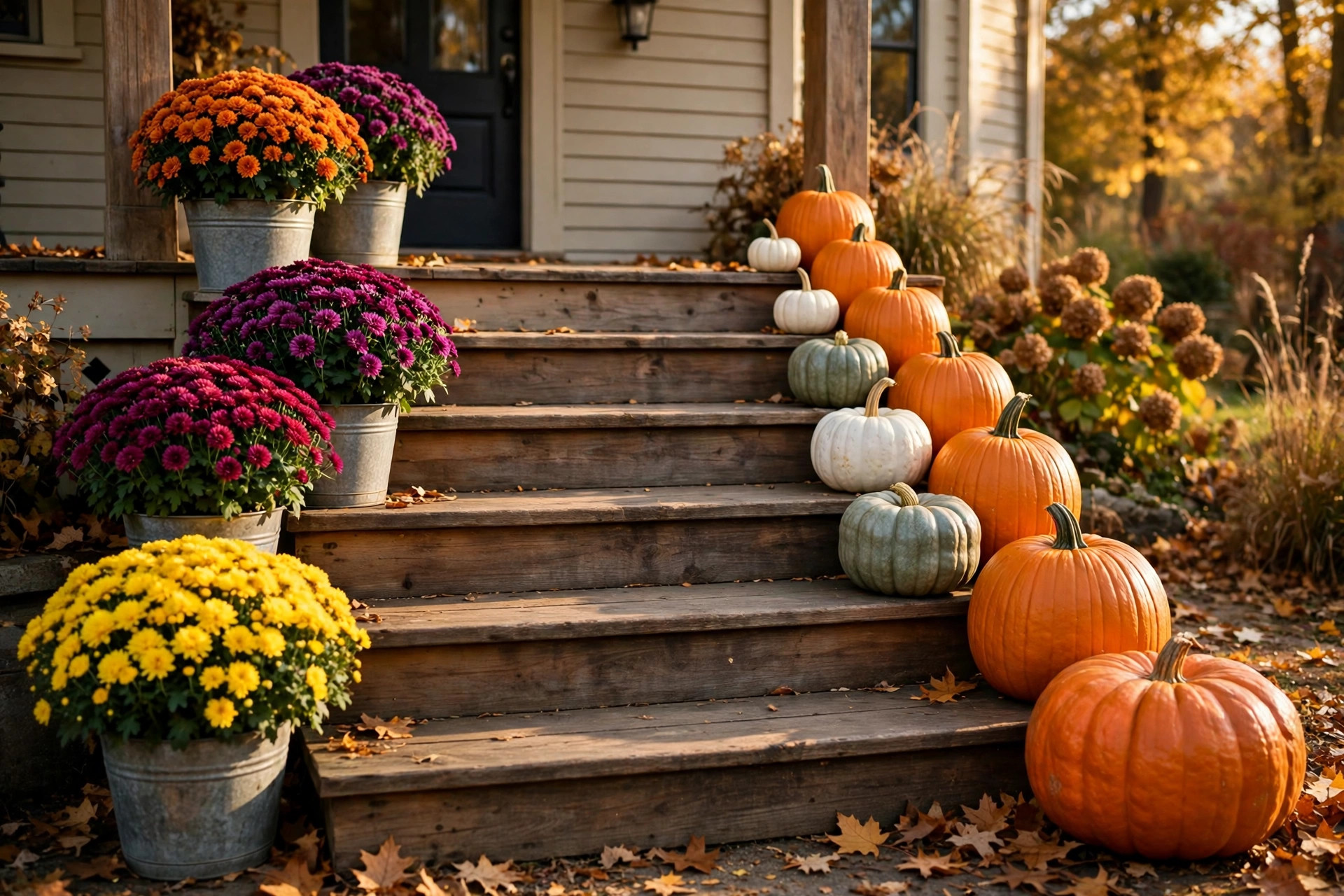
4. Run a pumpkin cascade down one side of the steps
Here is the specific trick most lists skip: put the biggest pumpkin on the bottom step and the smallest at the top. Your eye reads the descending line as you climb, and it looks designed instead of dumped. Use one side only — usually the side away from the handrail — and keep each pumpkin under half the step's depth so feet still land safely. A cascade of five pumpkins in mixed sizes costs about $15–25 total. Mix one white or sage variety in with the orange; the contrast is what makes it photograph well.
5. Pot mums the ten-second way
Nursery mums come in 8-inch pots that look raw on a porch. Do not repot them — drop the whole nursery pot into a galvanised bucket, a basket, or a larger decorative planter. It takes ten seconds, hides the plastic, and makes watering easier because you can lift the pot out. An 8-inch mum runs $6–10 and blooms 4–6 weeks if you water it properly: potted mums dry out fast, so check daily and water at the base, not over the flowers. Deadhead spent blooms and the plant pushes new buds. Honest warning: a mum bought in full bloom at the grocery store may only give you two good weeks — buy them in bud (tight, just showing colour) and you will get the full 4–6.
6. Layer the doormat over an outdoor rug
A coir doormat (standard 18×30 inches, $12–20) looks finished layered over a flatweave outdoor rug one size up — a 2×3 ft or 24×36 inch rug in a rust, charcoal, or faded pattern ($15–30). The rug should extend at least 6 inches beyond the mat on every side. This is the single highest-impact cheap change for a bare concrete porch. Watch-out: coir holds water; on a covered porch it is fine, but on an open stoop it stays soggy and marks the door threshold. For uncovered entries, choose a rubber-backed mat instead.
7. Skip the hay bale unless your porch is deep
This is the honest negative nobody prints: a standard hay or straw bale is about 36×18×14 inches. On a porch less than 5 feet deep, you will be squeezing past it for two months, and it sheds onto every coat that brushes it. If your porch is 6 feet deep or more, a bale makes a great pumpkin pedestal ($6–10 at a feed store). If it is shallow, get the same height from a wooden crate (about 12×12 inches, $8–15) turned on its side — it gives the lift without eating the walkway.
Zone 3: At the door (arm's-reach details)

8. Add one lantern with a flameless candle on a timer
Real candles on a porch are a wind problem and, near dried wreaths and doormats, a genuine fire risk. A flameless pillar with a built-in timer (set it once; it glows 5–6 hours nightly) inside a 12–18 inch lantern gives the same warm point of light for $15–28 all-in. Place it on the latch side of the door, where the eye lands as a visitor reaches for the handle.
9. Dress the door hardware zone
At arm's reach, people notice the small ring around the door: a seasonal door hanger on the handle, a clean kick plate, house numbers they can actually read from the street (numbers should be at least 4 inches tall). If your numbers are faded 3-inch stick-ons, replacing them with 5-inch matte black or brass numbers ($8–15) does more for the entry than another pumpkin.
10. Give the ceiling a thought
On a covered porch, the ceiling is a fifth wall that most people ignore. A coat of haint blue or a warm white, or even a string of outdoor lights swagged across it, changes how the whole porch feels at dusk. Our dedicated guide to front porch ceiling ideas prices out twelve options from a $100 paint job upward.
Zone 4: The seating corner (if depth allows)
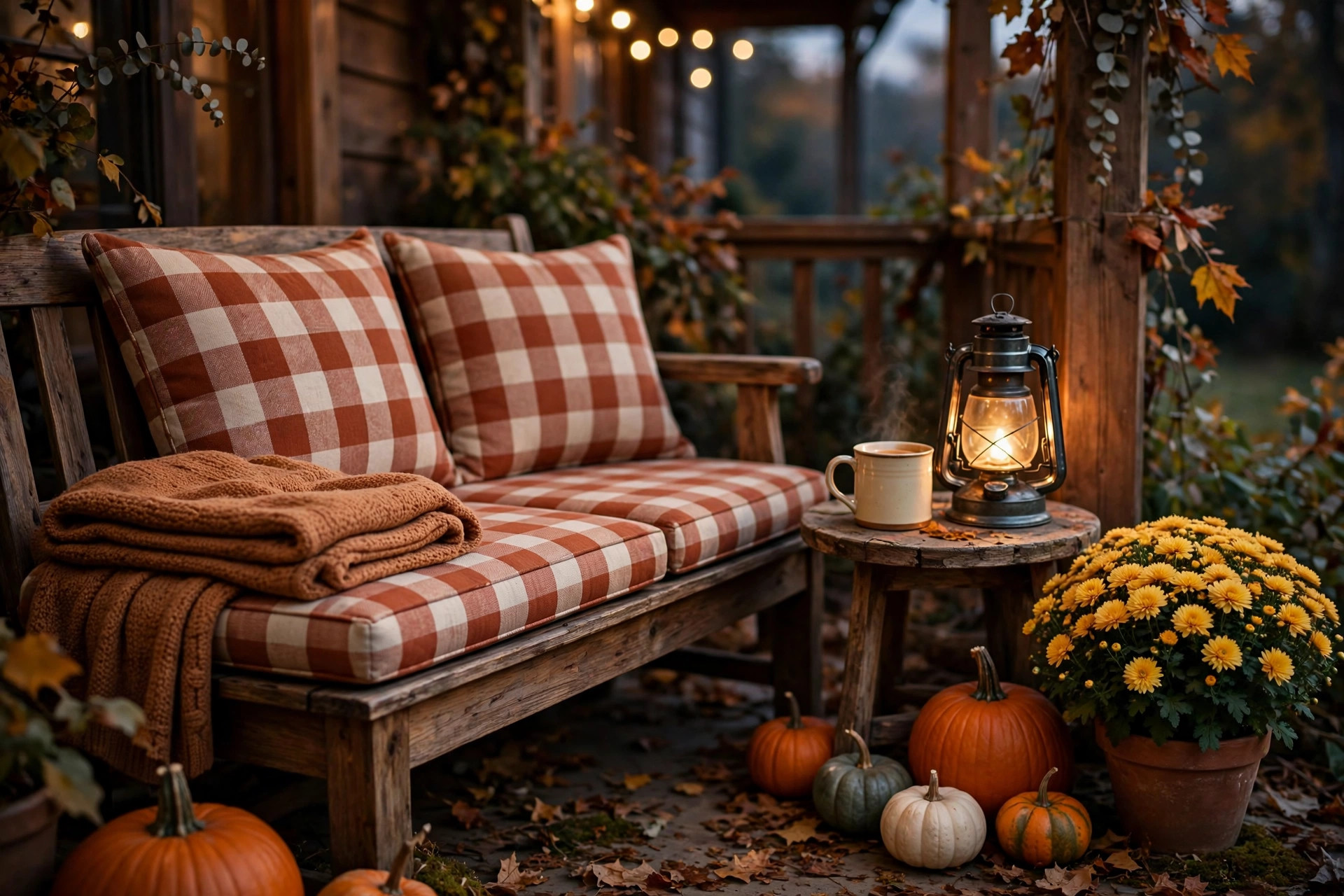
11. Only add seating if you have 6 feet of depth
A bench or rocker needs roughly 24 inches for the seat, 18 inches of legroom, and a walkway past it — that maths means seating only works on porches about 6 feet deep or more. Forcing a chair onto a 4-foot porch makes the whole entry feel blocked. Shallow porch? Spend the money on the door zone instead; it will look better. If you do have the depth, the sizing and layout rules in our small front porch decorating ideas will keep it proportionate.
12. Style the seat with outdoor textiles, in fall weight
Two 18×18 inch outdoor pillows ($12–20 each in solution-dyed acrylic or polyester) plus a throw is the whole formula. Choose a throw you can actually leave outside or bring in without thinking — a $15–25 outdoor or washable throw in a plaid or rust stripe. Styling rules and fabric picks are in our guide to fall throw blanket styling ideas. Watch-out: cotton throws left out overnight get damp, mildew fast, and fade within a season.
13. Add a side table at seat height
A small table 16–18 inches high next to the seat — a garden stool, a crate, a $20–35 metal drum table — is what turns a styled corner into a used one: it holds the coffee. Keep its footprint under 16 inches square on a small porch. Put the flameless lantern here instead of by the door if the seating corner is where people actually linger at dusk.
14. Light the porch for the hour people actually see it
Most porches are seen at dusk, and most porch bulbs are too harsh. Swap the fixture bulb for a 2700K warm-white LED and, if you add string lights, measure the run first (most porches need 15–25 feet; G40 globe strands run $15–30). The full sizing and placement guide is in our small front porch lighting ideas. One honest note: solar path lights rated under 50 lumens are decorative only — they will not light steps safely.
15. Finish with one living, one fading, one lasting layer
The porches that still look good in November are layered by lifespan: something living (mums, a kale or cabbage planter — ornamental kale actually improves with frost and holds to December), something fading gracefully (dried corn stalks or a wheat bundle by the door, $5–12), and something permanent (the wreath, lanterns, planters). When the pumpkins go soft, remove only that layer and the porch still reads finished. If your porch is enclosed, the same layering works with the ideas in our screened porch decorating ideas.
Mid-season refresh: the 20-minute November rescue
Around week five, most fall porches quietly fall apart: the first mums are spent, one pumpkin goes soft, and the doormat is full of leaf litter. A 20-minute reset fixes the whole impression. Pull any pumpkin that gives when you press the base — one rotting pumpkin softens its neighbours within days. Swap the spent mums for ornamental kale or cabbage (about the same $6–9 per pot); kale actually improves after the first frost and will hold its colour into December. Shake out the doormat, wipe the lantern glass, and check the string-light timer still matches the earlier sunset. Do this once in late October and once before Thanksgiving guests arrive, and the porch never has a "dead" week. The same lifespan layering extends past the porch — our fall outdoor decor ideas apply it to paths, fences, and garden beds.
What it costs: three honest budgets
- About $50: pumpkin cascade ($20), two mums in bud ($16), layered doormat set on sale ($14 by reusing a rug you own — $0). Door hook you already own.
- About $150: everything above, plus a 24-inch wreath ($30), a lantern with timer candle ($25), and a pair of planters ($40).
- About $350: everything above, plus seating-corner textiles ($60), string lights ($25), new house numbers ($12), and a bench or rocker if your porch has the depth (thrifted, $80–120).
Sizing by porch type: what actually fits
The stoop (under 3 feet deep): door zone only — wreath, layered mat, one mum or lantern per side on the ground. Nothing on the steps that narrows them. The standard porch (4–5 feet deep): the full door and step treatment plus planters; no seating, no hay bale; a narrow bench under 14 inches deep can work against the house wall if the walkway stays 30 inches clear. The deep porch (6–8 feet): everything here, including the seating corner — allow 24 inches for the seat, 18 inches of legroom, and keep 36 inches of walkway in front. The wraparound: treat each side as its own zone (door side social, far side quiet) and repeat one element — the same lantern or mum colour — on both sides so it reads as one design.
Order of work: one hour, one afternoon, one weekend
One hour: clear and sweep, layer the doormat, place the pumpkin cascade and mums, hang the wreath. That is 80% of the visual effect. One afternoon: add the lantern, planters, house numbers, and string lights. One weekend: paint the ceiling or door, build the seating corner, and do the lighting properly.
The edges of the porch: posts, railing, and the walkway in
The 15 ideas above work the porch itself. Four more work its edges — the frame a visitor passes through before reaching the door — and none of them costs much more than $30.
Tie cornstalk bundles to the posts. Pumpkins are all low mass, and a porch with nothing tall looks bottom-heavy. Bundle four to six dried cornstalks and tie one bundle to each porch post or column with natural twine (a bundle runs $5–8 at a farm stand). The height balances the pumpkin stacks below, and the gold reads as fall from the street before any detail does. No posts? Lean one bundle in the corner beside the door instead — the same vertical line, no tying.
Drape a garland along the railing. A 9-foot faux garland of maple leaves and berries (about $12–20) wired along the top rail connects the door styling to the rest of the porch and softens the hardest line in the whole composition. Wiring it on takes about five minutes and holds all season; left draped loose, the first windy night rearranges it. No railing? Run the same garland across the top of the door frame.
Line the walkway, not just the door. Guests experience the last stretch on foot. Six to eight metal lanterns with LED candles, spaced 4–5 feet apart along the path, turn an ordinary walkway into an arrival — and in October's early darkness it is a genuine safety upgrade, not just styling. Solar versions ($8–15 each) charge by day and need no wiring; keep them heavy or staked so the wind does not move the line.
Refresh the window boxes and mark the driveway. Two front-of-house touches that cost almost nothing: pull tired summer annuals out of the window boxes (most run 24–36 inches) and refill with pansies, ornamental cabbage, and ivy — about $15–20 per box, and pansies bloom through light frosts. At the driveway entrance, a wooden crate or half-barrel planter with one mum, two pumpkins, and a small lantern ($20–30, everything heavy or staked) welcomes people before they reach the house at all.
The 15-minute porch (for people who hate decorating)
Everything above assumes you enjoy this. If you do not, here is the whole porch in three moves and about 15 minutes: hang one wreath on the door, set one lantern by the step, and stand one basket by the door with a rolled throw inside it. Decorating is not about quantity — it is about warmth signals: one amber light, one natural texture, one textile. Three signals and the entry reads as autumn. One extra trick from the minimalists: keep two coir doormats, a plain one and a fall one, and swap them between October and November — the mat is the most-handled object at the door, and a fresh one at peak season makes the whole entry feel cared for. And if orange is the part you hate, skip it entirely: cream and white pumpkins, wheat stems, warm wood, and amber glass give the full fall feeling with zero orange in it.
Fall porch questions, answered straight
How long do potted mums actually last? Four to six weeks from bud. Water at the base daily in warm weather — a dry mum wilts within a day and never fully recovers. Once night temperatures drop below freezing regularly, the blooms are done, but ornamental kale carries the porch from there.
How do I stop pumpkins rotting (and squirrels)? Choose pumpkins that are firm with no soft spots, keep them off wet ground, and you will get 4–8 weeks. A 10-minute soak in water with a splash of bleach (about a tablespoon per quart) before placing them slows surface mould. For squirrels: be honest, sprays and hot sauce mostly disappoint. Physical distance from trees and a wire cloche over prize pumpkins work better; or accept some loss and buy two spares — they are $4 each.
When should fall porch decor go up and come down? Up in early-to-mid September (or when nights cool), refreshed once in October when the first mums fade, and down the weekend after Thanksgiving — swap the wreath and pumpkins for winter greenery and the porch never has a bare week.
My porch is tiny — under 4 feet deep. What actually works? Door zone only: the layered mat, a correctly sized wreath, one lantern, and mums flanking the door on the ground either side. Skip seating, hay bales, and anything that narrows the step. A small porch done tightly looks better than a big idea squeezed.


Comments
Post a Comment