
Front Porch Ceiling Ideas: 12 Ways to Transform Your Entry
Nobody decorates the porch ceiling on purpose — and that is exactly why it is the highest-impact surface on your home's face. It is what a guest sees while waiting at your door, what you see from every seat on the porch, and the one plane that can make a shallow, plain porch feel like a room instead of a ledge. The twelve ideas below run from a $100 paint job to a full coffered build, each with the materials, costs per square foot, and the climate warnings that decide whether it will still look good in five years.
Before You Choose: Exposure, Height, and Budget
Exposure first. A ceiling under a deep, dry roof can be pine or even MDF-panel beadboard; a ceiling on an open or damp porch needs PVC, vinyl, or cedar. Check the roof above it is watertight before you cover anything — a beautiful ceiling under a slow leak is a mold farm. Height second: if you ever want a ceiling fan, you need blades at least 7 feet above the floor (building-code standard), which usually means an 8-foot ceiling with a flush mount or 9 feet with a downrod. Budget last, for a typical 10 x 20 ft (200 sq ft) porch: paint only, about $100–$200; plywood and battens, $400–$600; vinyl beadboard, $500–$800; real cedar or quality tongue-and-groove installed, $1,500 and up.
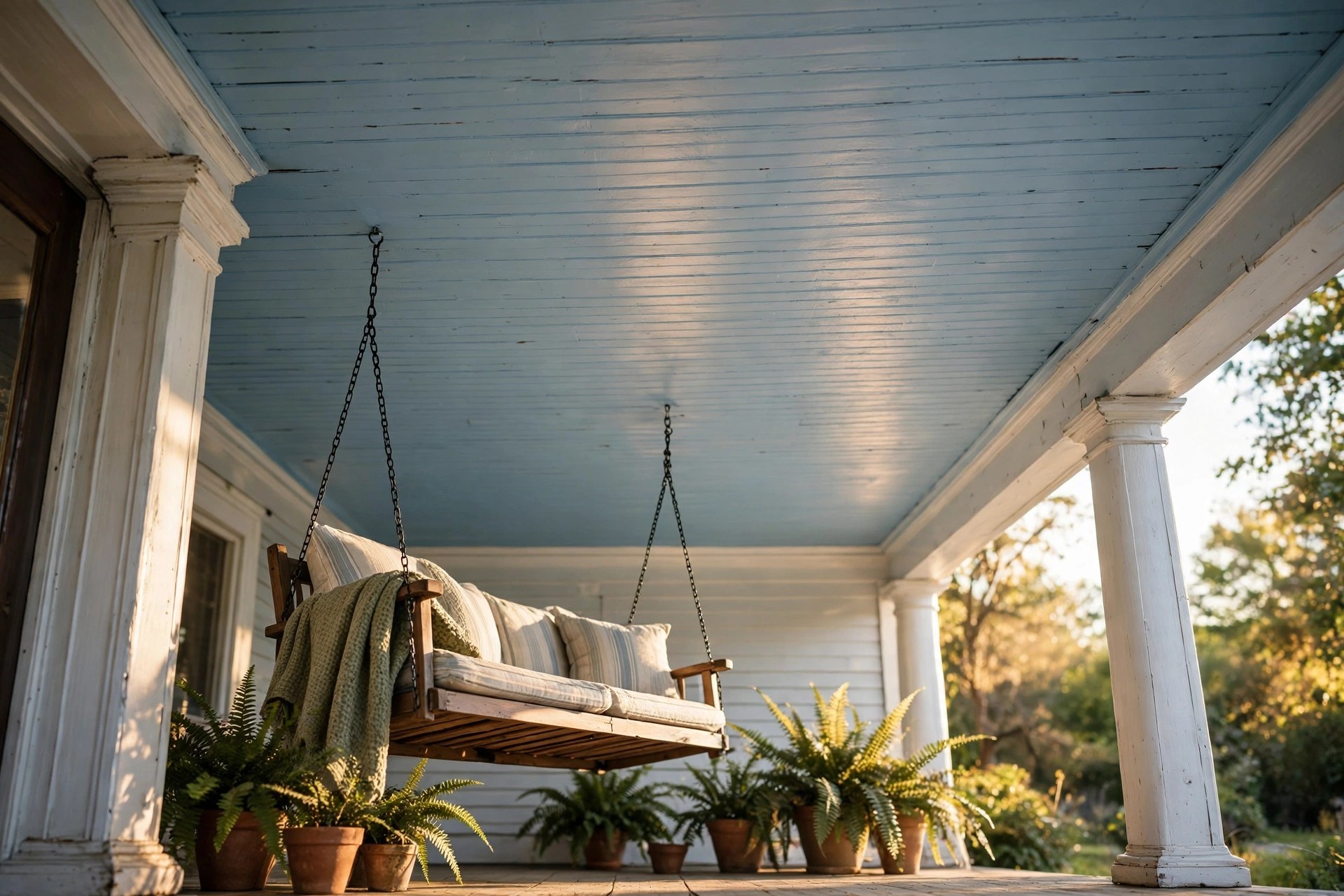
1. Haint Blue Paint on Beadboard
The South's most famous porch ceiling: beadboard painted a soft blue-green — the family of colors called haint blue, a Lowcountry tradition well over a century old. Benjamin Moore Wythe Blue HC-143 (about $75 a gallon) is the closest widely available match; Palladian Blue HC-144 and Sherwin-Williams Rainwashed are in the same family. The color works because it reads as sky, visually lifting the ceiling, and the beadboard's narrow grooves catch morning and evening light differently so the surface never looks flat. Two rules: keep columns, trim, and railings white — the contrast with white is the entire effect — and do not skip the beadboard to save money, because the same paint on a flat ceiling is forgettable. One gallon covers roughly 350–400 sq ft, so most porches need one gallon and a weekend.
2. Classic Beadboard, Painted White or Cream
If blue is not your house's language, beadboard in warm white delivers the same texture with zero color risk. Material choice is the whole decision: PVC beadboard runs $2–$5 per sq ft, never rots, and is the right call for humid or coastal porches; pine tongue-and-groove beadboard is $3–$9 per sq ft and takes paint beautifully but needs its finish maintained; MDF beadboard ($1–$5 per sq ft) is for fully sheltered ceilings only, because one season of driven rain swells it beyond repair. Install with the grooves running front-to-back (from house to street) to lead the eye outward, and finish the perimeter with lattice or quarter-round trim — it hides the expansion gap the boards need.
3. Stained Tongue-and-Groove Wood
The warm, lodge-like option: pine or cedar planks left natural or stained honey, walnut, or weathered gray. Cedar costs $4–$12 per sq ft in material and resists rot naturally, but wants resealing every 2–3 years on an exposed porch; pine is cheaper ($2–$8 per sq ft) and needs a good exterior stain or spar urethane to survive. Run the planks, then read the porch from the street: stained wood against white or cream siding is one of the strongest curb-appeal contrasts there is. This pairs beautifully with the warm, layered styling in our fall porch decor ideas.
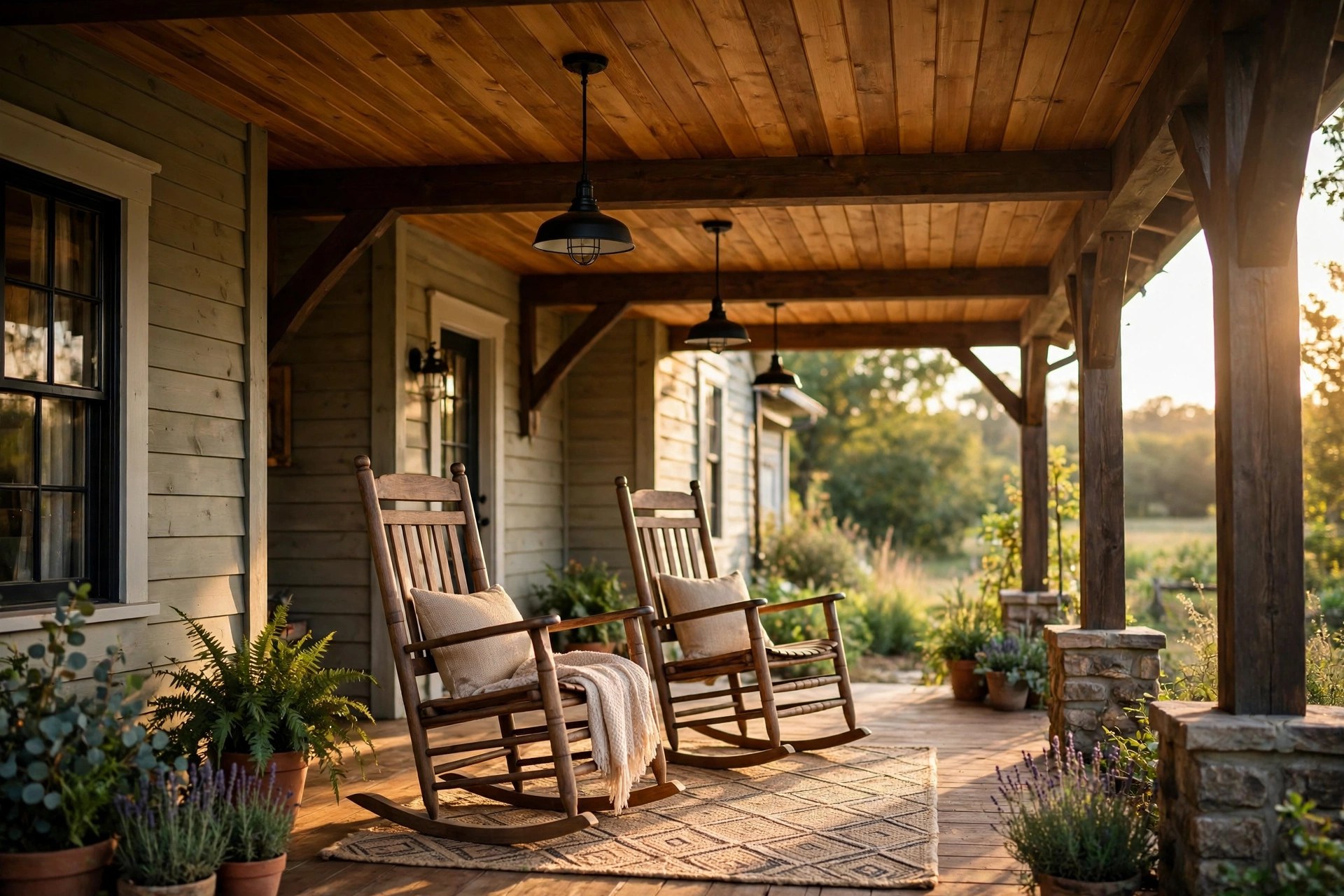
4. Shiplap, the Beadboard Alternative
Shiplap's wider boards (typically 6–8 inches with a 1/8-inch shadow gap) read more coastal and more modern than beadboard's tight grooves, and it is often the cheaper install because fewer, wider boards cover the ceiling faster. Painted white, it brightens a dark porch noticeably; painted a soft color, it feels designed rather than default. Use exterior-rated or PVC shiplap outdoors — interior MDF shiplap panels will not survive porch humidity — and caulk only the perimeter, never the gaps, or the shadow lines disappear.
5. Tin-Look Ceiling Tiles
Pressed-metal-look tiles (real tin, or far lighter PVC and foam versions at $2–$6 per sq ft) give a porch a vintage, main-street character that suits Victorian, farmhouse, and craftsman homes. The patterned surface hides imperfect ceilings better than any flat material, and the PVC versions glue or nail up over an existing sound ceiling in a day. Paint them white for a classic look or a deep bronze or charcoal for drama. Avoid real uncoated tin in salt-air climates; the PVC lookalikes exist precisely for that.
6. A Coffered Ceiling (or a Convincing Faux)
Coffers — a grid of recessed squares framed by beams — are the most architectural thing a porch ceiling can do. A true build is carpentry: boxes framed every 4–5 feet, trimmed, and painted, and it suits tall (9 ft+) porch ceilings on traditional homes. The convincing shortcut: keep your flat or beadboard ceiling, add beams alone (idea 7), and paint the ceiling field between them a deep color — navy, charcoal, or forest — which fakes the coffer depth at a tenth of the cost. Do not attempt coffers under 8 feet; the grid will feel like it is pressing down on your guests.
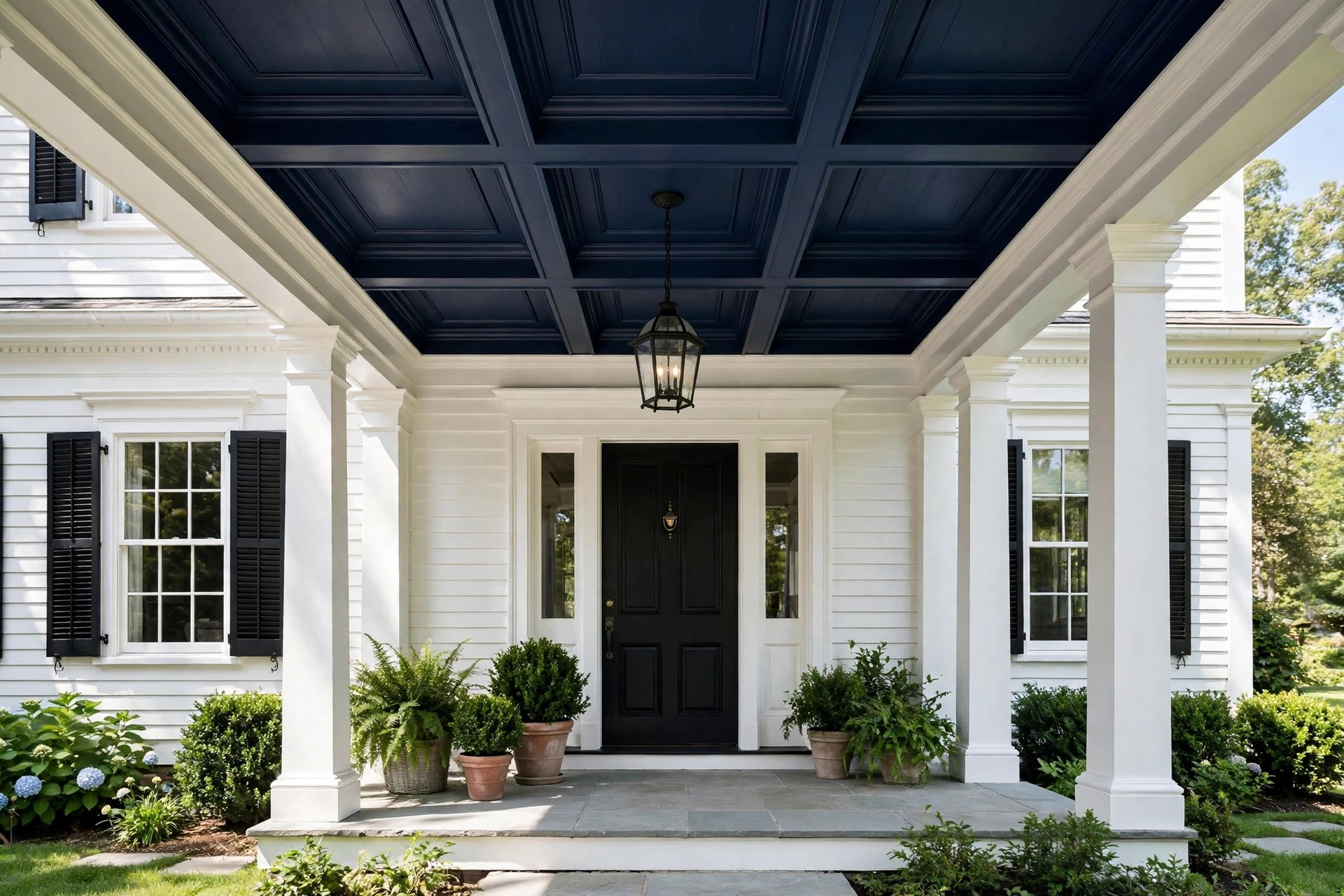
7. Faux Beams over a Plain Ceiling
Three to five beams across the porch add the warmth and rhythm of heavy timber for a fraction of the weight and cost. Hollow urethane foam beams that mimic hand-hewn wood run about $25–$45 per linear foot, weigh almost nothing, and screw to a simple mounting block; real box beams built from 1x pine boards cost less in material and more in labor. Space beams evenly (every 4–6 feet on a typical porch), run them the short direction of the porch to widen it visually, and stain or paint them to contrast the ceiling field — dark beams on white beadboard is the classic farmhouse formula.
8. One Bold, Dark Color
The cheapest transformation on this list after basic paint: take an existing sound ceiling — flat, beadboard, whatever you have — and paint it deep navy, charcoal, emerald, or even matte black. Dark ceilings do counterintuitive work outdoors: in daylight they make the porch feel shaded and cool; at night, with string lights or lanterns lit, the ceiling disappears and the porch feels taller and more intimate. The risk is a low ceiling in a north-facing porch, which can feel cave-like; if your ceiling is under 8 feet and your porch faces away from the sun, stay in the mid-tones instead. Budget: paint and supplies, $100–$200 total.
9. Plywood and Battens (the Budget Build)
The workhorse budget ceiling: exterior-grade plywood sheets (about $1–$2 per sq ft) screwed to the joists, with 1 x 2 or 1 x 3 battens covering every seam, all painted one color. It reads as a paneled, board-and-batten ceiling for $400–$600 all-in on a 200 sq ft porch — half to a third of beadboard — and every part of it is replaceable if a section ever gets damaged. Sand and prime the plywood edges well; raw ply edges telegraph through paint. This is the ceiling to choose when the porch also needs its budget spent on furniture — find that half of the project in our small front porch planter ideas and seating guides.
10. Draped Outdoor Fabric (the Renter's Ceiling)
If you rent, or your "porch" is a metal-roofed patio that bakes in summer, swag outdoor fabric overhead: UV-stable shade cloth or outdoor canvas, attached at the beams with cup hooks or a staple-and-batten you can remove. Gentle swags between beams soften hard rooflines, cut glare, and drop the felt temperature noticeably. Choose solution-dyed acrylic or shade cloth rated for outdoor use (cheap indoor fabric mildews in one season), and install it so rain runs off rather than pooling — a sagging puddle pocket over your seating is the one failure mode of this idea.
11. Build the Ceiling around a Fan
On porches in warm climates the ceiling's most important feature is not a material at all — it is a fan. Choose a damp-rated fan for covered porches, wet-rated for open ones, sized to the space: 36–42 inches for porches up to about 100 sq ft, 50–54 inches for 100–200 sq ft. Blades must sit at least 7 feet above the floor; on an 8-foot ceiling that means a flush (hugger) mount, and on 9 feet or more, a short downrod that drops the fan into the room's air. Center the fan over the seating, not the porch's geometric center, and give it a light kit in the 2700K warm range — a fan that moves air and light transforms more porch evenings than any paint color on this list. Our small front porch lighting ideas cover the rest of the after-dark picture.
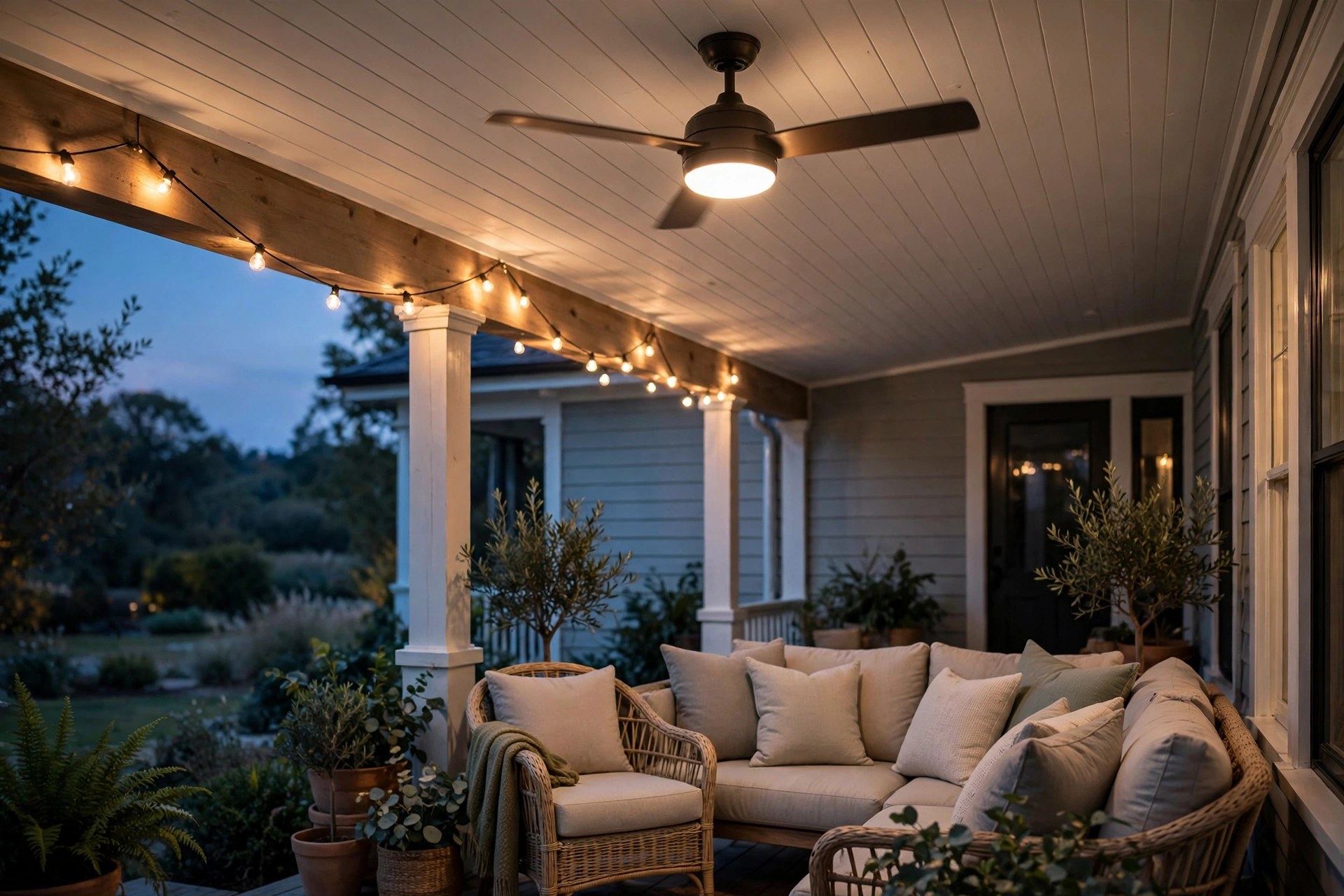
12. Keep the Ceiling, Change the Light
Sometimes the ceiling is fine and the porch is just dark. Recessed LED cans rated for damp locations (about $15–$30 each, spaced 4–5 feet apart) turn a flat ceiling into a lit room; a swag or two of commercial-grade string lights along the beams does it warmer and cheaper, in an hour, with no electrician if an outdoor outlet exists. Add a lantern pendant over the door zone and the ceiling you already own suddenly looks intentional. Start here if budget is tight this year — materials can come later, light cannot wait.
Keeping It Up: A Ten-Minute Annual Routine
Once a year, ideally in spring: soft-wash painted and vinyl ceilings with water, a little dish soap, and a long-handled soft brush (skip the pressure washer — it drives water up into the structure and invites mold), inspect for moisture stains that mean a roof leak above, check that boards and tiles are still tight, and touch up paint where it has thinned. Wood ceilings add one line to the list: note when the stain or sealer starts looking dry, because recoating a season early is a weekend, while replacing rotted boards is a project.
Porch Ceiling Questions
What is the best porch ceiling material for a humid climate?
PVC beadboard. It is waterproof rather than water-resistant, it never needs repainting for protection (only for looks), it will not swell, rot, or feed mildew, and at $2–$5 per sq ft it costs about the same as pine. Cedar is the natural-wood answer, with resealing every 2–3 years as the price of admission.
How much does a porch ceiling cost, honestly?
For a typical 10 x 20 ft porch, DIY: $100–$200 for paint alone, $400–$600 for plywood and battens, $500–$800 for vinyl beadboard, $1,500+ for real cedar or tongue-and-groove with stain and trim. Professional installation roughly doubles material cost on the carpentry options.
Does haint blue really keep wasps away?
It is a beloved folk claim — the idea being that insects mistake the sky-colored ceiling for open sky and do not nest there. There is no solid scientific proof, and wasps do occasionally nest on blue ceilings. Paint it because it is beautiful, traditional, and makes the porch feel bigger; treat any wasp benefit as a possible bonus, not a promise.
Can I paint a vinyl porch ceiling?
Yes, with the right prep: wash it, let it dry fully, and use a 100% acrylic exterior paint in a light-to-medium color. Very dark paint on vinyl can absorb enough heat to warp it, which is why manufacturers warn against colors darker than the original — if you want the bold dark look of idea 8, do it on wood or fiber-cement, not vinyl.


Comments
Post a Comment