
12 Small Home Office Desk Storage Ideas That Clear Clutter
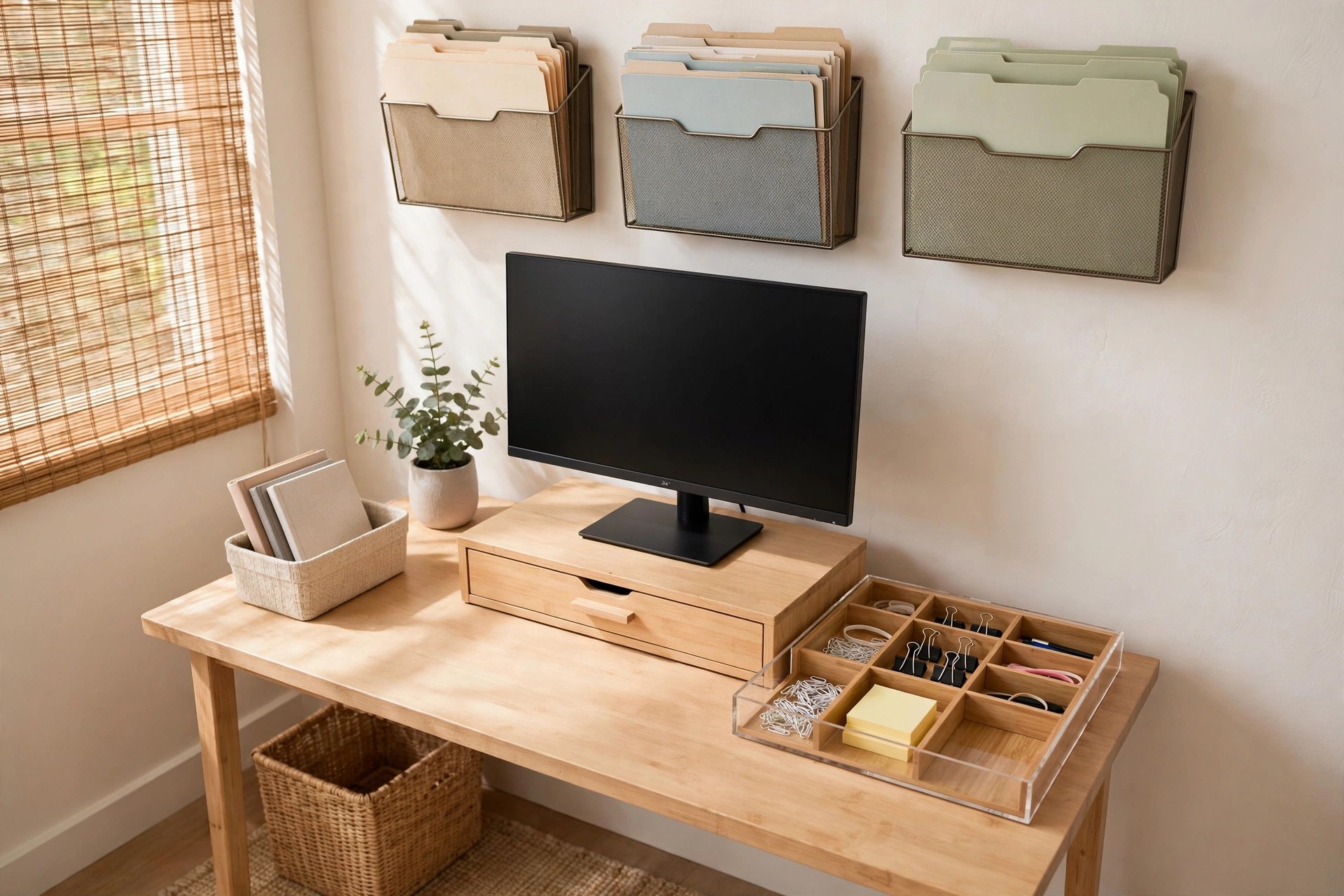
A small desk does not stay messy because you own too much. It stays messy because everything lands on the same flat surface. The best small home office desk storage ideas fix that by giving every item a level of its own: up on a riser, inside a divided drawer, onto the wall, or into a cable box underneath. None of these twelve ideas needs a bigger desk. Most need a tape measure and about an hour. Start with the surface you have, usually 40 to 48 inches wide and 20 to 24 inches deep, and build storage in the three directions a small desk allows: up, in, and under.
Measure First: The Three Zones Behind Every Idea Below
Before you buy a single organizer, split your desk into three zones and measure each one.
- Zone 1, the surface: keep 60 percent of it empty. On a 48 by 24 inch desk, that means roughly 690 square inches stay clear for keyboard, notebook, and elbows. If storage covers more than 40 percent of the top, the desk feels crowded no matter how neat it is.
- Zone 2, in and under: drawers and the space below the top. Measure drawer depth before buying any tray: most small-desk drawers are only 2 to 3 inches deep inside. Under the desk, you need 24 to 30 inches of knee clearance, so storage there must stay slim or hug the sides.
- Zone 3, the wall: the 24 inches above your desk. The wall strip from the desktop up to about 24 inches above it is free storage that costs zero surface. A shelf or file holder there holds papers and supplies at eye level while the desk stays clear.
Guides from Robyn's French Nest on how to organize a desk and Downsize Geek on tiny home office storage land on the same principle: wall space and contained storage do the heavy lifting in a small office, not a bigger desk.
12 Small Home Office Desk Storage Ideas That Clear Clutter
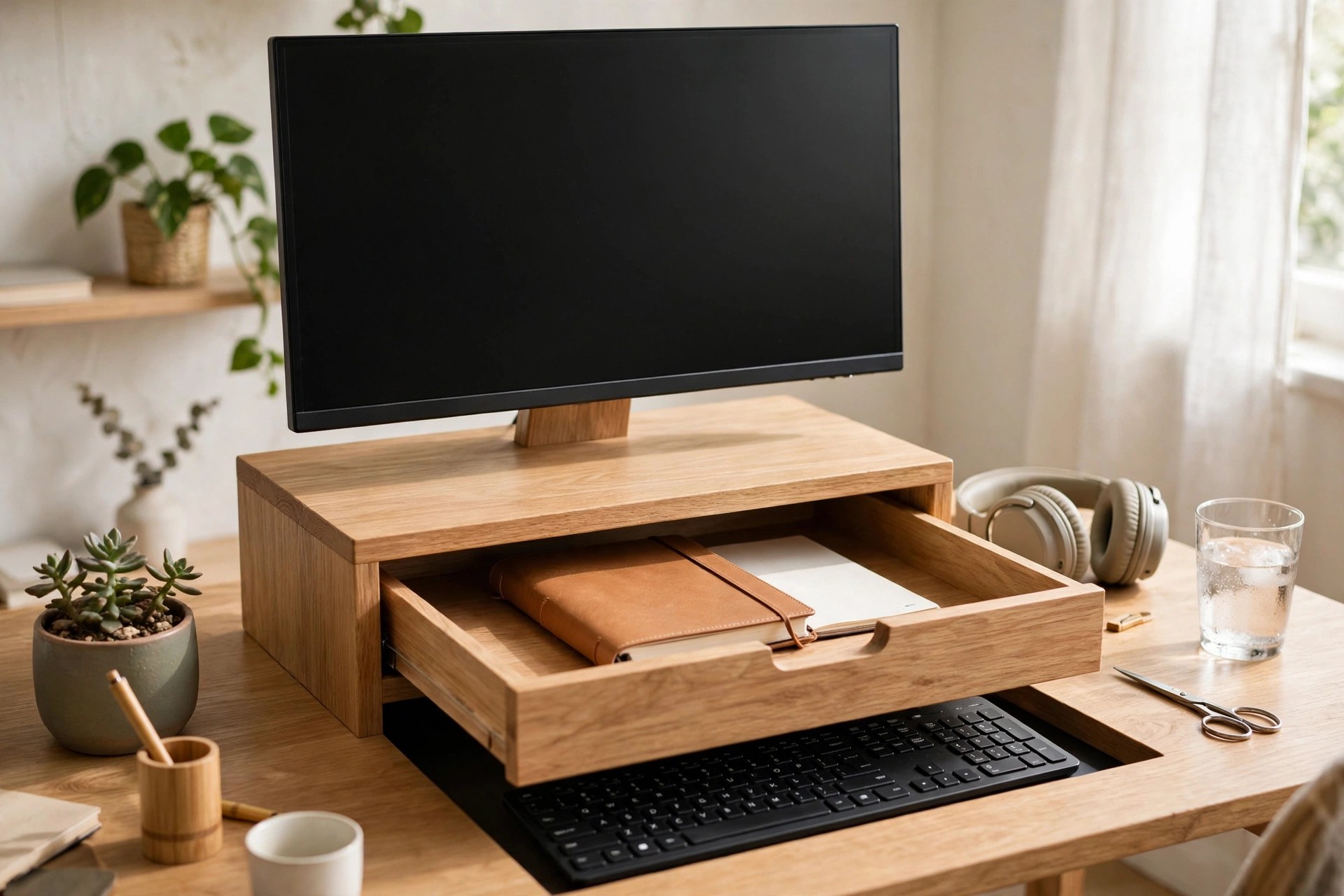
1. Add a Monitor Stand With a Drawer
This is the hardest-working upgrade on the list. A riser about 20 inches wide, 9 to 10 inches deep, and 4 to 5.5 inches high lifts your screen to eye level and creates two storage spots at once: a shallow drawer for notebooks and pens, and an open slot underneath for your keyboard at the end of the day. Check the clearance before you buy: you need at least 3.5 inches to slide a standard keyboard in and out comfortably. A ventilated mesh top also keeps a laptop cooler than a solid block.
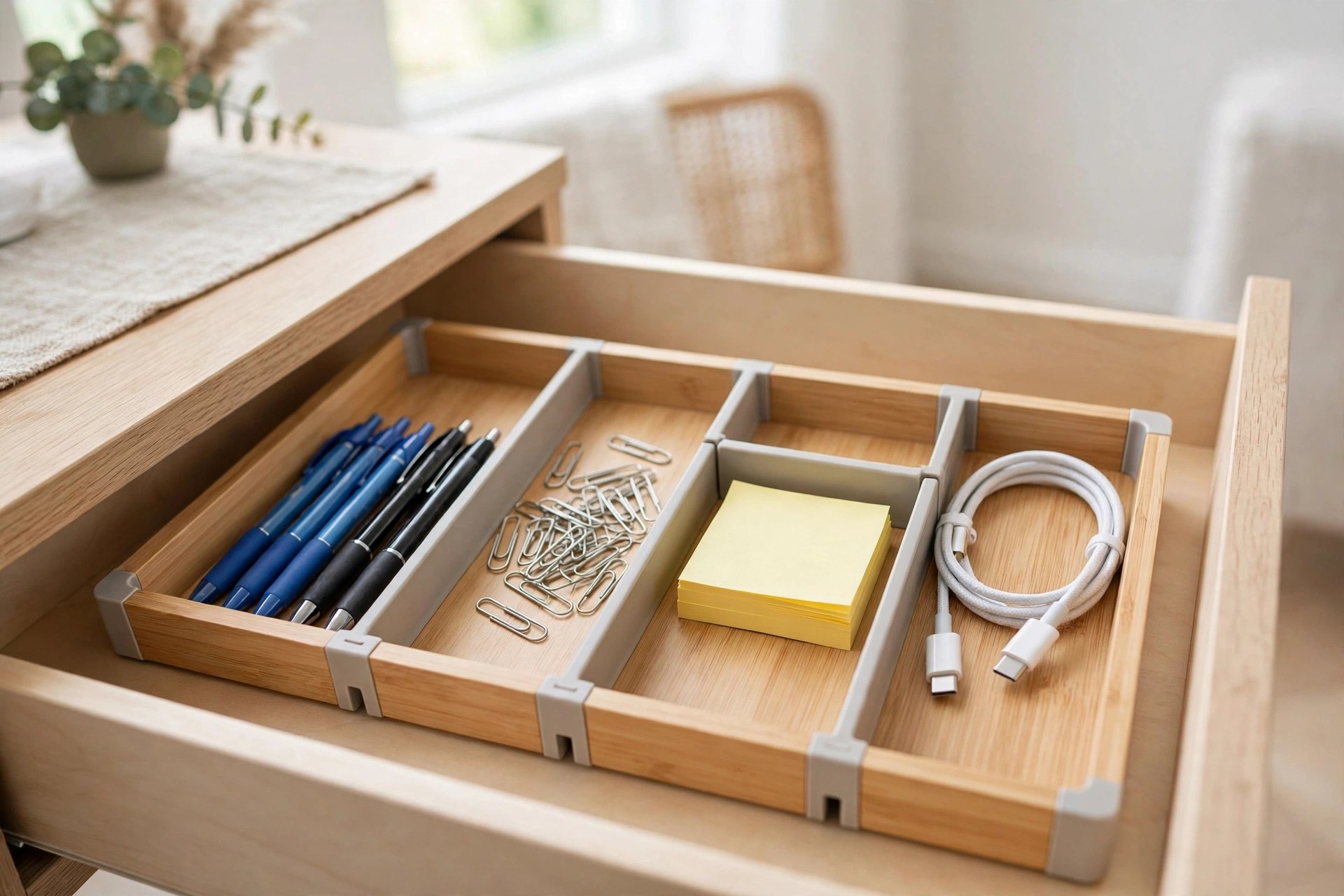
2. Fit One Drawer With an Adjustable Divided Tray
A loose drawer is just a clutter box with a lid. A divided tray turns it into a filing system for small things. Measure the drawer's inside width, length, and depth first, then choose a tray that leaves about 1/2 inch of slack on each side. Adjustable dividers beat fixed grids, because cables, pens, and sticky notes are not the same shape. Keep the tray to one layer: if you need to dig under things, the drawer holds too much. This one tray should swallow everything that currently lives loose on your desk.
3. Hide the Power Strip in a Cable Management Box
Half of most desk clutter is actually cable clutter. A cable box roughly 12 to 16 inches long, 5 inches wide, and 5 inches high swallows a standard 6-outlet power strip plus its brick adapters, and turns a visible tangle into one plain box behind the monitor. Choose one with ventilation slots and openings at both ends, and never coil excess cable tightly inside: loose loops only, so heat can escape.
4. Clip and Channel the Cables That Leave the Desk
The box handles the strip. The cables that travel still need a path. Stick adhesive cable clips along the back edge of the desk, one every 8 to 10 inches, so charger ends stay parked at the edge instead of sliding to the floor. For the run down to the box, an under-desk raceway, usually 24 to 31 inches long and about 3 inches wide, sticks or screws under the back of the top and hides the whole bundle.
5. Move Paper Up Into Wall File Holders
Paper piles grow because flat surfaces invite stacking. Wall file holders break the habit by storing paper vertically, where you can see it. A 3 to 5 pocket holder is typically 13 to 15 inches wide and holds letter and A4 folders upright. Mount it so the lowest pocket sits about 6 to 8 inches above the desk surface: reachable from your chair, clear of your monitor. Give each pocket one job only: in, active, and file-or-shred. When the active pocket will not close, process it. Do not buy a bigger holder.
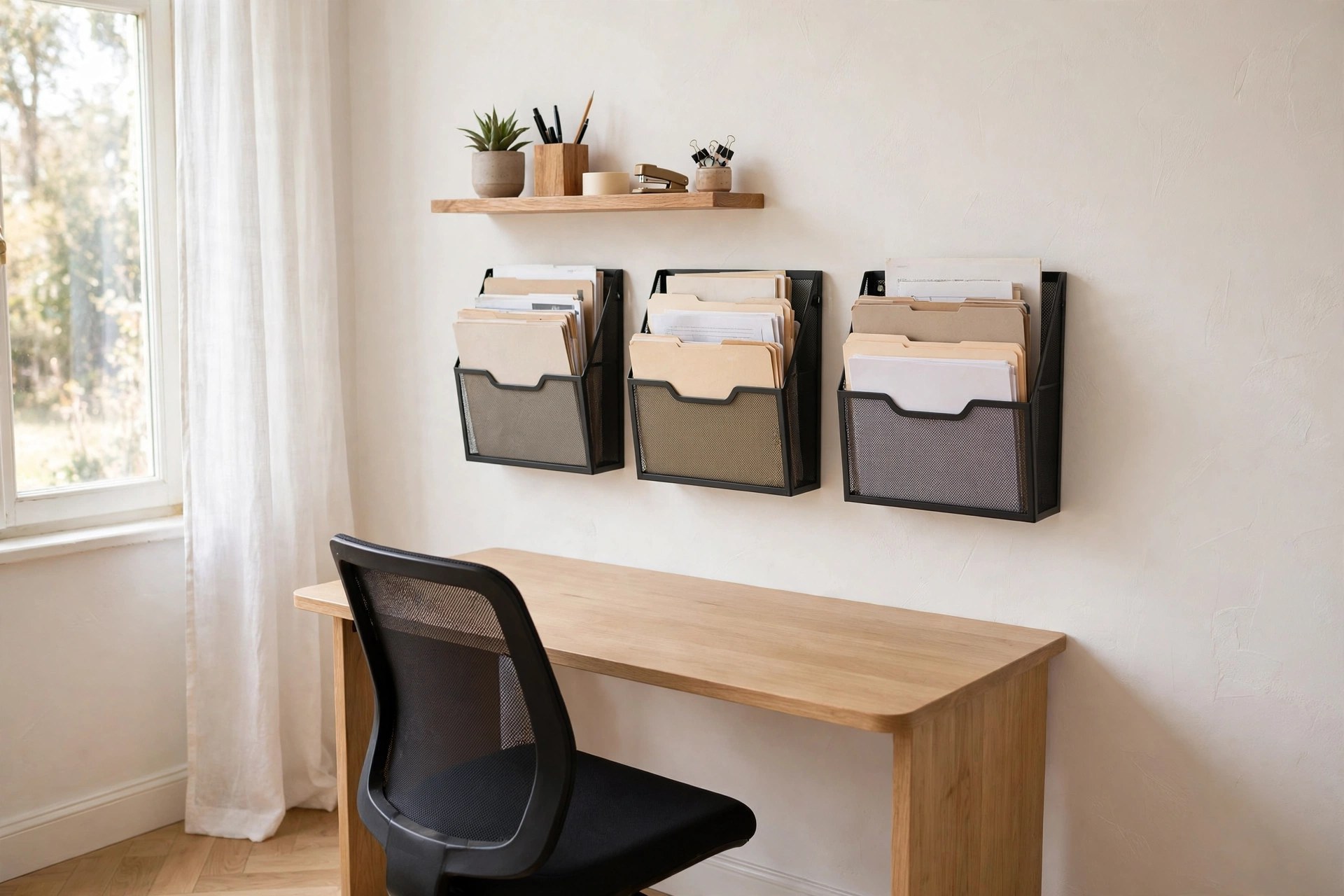
6. Hang One Floating Shelf in the Wall Zone
One shelf in the wall zone holds the things you reach for weekly: reference books, a supply box, the printer paper. Keep it modest: 24 to 36 inches long and 6 to 8 inches deep is enough, and deeper shelves just collect. Mount the underside 18 to 24 inches above the desk surface, high enough that you never bump it standing up, low enough to reach while seated. Anchor into studs or use rated anchors, and stay under the bracket rating, usually 15 to 25 pounds for a small shelf: paper and books are heavier than they look.
7. Use a Small Pegboard for the Daily Tools
Scissors, headphones, tape, chargers: the odd-shaped daily tools drawer trays handle badly. A pegboard panel about 24 by 24 inches, mounted beside the monitor or on the side wall, holds them on hooks and small bins you can grab and return in one motion. Keep the board inside arm's reach from your chair, roughly the 20 inches either side of your keyboard. Nothing can hide behind anything else on a pegboard. When every hook has a tenant, the board is full: new tool in, old tool out.
8. Slide a Slim Pedestal Beside Your Knees, Not in Front of Them
If your desk has no drawers at all, a slim rolling pedestal gives you a drawer stack without replacing the desk. Look for a unit about 15 inches wide and 20 inches deep, on casters, that slides under a standard 28 to 30 inch desk height with an inch to spare. Position it at one side, never centered, so your knees keep their 24 to 30 inches of clear width. Top drawer for daily supplies, bottom section for files. Because it rolls, you can pull it out to clean behind it.
9. Sort Desktop Paper Vertically, in One Sorter Only
Some paper must stay on the desk. Keep it vertical and keep it to one container. A desktop file sorter with 4 to 6 sections takes up about 4 inches of depth and 10 to 12 inches of width at the back corner, and holds the same paper that would sprawl across a quarter of the surface as a flat pile. One sorter is the rule. A second sorter is just a pile with better marketing.
10. Clamp Small Holders to the Desk Edge
The edge of the desk top is storage space most people never use. Clamp-on holders grip tops from about 0.6 to 1.6 inches thick and hold the cup, headphone hook, or phone stand that would otherwise eat surface. A headphone hook under the front edge keeps a bulky headset off the desk entirely. A clamp cup holder on the side edge moves your mug away from the keyboard, which is where spills do their damage. Two clamps maximum.
11. Dock a Laptop Vertically When You Use a Monitor
If you work on an external monitor, your laptop is probably lying flat, taking up about 13 by 9 inches of prime surface. A vertical laptop stand holds it upright in a slot about 2 to 3 inches wide, adjusted to your machine's thickness, and gives you back almost all of that footprint. Park it at the back of the desk near the cable box, so its cables run short and straight into the raceway, and leave the vents unobstructed.
12. End With a Two-Minute Reset, Every Day
Storage systems fail at the end of the day, not in the shop. The reset is simple and timed: two minutes, everything back to its zone. Pens and notebook into the riser drawer, paper into the wall holder or sorter, charger end back in its clip, mug to the kitchen. Set a small landing tray, about 10 by 6 inches, at the desk's entry corner for things that arrive during the day. Anything still on the tray at reset time gets filed, trashed, or taken to its real home. The tray is allowed to collect. The desk is not.
Quick Picks: Match the Idea to Your Clutter
Not sure where to start? Match the fix to the pile. If your surface disappears under paper, start with ideas five and nine: wall file holders and one vertical sorter, and ban flat stacks. If cables are the mess, ideas three and four clean up the view in under an hour. If small supplies are everywhere, ideas one and two give every clip and cable a compartment. If you have no drawers, idea eight, the slim rolling pedestal, is your foundation, and idea six, the wall shelf, your second buy. On a tight budget: reset habit first because it is free, then the cable box, then the drawer tray, then the wall storage. If the whole corner is fighting you, our guide to small home office layout ideas covers where the desk itself should sit, and once storage works, our home office desk styling ideas make it look good too.
Desk Storage Mistakes That Bring the Clutter Back
Four mistakes undo everything above: buying organizers before measuring, so trays do not fit drawers and risers do not fit keyboards; storing things on the surface that you use less than once a week; adding a second container for the same category, which splits supplies and guarantees duplicates; and skipping the daily reset, so every system slowly becomes a pile again. Storage is a set of sizes and one small habit, not a shopping trip. For more ways to make a compact workspace work, browse our Home Office ideas archive.
Start this weekend with the free step: clear the desk completely, sort everything into the three zones, and put back only what earns its place. Then measure your drawer and the wall strip above the desk. Those two measurements decide your first two purchases.


Comments
Post a Comment