
12 Small Living Room Curtain Ideas That Make Ceilings Higher
If your ceiling feels low, your curtains are probably hung too low. The best small living room curtain ideas are not really about fabric at all. They are about placement: a rod moved a few inches higher, panels that run all the way to the floor, and fabric that stacks on the wall instead of covering your glass. Get those three things right and an 8-foot ceiling reads taller, the window looks wider, and the whole room feels less boxed in. These twelve ideas give you the exact measurements behind each trick, so you can measure once and hang once.

Measure First: The Three Numbers Behind Every Idea Below
Learn the three numbers that decide whether curtains lift a small room or squash it.
- Rod height: 4 to 6 inches above the window frame, minimum. On a standard 8-foot ceiling, go higher: halfway to two-thirds of the way between the top of the frame and the ceiling, or 2 inches below the ceiling itself. If you have crown molding, stop 1 to 2 inches below it.
- Rod width: extend 8 to 12 inches past each side of the frame. That extra width is where open panels live. Every inch of glass they uncover is an inch of daylight and visual width you get back.
- Panel length and fullness: floor length, at 1.5 to 2 times the rod width in total fabric. Standard lengths are 84, 96, and 108 inches. Measure from your planned rod height to the floor, then buy the next length up and hem if needed. You can shorten a panel. You cannot lengthen one.
Designer guides from Jenna Kate at Home on how to hang curtains and By Arlyss on how high to hang curtains land on the same baseline: 4 to 6 inches above the frame is the floor, not the ceiling, of good placement. Each idea below builds on those numbers.
12 Small Living Room Curtain Ideas That Make Ceilings Higher
1. Hang the Rod as Close to the Ceiling as You Can
This is the single highest-impact move on the list. Mount the rod 2 inches below the ceiling, or 1 to 2 inches below crown molding, instead of just above the frame. On an 8-foot ceiling, that shift adds nearly a foot of uninterrupted vertical line. Your eye travels from floor to ceiling without stopping at the frame, so the ceiling reads higher. Use the longest standard panel that fits, usually 96 inches.
2. Go Wide: Extend the Rod 8 to 12 Inches on Each Side
Height is only half the trick. Extend the rod 8 to 12 inches past the frame on both sides, so a 36-inch window gets a rod of 52 to 60 inches. Open panels then stack against the wall, not over the glass, which does two things at once: the window looks up to 24 inches wider, and the room gets the full daylight the glass was made to deliver. In a small living room, that extra light matters as much as the illusion. Check for a stud or use a proper anchor at each bracket, not just plaster.

3. Choose Floor-Length Panels, Never Sill Length
Short curtains chop a small room at exactly the wrong height. Floor-length panels create one unbroken line from rod to floor, and that line is what your brain reads as ceiling height. Aim for a float, about 1/2 inch above the floor, best for busy rooms and pets; a kiss, where the hem just grazes the floor; or a slight break, about 1 inch extra. Skip the puddle: 2 to 4 inches of pooled fabric collects dust and drags the eye down.
4. Try a Ceiling-Mounted Track for the Full Height Illusion
When a rod cannot go any higher, a track screwed directly into the ceiling removes the gap entirely. Panels hang from the ceiling line itself, so the fabric becomes a soft wall running the full height of the room. Tracks glide better than rods and disappear visually. Set the track 2 to 4 inches out from the wall so panels clear the frame and radiators below. It is the closest thing to raising the roof.
5. Let Sheers Do the Daytime Work
In a small living room, heavy fabric all day makes the room feel smaller by lunchtime. A sheer panel in white, ivory, or pale linen filters harsh sun into a soft glow, gives real daytime privacy, and adds almost no visual weight. Hang sheers on the same high, wide measurements as any other panel: the height trick works even when the fabric is nearly transparent, because the eye still follows the line to the top of the wall. One warning: sheers protect privacy only while daylight outside is brighter than your lamps. After dark, you need a second layer.
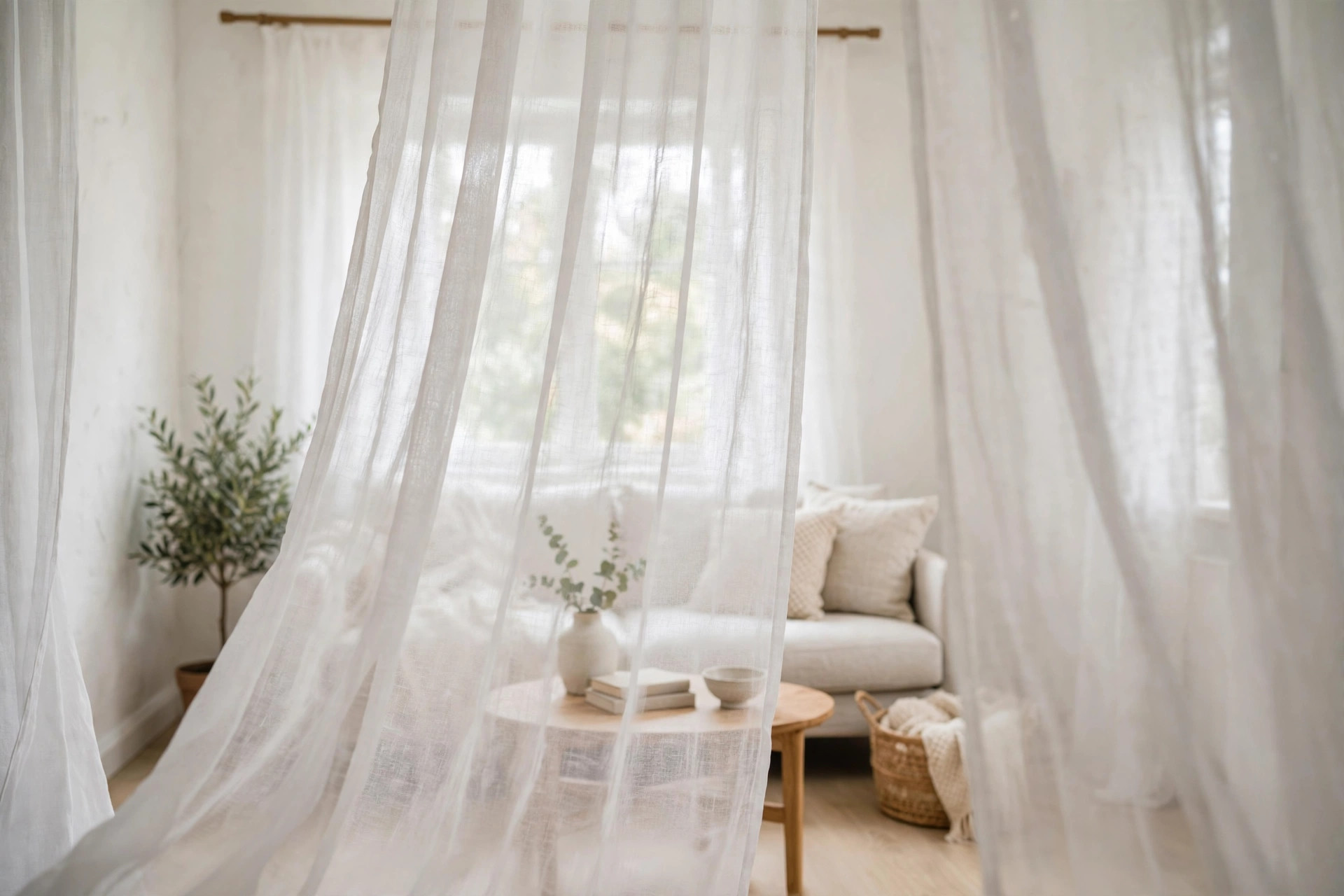
6. Layer Sheers With Light-Filtering Panels on a Double Rod
The most practical setup for a living room that is also a TV room: sheers closest to the glass for the day, light-filtering or blackout-lined panels in front for the evening. A double rod, back rod 2 to 3 inches from the wall and front rod 2 to 3 inches beyond it, keeps layers from tangling. Keep both layers the same length and light color family. Draw the front panels at night for privacy and glare-free screens.
7. Match the Curtain Color Closely to the Wall Color
Contrast is a frame, and a frame shows you exactly where the window ends. In a small room, you want the opposite: curtains within one or two shades of the wall color, so the window edge blurs and the wall reads as one wide, tall surface. White walls get warm white or ivory panels. Pale gray walls get light gray or soft greige. A linen weave still adds texture without a hard outline. Save strong color for cushions and throws, which are cheaper to change.
8. Use Vertical Stripes or a Tone-on-Tone Vertical Pattern
If plain panels feel too plain, let the pattern work vertically. A woven stripe, a pinstripe, or embroidered vertical lines pull the eye upward every time you look at the window, reinforcing the high rod instead of fighting it. Keep stripes 1 to 3 inches apart, ideally tone-on-tone, a shade deeper than the ground. Avoid large horizontal bands, wide checks, and busy small prints: they cut the height or clutter the wall.
9. Pick the Right Fullness: 1.5 to 2 Times the Rod Width
Skimpy panels are the quiet reason many curtains look cheap. Too little fabric hangs in flat, sad folds, and flat folds make a window look narrower. Add up the width of all your panels and aim for 1.5 to 2 times the rod width: a 60-inch rod wants 90 to 120 inches of total panel width, so two 50-inch panels are the minimum, not a luxury. Linen blends look best near 1.5 times. Sheers can go to 2 or 2.5 times, because the gathers give a sheer its glow.
10. Make Curtains Part of the Whole Wall, Not Just the Window
Curtains get taller when the wall cooperates. Keep the sofa back below the sill line where you can, and leave 2 to 3 inches between panel and sofa arm, so fabric falls in clean folds. A rug under the seating pulls the eye across the floor while curtains pull it up the wall. If your rug is fighting your layout, our guide to small living room rug ideas fixes the floor half of the picture, and our small apartment living room layout ideas cover where the sofa should sit in the first place.
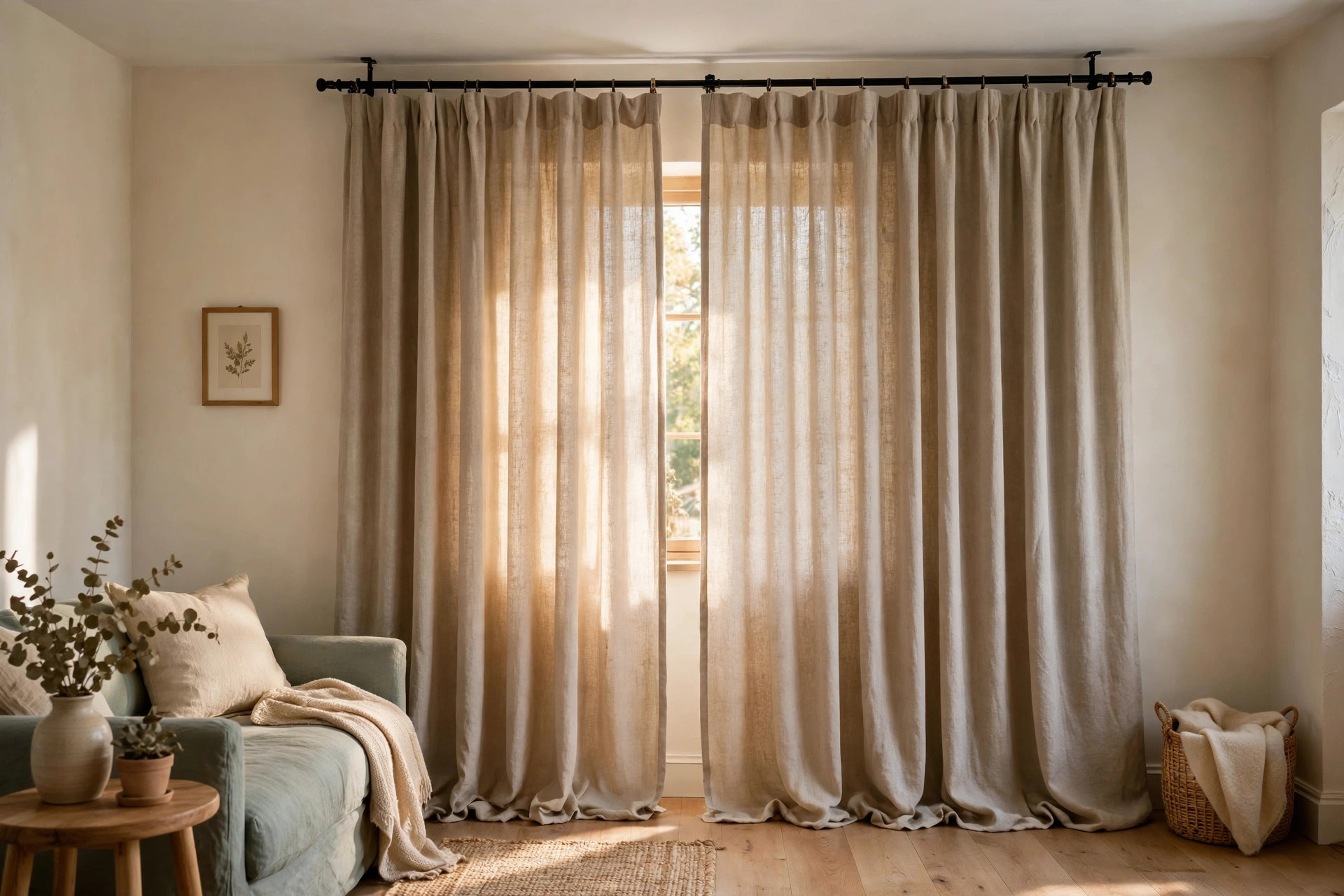
11. Go Renter-Friendly: No-Drill Options That Still Hang High
You do not need to drill to hang high. Tension rods fit inside the frame and suit sheers only; most hold under 5 pounds and bow past 60 inches. Adhesive brackets hold light to medium panels, typically 10 to 15 pounds per pair, and come off with heat at move-out. Clamp brackets grip the frame itself, hold the most weight, and let you mount 4 to 6 inches above the glass. Weigh the panels first and buy hardware rated above it. Renting is no reason to hang at frame height.
12. Finish With Simple Hardware and a Quick Steam
The last 10 percent is polish. Choose a slim rod, 3/4 to 1 inch in diameter, and keep finials small or skip them; oversized finials eat your width. Clip rings help panels stack tighter. Then steam the panels after hanging: packet fold lines break the vertical line, and ten minutes with a steamer, top to bottom, makes curtains look installed rather than unpacked.
Quick Picks: Match the Idea to Your Problem
Not sure where to start? Match the fix to the feeling. If the ceiling itself feels oppressive, start with ideas one and four: rod at the ceiling line, or a ceiling track, with 96-inch panels. If the room feels dark, start with ideas two and five: widen the rod by 8 to 12 inches a side and switch to sheers, so the glass works all day. If evenings feel exposed, or the TV washes out, go to idea six and layer a light-filtering panel in front of the sheer. If you rent, idea eleven gets you the same high line without a single hole. And if the budget only stretches to one change this month, make it length: replacing sill-length panels with floor-length ones, at the rod height you already have, is the cheapest single upgrade here, usually one pair of 96-inch panels and a hem. Do that first, live with it for a week, then decide whether the rod needs to move too. Most people find it does, and by then the measuring feels easy.
Curtain Mistakes That Make a Small Living Room Feel Lower
Four mistakes undo everything above: a rod mounted 1 or 2 inches above the trim, which pins the eye at window height; panels that stop at the sill or hover 3 or 4 inches above the floor; a rod the same width as the window, so open panels cover a third of the glass; and dark, heavy drapes on a small window, whose weight and contrast shrink the wall. Fix the numbers first, and most small living room curtain ideas start working in your room, not just in photos. For more ways to stretch a compact room, browse our Living Room ideas archive.
Start this weekend with idea one. Move the rod up, extend it wide, measure for floor length, and live with the new line for a week before you change anything else. It is the cheapest ceiling raise you will ever buy.
Comments
Post a Comment