
12 Small Living Room Rug Ideas That Make the Room Feel Bigger
12 Small Living Room Rug Ideas That Make the Room Feel Bigger
Here is the uncomfortable truth about compact living rooms: the rug you think is "safe" is probably the thing making the room feel small. The best small living room rug ideas start from the same counterintuitive move — go bigger than feels sensible. A too-small rug chops the floor into little islands of furniture. A properly sized one pulls the seating area into a single calm zone, and the room reads as larger and finished.
Every idea below comes with the real numbers: exact rug sizes, how far furniture legs should sit on the rug, how much bare floor to leave at the walls, pile heights that work, and materials that survive daily life. Measure first, then shop — in that order.
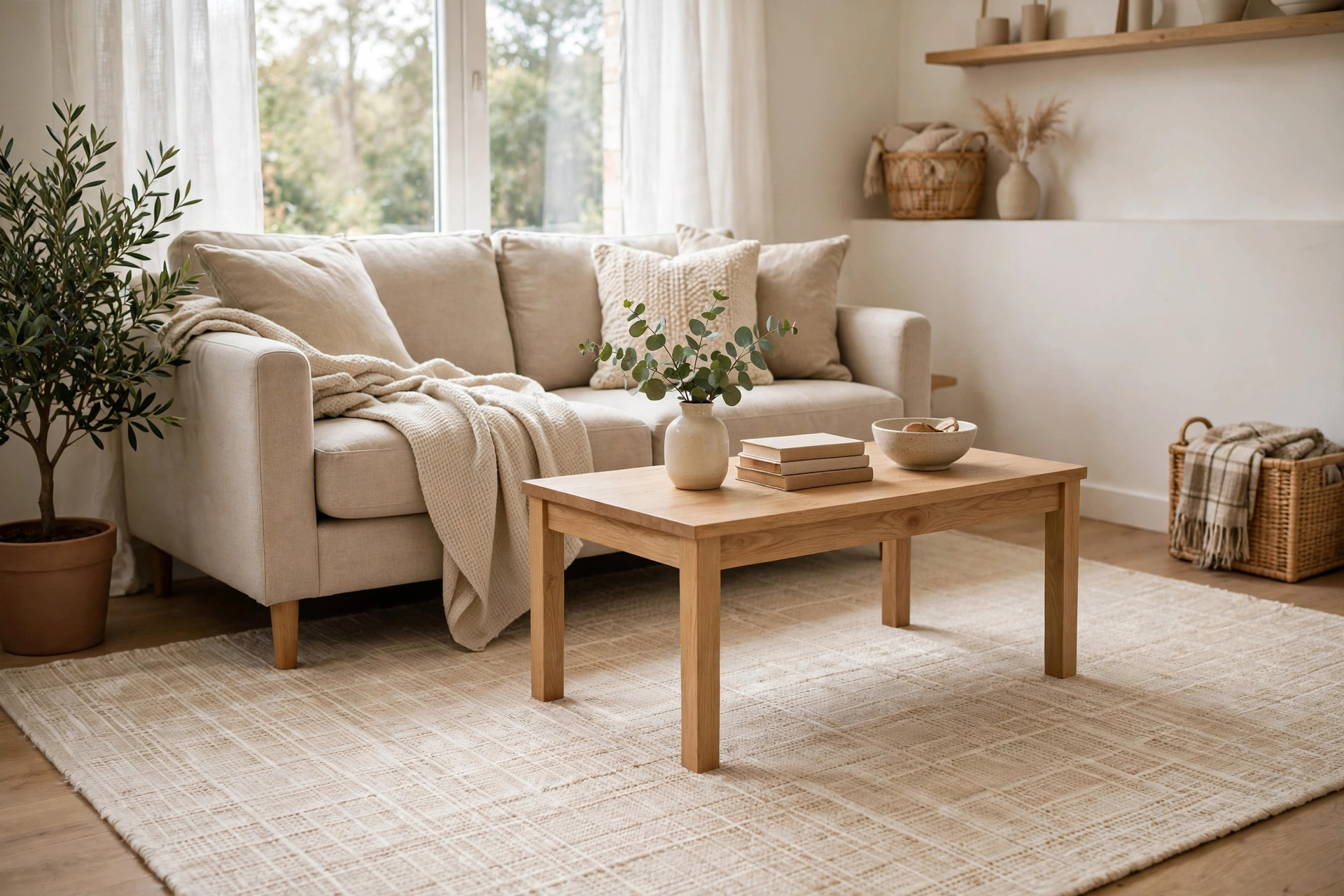
One quick principle before the list: at least the front legs of your sofa and chairs should rest on the rug. That single rule, confirmed in sizing guides like The Spruce's rug size guide, is what connects separate pieces of furniture into one "room within the room." A rug that floats in front of the sofa with no legs on it almost always looks like a bath mat that wandered in by mistake.
12 Small Living Room Rug Ideas for a Bigger-Feeling Room
1. Size Up: A 6x9 Beats a 5x7 in Most Small Rooms
The most common small-room mistake is buying the 5x7 because it feels proportionate. It usually is not. A standard three-seat sofa is 84 to 90 inches long — wider than the 84-inch long side of a 5x7 rug — so the rug ends up narrower than the sofa, and the whole arrangement looks pinched.
Use this ladder instead:
- 5x7 or 5x8 ft: only for a loveseat (under 72 inches) or a coffee-table-only layout in a studio corner
- 6x9 ft: the small-room sweet spot — front legs of a full sofa plus two chairs land on it comfortably
- 8x10 ft: if your room is around 10x12 ft or bigger, this often fits with front legs on and still leaves a floor border
- 9x12 ft: rarely needed in a small room, but the right call for open-plan spaces where the seating zone needs real definition
The rule that settles it: the rug should extend at least 6 to 8 inches beyond the sofa on each side. If you are between two sizes, buy the larger one. Nobody regrets the bigger rug; the returns queue is full of the smaller one.
2. Use the Front-Legs Rule — and Measure It Properly
"Front legs on" gets quoted everywhere, but here is what it means in practice: slide the rug under the sofa so the front legs sit 6 to 8 inches onto the rug, with the back legs on bare floor. That overlap is what locks the sofa to the rug visually. If only an inch of rug peeks out under the legs, the connection is too weak and the rug still reads as separate.
Apply the same rule to armchairs: front legs on, angled chairs included — a chair with all four legs off the rug looks like it is trying to leave the conversation. Before you buy: mark the rug outline with painter's tape and live with it for a day. Walk your normal paths and open every door. Ten minutes of tape saves a return trip.
3. Leave a Deliberate Border of Bare Floor
A rug that runs wall to wall reads as carpet, and carpet makes a small room feel like a padded box. The frame of bare floor around the rug is what tells your eye "this is a defined zone inside a larger room" — even when the room is not, in fact, larger.
The numbers, echoed by sizing guides such as the one from RugKnots: leave 12 to 18 inches of bare floor between the rug edge and the walls in a standard room, and 8 to 12 inches in a genuinely small one. Keep the border roughly even on all sides — if one side has 14 inches and the other has 2, the rug looks shoved rather than placed. Center it on the seating arrangement, not necessarily on the room.
4. Go Light and Low-Contrast to Borrow Visual Space
Light rugs reflect more light and push the room's edges outward visually. Cream, warm white, pale oatmeal, flax, and soft mineral gray are the reliable enlargers. Control the contrast: the rug should be clearly lighter (or darker) than your sofa, but avoid a harsh jump — a stark white rug among black furniture can look like a dropped sheet of paper.
If all-pale feels risky with kids, pets, or coffee, pick a light base with a subtle tonal pattern — a faint vintage fade hides everyday marks while the read stays light. Pair it with the light-bouncing placements in these living room mirror ideas that bounce light around and floor and walls work together.
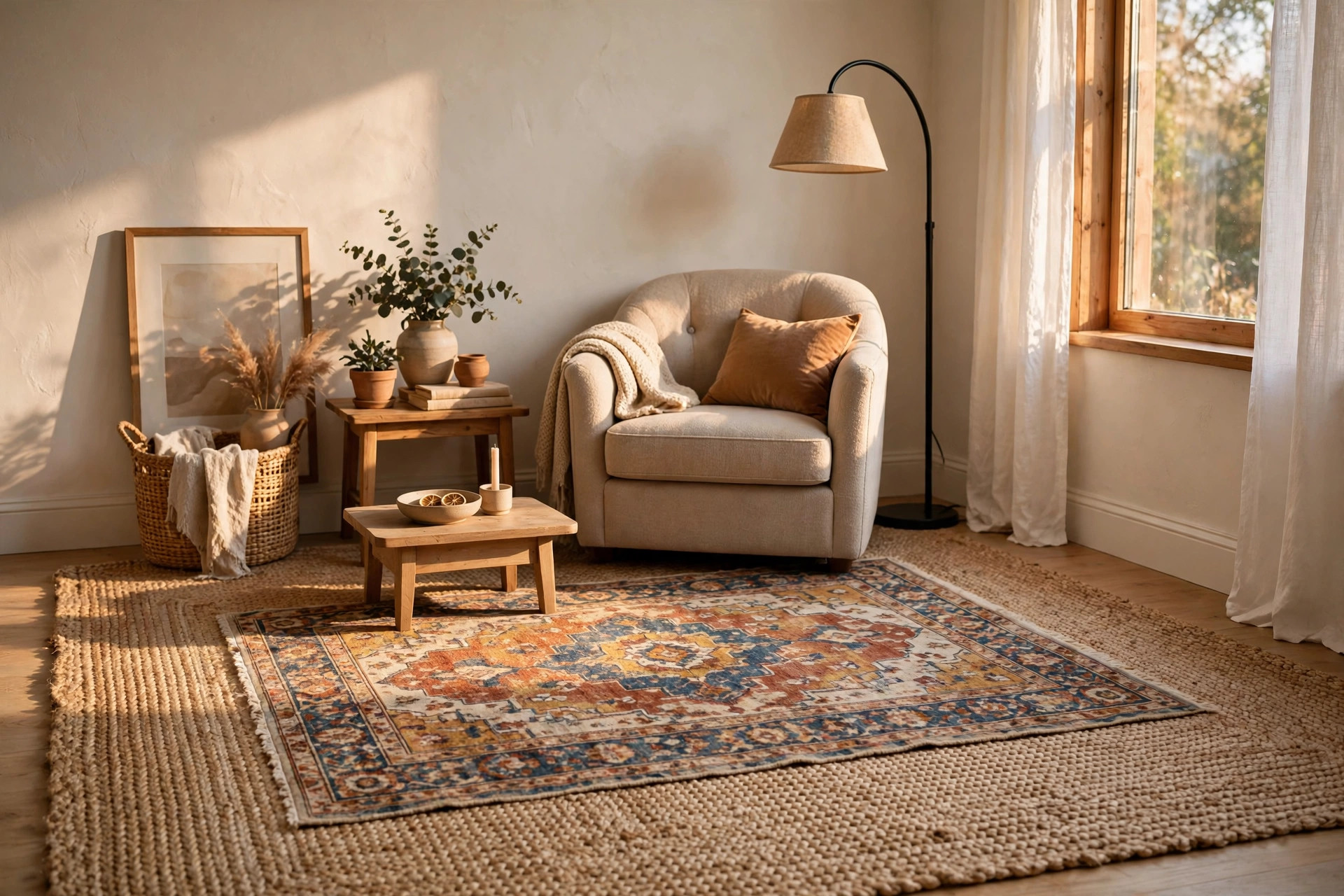
5. Layer a Small Statement Rug Over a Big Neutral Base
Layering is actually a small-room budget strategy: buy one large, inexpensive neutral base rug in the correct size (a flatweave jute or cotton 6x9 or 8x10), then layer the rug you actually love on top in a smaller 4x6 or 5x7, centered under the coffee table. You get the size benefits of the big rug and the personality of the small one for far less than a large statement rug costs.
Keep it tight: base quiet and flat, top rug carries the pattern, with a clear 12 to 18 inch border of base showing on all sides. Keep the combined pile under about half an inch where people walk, and pad the base so nothing creeps.
6. Run Stripes Across the Short Dimension to Widen the Room
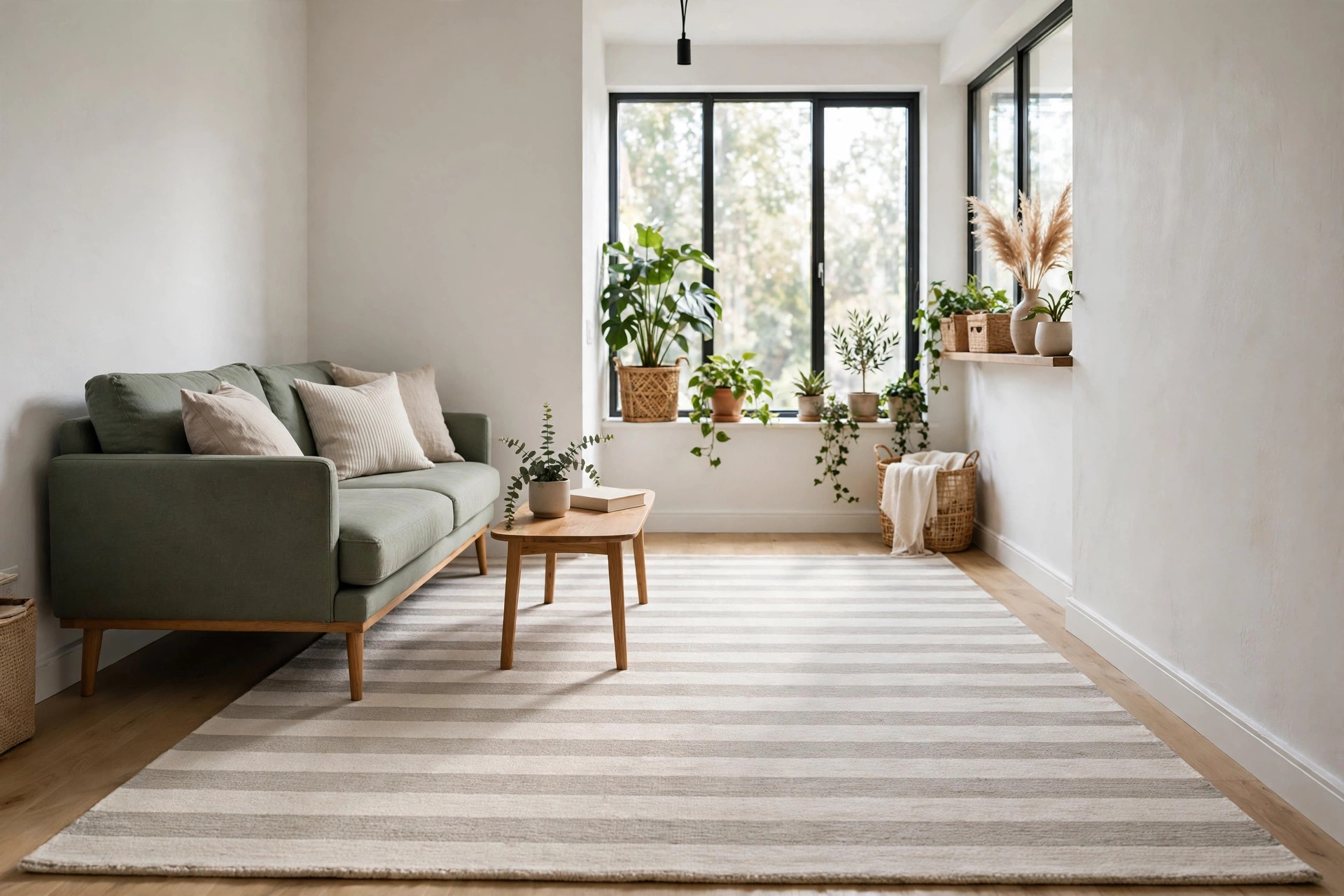
Stripes genuinely work: lay them across the short width of a narrow room — perpendicular to the longest wall — and the floor reads wider. Run them lengthwise and you get a bowling-lane effect instead. Keep stripes wide and contrast soft: broad bands in two close tones (ivory and warm greige) stretch the room calmly, while thin, high-contrast stripes vibrate and make a compact space feel restless. A striped flatweave is also easy to keep clean — which brings us to pile.
7. Keep the Pile Low: Under Half an Inch, Ideally Less
Deep, plush pile feels luxurious in a showroom and swampy in a 10x12 living room. High pile eats visual space, makes furniture wobble, traps dust, and catches on door swings. For small living rooms, the working range is:
- Flatweave (under 1/4 inch): crisp edges, chairs slide easily, doors clear it — the best choice under dining-adjacent seating and in high-traffic small rooms
- Low pile (1/4 to 1/2 inch): a little softness underfoot while staying tidy and vacuum-friendly
- Medium pile (1/2 to 3/4 inch): the practical ceiling for a living room rug; beyond this, only in a quiet corner setup
- Shag (3/4 inch and up): skip it in small rooms — it visually shrinks the floor and is miserable to clean
Missing the cushioned feel? Get it from the pad, not the pile. A felt-and-rubber rug pad about 1/4 to 3/8 inch thick under a low-pile rug gives you the soft step, stops sliding, and protects the floor — and nobody sees it doing any of it.
8. Try a Round Rug to Break Up a Boxy Room
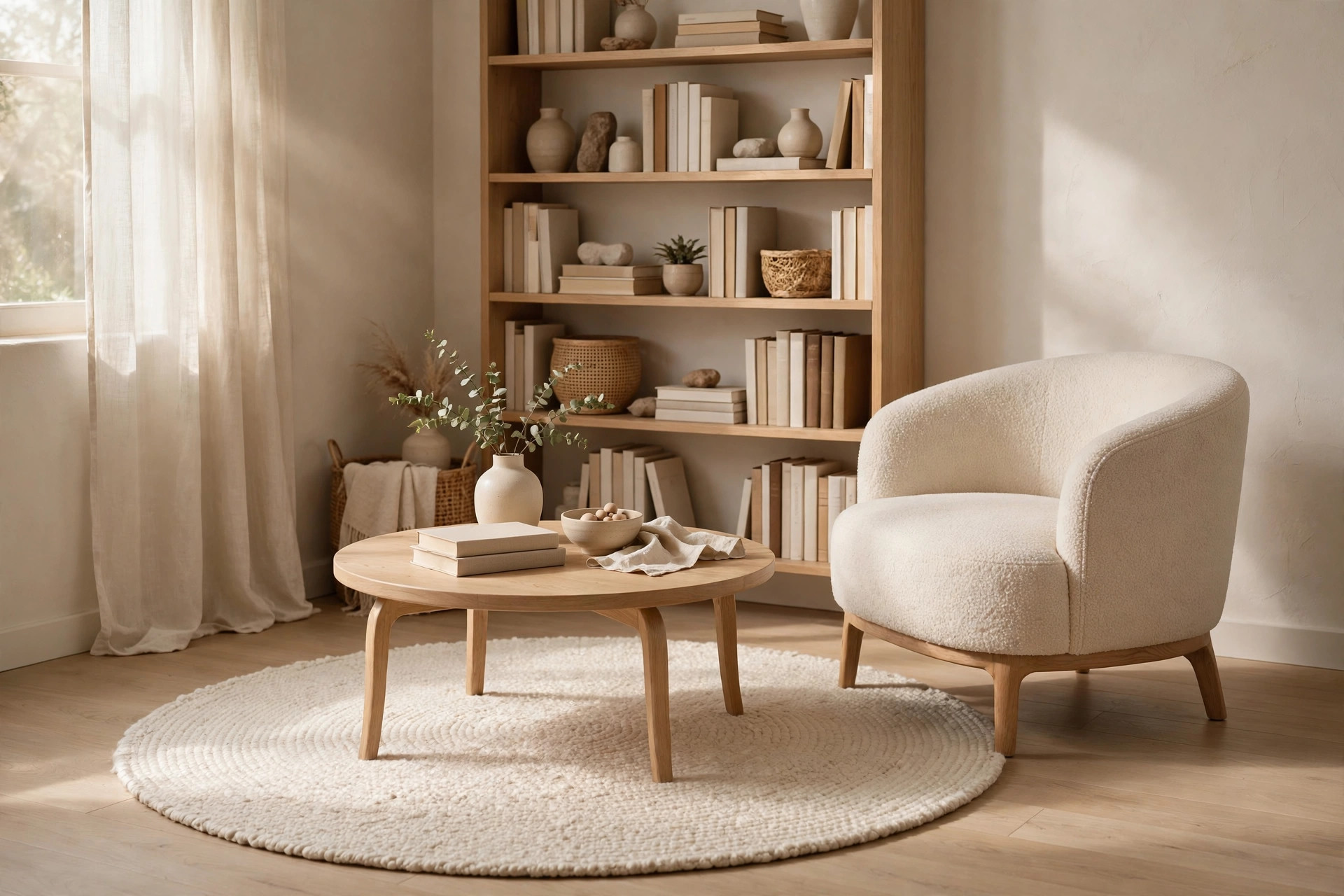
Small living rooms are usually rectangles full of rectangles. A round rug interrupts that grid and softens traffic flow. Sizes that work: a 6-foot round under a round or square coffee table with two chairs, or an 8-foot round if you want seating front legs on it — tape-test first, because round rugs cover less usable area than their diameter suggests.
Round rugs shine in a reading corner, a room with an angled wall, and any layout where a rectangle would collide with a door swing or hearth. If storage is eating your corners instead, solve that first with these small living room storage ideas, then let the round rug claim the cleared floor.
9. Pick Materials for the Life You Actually Live
A beautiful rug you are afraid to walk on is a failed rug. Match the material to your household, honestly:
- Wool (low pile): the long-term champion — naturally resilient, bounces back from furniture dents, hides soil between cleanings, and feels warm. Costs more upfront, lasts a decade or more
- Jute and sisal: tough, textured, and perfect as a large neutral base for layering. Jute is softer; sisal is harder-wearing but rougher barefoot. Both hate standing water — blot spills fast
- Cotton flatweave: light, affordable, easy to shake out; smaller sizes are often washable. Less cushion, less dent resistance
- Washable low-pile synthetics (polyester / polypropylene): the pragmatic pick for kids and pets — many are machine-washable, and polypropylene resists stains and fading. The trade-off is a shorter lifespan and a less rich feel than wool
Care basics that extend any rug's life: vacuum weekly without a beater bar on delicate weaves, rotate the rug 180 degrees every 6 months so wear and sunlight even out, and treat spills by blotting — never rubbing — from the outside of the stain inward.
10. Use a Runner When the Room Is Long and Narrow
Some small rooms are stretched rather than boxy — 8 feet wide and 16 long, or a studio where the "living room" is really a wide hallway. A standard rectangle leaves dead strips at both ends. A 2.5x8 or 3x10 ft runner in front of the sofa, or between sofa and TV stand, defines the seating strip and makes the narrow proportion feel deliberate. Leave 4 to 6 inches of floor along the long edges, and anchor it with a non-slip pad — runners in walkways migrate more than any other rug type.
11. Float the Rug Off-Center in an Awkward Layout
Not every small room allows a symmetrical layout — a fireplace on one wall, a radiator on another, a door in the wrong corner. The fix is to center the rug on the seating, not on the room, even if that leaves a wider floor border on one side. An off-center rug that fits the furniture looks intentional; a room-centered rug the sofa half-misses looks like a measuring error. Complete the effect after dark with the layered approach in these cozy living room lighting ideas — a defined rug zone plus warm pools of light makes a small room feel designed rather than squeezed.
12. Never Skip the Rug Pad — It Is Half the Result
The pad is invisible, which is why people skip it — then wonder why the rug bunches, slides, and feels thin. A felt-and-rubber pad stops the creeping, adds the cushion that lets you choose a sleeker low pile, protects the floor finish, and extends the rug's life by absorbing backing friction. Buy it 1 inch smaller than the rug on every side so it stays hidden. On wall-to-wall carpet, use a dedicated rug-on-carpet pad instead. Small cost; the difference is between a rug that feels installed and one that feels parked.
Small Living Room Rug Size Cheat Sheet
| Your situation | Rug size | Placement rule |
|---|---|---|
| Loveseat under 72" in a studio corner | 5x7 or 5x8 ft | Front legs on, or coffee table only |
| Standard sofa (84-90") in a small room | 6x9 ft | Front legs of sofa + chairs on; rug 6-8" wider than sofa per side |
| Room around 10x12 ft | 8x10 ft | Front legs on, 8-12" bare-floor border |
| Open-plan seating zone | 9x12 ft | All legs on if possible; defines the zone |
| Round coffee table / reading corner | 6-8 ft round | Table fully on; chair front legs on for 8 ft |
| Long, narrow room | 2.5x8 or 3x10 ft runner | 4-6" floor showing along long edges |
| Any rug, any room | Pile under 1/2 inch | Pad cut 1" smaller per side |
Small Living Room Rug FAQs
What rug size makes a small living room look bigger?
The largest standard size that still leaves an 8 to 12 inch border of bare floor — for most small rooms that is a 6x9, and for rooms near 10x12 feet it is an 8x10. The rug should be wider than your sofa by at least 6 to 8 inches on each side, with the front legs of all seating resting on it.
Should all the furniture legs be on the rug in a small room?
All legs on is the most polished look but demands a big rug. Front legs on is the practical small-room standard and looks just as intentional when done consistently. The one arrangement to avoid is no legs on with a small rug — that is the floating "postage stamp" that makes rooms feel disjointed.
How much floor should show around a rug in a small living room?
About 8 to 12 inches in a small room, and 12 to 18 inches in a standard room. Keep the border as even as you can on all sides, centering the rug on the seating arrangement rather than the room if the two disagree.
Are dark rugs a mistake in small living rooms?
Not automatically. A deep-toned rug can ground a room with pale walls and a light sofa, and dark patterns hide wear well. The risk is dark rug plus dark furniture plus low light, which collapses the contrast the eye uses to read space — if you go dark, keep the sofa or walls clearly lighter.
Do I really need a rug pad on hard floors?
Yes. Without one the rug slides, edges curl into trip hazards, and the backing grinds against the floor finish. A felt-and-rubber pad cut 1 inch smaller per side fixes all three.
The Bottom Line
The best small living room rug ideas are not really about pattern or color first — they are about proportion. Size up to a 6x9 or 8x10, put the front legs on, keep an honest border of bare floor, stay under half an inch of pile, and let a good pad do the invisible work. Get those five decisions right and even a bold Persian-style or a humble jute flatweave will make the room feel bigger. Get them wrong and the prettiest rug in the shop will still make your living room feel like it shrank in the wash.
For more ways to stretch a compact room, browse all Living Room ideas on DecorNest — new small-space guides go up every week.


Comments
Post a Comment