
14 Cozy Living Room Lighting Ideas for Small Apartments
14 Cozy Living Room Lighting Ideas for Small Apartments
These cozy living room lighting ideas for small apartments prove one thing: coziness is a light setting, not a square-footage setting. In a small rental living room, a single harsh ceiling fixture is usually the reason the space feels flat, cold, and unwelcoming after dark. Warm bulbs, layered low light sources, and dimmers change that completely — no wiring, no electrician, and nothing your landlord will object to.
Below are fourteen ideas, ordered from the fastest wins to the designer-level touches. The first three alone will make your living room feel like a different room tonight.
The Warm-Light Formula: Color Temperature First
1. Swap every bulb to 2700K warm white
The single biggest upgrade costs the least. Most rentals come with 4000K–5000K “daylight” bulbs that make a living room feel like an office. Replace them with 2700K warm-white bulbs in every fixture — the difference is instant. Look for CRI 80 or higher so your sofa, rug, and wall colors still read naturally. Keep one spare box; once you go warm, you will never go back.
2. Put the main ceiling fixture on a dimmer
If your apartment allows a simple switch swap (many leases do), a plug-and-play dimmer on the overhead light turns the room’s loudest light source into its most flexible one. Evenings drop to 20–30% brightness; cleaning or hosting goes full bright. For a no-tools alternative, smart bulbs with a phone or remote dimmer do the same job with zero wiring.
3. Light at three heights, never just one
Designer trick that works in any small living room: make sure light is coming from three levels — something high (ceiling or top of a tall shelf), something at eye level (table lamp or sconce), and something low (floor lamp, lantern, or LED strip). One level of light looks flat; three levels give the room depth and that layered evening glow. This same layering principle is behind the cozy bedroom lighting ideas for small rooms that pair perfectly with this guide.
Lamps That Do the Heavy Lifting
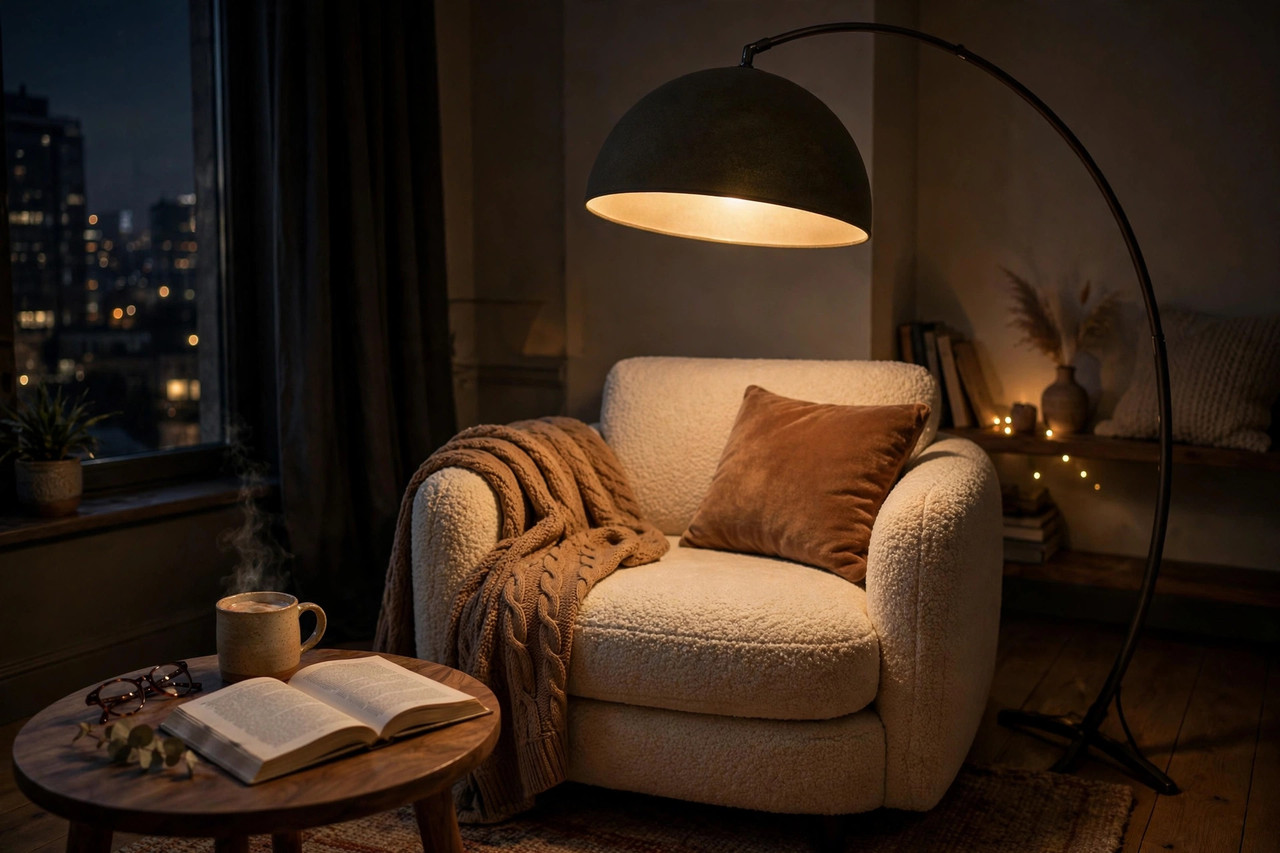
4. Add an arc floor lamp over the reading corner
An arc floor lamp curves its shade right over an armchair or the end of the sofa, giving you a focused reading pool without a hardwired ceiling fixture. In apartments under 500 square feet, place the base behind the chair (about 12 inches of clearance) so the arc reaches over the seat. Pair it with a 2700K bulb and you have the room’s warmest, most inviting corner.
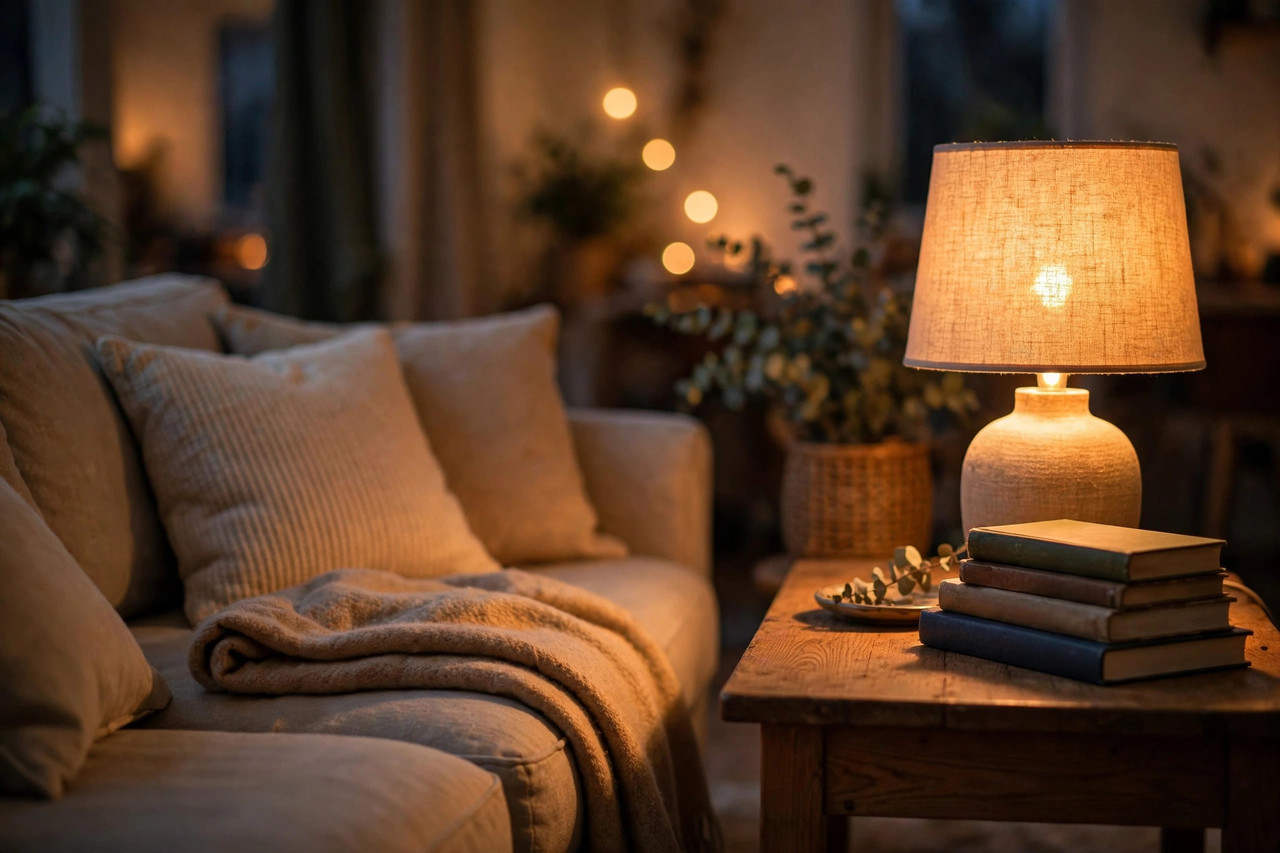
5. Use paired table lamps at seating height
Two table lamps at matching height — one on a side table, one on a console or bookshelf — create symmetry and double the low warm light that makes a room feel cozy. Choose fabric drum shades 12–16 inches wide; opaque or lined shades throw the softest glow. Keep the shade’s bottom edge at about eye level when you are seated (roughly 40–44 inches from the floor) so the bulb never glares.
6. Mount plug-in wall sconces — no wiring needed
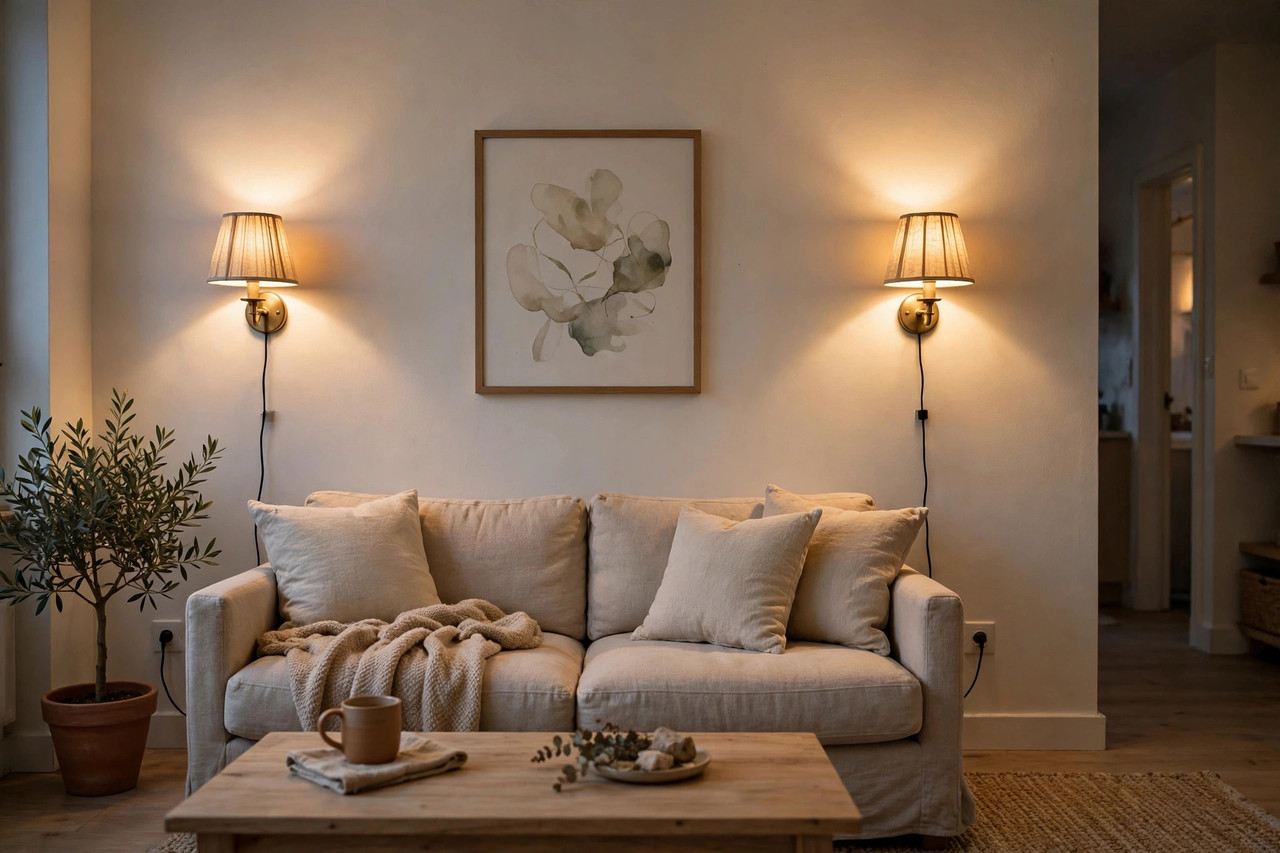
Plug-in sconces are the renter’s secret weapon: they screw into the wall with two anchors, the cord runs down to an outlet, and you get real sconce light at eye level. Flank a sofa, a mirror, or a piece of art with a pair, about 60 inches from the floor. Choose shades that glow rather than opaque metal ones — the wall-wash effect doubles the light’s reach.
7. Clip a battery picture light over your art
That gallery wall looks dead at night because nothing lights it. A battery-operated picture light clips onto a frame and throws a warm accent beam across the artwork, adding a second story of light to the wall. Most run 50–100 hours per set of batteries, and the warm tone makes even budget prints look collected.
Cozy Accent and Mood Light
8. Drape string lights where they belong: high and sparse
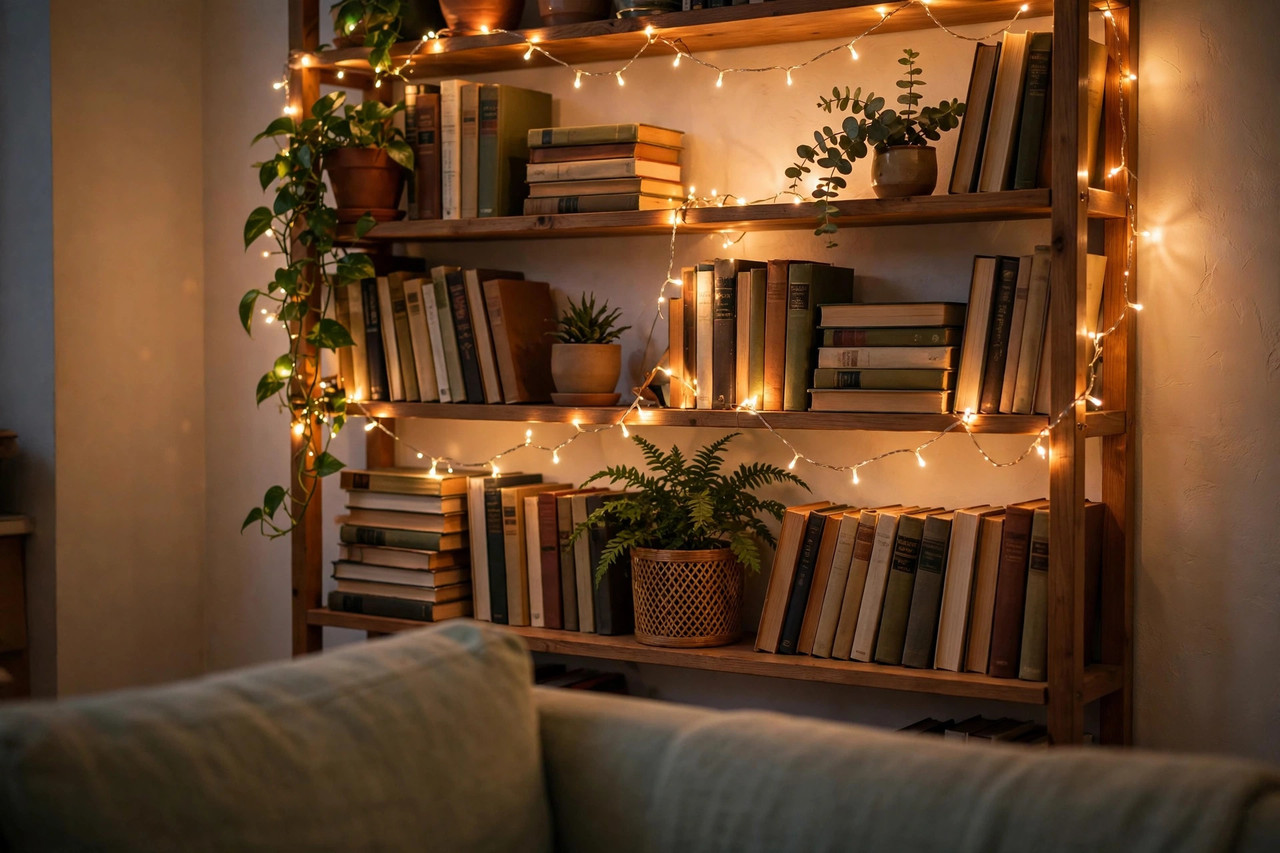
Warm-white fairy lights work in adult living rooms when they are placed like designers place them — along a bookshelf edge, across the top of a curtain rod, or woven through a plant — not tangled across the ceiling. One or two strands of 2700K micro-LED lights, hidden clips, and a timer plug so they come on automatically at dusk. The rule: if the wire shows, it looks like a dorm; if the glow shows, it looks like a boutique hotel.
9. Add LED strip light behind the TV
A warm LED strip stuck to the back of the television creates bias lighting: a soft halo on the wall behind the screen that reduces eye strain and makes the whole media corner glow instead of floating in darkness. Stick to warm white (2700–3000K), not color-changing modes, for the cozy effect. A USB-powered strip that switches on with the TV costs little and needs no remote juggling.
10. Group lanterns and candles for living light
No bulb reproduces flicker. A cluster of three lanterns or candles at different heights — on a coffee table, a stool, or the floor beside the sofa — adds the moving, breathing light that makes a room feel alive. Use LED pillar candles with a realistic flicker if your lease bans open flame; grouped in odd numbers, they read as intentional decor, not a power outage.
11. Uplight a tall plant or an empty corner
Dark corners shrink a room. A small uplight can (a can-shaped lamp that sits on the floor behind a plant) aimed at the ceiling bounces soft light upward and erases the shadow that makes corners disappear. Tuck one behind a tall plant and you get two effects at once: the plant’s leaves glow with rim light, and the ceiling brightens, which reads as more space.
Small-Apartment Lighting Tricks
12. Bounce light off light-colored surfaces
In a rental you cannot repaint, so work with what reflects: white or light curtains, a light rug under the seating area, and a mirror opposite a lamp all multiply your warm light without adding a single bulb. This is the same placement logic as the awkward living room layout guide — where light lands matters as much as where fixtures sit.
13. Never leave one end of the room dark
The most common small-apartment lighting mistake: every lamp clustered around the sofa, leaving the far half of the room in shadow. The brain reads a half-dark room as smaller. Put at least one low warm source — a small table lamp, a lantern, or an LED strip on a shelf — in the farthest zone from your seating. The whole room suddenly reads as one connected, larger space.
14. Set one-tap lighting scenes with smart bulbs
Two or three smart bulbs in your existing lamps, set to a “Movie” scene (warm, 30%) and a “Evening” scene (warm, 70%), give you boutique-hotel control for the price of a pizza. In a small apartment, being able to dim everything from the sofa — without walking lamp to lamp — is the difference between using your lighting layers and ignoring them. Deep, moody wall colors like the ones in these dark green living room ideas look especially rich under warm dimmed light.
Prices and brightness, source by source
Brightness targets. A small living room (about 120–180 square feet) feels properly layered at roughly 1,500–2,500 lumens total across all sources. Per source: ceiling fixture 1,100–1,600 lumens on the dimmer from idea 2; each table lamp a 450–800-lumen bulb (40–60W equivalents — 800 for reading, 450 for pure glow); an arc lamp 800–1,100. LED strips (idea 9) for bias light want about 150–300 lumens per foot; brighter turns the TV wall into a billboard. What each idea costs. 2700K LED bulbs: $3–$6 each, usually in four-packs. Smart bulbs (idea 14): $10–$15 each. Plug-and-play or smart dimmer (idea 2): $15–$30. Arc floor lamp (idea 4): $60–$150, with the arc reaching 48–66 inches out and the shade peaking at 66–80 inches high — measure your ceiling and the chair's position before ordering, because a short arc parks the shade behind the chair instead of over it. Table lamps (idea 5): $25–$60 each with shade; the 12–16-inch drum shades mentioned there want a harp and base that put the shade bottom at that seated eye level of 40–44 inches, which usually means a lamp 24–28 inches tall overall on a standard 24–26-inch side table. Plug-in sconces (idea 6): $30–$80 for a pair. Battery picture light (idea 7): $20–$40. String lights (idea 8): $10–$20 for a 10–15-ft warm micro-LED strand. TV bias strip (idea 9): $10–$18 for a 55–65-inch TV (strips are sold by TV size; buy the size up if between). Lanterns (idea 10): $12–$25 each in metal, LED pillars $15–$25 for a set of three with a remote. Uplight can (idea 11): $15–$30 plus bulb. Total: the full fourteen-idea room, bought new, lands around $250–$450 — but bulbs, one arc or floor lamp, and the bias strip alone ($100–$180) deliver most of the effect.
Cozy Living Room Lighting Mistakes to Avoid
- Daylight bulbs in a living room: 4000K+ bulbs flatten skin tones and kill coziness. 2700K everywhere is the baseline.
- One overhead light doing all the work: a single ceiling source creates harsh shadows and flat light. Add at least two low sources before judging any other change.
- Shade bottoms above eye level: if you can see the bare bulb from the sofa, the shade is too high or the lamp is too tall — glare destroys the mood instantly.
- Cool-white string lights: blue-white fairy lights read as holiday decor, not cozy. Warm white only in living spaces.
- Lighting only the sofa zone: a dark far half of the room makes the whole space feel smaller. One small warm source in the far zone fixes it.
For more layered-lighting inspiration, Family Home Inspo’s 20 cozy living room lighting ideas covers more fixture styles room by room, and Livingetc’s designer guide to cozy living room light has excellent placement advice for low pendants and sconces.
Cozy Living Room Lighting for Small Apartments: FAQ
What color temperature is best for a cozy living room?
2700K warm white, throughout the room. It mimics candlelight and makes seating areas feel relaxing after dark. Avoid 4000K “daylight” bulbs in living spaces — they read as clinical and flatten the room’s warmth.
How can I make my apartment living room cozy without rewiring anything?
Plug-in sconces, arc and table lamps, battery picture lights, USB LED strips, and smart bulbs all need zero wiring. Layer three heights of 2700K light and put the overhead on a smart-bulb dimmer — landlords never need to be involved.
How many light sources does a small living room need?
Aim for five to seven: one dimmable overhead, two to three lamps at seating height, one floor lamp or uplight, and one to two accent sources (string lights, candles, TV bias light). Fewer than four sources almost always looks flat.
Should the lights match in a small living room?
Match the warmth (all 2700K), not the fixtures. Mixing a modern arc lamp with a vintage-style table lamp looks collected and intentional — but one cool-white bulb in the mix will clash with everything warm around it.


Comments
Post a Comment