
15 Dark Green Living Room Ideas That Feel Rich and Cozy, Not Dark
15 Dark Green Living Room Ideas That Feel Rich and Cozy, Not Dark
A dark green living room with a brown couch is one of those combinations that sounds risky and looks expensive — deep, library-like, the kind of room where you actually want to sit down with a book and a blanket. These dark green living room ideas with brown couch pairings focus on the two things that keep the look rich instead of gloomy: enough warm light to balance the depth, and enough contrast (cream, brass, caramel) so the green reads as a color, not a shadow. Every idea below comes with realistic costs and measurements so you can plan instead of guess.
If you have been warming up the rest of the house this month, pair these with our cozy fall living room decor ideas for a full autumn refresh.
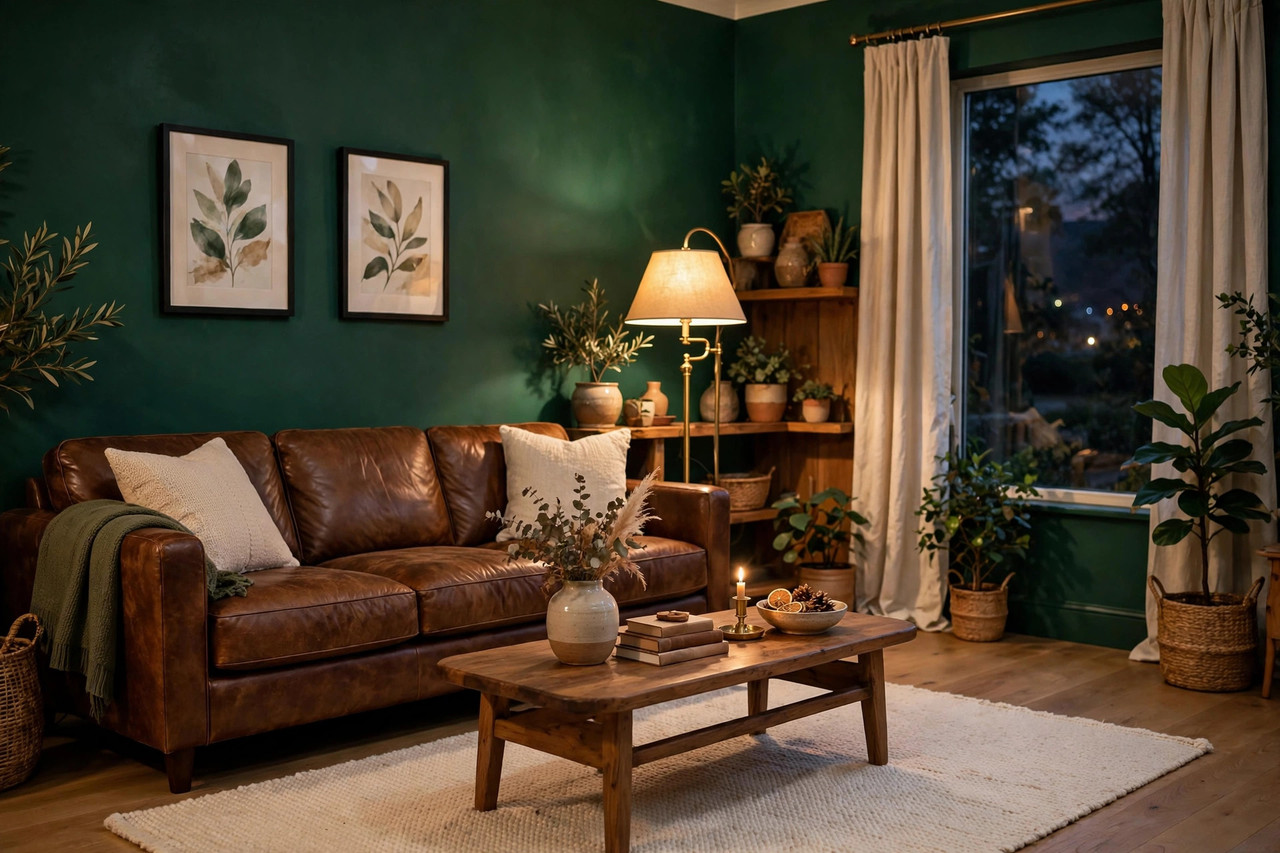
Dark Green Walls and Paint Ideas for a Brown Couch
The biggest decision is how much green goes on the walls. The rule that keeps it cozy: green wants company. Dark walls look richest when something light sits against them — and a brown couch alone is not enough contrast, so plan for a cream rug, light curtains, or pale wood in the same plan as the paint.
1. Paint one accent wall behind the couch in deep emerald
Start with a single 12-by-14-foot accent wall behind the brown couch: Sherwin-Williams Hunt Club or Evergreen Fog are the two most-used deep greens for this look. One gallon of quality paint ($38–55) plus primer covers about 400 square feet, so a single wall needs one gallon and an afternoon. Painter's tape, a 9-inch roller, and two coats — done by dinner. This is the lowest-commitment way to test whether you love living with the color before touching the other three walls.
2. Go all-in: four green walls with a warm white ceiling
Full-room green works — but only if the ceiling stays warm white (try a soft white like Swiss Coffee) and the room has at least two windows or a glass door. The white ceiling acts as a reflector, bouncing light down so the room reads "moody" rather than "cave." Budget two gallons of paint ($75–110) plus a gallon of ceiling paint for a standard 12x14 room, and plan a full weekend including prep. The payoff is a room that looks designed, not decorated — the green becomes architecture.
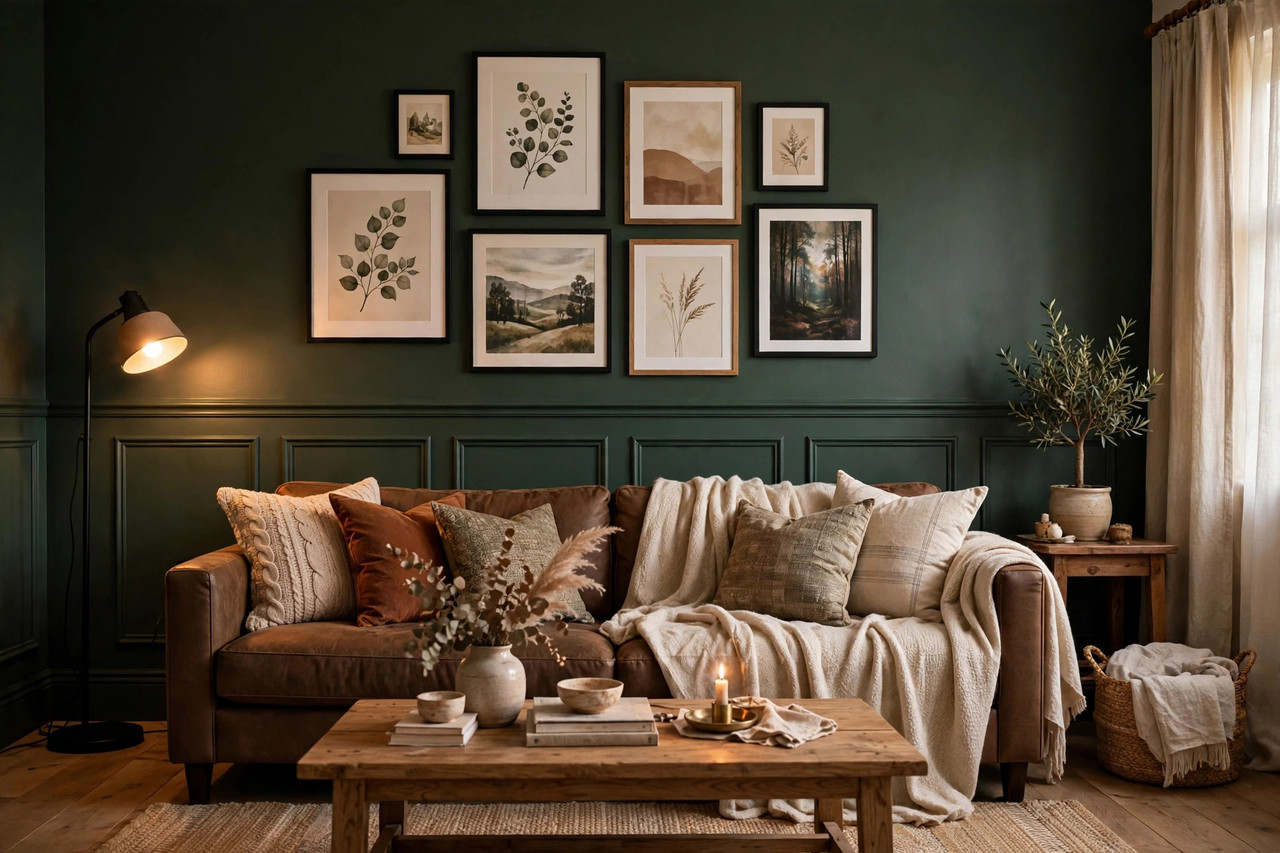
3. Try green wainscoting with a warm white upper wall
If four dark walls feel like too much, split the difference: paint the lower third or half of the wall (wainscoting, beadboard, or a simple picture-frame molding) in deep green and keep the upper wall a warm white. Tongue-and-groove beadboard panels run $2–4 per square foot, and a 12-foot wall costs roughly $150–250 in materials plus a weekend of install. The white upper half keeps all your daylight, while the green base grounds the brown couch beautifully. This is also the best green look for low-light, north-facing living rooms.
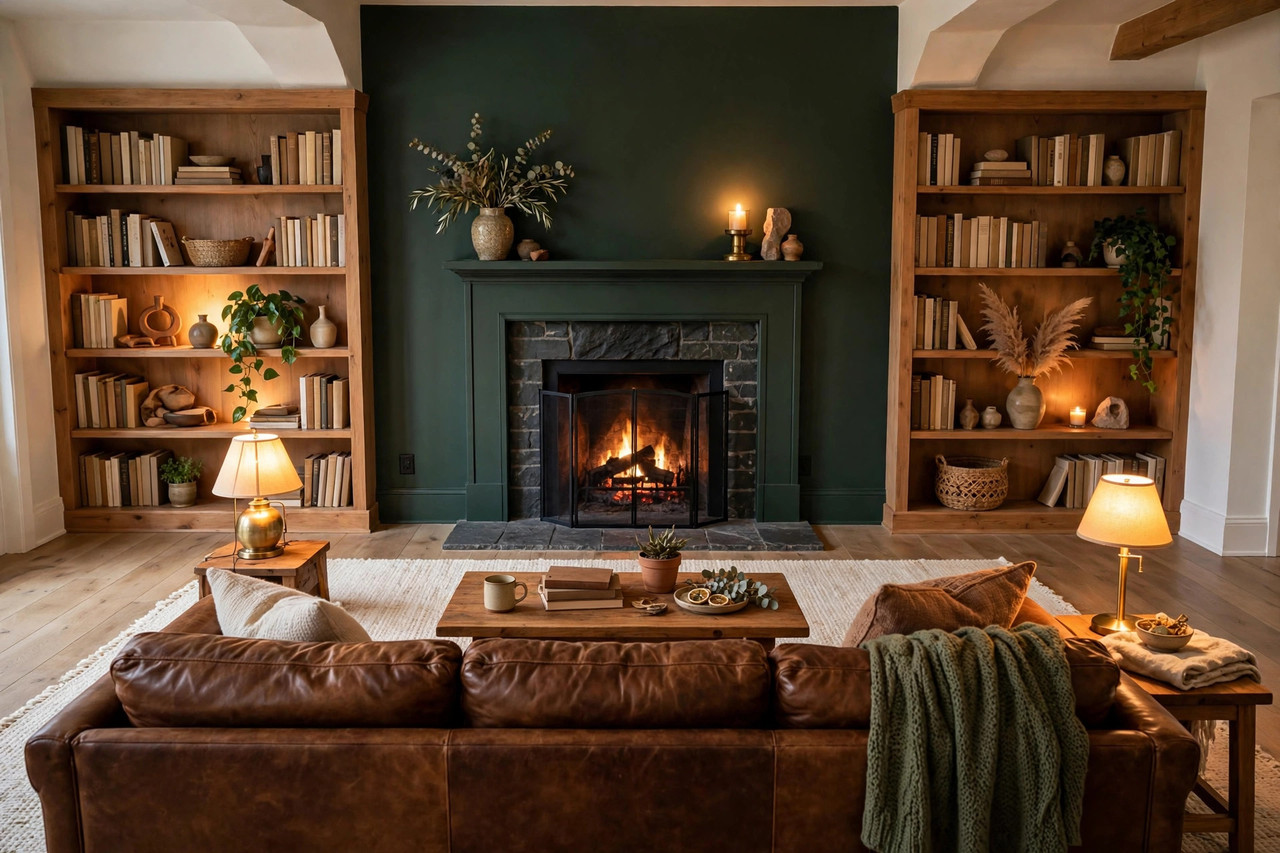
4. Frame the fireplace wall in green
Got a fireplace? Paint the chimney breast or the wall behind it deep green and let the mantel stay white or wood. The green frames the firebox like a picture, and when the fire (or candles) is lit, the warm glow against dark green is the single coziest sight in interior design. A chimney breast is usually under 100 square feet — one quart to one gallon of paint, $15–55, and it transforms the whole focal wall. Apartment Therapy's small-space makeovers show this trick repeatedly because it delivers designer impact for under $60.
5. Paint the ceiling green and keep walls light
The reverse move for the cautious: keep walls a warm greige or cream and paint only the ceiling in deep green. It sounds odd, but a dark ceiling visually lowers a too-tall room and makes it feel intimate — perfect above a brown leather couch and a low coffee table. One gallon covers a 12x14 ceiling ($38–55). Pair with a statement pendant light (see idea 9) so the green ceiling has a reason to exist after dark.
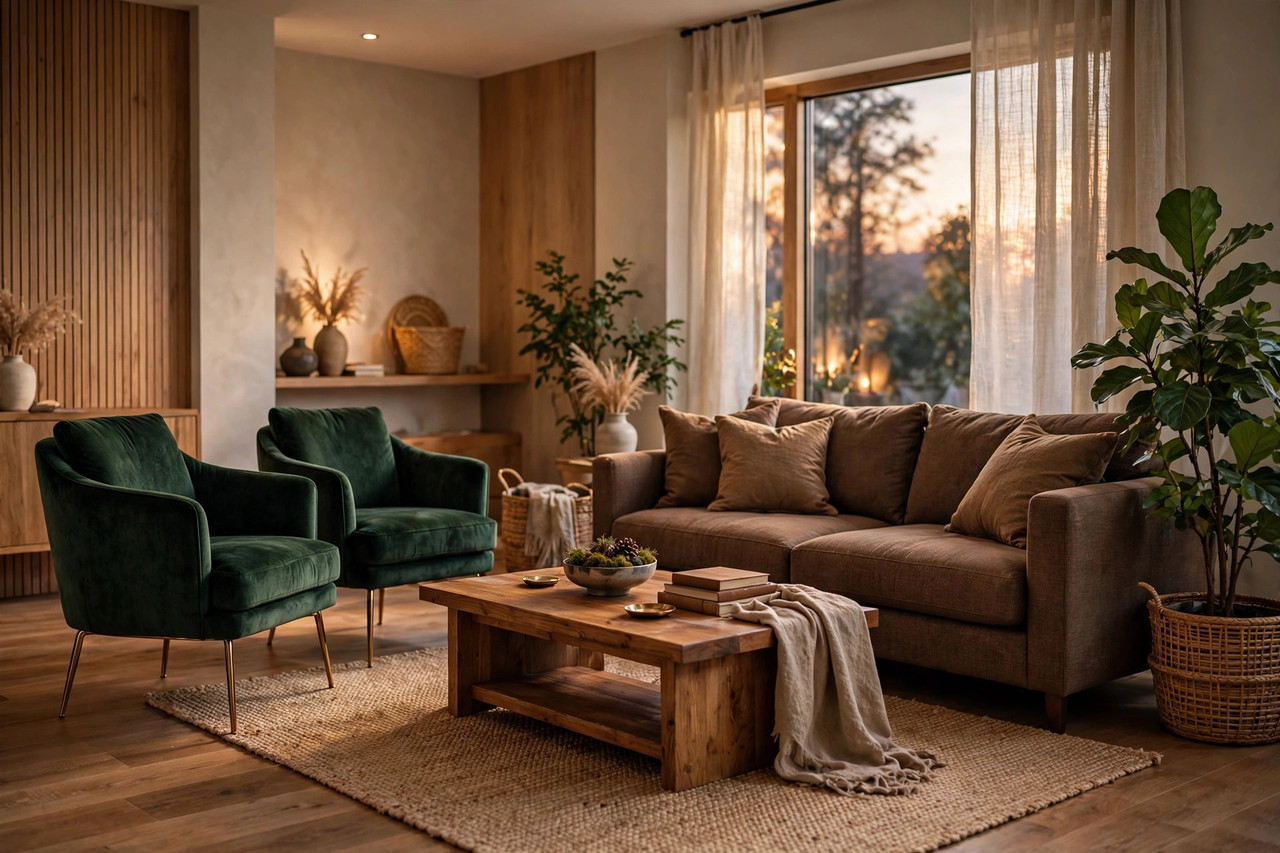
Brown Couch Styling Against Dark Green Walls
The brown couch is the anchor, so everything else styles around it. Brown and green are both earthy, which is why they harmonize — but earthy plus earthy needs texture and metal to keep from looking flat.
6. Pair the brown couch with green velvet accent chairs
The classic pairing: a brown leather or fabric sofa with two dark green velvet accent chairs opposite it. The velvet catches light differently than leather, so the two greens and browns read as layers, not a blob. Decent velvet accent chairs run $120–250 each. Keep them 18–24 inches from the coffee table edge so the conversation triangle feels intentional, and angle them slightly inward.
7. Layer a cream or ivory rug under everything
This is the single most important anti-dark move. A 5x8-foot ivory or cream rug ($80–180 for a low-pile washable rug) under the coffee table and front legs of the couch lifts the whole room by a full shade. In dark green rooms, go one shade lighter on the rug than you think you need — the walls darken everything they sit near. Flat-weave or low-pile also keeps the room from feeling heavy; save the shag for the bedroom.
8. Add caramel, mustard, and rust textiles
Green's best friends are warm ambers. Throw pillows in mustard velvet, caramel leather, and rust linen ($15–35 each, mix 5–7 across the couch and chairs) pull the brown couch into the green story. Add a chunky knit throw in oatmeal ($30–60) draped over one couch arm. The 60-30-10 trick works here: 60% green (walls), 30% brown (couch), 10% warm accents — and the accents do all the talking.
9. Hang brass and gold accents to warm the green
Dark green plus brass is the reason hotel lobbies look expensive. A brass arc floor lamp ($60–150) curving over the couch's reading corner, brass picture frames, a brass tray on the coffee table — three to five brass touches total. Brass reflects warm light, which is exactly what a dark green room needs after sunset. Brushed or antique brass reads cozier than polished; polished can go a little cold against deep green.
10. Style open shelves and bookcases against the green
Dark green makes books, ceramics, and framed photos pop like a gallery wall. If you have a bookcase against a green wall, style it with breathing room: books in vertical stacks, one ceramic or plant per shelf, and leave 20–30% of each shelf empty. The negative space is what makes it look curated.
Lighting Tricks That Keep a Dark Green Room Bright
Every dark-walled room lives or dies by its lighting. The designer's rule is three light sources minimum at different heights — and in a green room, all of them warm.
11. Use the three-height lighting rule with 2700K bulbs
You need one overhead (pendant or semi-flush mount), one mid-height (table lamps on side tables, $25–60 each), and one low or tall (floor lamp). Swap every bulb to 2700K warm white — cooler 4000K+ bulbs turn deep green walls gray and clinical. Smart bulbs ($10–15 each) let you dim the whole room to "evening mode" from the couch, which is when a green living room earns its keep.
12. Hang a big mirror opposite the windows
A 24x36-inch (or larger) mirror hung directly opposite your main window doubles the daylight hitting the green walls. Lean a full-length mirror ($60–120) against the wall beside the couch for the same effect with less commitment. Brass or wood frames tie back into the warm accents from idea 9. One mirror per dark wall is plenty — two starts to feel like a dance studio.
13. Add picture lights over art on the green wall
Battery-operated LED picture lights ($20–40 each) mounted above framed art or the mantel wash the green wall with a warm gradient after dark. They take 10 minutes to install (most are magnetic or adhesive, no wiring) and they are the detail that makes guests ask who your designer was. Two picture lights, evenly spaced over a gallery wall, is the sweet spot.
14. Bring in plants — green on green works
It sounds like too much green, but living plants against a dark green wall look incredible because the leaf tones vary. A 4–5-foot fiddle-leaf fig or bird of paradise ($40–80) in a cream or terracotta pot beside the couch adds height, life, and a completely different texture. Lower-light rooms: snake plants and pothos ($15–30) tolerate the dimmer corners of a green room. One tall plant per corner, max — let each one breathe.
15. Ground it with warm wood furniture
The final layer: wood tones that echo the brown couch. A walnut or warm oak coffee table (36–48 inches long, $120–300), a wooden side table, or open oak shelving bridges the brown upholstery and the green walls so neither feels isolated. If your couch is brown leather, match the wood undertone to the leather — warm caramel leather loves walnut; cooler espresso leather pairs better with oak.
The light and proportion numbers for dark rooms
How much light a dark green room actually needs. Deep greens have a light-reflectance value of roughly 5–12 — the walls give back almost nothing, so a green room needs about twice the light output of a white one to feel equally bright. Work to a total of roughly 2,000–3,000 lumens across the three layers in idea 11 for a 12×14-ft room: an overhead fixture of 1,100–1,600 lumens, two table lamps of 800 lumens each (60W equivalents), and the floor lamp or picture lights as the accent layer. If the room still feels dim, the fix is almost always a second lamp, not brighter bulbs in the same sockets. Paint sheen. Use eggshell or satin for deep green: flat/matte in dark colours shows every scuff and roller lap, while eggshell's slight sheen also bounces a little more of your lamplight back into the room. Rug size, honestly. The 5×8 in the budget guide is the minimum for a couch-and-table grouping; if two accent chairs join the arrangement (idea 6), step up to 8×10 ft so the front legs of every seat land on the rug — a rug that only the coffee table touches makes the seating look like it is floating apart. Coffee table proportions. Length about two-thirds of the sofa (an 84-inch sofa wants a 48–56-inch table), height at or 1–2 inches below the seat cushions (usually 16–18 inches), and the 18–24-inch gap from idea 6 measured to the chairs as well as the couch. Picture lights. Mount them 5–7 inches above the frame's top edge, and size the light to about half to three-quarters of the frame's width — a 16-inch light over a 24-inch frame washes it evenly without hotspotting the centre.
Quick-Start Budget Guide: Green Living Room, Brown Couch
- Under $100: one gallon of deep green paint for an accent wall ($45) + two mustard throw pillows ($30) — the room changes character in a weekend.
- $200–400: add a 5x8 cream rug ($150) + brass table lamp ($50) — the anti-dark insurance policy.
- $500–800: add two green velvet accent chairs ($400) + big mirror ($80) — the full designer pairing.
- $1,000+: full-room paint ($110) + walnut coffee table ($250) + plants and picture lights ($120) — the magazine look.
Renters who cannot paint: skip ideas 1–5 and stack 6 through 15 — green velvet curtains ($25–45 per 84-inch panel), a dark green throw blanket, and green art prints deliver 80% of the look with zero paint. Our no-cost fall living room refresh has more zero-paint tricks in the same spirit.
Frequently Asked Questions
Will dark green walls make my living room look smaller?
Not if you keep contrast in the room. A cream rug, light ceiling, and a mirror opposite the window keep a dark green room feeling the same size — the walls recede, which can actually make the room feel deeper. The rooms that feel small are the ones with dark walls AND dark floors AND dark furniture with no light layer.
What colors go with dark green walls and a brown couch?
Cream and ivory (non-negotiable for brightness), brass and gold (warmth), caramel and mustard (bridge the brown), and small hits of black (picture frames, lamp bases) for definition. Avoid pairing with navy or charcoal — two darks fight each other.
Which green paint shade works best in a living room?
For warmth with brown: Sherwin-Williams Hunt Club or Evergreen Fog, Benjamin Moore Essex Green. All have warm undertones that harmonize with brown leather and wood. Test a large swatch and look at it at 7pm under your actual lamps before committing — greens shift dramatically between daylight and lamplight.
Is dark green okay for a north-facing living room?
Yes, with two adjustments: choose a green with warm undertones (not a blue-green, which goes cold in northern light) and commit to the three-height lighting plan. A green wainscoting half-wall (idea 3) is the safest north-facing version of this look.
That is the full playbook: pick your green, anchor with the brown couch, add one light rug and one warm metal, and light it like you mean it. Dark green was never the risk — flat, under-lit rooms are. Do these fifteen and the room feels rich, layered, and unmistakably cozy.


Comments
Post a Comment