
12 Winter Greenery Decor Ideas That Stay Fresh All Season
When the garden goes bare, the house does not have to. A vase of pine on the table, cedar along the mantel, and a small potted evergreen by the door bring the colour and scent of the whole season indoors — no flowers to buy every week, no arrangement skills required. The best winter greenery decor ideas are mostly about handling: how you cut, soak, place, and mist fresh branches so they stay green and fragrant for weeks instead of dropping needles in days.
You do not need a florist or a big budget. You need a mix of sturdy evergreens, water treated properly, and distance from heat. Below are twelve ideas with real keeping times, simple techniques, costs, and watch-outs, so a few armfuls of branches carry your rooms from the first cold week to the last.
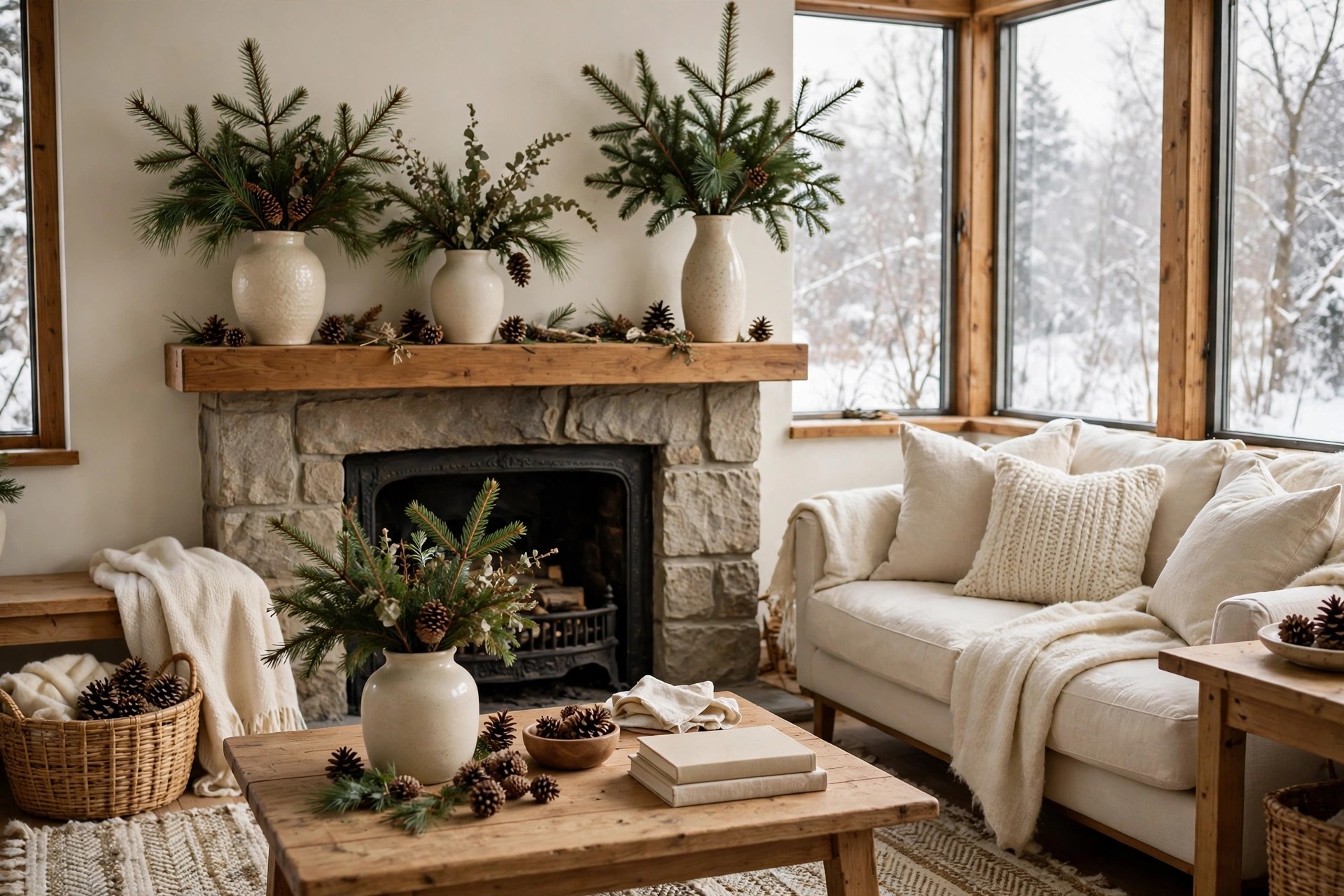
Greenery works hardest in rooms already dressed for the cold months, so pair this guide with our late fall decor ideas — the textures and layers that carry a home from autumn into deep winter are exactly the background that makes fresh branches look settled rather than stranded.
Keep It Fresh First: Water, Distance From Heat and a Daily Mist
Rule one: heat and sun are the enemy. Keep loose greenery away from direct sun and away from heat sources — radiators, vents, fireplaces in use, and the top of a warm television. Warm, dry air is what pulls moisture out of needles and turns a lush branch brittle, so the coolest spot that still shows the arrangement is always the right spot.
Rule two: water is a routine, not a rescue. Mist loose greenery daily and expect it to look its best for about two weeks; in a vase, cut stems at a 45-degree angle so they drink freely, change the water when it clouds, and recut the stems weekly. Seasonal guides like Love My Simple Home on winter greens to love in your home all season and The English Home on winter floral display ideas return to the same craft: prepare the stems properly, mix varieties, and let branches build the structure before any accent is added.
Rule three: prepare before you arrange. Soak branches in lukewarm water for a few hours before arranging so they enter the vase fully hydrated, and crush the ends of woody stems lightly so they take up more water. Then mix varieties on purpose — pine, spruce, cedar, eucalyptus, and juniper together give fragrance no single green can match, each releasing a slightly different scent as the room warms. Finally, mix fresh with faux without apology: a few real branches folded into good faux greenery make the faux read as real, and stretch a small fresh bundle across the whole house.
12 Winter Greenery Decor Ideas That Stay Fresh All Season
Work in order: prepare the branches, build the big structural pieces, then scatter the small ones. Most of these ideas cost under $20 in branches, and several use clippings that cost nothing at all.
1. Soak Every Branch in Lukewarm Water Before It Goes Anywhere
This unglamorous first step decides how the next two weeks go. Fill a tub or deep bucket with lukewarm water and lay the branches in it for a few hours before arranging — stems that start fully hydrated stay green noticeably longer than stems arranged dry and watered later. While they soak, strip any needles or leaves that would sit below the waterline of your vase, since submerged foliage rots and clouds the water. Crush the ends of the thickest woody stems lightly with a hammer or the back of pruning shears to open them up for drinking. Cost: $0 and a little patience. Watch-out: do not use hot water, which scalds the stem ends shut, and do not skip the soak for branches that travelled in a cold car — they arrive thirstier than they look.
2. Cut Vase Stems at 45 Degrees and Recut Them Weekly
A stem cut straight across sits flat on the bottom of the vase and drinks through a straw pressed shut. Cut at 45 degrees, the same stem exposes a long open face to the water and keeps drinking. Make the first cut under water if you can, recut about an inch off weekly, and change the vase water whenever it turns cloudy — usually every three to four days. A mixed vase of pine, cedar, and eucalyptus handled this way stays presentable for three weeks or more, far beyond the roughly two weeks of loose, unwatered greenery. Vases of fresh branches cost about $10 to $20 in cut greenery. Watch-out: dull scissors crush instead of cut, sealing the stem you just opened; use sharp pruners or a knife, and cut once, decisively.
3. Mix Five Greens for Fragrance No Single Branch Can Give
One variety looks like a clipping. Five varieties look — and smell — like a winter woodland brought indoors. Combine pine for softness, spruce for structure, cedar for its feathery scale and sweetness, juniper for its blue-grey berries and sharp scent, and eucalyptus for the clean, cool note that lifts the whole mix. There is no correct ratio; a rough handful of each per arrangement keeps any one scent from dominating. Bundles of mixed greenery run about $12 to $25 at markets in season, and far less from a garden centre's offcut bin. The layered approach suits the room-by-room build in our cozy winter decor ideas, where scent is treated as part of the decor. Watch-out: juniper and cedar shed fine debris as they dry, so keep the mix off pale upholstery and shake branches outdoors before bringing them in.
4. Learn Three Leaves: Cypress, Pine and Boxwood
Knowing three textures by sight makes every arrangement easier. Cypress is feathery and fine, with flattened sprays that drape softly over a vase edge. Pine carries the long needles — soft, bundled, unmistakably winter — and gives volume without weight. Boxwood is the opposite: small, neat oval leaves on dense stems, the green that holds a shape in a wreath, a swag, or a tight table arrangement. Use cypress where you want movement, pine where you want fullness, and boxwood where you want definition, and a mixed bunch separates into a designed arrangement instead of a green tangle. Watch-out: boxwood dries out faster than pine and cedar once cut, so it benefits most from the daily mist and from being placed away from heat.
5. Stand Tall Birch and Eucalyptus Branches in a Floor Vase
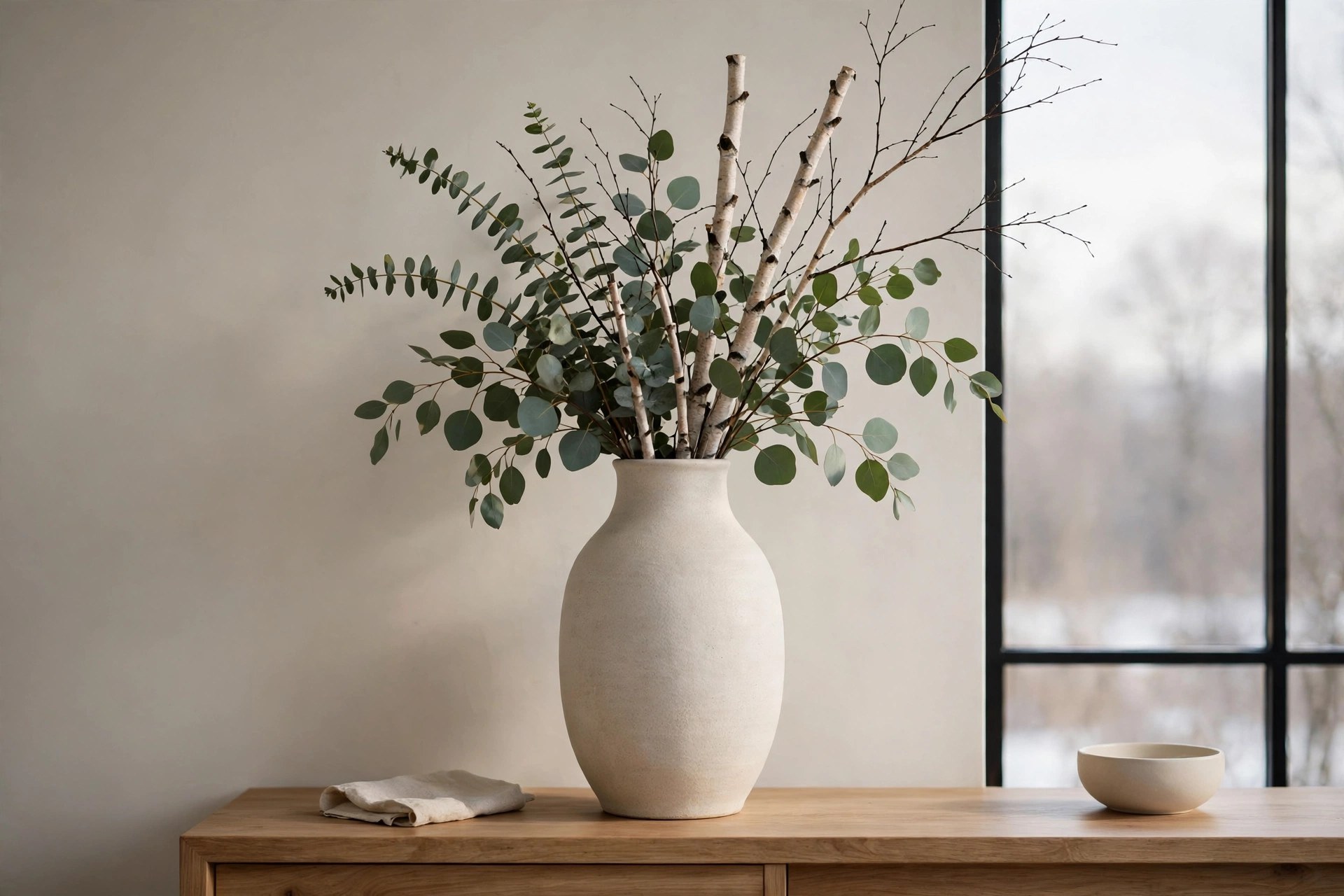
The simplest large-scale idea on this list: no arranging at all. Take tall branches — white birch for its pale bark, eucalyptus for its round blue-grey leaves — three to five stems, 36 to 48 inches tall, and stand them in a heavy floor vase in a corner or beside a fireplace that is not in use. The height draws the eye up and fills the vertical emptiness that makes winter rooms feel stark, and branches this size dry gracefully instead of collapsing, so they last the whole season with no water at all if you let them dry in place. A bundle of tall branches costs about $15 to $30. Watch-out: match vase weight to branch height — tall stems in a light vase tip at the first knock, so choose stone, ceramic, or add stones in the base.
6. Build Structure With Branches First, Accents Second, in Odd Numbers
Every strong arrangement is built in the same order: structure first, accents after. Set the longest branches to establish height and outline, fill with the mid-length greens, and only then add accents — pinecones, dried orange slices, a few berries, ribbon — grouped in odd numbers: three cones here, five berries there. Odd groupings read as natural; even ones read as placed in pairs by a machine. Work with the arrangement at the height it will be seen from, turning the vase a quarter turn after every few stems so no side becomes the neglected back. Watch-out: the most common failure is accents first — decorations hung on a shape that does not exist yet — so forbid yourself the pretty extras until the green skeleton stands on its own.
7. Run a Loose Green Runner Down the Table Instead of a Cloth
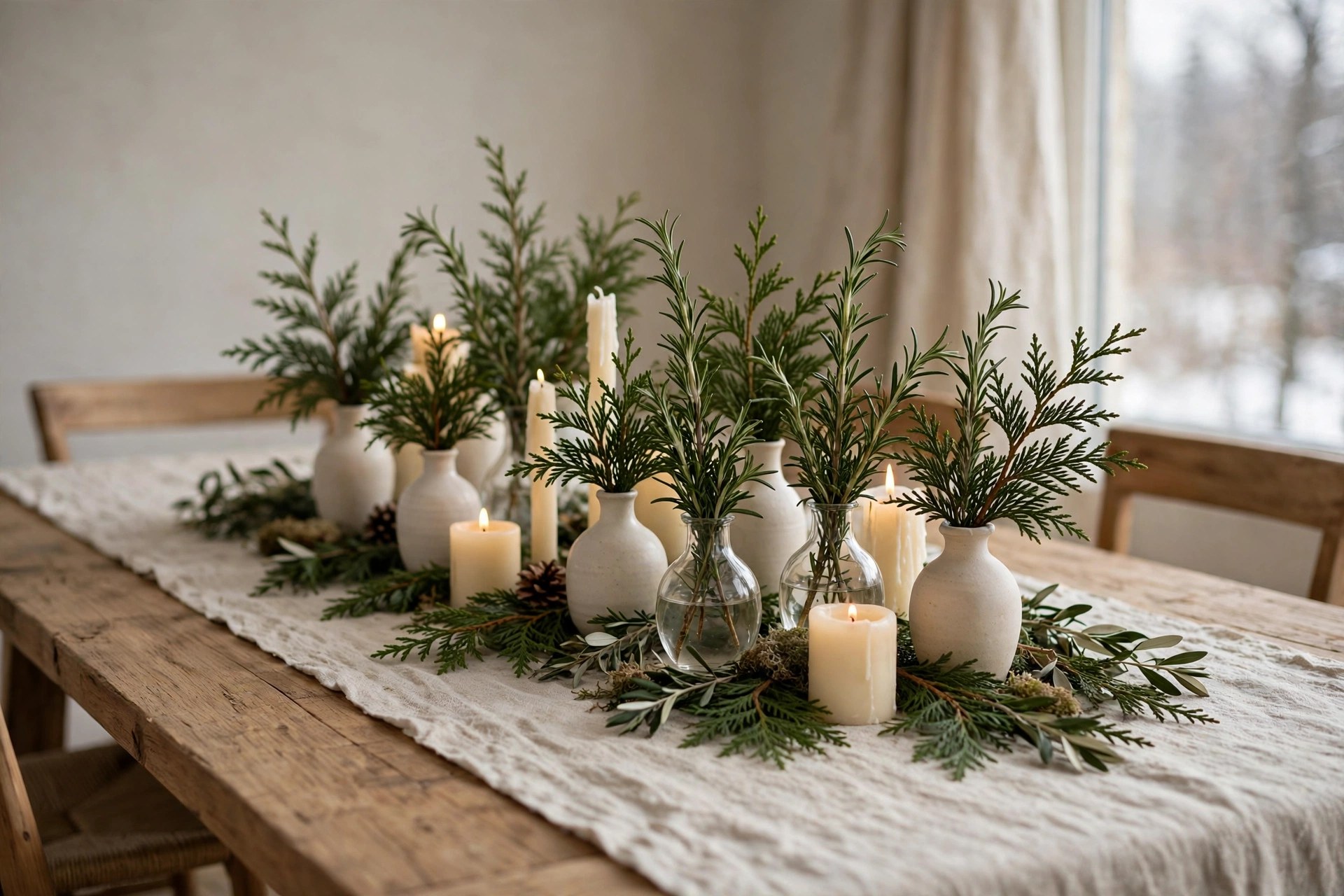
For the table, skip the formal arrangement and lay greenery loose: a relaxed line of cedar and pine laid stem-to-tip down the centre, about 8 to 10 inches wide, with candles in holders standing safely above it and accents tucked in following the odd-number rule. Loose greenery like this lasts about two weeks with a daily mist, and its great virtue is speed — ten minutes from bundle to finished table, and fully compostable afterwards. Keep it clear of serving dishes and sleeves, and never let it touch an open flame: candles belong in glass or metal holders with greenery kept a hand's width away. This is the table version of the warmth-first thinking in our cozy winter window decor ideas. Watch-out: resinous pine can mark a pale tablecloth, so lay loose greens on the bare table or on a dark runner.
8. Wrap a Small Potted Evergreen in Burlap and Keep It Alive
Cut greenery is on a clock; a potted evergreen is not. A small potted conifer or boxwood — a 6 to 10 inch pot — set into a wrap of burlap tied with twine becomes a living decoration for a hall table, a hearth, or the centre of the dining table, and in spring it can move to a bigger pot or the garden instead of the bin. Small potted evergreens cost about $10 to $25. Water it as a houseplant, keeping the soil just moist, and keep it away from radiators like any other green. The burlap does real work: it hides the plastic pot, suits every winter texture in the room, and costs about $3 a wrap. Watch-out: a pot wrapped in burlap still needs a saucer inside the wrap, or the first watering soaks through onto the furniture.
9. Mix Fresh Branches Into Faux Greenery So the Faux Reads Real
Good faux greenery has the shape but never the scent or the slight irregularity of the real thing — which is exactly what a little fresh material supplies. Take a faux garland or wreath you already own and tuck in eight to ten short fresh stems of cedar, pine, or eucalyptus, wired or simply pushed deep enough to hold. The eye lands on the real pieces, the nose confirms them, and the whole piece reads as fresh at a third of the full-fresh cost and effort. Refresh the fresh stems every two weeks as they fade; the faux base carries on regardless. Watch-out: place fresh stems where they can be removed without dismantling the piece, and mist them daily — tucked inside faux, they get no vase water and dry fastest of all.

10. Mist Loose Greenery Daily and Keep It Away From Heat and Sun
This is the maintenance idea that makes all the others true. Loose greenery — runners, swags, mantel lengths — has no water supply except what you give it, so mist it daily, ideally in the morning, until the needles glisten. Positioned away from direct sun and every heat source, misted loose greenery stays fresh-looking for about two weeks; beside a radiator, the same branch can be crisp in four days. A $4 spray bottle is the only equipment. When a length starts to shed at a touch, it is done — replace that section rather than misting harder, and compost the old. Watch-out: mist over a tray or towel on wooden surfaces, because daily water plus fallen needles will mark a polished mantel over a fortnight.
11. Fill the Small Gaps: Bowls, Lanterns and Jars of Short Clippings
Every bundle leaves short ends, and short ends are a decoration of their own. Gather clippings 4 to 8 inches long and use them where a full branch cannot go: a shallow bowl of boxwood tips on a side table, a lantern with a bed of cedar around its candle, jars of pine tips along a windowsill, a small jug of eucalyptus in the bathroom where the steam keeps it fragrant. These pieces cost nothing beyond the bundles you already bought, and they spread the season's colour and scent into rooms the big arrangements never reach. Group them in odd numbers like every other accent. Watch-out: change jar water every few days and rinse the stems, because small volumes of water go stale fastest and a sour jar undoes the fragrance you placed it for.
12. Refresh in Waves So the House Never Goes Bare at Once
The secret to greenery that lasts all season is not one heroic arrangement — it is staggering. Start the season with the long-lived pieces: the drying floor branches, the potted evergreen, the faux-and-fresh garland. Add the vase arrangements a week or two later, and the loose table and mantel greens last, knowing each runs on its own roughly two-week clock. As one piece fades, replace just that piece in a quiet ten minutes instead of redoing the whole house in a day. Keep a standing habit: one fresh bundle with the weekly shopping, mist each morning, recut vase stems each week. Watch-out: do not install every fresh piece on one day; a house where everything fades in the same week feels like an event ending, not a season unfolding.
Mistakes That Make Greenery Fade in Days
Placing arrangements where the warmth is. The mantel above a working fire and the shelf over a radiator are the two most traditional spots and the two fastest killers — rising dry heat strips moisture from needles around the clock. If the mantel must be dressed, use the potted evergreen or the faux-and-fresh mix there, and give loose greens a cooler stage. The same know-your-room honesty runs through our cozy winter decor guide: comfort and keeping quality both start with where things actually sit.
Skipping the preparation. Branches arranged dry, with straight-cut stems, in stale water, fade in days no matter how beautiful the first hour looked — the soak, the 45-degree cut, and the weekly recut are the difference between two weeks and six. And never crowd every stem into one vase: branches packed tight trap stale air and rot from the middle. Give arrangements air, water, and distance from heat, and browse the Seasonal Decor collection for the rest of the season's room-by-room ideas.
Questions People Ask
How long does fresh winter greenery last indoors?
Loose greenery, misted daily and kept away from direct sun and heat sources, looks its best for about two weeks. Greenery in a vase lasts longer when stems are cut at 45 degrees and recut weekly. Tall branches left to dry in place and potted evergreens last the whole season.
How do you prepare fresh branches before arranging them?
Soak branches in lukewarm water for a few hours before arranging, strip foliage that would sit below the waterline, and crush the ends of woody stems lightly so they drink more. For vases, cut stems at a 45-degree angle and recut about an inch weekly.
Which winter greens smell best together?
Mix varieties: pine, spruce, cedar, eucalyptus, and juniper each release a different scent, and together they smell like a winter woodland rather than a single note. Know them by texture too — cypress is feathery, pine carries long needles, and boxwood has small oval leaves.
Can you mix fresh and artificial greenery?
Yes, and it is one of the smartest moves: tuck eight to ten short fresh stems of cedar, pine, or eucalyptus into a faux garland or wreath. The eye and nose land on the real pieces, the faux reads as real, and you only refresh the fresh stems every two weeks.
Soak the branches, cut the stems at an angle, keep everything clear of heat, and mist each morning — a handful of winter greens, handled properly, will carry your home in colour and scent from the first cold week to the last.


Comments
Post a Comment