
14 Dried Flower Fall Decor Ideas That Last All Season
14 Dried Flower Fall Decor Ideas That Last All Season
Fresh flowers give you a week. Dried flowers, handled right, give you September through Thanksgiving and often a second season after that — no water, no wilting, no Sunday-night grocery run for a replacement bouquet. The trick is knowing that not all dried flowers are dried the same way, and that the method decides both the look and how long it lasts. This guide starts with the three methods worth knowing and what they actually cost, then walks through fourteen arrangements with real stem counts, vase sizes, and heights, and finishes with the care rules that separate arrangements that last twelve months from ones that look dusty and sad by late October.
First, How Drying Actually Works
Air-drying upside down — free, slow, and best for most flowers
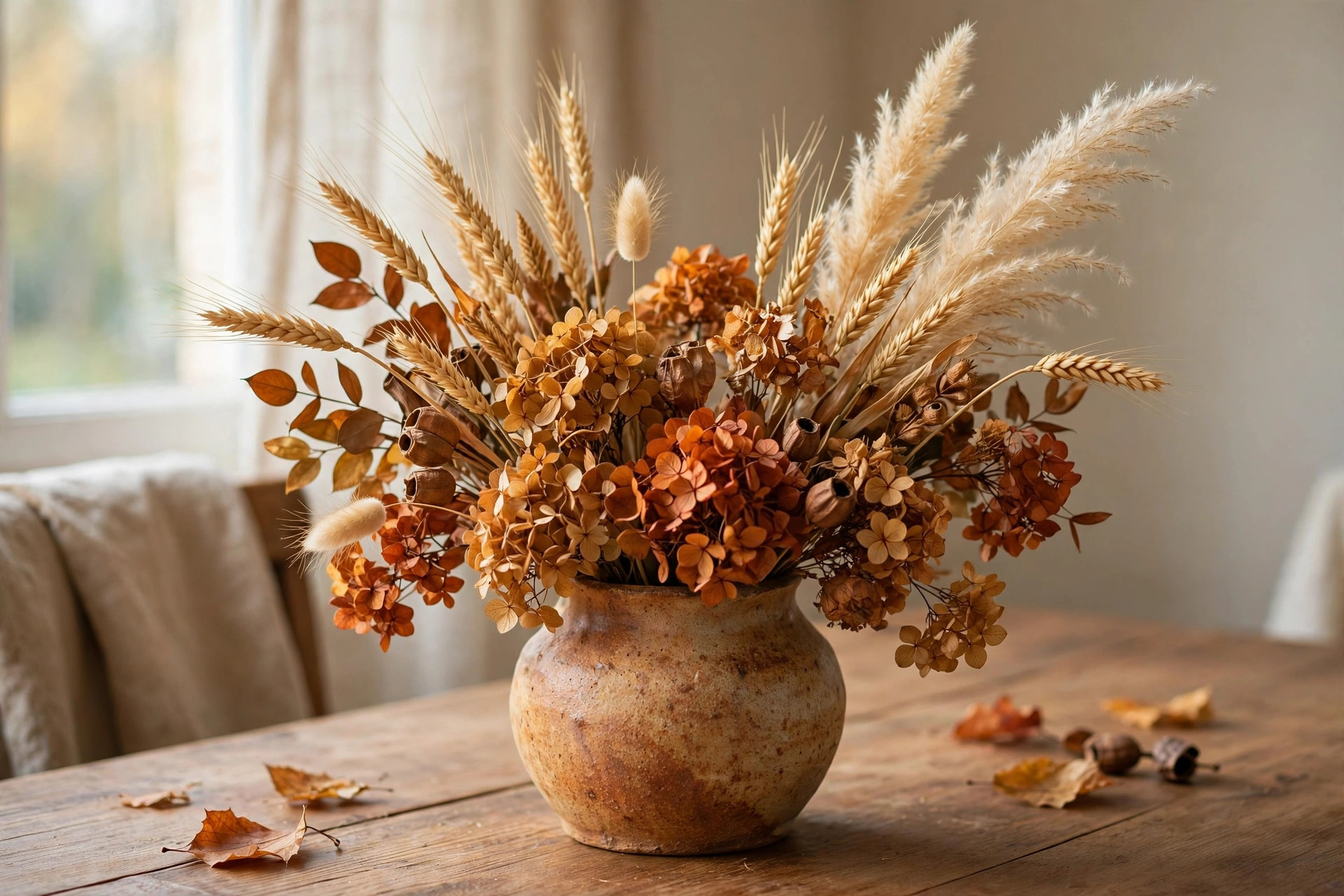
Gather stems in small bunches of 5–8 — bigger bunches trap moisture in the middle and mold. Strip leaves from the lower two-thirds of each stem, bind the bunch tightly with a rubber band (it contracts as stems shrink, unlike twine, which loosens and drops flowers on the floor), and hang upside down from a hook or closet rod in a dark, dry room with air movement. A spare closet, a garage corner away from the door, or a laundry room all work; a steamy bathroom does not. Most flowers are ready in 2–3 weeks. They are done when stems snap instead of bending. Lavender, strawflower, statice, baby's breath, celosia, globe amaranth, and eucalyptus all air-dry beautifully. Roses air-dry too, but expect them to darken two shades and shrink about a third. Cost: essentially $0 beyond the fresh bunch itself.
Silica gel — fastest and truest to color
Silica gel crystals pull moisture out in 2–7 days and preserve shape and color better than any other home method, which is why it is the choice for dahlias, zinnias, roses, and peonies that would collapse air-drying. Pour an inch of crystals into an airtight container, set flower heads face-up on top without touching each other, gently cover them completely, seal, and wait — 2–3 days for thin petals, up to 7 for dense roses. A 1.5-pound bag of silica gel costs $10–$15 and can be recharged in a 200°F oven and reused for years, so the per-batch cost quickly drops below $1. Lift flowers out with a soft brush in hand; silica-dried petals are the most fragile of all.
Glycerin — for foliage that stays flexible
Glycerin does not really dry leaves — it replaces their water, so eucalyptus, magnolia leaves, beech branches, and leather fern stay supple instead of brittle and can be wiped clean. Mix 1 part vegetable glycerin to 2 parts very hot water, pour into a clean vase, recut stems at an angle and lightly crush the last inch with a hammer so they drink, then stand foliage in the solution for 2–4 weeks until leaves change color slightly and feel leathery. A 16 oz bottle of glycerin runs $8–$12 at craft or drug stores and treats several bunches. Glycerin-preserved foliage lasts a year or more and is the one kind of dried material safe to handle often, which makes it ideal for wreaths and garlands that get moved.
What to buy: dry your own or buy pre-dried?
Fresh bunches to dry yourself cost $5–$15 at grocery stores and farmers markets — a $6 bunch of strawflowers or $8 of eucalyptus gives you plenty to work with, plus the satisfaction tax is negative. Pre-dried bunches cost $12–$25 depending on the flower: bunny tails and pampas sit at the high end, dried wheat and lavender at the low end. Buy pre-dried when you want something that does not grow locally, need it this weekend, or want pampas plumes, which are messy to handle loose. Dry your own when the flower is sturdy and in season. Either way, one sizing rule governs every idea below: a finished arrangement should stand about 1.5 times the height of its vase, vase mouths of 2–4 inches suit most bunches, and odd stem counts — 3, 5, 7 — almost always look better than even ones because the eye reads them as natural rather than paired.
The 14 Ideas
1. A single-variety statement vase for the entry
One flower, lots of it, nothing else. Take 15–20 stems of dried strawflower or statice in one color, trim to 18–20 inches, and pack them into a ceramic vase 10–12 inches tall with a 3-inch mouth. Abundance of a single variety reads expensive; a mixed handful reads like leftovers. Cost: $8–$14 for the bunch if bought pre-dried, around $6 fresh to dry. Place it where people pause — by a mirror or key bowl — because this is the arrangement guests actually notice.
2. Pampas grass floor arrangement
For an empty corner, nothing beats scale. Use 7–9 pampas plumes, 36–42 inches tall, in a floor vase 18–24 inches high with a narrow 3-inch mouth — the narrow mouth is what stops tall plumes flopping apart. Shake each plume gently outside before arranging; loose fluff belongs outdoors, not on your rug. Pre-dried pampas costs $18–$25 for a bunch of 10. Keep it out of walkways: brushing past pampas daily breaks plumes down within months, while an undisturbed corner arrangement lasts well over a year.
3. Lavender bundles on a kitchen shelf
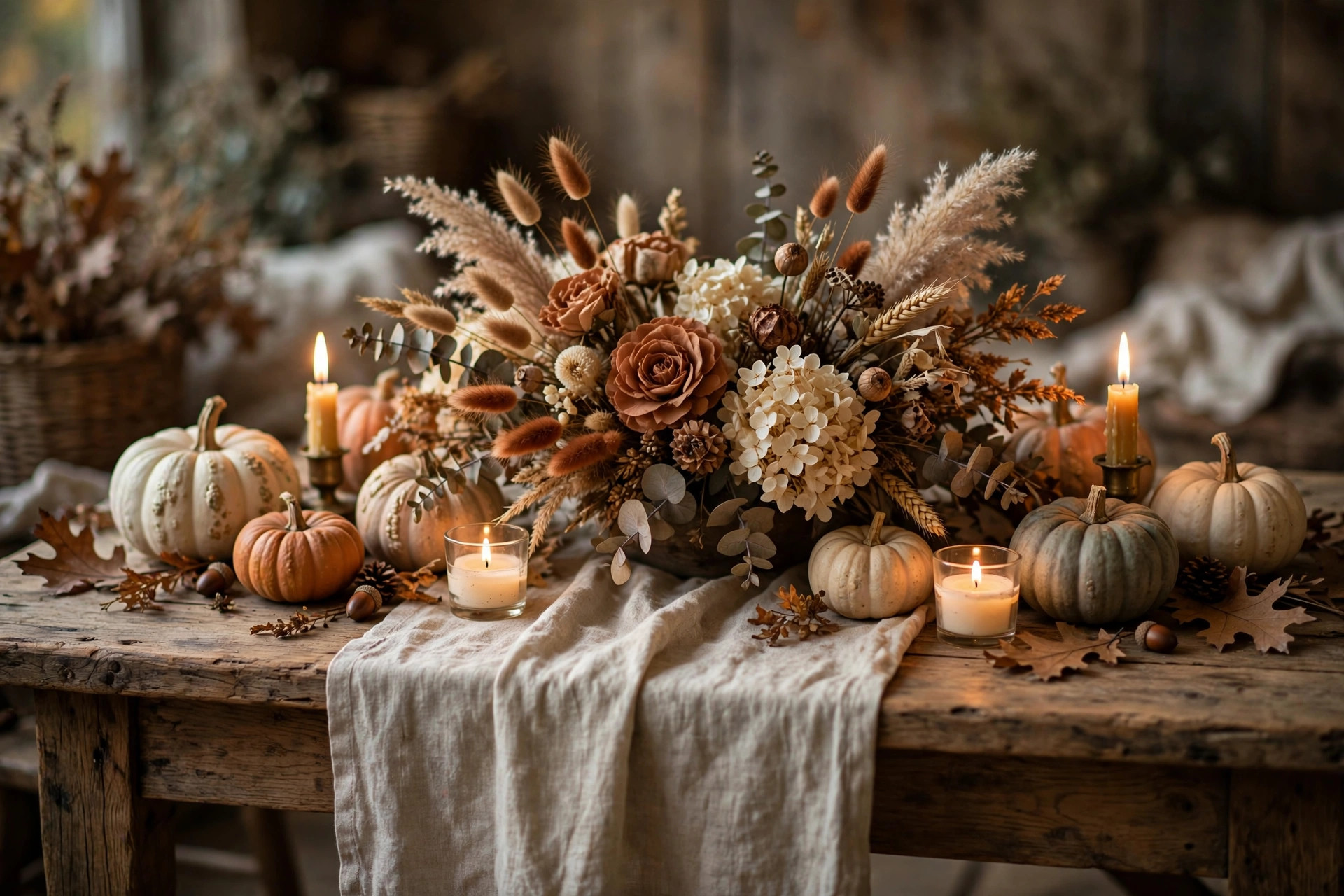
Dried lavender holds its scent for 6–12 months and its tidy shape forgives small spaces. Tie bunches of 25–30 stems (about a handful 1 inch thick at the stems) with twine, trim to 10–12 inches, and lay them across a shelf, stand them in 5-inch jam jars, or hang them from cup hooks under a cabinet. A pre-dried lavender bunch costs $10–$16 and divides into two or three mini bundles. Kitchen heat revives the scent every time you cook. One caution: keep lavender out of bedrooms if anyone in the house finds it overpowering — its scent is relaxing to most people and headache-inducing to a real minority, and a pillow-side bunch is a lot at 2 a.m.
4. Eucalyptus shower-meets-entry swag
Glycerin-preserved eucalyptus is the workhorse here because it will not shatter when the front door slams. Layer 5–7 stems 18–24 inches long, fan them, bind at one end with wire and twine, and hang the swag from a hook beside the door or over a mirror corner. Fresh eucalyptus to preserve costs $5–$8 a bunch; pre-preserved runs $14–$20. This pairs especially well with the warmer wood and amber tones in vintage-inspired fall decor ideas, where preserved greenery does the softening work that fresh plants do in summer.
5. Wheat and bunny tails in a stoneware crock
The classic harvest mix, in honest proportions: 15 stems of dried wheat plus 9–11 bunny tails, total height about 16 inches, in a crock 8 inches tall with a 4-inch mouth. The wheat gives structure, the bunny tails give softness, and the ratio of roughly three wheat to two bunny tails stops it looking fuzzy. Combined cost $12–$18 pre-dried. This is a centerpiece that can sit through actual dinners — at 16 inches total it stays below seated eye level, so guests can talk over it.
6. Dried orange and flower garland for the mantel
Thread dried orange slices (oven-dried at 200°F for 2–3 hours, as any fall kitchen project will teach you), bay leaves, and small strawflower heads onto twine for a 5–6 foot garland. Plan on 12–15 orange slices and 15–20 flower heads, spaced 3–4 inches apart. Drape it with a gentle 6-inch sag in the center and keep every inch of it at least 3 feet from open flame — dried material and fireplace sparks are a genuinely bad combination. Cost: $6–$10, mostly oranges. Expect one good season; citrus is the first element to fade.
7. A dried-flower wreath that survives the door
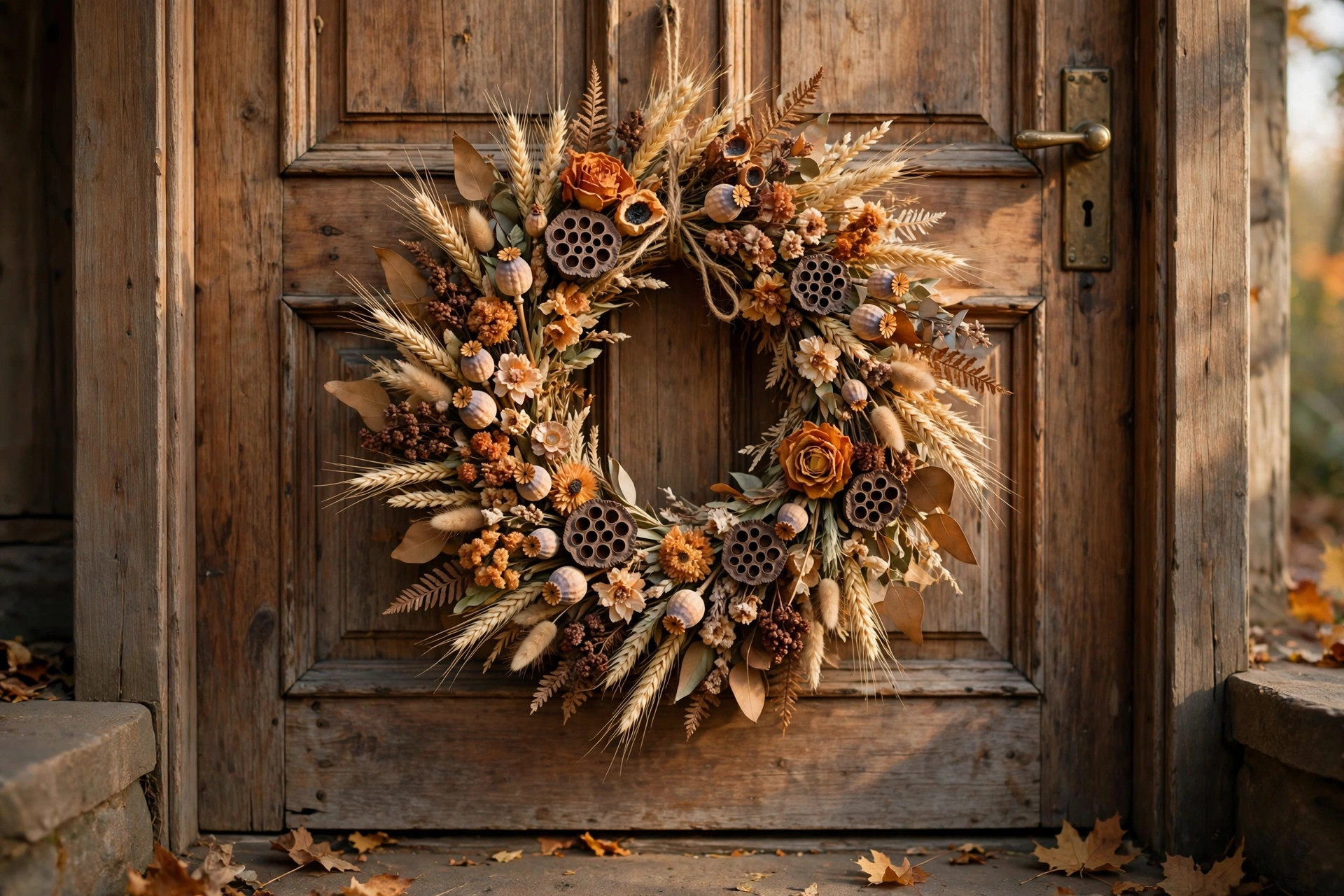
Start with a 14-inch grapevine base ($4–$6). Working in small clusters of 3 stems, wire in statice, strawflower, lavender, and preserved eucalyptus, all cut to 4–5 inches, overlapping each cluster over the last so no base shows on the front. You will use 60–80 short stems in total — buy two bunches. Total cost $16–$28, which compares well with $45–$70 for a bought equivalent. Hang it on a covered porch or inside the door rather than in direct rain and sun, and see the wider set of fall wreath ideas for a welcoming entry for placement and sizing rules by door width. Indoor wreaths last 1–2 years; exposed outdoor ones fade in a single season.
8. Bud-vase trio down the table
Three small bud vases, 4–6 inches tall, in a line down a dining table or windowsill, each holding just 3 stems: one tall (a wheat stem at 10 inches), one round (a strawflower or billy button), one wispy (bunny tail or baby's breath). The trio costs $8–$14 all-in with dollar-store vases and one shared bunch of each flower. This is the lowest-commitment arrangement on the list and the easiest to move when the table needs to be a table.
9. Framed pressed flowers as permanent art
Press flat-faced flowers — fern fronds, larkspur, small leaves, single strawflower heads — in a heavy book for 1–2 weeks, then mount on cream cardstock in 8 x 10 or 11 x 14 inch frames with a single glue dot behind each stem. Frames cost $5–$12 each; the flowers are nearly free. Hang away from sunny windows. Pressed work is the longest-lived decor in this guide — shielded from dust and handling behind acrylic or glass, it keeps for years, which no loose arrangement can promise.
10. Billy buttons and craspedia for a modern shelf
If dried arrangements usually feel too cottage for you, yellow billy buttons (craspedia) are the exception: graphic yellow spheres on straight stems. Stand 7 stems, 14–16 inches tall, in a matte black or white cylinder vase 8 inches tall with a 2-inch mouth. Nothing else in the vase. A bunch costs $10–$15 and the stems are unusually sturdy, so this is the arrangement to put on a busy family shelf where things get knocked.
11. Hydrangea heads in a low bowl
Hydrangeas dry best cut late in the season when petals already feel papery on the bush — cut too early and they wilt instead of drying. Stand fresh-cut heads in a vase with just 2 inches of water and let the water evaporate over 2 weeks; the heads dry in place with good shape. Pile 5–7 dried heads loosely in a low bowl 10–12 inches across for coffee tables and ottomans where tall arrangements get in the way. Cost: free from your own garden, or $12–$18 for a pre-dried bunch. Their muted mauve and sage tones are a natural fit for the palette in these neutral fall decor ideas for a warm, calm home.
12. Herb bundle trio for the kitchen wall
Dried herbs are decor that earns its keep. Bind separate small bunches of dried sage, rosemary, and thyme — 8–10 sprigs each, 8–10 inches long — hang them from a small branch or wooden peg rail, and snip from them all winter for cooking before they fade. Farmers-market herb bunches cost $3–$5 each fresh. Keep them away from the stove's steam plume; steam rehydrates dried herbs and invites mold. On a dry wall across the kitchen, they last 4–6 months as usable herbs and longer as looks alone.
13. Mini posies as place settings and gifts
For a dinner party or as favors, make posies of 5 stems each — one strawflower, two lavender sprigs, one bunny tail, one wheat stem — cut to 7 inches and tied with twine. One $15 assortment of bunches makes 8–10 posies, so each costs under $2. Lay one across each napkin. Guests take them home, stand them in a jam jar, and your table decor problem for their house is also solved.
14. A mantel runner of preserved foliage
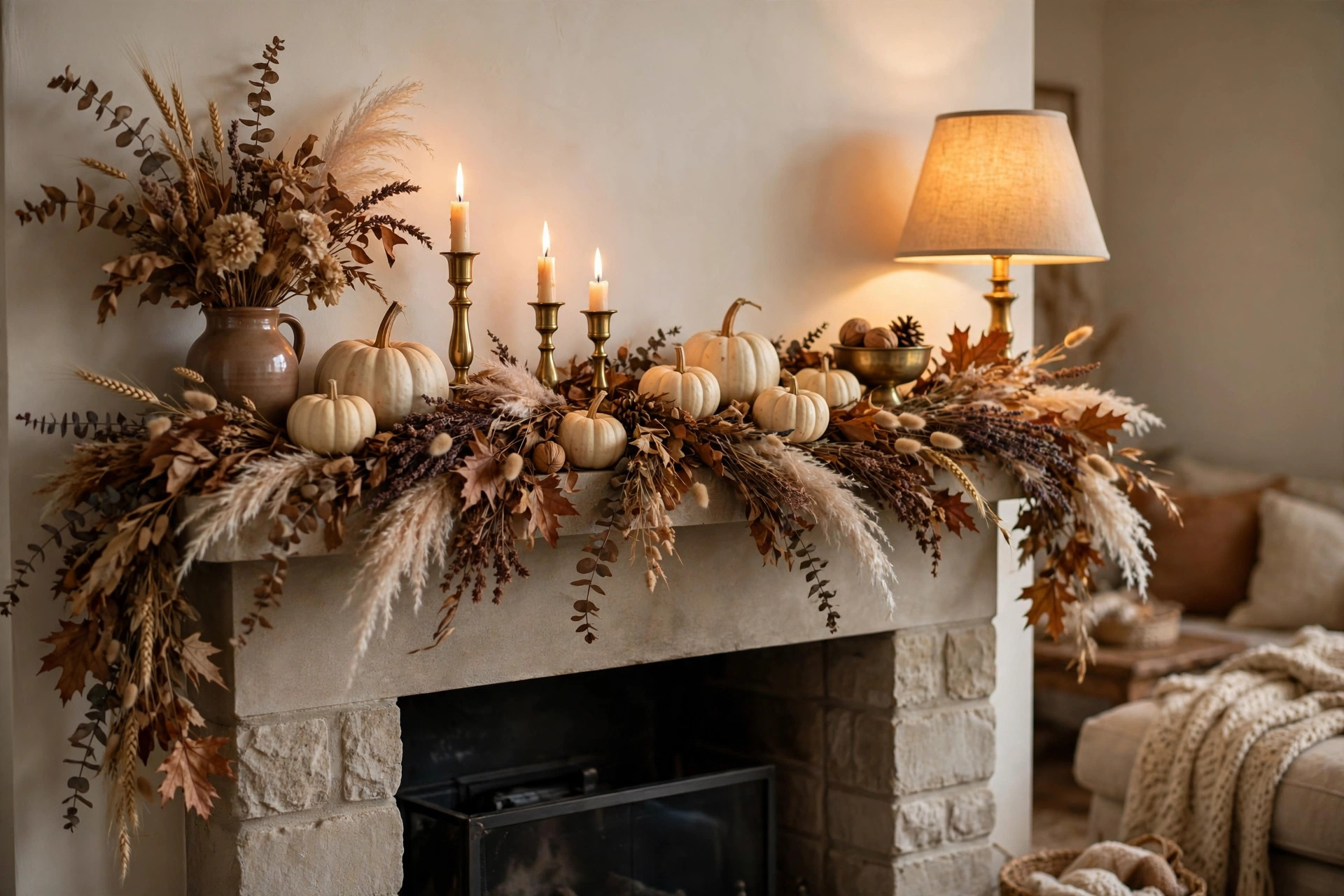
Lay a base of glycerin-preserved beech or eucalyptus branches, 24–36 inches long, directly along the mantel, then tuck in 9–13 strawflower and globe amaranth heads among the leaves and finish with two or three pillar candles in glass hurricanes. Preserved branches cost $15–$22 a bunch and two bunches cover a standard 48–60 inch mantel. Because glycerin foliage is flexible, it drapes over the mantel edge instead of poking straight out, and it can be rolled up in tissue at season's end and reused next year — the only loose arrangement here that stores well.
Care: Making Them Actually Last All Season (and Longer)
Dusting. Dust is what makes dried flowers look old, not age itself. Every 3–4 weeks, hold a hair dryer on its coolest, lowest setting 12 inches away and blow dust off in short passes, working from top to bottom. A soft makeup brush handles small, fragile heads. Never use water or a damp cloth — moisture spots petals permanently and can restart mold in stem centers.
Humidity. Dried flowers and steamy bathrooms are enemies. In a room that fogs a mirror daily, unprotected dried arrangements absorb moisture, droop, and can mildew within weeks. Keep the ideas in this guide in living rooms, bedrooms, entries, and kitchens. If you insist on one in a bathroom, choose glycerin-preserved foliage only, keep it far from the shower, and run the exhaust fan without exception.
Sunlight. Direct sun bleaches dried flowers fast — reds and purples go first, sometimes within a month in a south-facing window. Indirect light is fine. If a beloved arrangement must sit in sun, accept it as a one-season piece and photograph it fresh.
Lifespan, honestly. Indoors, away from sun and steam, most arrangements here look good for 6–12 months, statice and strawflower often longer, and preserved foliage longest of all. Brittleness increases with age no matter what you do: silica-dried and air-dried stems will eventually snap if handled, so arrange once, place, and admire rather than restyling weekly. Keep every dried piece at least 12 inches from candles, stove burners, and fireplace openings — dried material ignites readily — and if scent has been added, remember lavender and eucalyptus oils can be too much in small bedrooms; move a strong bunch to a hallway rather than suffering it at pillow height. At season's end, store loose bunches upright in a box with tissue, in a dry closet. The attic's heat swings and the basement's damp are both shorten-lifespan choices.


Comments
Post a Comment