
12 Small Bedroom Accent Wall Ideas That Make a Tiny Room Feel Designed
If you are looking for small bedroom accent wall ideas, you probably do not need more furniture. You need one wall to do the work. In a tiny bedroom the bed takes up most of the floor, so the wall behind it is the largest clear surface you have — and when that wall is plain white like the other three, the whole room can feel unfinished, however tidy it is.
An accent wall fixes that in a weekend. It gives the room a focal point, makes the bed look intentional instead of just placed, and — done well — it can make a small room feel deeper and taller, not smaller. Done badly, it does the opposite, which is why the rules matter more than the colour chart.
This guide covers the rules designers repeat for small rooms, then 12 ideas that actually work at this scale: sage, navy, terracotta and soft black paint, two-tone walls, vertical stripes, painted arches, peel-and-stick wallpaper, board and batten, wood slats, upholstered panels, and a built-in storage wall. Every idea includes what it costs, who it suits, and the mistake to avoid.
The 4 Rules That Make an Accent Wall Work in a Small Bedroom
1. Put it behind the bed. This is the rule almost every designer agrees on. The wall behind the bed is the one you see when you walk in, and the bed anchors the treatment so it reads as a headboard zone. An accent wall behind a dresser or on a side wall usually fights the bed instead of framing it — and in a small room, you cannot afford two focal points.
2. Dark colours recede — use that. It sounds backwards, but a deep colour on one wall pushes that wall back visually and adds depth, especially when the other three walls, the ceiling and most of the bedding stay light. A navy or soft black wall behind white bedding does not shrink the room; it gives it a back wall with somewhere for the eye to land. What shrinks a room is a mid-tone colour on all four walls with dark bedding on top.
3. Vertical lines raise a low ceiling. Stripes, slats and board and batten that run floor to ceiling pull the eye up. If your ceiling is under 8 feet, choose a vertical treatment over a horizontal one. If your room is narrow, the opposite trick helps: a two-tone wall with the darker shade on the lower half widens the feel of the wall.
4. One wall, one treatment, then stop. In a small bedroom the accent wall is the pattern, colour and texture budget for the whole room. Keep bedding mostly plain, curtains simple, and art minimal. If you are still choosing the base colour, our guide to small bedroom paint color ideas that make a tiny room feel bigger covers the shades that work before you commit to a bold accent.
How Much Does a Small Bedroom Accent Wall Cost?
Paint is the cheapest route: one gallon covers a typical 10 to 12 foot accent wall with two coats, and most people spend $25 to $60 on paint plus $15 to $25 on tape, rollers and a drop cloth. Peel-and-stick wallpaper for one wall usually runs $30 to $120 depending on how many rolls your wall width needs. Board and batten as a DIY sits around $75 to $250 in timber and paint. Slat panels and upholstered panels cost more — roughly $120 to $400 and $80 to $300 — but they add texture paint cannot.
Measure your wall width and height before you buy anything, and order one extra wallpaper roll or keep the paint code. Small walls still have corners, sockets and mistakes.
12 Small Bedroom Accent Wall Ideas That Actually Work
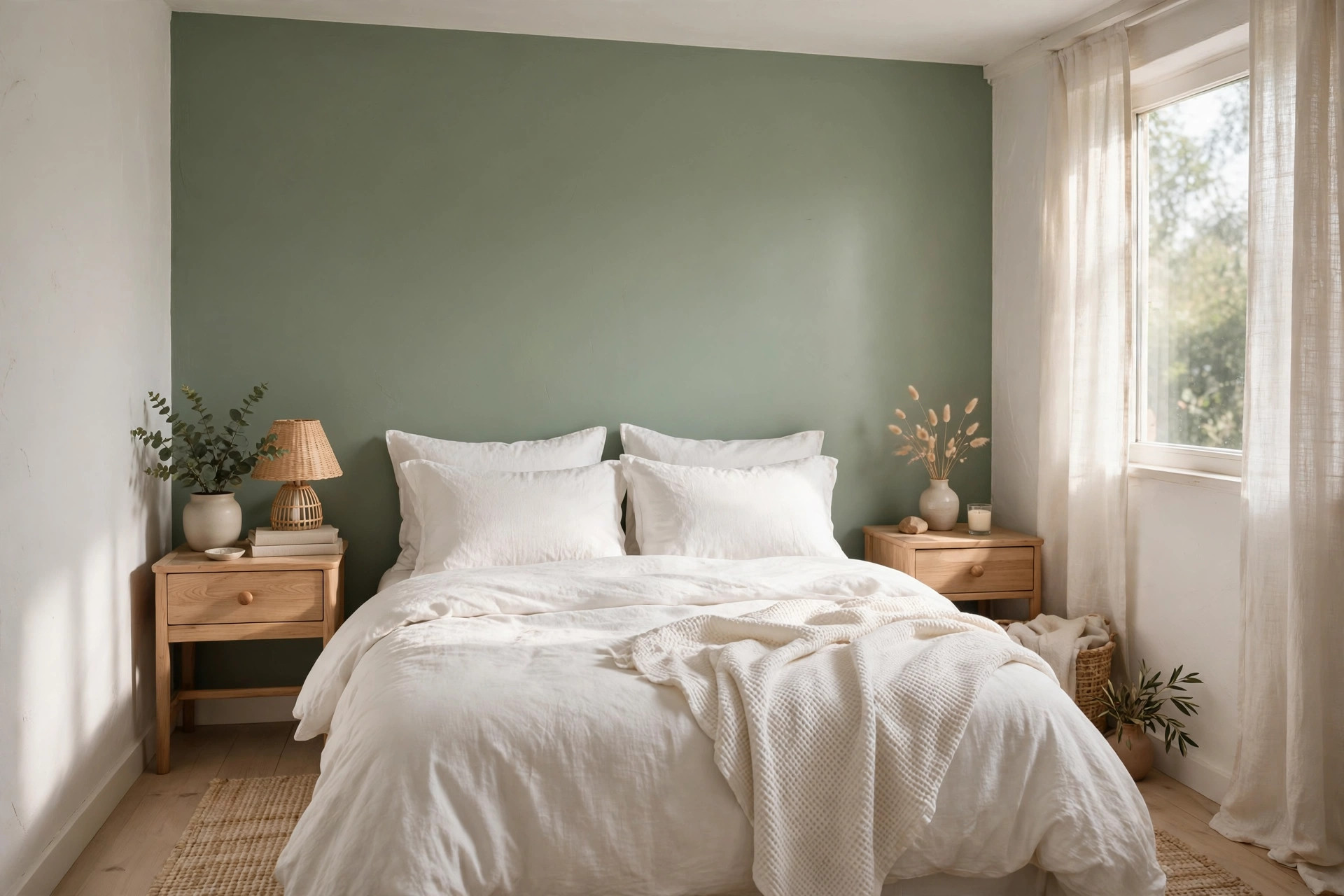
1. Sage Green Paint for a Calm, Light Accent Wall
Sage is the safest bold move in a small bedroom. It is clearly a colour — the wall reads as designed — but it is soft enough to keep the room bright. It pairs with white bedding, light wood and rattan without any effort, as in the hero photo above.
How to get it right: choose a sage with a grey undertone rather than a yellow one, and test a large swatch behind the bed for a full day. Sage shifts a lot between morning and evening light. Price: $25–$55 in paint. Best for: north-facing rooms and anyone nervous about going dark.
2. Navy Paint That Makes the Wall Recede
Navy is the classic depth trick. A deep navy wall behind a white or pale grey bed makes the back wall feel further away, and the contrast makes white bedding look crisp rather than washed out.
How to get it right: keep the ceiling and side walls white or very pale, and repeat navy in just one small place — a cushion or a throw — so it feels planned. Warm lighting matters here; a cool bulb over navy can turn it cold. The warm-light approach in our cozy bedroom lighting ideas for small rooms is exactly what a dark accent wall needs at night. Price: $25–$60. Best for: bright rooms that can carry a dark wall.
3. Terracotta Paint for Warmth Without Pattern
Terracotta gives a small bedroom the warmth of a Mediterranean wall without any pattern to manage. It works especially well with white linen, light wood and black metal details, and it flatters warm skin tones and warm light — which is why so many small guest rooms use it.
How to get it right: go one shade muddier than the chip you first pick. Clean orange-terracotta can turn loud at full-wall scale; the earthy version stays calm. Price: $25–$60. Best for: rooms that feel cold or grey.
4. Soft Black Paint for a Small Room That Feels Expensive
Soft black — a black softened with brown or blue, not a harsh jet black — is the boldest paint choice on this list, and in a small bedroom it can look genuinely luxurious. The wall disappears at night, the bed becomes the whole picture, and light wood and brass stand out against it.
How to get it right: bedding must stay light, and you need at least one warm lamp on each side of the bed. If your room gets almost no daylight, choose navy instead — it gives you most of the effect with more forgiveness. For a warmer take on dark walls, see our chocolate brown bedroom ideas for a warm, cozy retreat. Price: $30–$65. Best for: confident, light-bedding rooms.
5. Two-Tone Wall That Widens a Narrow Bedroom
A two-tone wall splits the wall horizontally — darker colour on the lower third, white or pale above — with the split line usually at 36 to 42 inches high, roughly headboard height. The horizontal line widens a narrow wall, and the darker lower half hides scuffs from the bed frame.
How to get it right: use a level and good tape, and let the line run wall to wall with no breaks. A crisp line looks architectural; a wobbly one looks like a mistake. Price: $35–$70 for two colours. Best for: narrow rooms and renters whose lease allows paint.
6. Vertical Stripes That Raise a Low Ceiling
Painted vertical stripes are the old decorator trick for low ceilings, and they still work. Keep the stripes subtle — two close tones of the same colour, like a matte base with a slightly deeper stripe 6 to 8 inches wide — so the wall gains height without turning into a circus tent.
How to get it right: tape every stripe, paint the base colour over the tape edges first to seal them, then add the stripe colour. It takes an extra hour and it is the difference between sharp lines and bleeding ones. Price: $35–$75. Best for: ceilings under 8 feet.
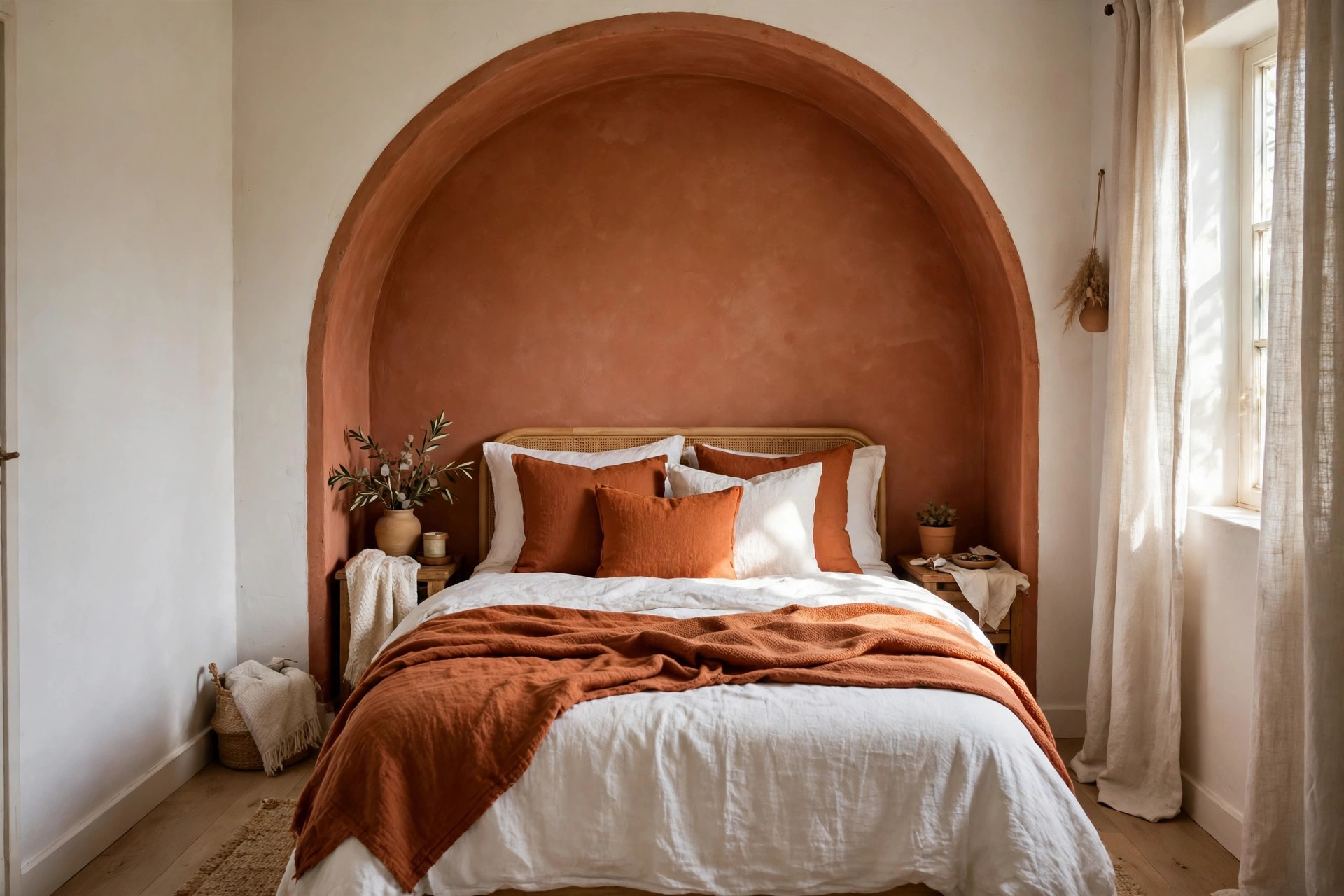
7. Painted Arch Behind the Bed
A painted arch creates a headboard shape out of paint alone. You mark an arch wider than the bed by about 8 to 12 inches on each side, rising 12 to 18 inches above the headboard, and paint inside it in a contrasting colour — terracotta on white is the most loved version, as shown above. It costs almost nothing and it is completely reversible.
How to get it right: draw the curve with a pencil on a string pinned at the centre point, not freehand. Stand back and check it from the door before any paint touches the wall. Price: $20–$45 — often just a sample pot or one litre. Best for: renters, tiny budgets and beds with no headboard.
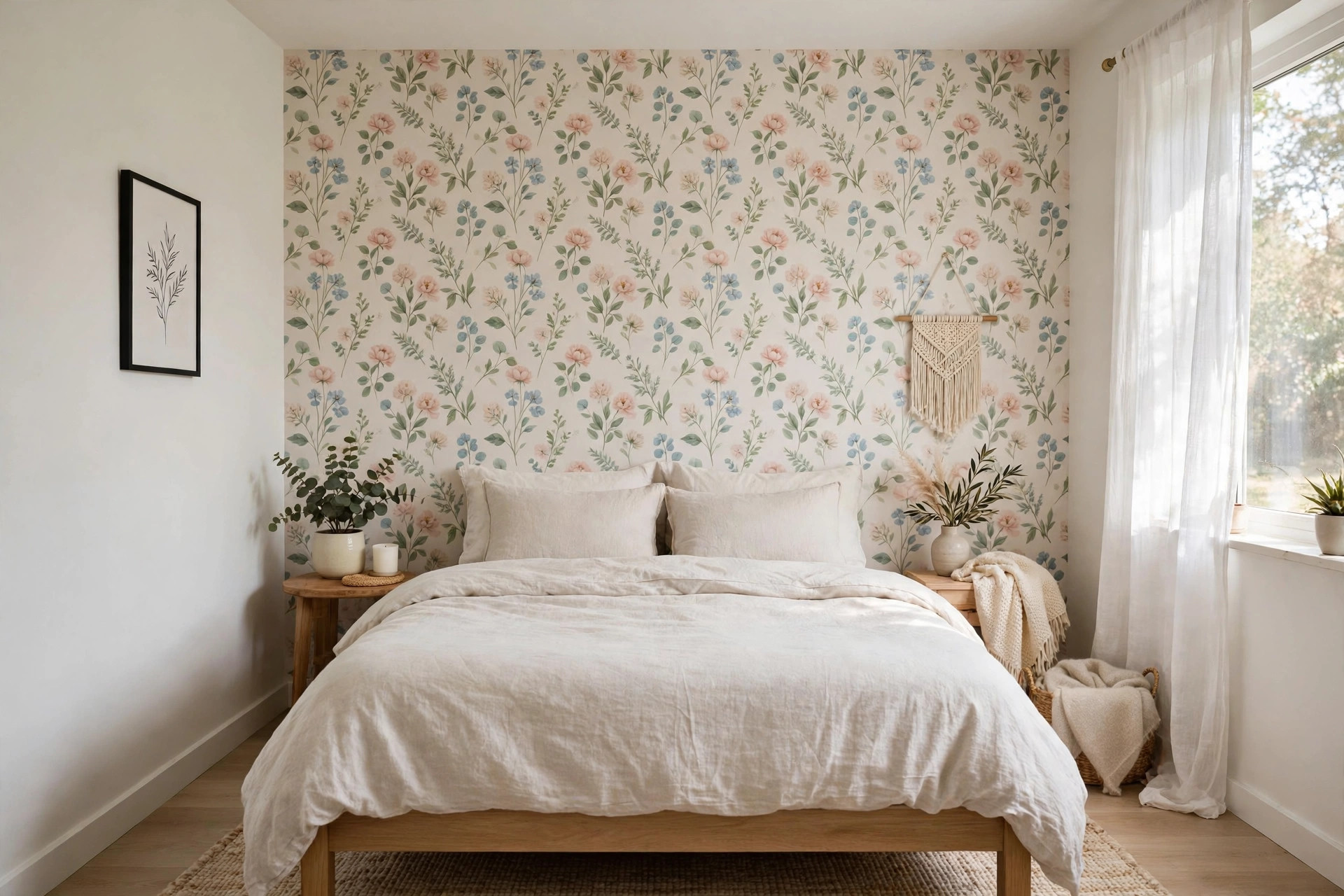
8. Floral and Botanical Peel-and-Stick Wallpaper (The Renter Favourite)
Peel-and-stick wallpaper is the renter-friendly way to get pattern behind the bed. A soft floral or botanical print on a light background adds the most visual interest of any idea here, while the side walls stay plain. It goes up in an afternoon and peels off without damaging paint when you leave.
How to get it right: in a small room, pick a print with a light background and a repeat you can live with at close range — you will see this wall from two feet away every morning. Order all rolls at once so the dye lots match, and start from the centre of the bed outward so the pattern sits symmetrically. Price: $30–$120 per wall. Best for: renters and pattern lovers.
9. Board and Batten for a Custom, Built-In Look
Board and batten — vertical battens over a flat wall, all painted one colour — adds shadow lines and architecture to a plain box room. Run it floor to ceiling behind the bed and the verticals also lift the ceiling. Painted in sage, navy or white-on-white, it looks custom in a way flat paint never quite does.
How to get it right: space battens 12 to 16 inches apart and plan the layout from the centre of the bed so both sides match. Use MDF battens for the cheapest, smoothest finish, caulk every seam, and allow a full weekend. Price: $75–$250 DIY. Best for: owners who want a permanent, tailored wall.
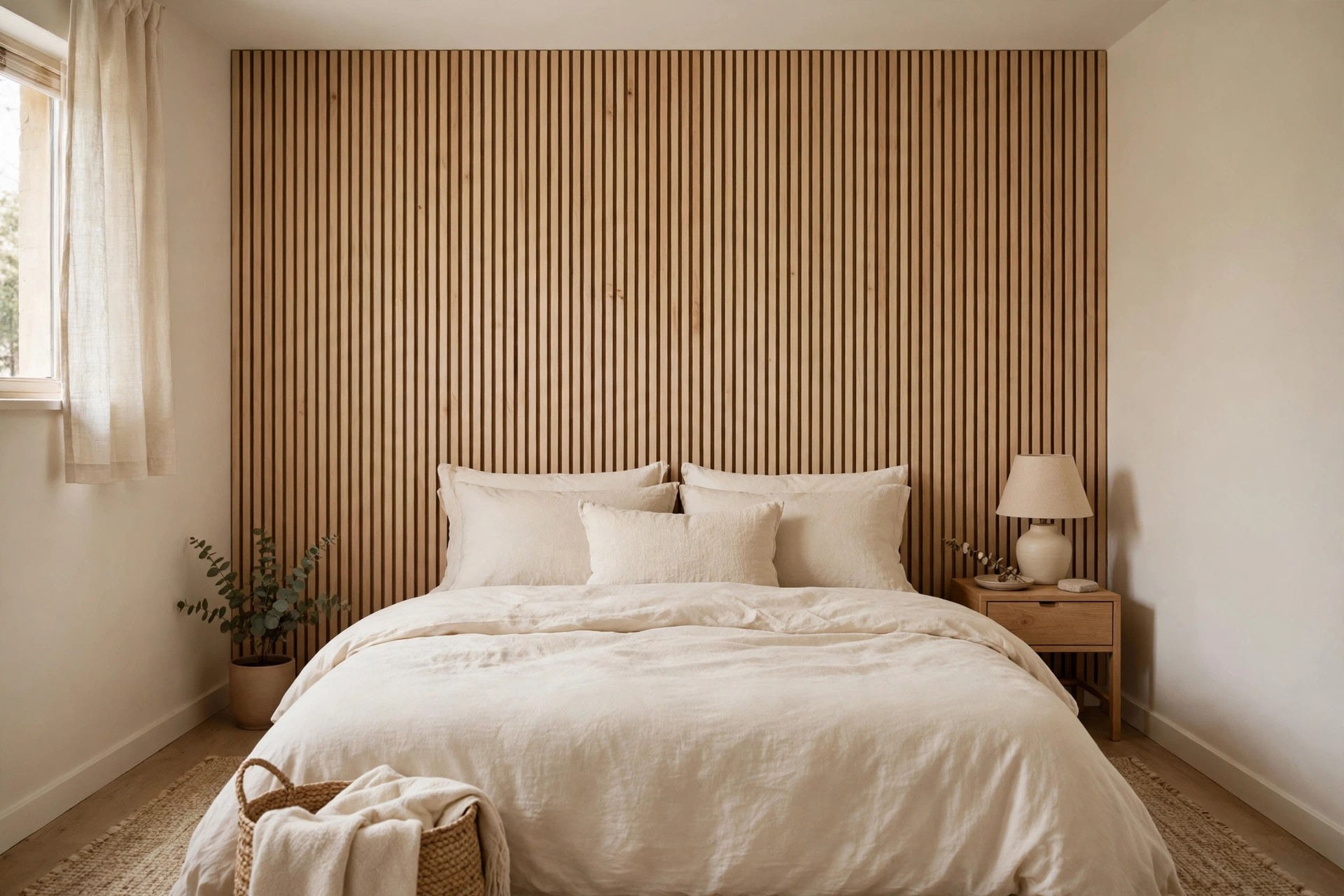
10. Vertical Wood Slats for Warmth and Texture
Wood slat panels bring warm, natural texture and the strongest vertical lines on this list. In a small bedroom they work best as a full wall behind the bed in a light oak tone — the room gains a boutique-hotel feel, and the slats even soften echo in a bare room.
How to get it right: light wood, not dark walnut, unless your room is very bright. Pre-made acoustic slat panels are the fastest route: most fix with screws or adhesive in a few hours, and a standard double-bed wall takes roughly 4 to 6 panels at 24 inches wide each. Price: $120–$400. Best for: minimalist rooms that need warmth.
11. Upholstered Panels That Double as a Headboard
Upholstered wall panels turn the whole accent wall into a soft, padded headboard. Individual panels — often 12 x 24 inches or 16 x 16 inches — stick or fix in a grid behind and above the bed, in velvet, linen-look or bouclé fabric. For anyone who reads or works in bed, the comfort difference is real.
How to get it right: extend the panels about 12 inches beyond the bed on each side and at least 24 inches above the mattress, so the grid frames the bed instead of ending exactly at its edges. Choose a fabric colour you can match bedding to easily — warm grey, oatmeal and sage are the forgiving ones. Price: $80–$300 depending on coverage. Best for: bed-readers and rooms that feel hard and echoey.
12. Built-In Storage Wall That Earns Its Space
The most practical accent wall of all: shallow built-ins or a run of wardrobes and shelves around and above the bed, painted one colour so the storage reads as architecture. In a very small bedroom this can be the idea that saves the room — the accent wall stops being decoration and starts holding clothes, books and bedding.
How to get it right: keep units shallow — 12 to 14 inches deep for shelves, standard wardrobe depth only at the sides — and paint everything, including doors, the same colour as the wall. Add two wall lights over the bed so you do not lose nightstand space to lamps. Flat-pack wardrobes painted to match are the budget route. Price: $250–$900+ depending on units. Best for: the smallest bedrooms with no closet room to spare.
Which Accent Wall Should You Choose? A Quick Decision Guide
- You rent: painted arch, two-tone paint (if your lease allows paint), or peel-and-stick wallpaper.
- Your budget is under $75: any single-colour paint idea — sage, navy, terracotta or soft black — or the arch.
- Your ceiling is low: vertical stripes, board and batten, or wood slats.
- Your room is narrow: two-tone wall, or a lighter accent with plain side walls.
- You want texture, not just colour: slats, board and batten, or upholstered panels.
- You need storage more than style: the built-in storage wall — style comes from painting it as one piece.
For more worked examples and colour combinations, the roundup of small bedroom accent wall ideas from Panyl is a useful companion browse before you buy.
5 Mistakes That Make a Small Bedroom Feel Smaller
- Putting the accent on the wrong wall. A bold side wall pulls the room sideways and leaves the bed wall blank. Behind the bed is the default for a reason.
- Going mid-tone everywhere. A medium colour on the accent wall plus medium bedding plus dark curtains leaves no contrast anywhere — the room just feels heavy. One dark or one pattern, the rest light.
- Choosing the print at the wrong scale. A tiny, busy print from close range looks like visual noise behind a bed. For small walls, medium-scale prints with space between motifs read calmer.
- Skipping the test patch. Accent colours look different at full-wall scale and in your light. A $6 sample pot and one day of looking is the cheapest insurance in this whole list.
- Adding more decor on top. A gallery wall over a wallpaper accent wall, plus patterned bedding, plus a patterned rug — each one is fine alone. Together in a small room, they cancel each other out.
Frequently Asked Questions
What is the best accent wall colour for a small bedroom?
Sage green is the most forgiving — clearly a colour, still light. Navy and soft black create the most depth when bedding and side walls stay light, and terracotta adds the most warmth. The best colour is the one that contrasts clearly with your bedding; a wall only slightly darker than everything else looks like a mistake.
Does a dark accent wall make a small room look smaller?
Usually the opposite, when it is only one wall. A dark wall recedes, which adds depth, and light bedding against it looks brighter by contrast. A dark colour on all four walls is what shrinks a room — that, and dark bedding against a dark wall with no light contrast left.
Can renters do an accent wall?
Yes. Peel-and-stick wallpaper is designed to remove cleanly, and a painted arch uses so little paint that many landlords allow it — check your lease first. Upholstered panels with adhesive backing are another reversible option. Keep photos of the wall before you start.
How wide should a painted arch be?
About 8 to 12 inches wider than the bed on each side, rising 12 to 18 inches above the headboard or above where a headboard would end. Too narrow and it looks like a mistake behind the pillows; too wide and it stops reading as an arch and becomes a colour block.
Should an accent wall be behind the bed or opposite it?
Behind the bed, almost always. You see it on entry, the bed frames it, and you are not staring at a bold pattern while trying to fall asleep. The exception is a very long, narrow room, where a treatment on the far short wall can pull the room together — but for a standard small bedroom, behind the bed wins.
The Bottom Line
A small bedroom does not need more things. It needs one wall with a decision on it. Choose the wall behind the bed, pick the treatment that matches your budget and your lease — paint this weekend, wallpaper if you rent, slats or board and batten if you own — and keep everything else in the room calm so the wall can do its job.
Test the colour first, measure before you buy, and stop at one wall. That restraint is exactly what makes a tiny room feel designed instead of decorated at.


Comments
Post a Comment