
14 Cozy Fall Home Office Ideas for a Warm, Focused Workspace
14 Cozy Fall Home Office Ideas for a Warm, Focused Workspace
A cozy home office is easy to build and easy to ruin. Add warmth the wrong way — a cluttered desk, a scented candle in a small room, a throw tangled in your chair wheels — and the room feels nice for a photograph and worse for the four hours of focused work you actually need from it. So start with focus, and let fall fit inside it. Three numbers govern everything below. Light: a task lamp in warm-white 2700–3000K feels cozy for writing and calls; go up to 4000K only for detail work like drawing, crafts, or reading small print, and do not mix the two in one fixture. Screen: the top of your monitor should sit at or slightly below eye level, with the screen 20–28 inches from your eyes — roughly an arm's length. Desk: a standard desk is 28–30 inches high; if yours is higher, raise your chair and use a footrest rather than hunching. Get those right first, then layer warmth in three groups: warmth that does not hurt focus, visual calm, and seasonal touches that still look professional on a video call.

Group 1: Warmth layers that don't hurt focus
1. Put a rug under the desk — sized to the chair's roll zone
A rug is the biggest warmth upgrade in a fall office, and the most commonly bought wrong. Size it to where your chair actually rolls: measure the chair's travel, usually about 3 feet back from the desk edge, and choose a rug that covers the desk footprint plus that zone — typically 5 x 7 feet for a single desk, 4 x 6 feet in a very small room ($45–$95 for a low-pile washable rug). Low pile, under about 1/4 inch, is non-negotiable: chair casters catch and chew high pile within weeks, and a rug your chair fights is a distraction every time you move. Use a rug pad on hard floors to stop creep. Warm pattern — Persian-look, plaid, or a faded rust and cream design — does the fall work here, so the desk itself can stay plain. On carpet, skip the rug entirely; layered rug on carpet bunches under wheels.
2. Keep one throw on the chair — and a place for it to live
Fall offices are drafty in a specific way: still air, cold legs under a desk while your upper body is warm. One throw, 50 x 60 inches ($18–$35, cotton or wool-blend), draped over the chair back or folded on the seat when you stand, solves it without heating the whole room. The rules are mechanical: keep it off the floor, out of the caster path, and never bunched behind your back while you work, where it wrecks the lumbar support your chair was adjusted to give. When you are on a long call, a throw over your legs reads as nothing on camera — only shoulders and background show. Washable matters here too; a throw in a working office collects coffee drips and everyday dust, and a dry-clean-only blanket will end up exiled to a closet by November.
3. Choose a warm-metal task lamp — and set it opposite your writing hand
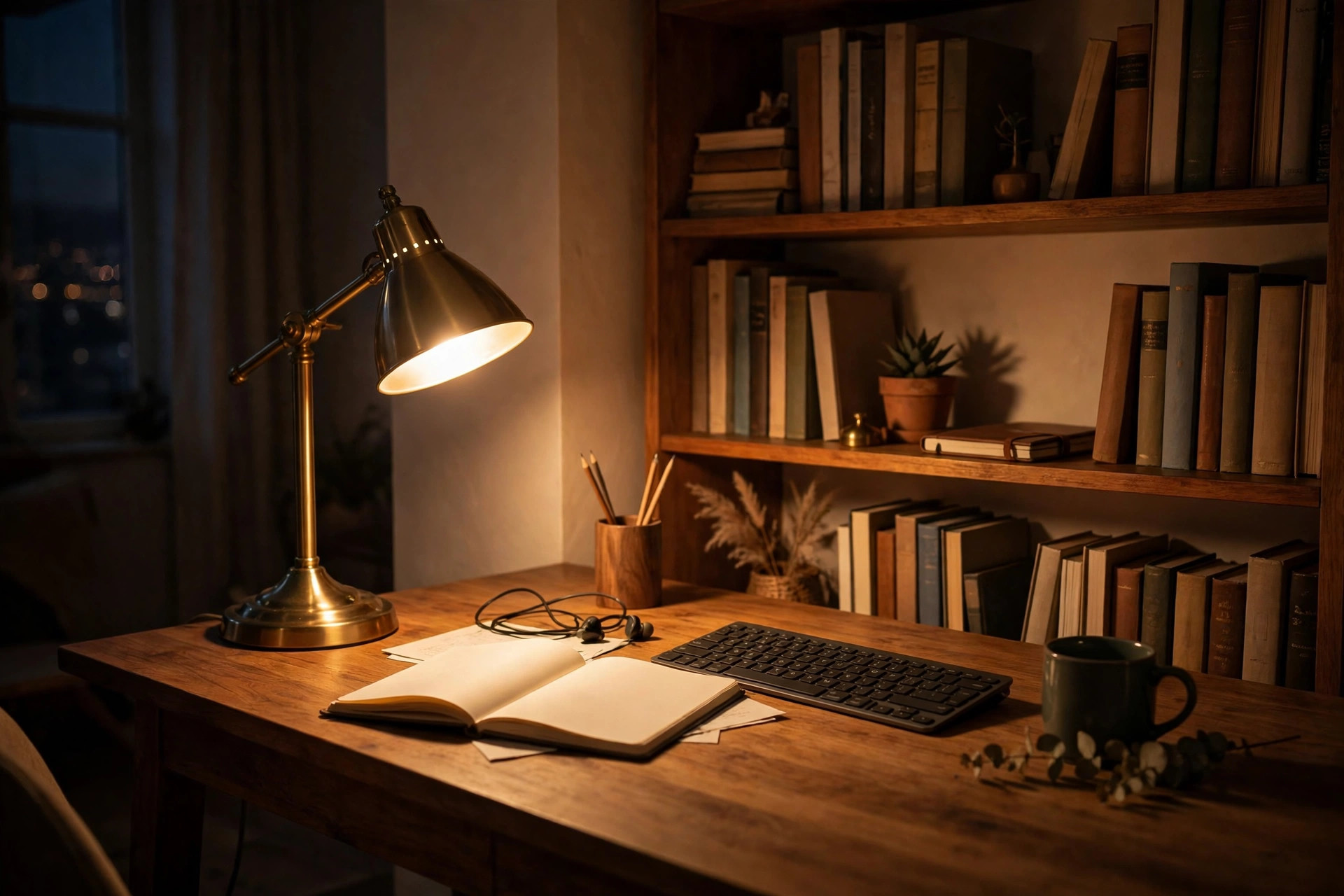
A lamp in brushed brass, copper, or matte black with a warm finish ($35–$70 for a solid desk lamp with an adjustable arm) adds fall color every hour you work, unlike a pumpkin you notice twice a day. Place it on the opposite side from your writing hand — left side for right-handers — so your hand does not shadow the page, and angle the shade so the bulb is not visible from your chair or your camera. Look for a lamp that takes a standard bulb so you can control temperature yourself: 2700–3000K for most work. If your office lighting is the reason the room feels cold, the layered fixes in these small home office lighting ideas — one overhead, one task lamp, one low ambient source — will do more than any single brighter bulb, which usually just adds glare to your screen.
4. Warm the window, not the desk, with one heavy curtain panel
If your desk sits by a window, fall drafts and flat gray light both come from the same place. A heavier curtain panel in a warm neutral or deep olive — one panel for a single window, 84 inches long, $25–$45 — hung close to the frame softens both, and it shows in your background on calls as texture rather than decor. Keep curtains at least 3 feet from any space heater, and never let a panel pool on top of a radiator or baseboard heater. Do not solve a cold office with a heater under the desk surrounded by paper, curtains, and a throw: heaters need 3 feet of clear space on all sides, away from paper and fabric, and most small offices simply do not have that footprint near a desk. Warm the textiles and block the draft first; they have no clearance rules.
Group 2: Visual calm — the part that protects focus
5. Control cords once, properly, under the desk
Nothing makes a desk look cluttered faster — or feel more chaotic on a bad workday — than a nest of cords in your eyeline and around your feet. Fix it once: a cable tray or raceway mounted under the desk ($16–$28, about 16–24 inches long) holding the power strip off the floor, Velcro ties every 12–18 inches along each run ($6–$10 for a pack), and exactly one cord dropping to the wall outlet. Label both ends of each cable with tape if you have more than four devices; future-you unplugging the wrong thing mid-call is a real cost. Keep the power strip ventilated and uncovered — not buried under paper or a throw — and replace any cord with a cracked jacket rather than taping it. A clear floor under the desk also gives your feet and the throw in idea 2 room to exist without tangling.
6. Give paper one tray in, one tray out — and nothing else
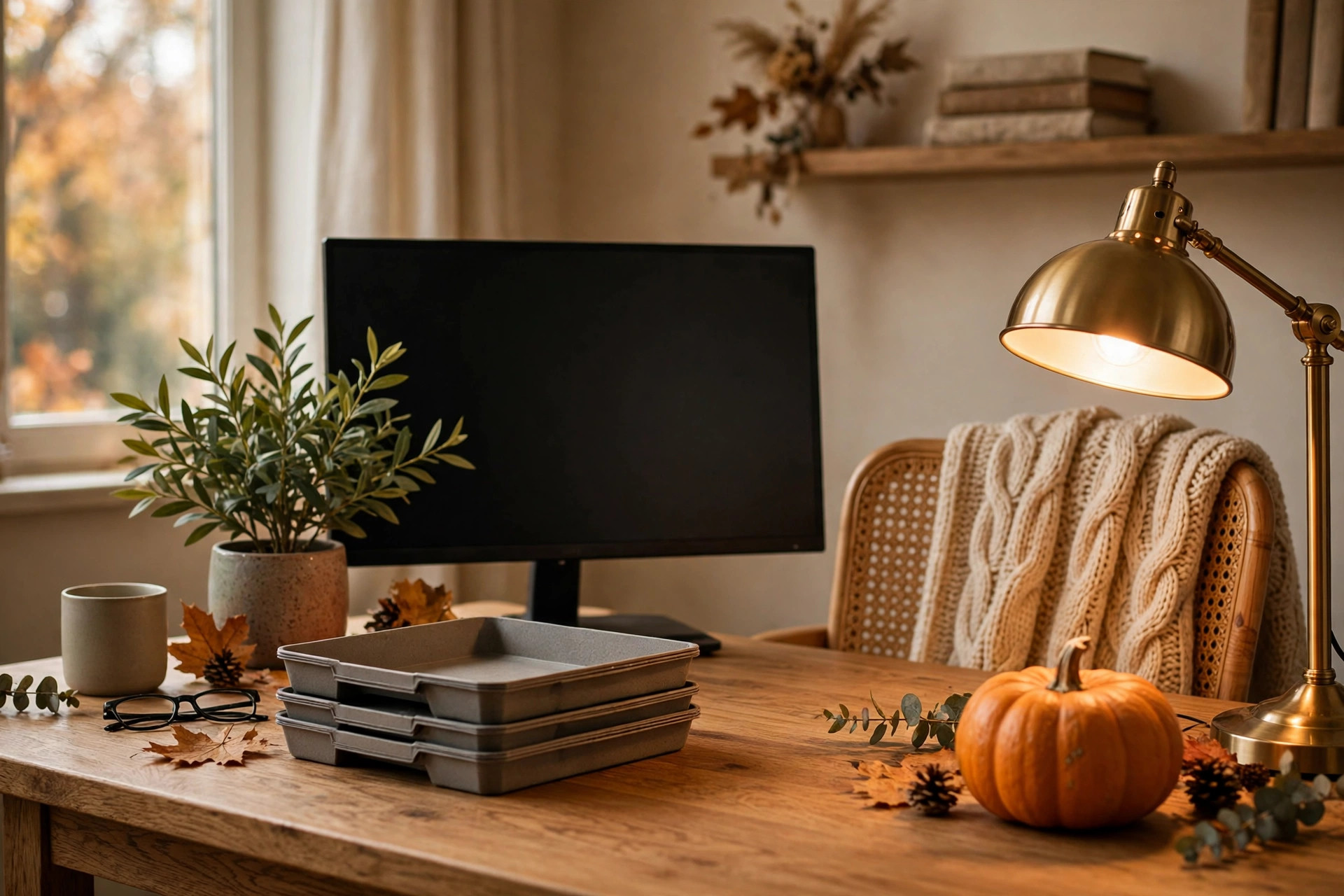
Paper is where fall clutter creep starts: a flyer, a form, a notebook, and suddenly the desk is a filing system. Cap it with a two-tier tray ($14–$24, letter-size, about 10 x 13 inches per tier) at the desk's back corner: top tier is in — needs action this week; bottom tier is out — file, mail, or recycle at week's end. Everything that does not fit in the in-tray gets dealt with or thrown away the day it arrives. That hard edge is the point. The broader desk-by-desk system in these beautiful fall desk organization ideas pairs well with the tray rule if your problem is supplies rather than paper — pens, chargers, and notebooks each need one home, not a drawer of spares. Keep the tray off your main work zone: your central 24 x 16 inch area — laptop or keyboard, notebook, drink — stays clear by default.
7. Pick plants by your window's light, in the right pot size
A plant softens an office more honestly than any seasonal object, but only if it survives. Match the plant to the light you have, not the light you wish for. Bright window (south or west, within 3 feet): a small olive tree or rosemary in a 6-inch pot ($18–$30) handles sun and suits fall. Medium light (east window, or 4–6 feet from a bright one): a pothos in a 6-inch pot ($12–$20) trails nicely off a shelf and forgives missed watering. Low light (north window or an interior desk): a snake plant in a 5- to 6-inch pot ($14–$22) tolerates it, though it will grow slowly. Go one pot size up — about 2 inches wider — when roots circle the drainage hole, and always use a saucer ($3–$6) on wood desks. A dead plant on camera looks worse than no plant, so if you travel or forget watering for weeks, a good faux stem in a real ceramic pot is the professional choice, not a failure.
8. Close storage before you add open storage
Open shelves photograph well and distract all day: every visible object is a small demand on your attention. In a working office, prefer closed storage for supplies — a drawer unit that fits under the desk (about 16 inches wide, 24–28 inches high, $50–$90) or a lidded box on the shelf ($12–$18) — and reserve open display for the narrow zone behind you that the camera sees (idea 10). If your desk is already buried, work through these small home office storage ideas for cluttered desks before buying autumn anything; decor added to a cluttered desk just gives clutter warmer colors. One honest test: sit in your chair and look straight ahead. Everything in that view should be either a tool you use daily or deliberately calm. Move the rest behind a door, literally or figuratively.
9. Set a drink station off the work surface
Fall means more hot drinks, and hot drinks on a desk with a laptop and paper are a spill waiting for a deadline. Move the ritual 2 feet sideways: a small side table, stool, or the top of a filing cabinet, about 16–20 inches across ($22–$40 if you buy one), holding your mug, a coaster, and a small carafe or teapot. A wood tray under them ($12–$18) catches drips and defines the station. Keep all liquids at least 12 inches from your keyboard and never on the same surface as the paper tray. This also creates the micro-break fall work needs: standing to pour tea every couple of hours is movement your back and eyes — still at that 20- to 28-inch screen distance all day — will thank you for. Keep scented drinks and spiced candles separate ideas; a strongly scented candle or diffuser in a small office (under about 120 square feet) can build to a headache-level fragrance by midday and cling to paper and fabric, so most small offices are best unscented or scented only by the drink itself.
Group 3: Seasonal touches that stay professional on video calls
10. Style only what the camera frame actually sees
Do not decorate the whole back wall. Sit in your chair, open your camera preview, and note the frame — for most webcams at arm's length, that is a rectangle roughly 4–5 feet wide and 3–4 feet high behind you. Style only inside it: one shelf or surface at shoulder height holding three things at varied heights — a short stack of books with warm-colored spines (about 10–12 inches of stack), a plant from idea 7, and one fall object, a small pumpkin or an amber vase with dried stems trimmed to 12–16 inches. Everything outside the frame can stay purely functional. This is why a professional fall background is cheap: you are styling about 12 square feet, not a room. Check the preview in the light you actually call in — a background that looks warm at noon can go orange and murky under a lamp at 5 p.m.

11. Add fall color through desk tools you already touch
The seasonal layer clients and coworkers will actually notice is small and close: a notebook in rust or chocolate ($8–$14), a ceramic pen cup in a warm glaze ($10–$16) replacing a plastic one, a desk pad in cognac or deep tan faux leather, 31 x 15 inches ($20–$32), that also defines your work zone and protects the desk. Together they recolor every photo, call close-up, and workday glance for under $55, and none of them needs dusting around or explaining. Limit the palette to two fall colors plus your existing neutrals. Four seasonal colors on one desk — orange mug, plaid notebook, gold lamp, green plant pot — reads busy at exactly the distance a camera sits. When winter comes, the notebook and pen cup go in a drawer; the desk pad stays.
12. Keep one seasonal object on the desk — singular
One small object by the monitor is charm; three is a theme park. Choose a single piece: a 3- to 4-inch mini pumpkin (real, $1–$3, lasting 2–4 weeks before it softens; or faux, $5–$8, lasting years), a small wood bowl of acorns or walnuts, 4–5 inches across, or a short amber candle holder used flameless. Place it at the monitor's base or beside the lamp — inside your view, outside your work zone and outside the camera's main frame, so it is for you, not for show. Check a real pumpkin weekly from the stem end and remove it the day it softens; a leaking gourd on a desk with paper and electronics is a mess out of proportion to a $2 decoration. Keep any dried stems at least 12 inches from a lamp bulb that gets hot, and skip loose dried leaves on the desk entirely — they crumble into the keyboard.
13. Light your face for calls with the lamp you already have
Fall's early dusk means afternoon calls happen in the dark by November, and an overhead light alone makes everyone look tired. For calls, swing your task lamp (idea 3) or a small second lamp to face you from behind the camera, slightly above eye level and about 3–4 feet away, at the same warm 2700–3000K as the room. Mismatched color — a cool ring light in a warm room — makes skin look gray. A basic warm-white lamp for this job costs $25–$45 if you need a dedicated one; a $0 version is turning your desk lamp around for the call and back after. Test in preview before an important meeting, with your fall background in frame: you want your face brighter than the shelf behind you, or the camera will expose for the shelf and leave you in shadow.
14. End the day with a five-minute reset in a seasonal box
Clutter creep is not a character flaw; it is what happens when decor and work share a room with no closing routine. Keep one box or basket, about 12 x 16 inches ($10–$16), in the closet or under the desk labeled for fall: spare seasonal items, the extra throw, candle refills, and the fall notebook when it is full all live there, not on surfaces. Then close each workday the same way: paper tray sorted to what fits, drink station wiped, throw folded on the chair, desk's central zone empty. Five minutes. A desk that starts clear keeps focus cheap all fall, and a desk that starts half-buried taxes every first hour. The box is also your season-change system — in December, fall objects go into it in ten minutes, and the office never becomes a museum of seasons past.
The focus test
- Eyes: Screen top at or below eye level, 20–28 inches away, no glare from the window or lamp?
- Desk: Central 24 x 16 inch zone clear, paper capped at one two-tier tray, cords off the floor?
- Warmth: Rug under the roll zone, one throw on the chair, heater — if any — 3 feet clear of paper, fabric, and curtains?
- Camera: Background styled only inside the frame, face lit warmer and brighter than the shelf?
Pass those four checks and fall becomes what it should be in a workspace: a warmer room around the work, not a distraction from it. Build it in the group order above — warmth, calm, then the seasonal layer — and you will notice the odd truth of office decorating: the ideas that help focus, the tray, the cords, the rug, are the same ones that make the room look best on camera.


Comments
Post a Comment