
13 Small Home Office Storage Ideas That Actually Free Up Desk Space
13 Small Home Office Storage Ideas That Actually Free Up Desk Space
A cluttered desk is not a storage problem — it is a home problem. When every pen, charger, notebook, and paper stack lives on your desk surface, the desk stops being a workspace and becomes a junk drawer with a chair. These small home office storage ideas for cluttered desks fix the root cause: they give everything a home that is NOT the desk. Expect real measurements, real costs, and zero advice that requires a bigger room.
If you have already organized the surface, our fall desk organization guide covers the surface-level styling side of a tidy desk.
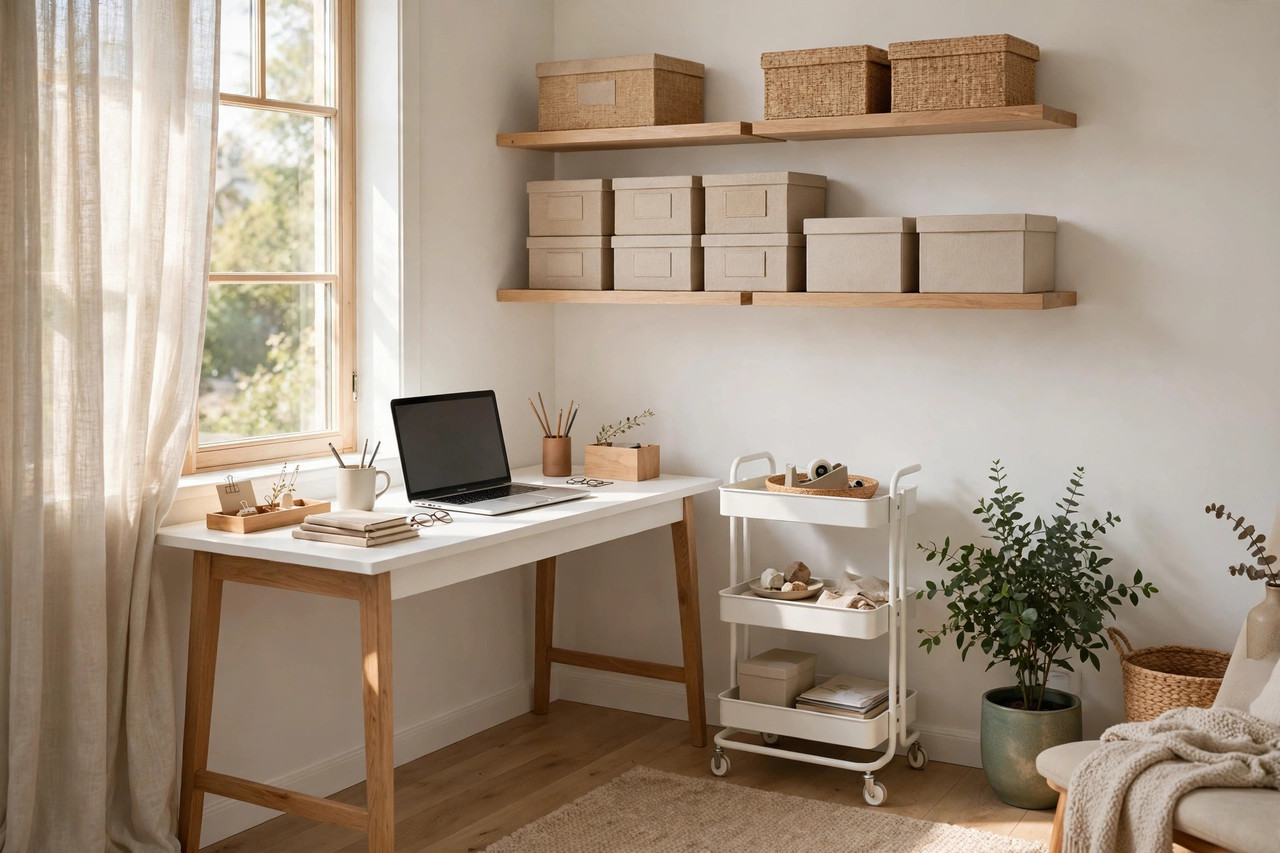
Vertical Storage: Use the Walls Your Desk Can't Reach
The wall above your desk is the most underused square footage in a small home office. Floor space is limited; wall space is not. Start here before buying a single new piece of furniture.
1. Mount two floating shelves above the desk
Two 36-inch floating oak or white shelves, mounted 14-16 inches above the desk surface, hold books, reference binders, and labeled storage boxes — about 6 square feet of new storage that touches zero floor. Budget $25-45 per shelf plus $8 in brackets and anchors. Keep the bottom shelf for things you grab daily and the top shelf for reference; anything you need more than twice a day should move lower.
2. Turn one wall into a pegboard command center
A 24-by-36-inch pegboard ($20-40 in wood or painted finish) above or beside the desk holds scissors, headphones, tape, cables, and small baskets on hooks — everything visible, everything off the desk. The reason pegboards beat shelves for supplies: you see everything at a glance, so nothing gets re-purchased and re-stacked. Add two small shelf ledges on the board for jars of pens.
3. Hang a wall-mounted file pocket for active paperwork
Paper is what actually buries desks. A three-pocket wall file ($18-35) mounted beside the desk creates a hard rule: incoming, in-progress, outgoing. Whatever does not fit the pockets gets filed, scanned, or recycled that evening. Paper without a wall home always migrates to the desk.
4. Use the side wall for a tall, narrow bookshelf
A 12-inch-deep, 72-inch-tall bookshelf ($60-120) fits in a corner most people ignore and stores a full home-office library plus baskets for tech gear. Anchor it to the wall (especially on carpet) and put the heaviest items on the bottom shelf. Twelve inches of depth is the sweet spot: deep enough for binders, shallow enough to hug a wall.
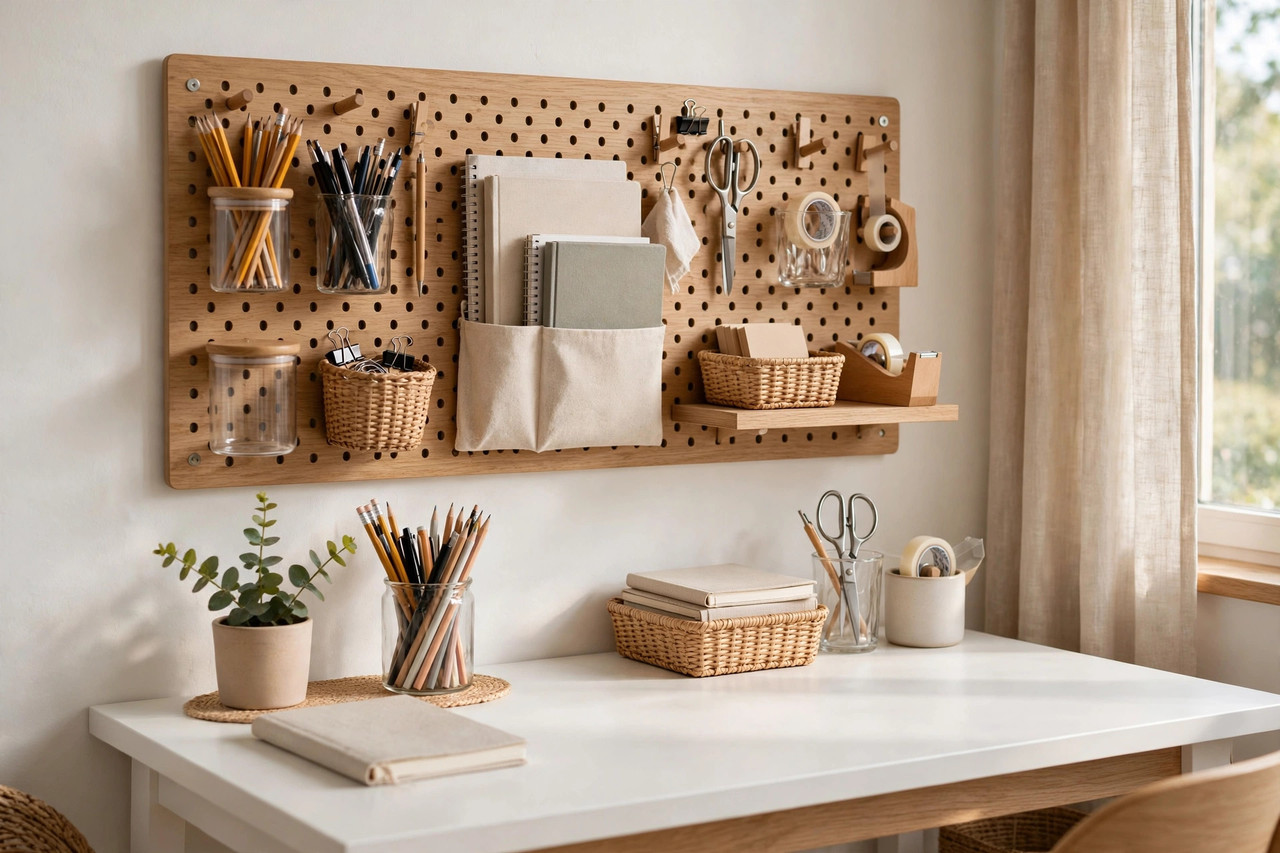
Desk-Level Storage: Keep the Surface Sacred
The rule for a small desk: only what you touch hourly lives on it. Everything else goes under, beside, or inside something. These ideas move the second tier of supplies off the surface. For the drawers and desktop itself, our small desk storage ideas squeeze real capacity out of the space your hands actually reach.
5. Slide a slim rolling cart under or beside the desk
A 3-tier rolling cart about 17 inches wide ($30-50) slides into the dead space beside most desks and holds a printer on top, supplies in the middle, and paper below. The wheels matter: roll it out when you need it, tuck it away when you don't. Measure the gap before buying — 2 inches of clearance on each side is the minimum for smooth rolling.
6. Add an under-desk rolling drawer unit
A 16-inch-wide drawer pedestal on casters ($40-70) converts the dust zone under your desk into two or three drawers of storage: chargers and headphones on top, documents in the middle, personal items below. It needs about 20 inches of knee-room depth, so it suits desks 24 inches deep or more.
7. Lift the monitor onto a storage riser
A 20-inch monitor riser ($25-45, or a sturdy box in a pinch) raises the screen to eye level and creates a 4-to-6-inch shelf underneath for the keyboard when you leave, a notebook, and a pen cup. Ergonomics and storage in one purchase — the top of the screen should sit at or slightly below eye level.
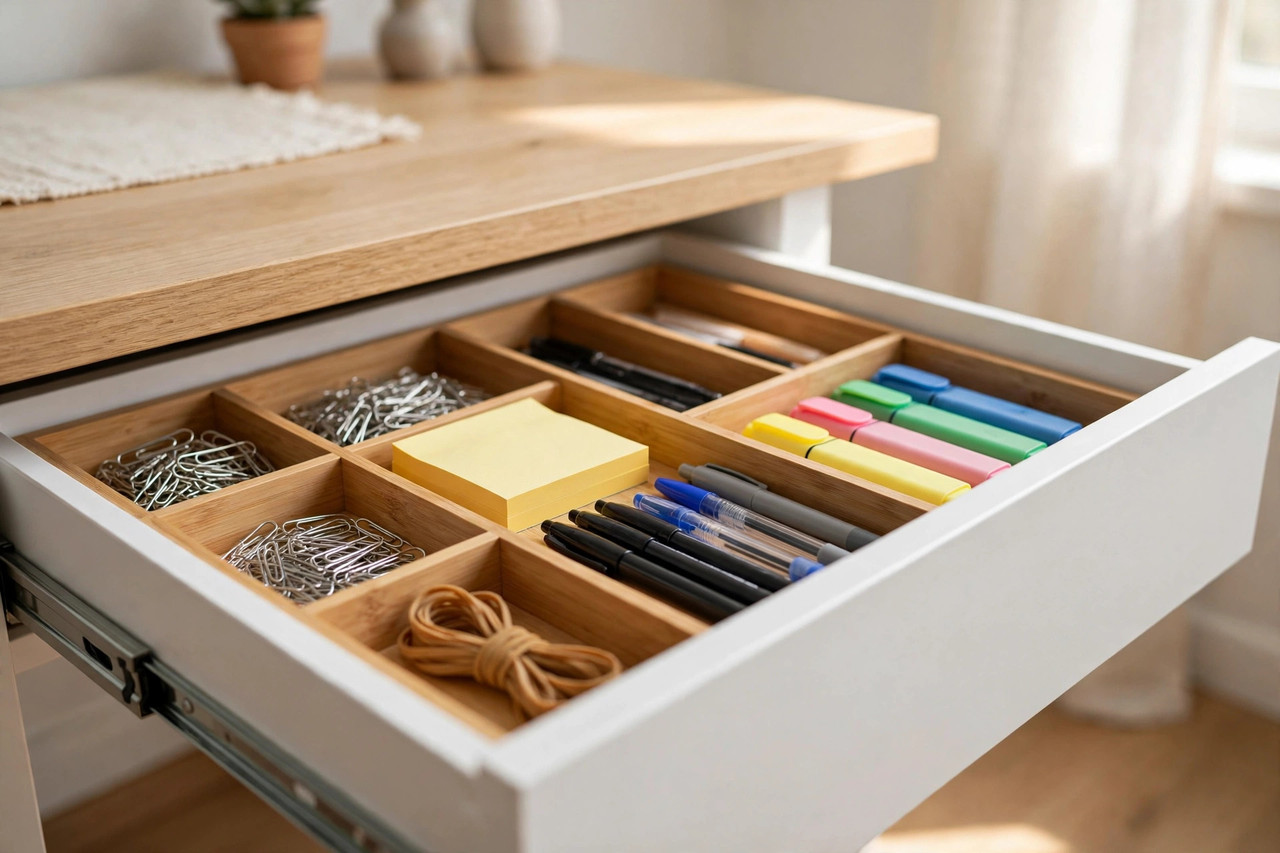
8. Divide every drawer with organizers
Bamboo or plastic drawer organizers ($15-25 for a set) turn a junk drawer into a grid where everything has an address: pens, sticky notes, USB drives, batteries. The test is simple — open the drawer, and if you can find anything in five seconds, it passes. One drawer deep-cleaned with organizers saves more time than any filing system.
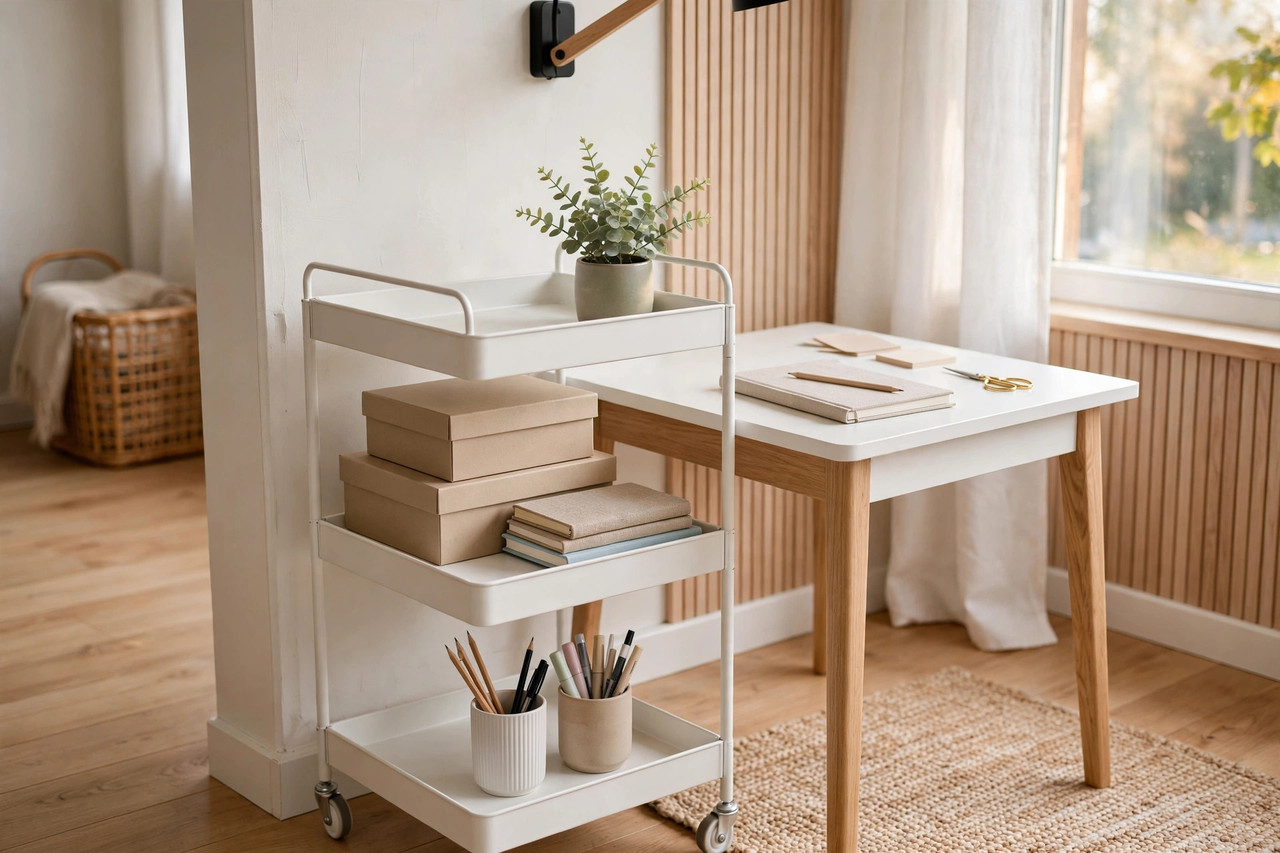
Hidden and Multi-Purpose Storage for Tiny Offices
When the office is a corner of a bedroom or living room, storage has to disappear. These ideas hide supplies in furniture that would be there anyway.
9. Corral cables with a tray and cord box
Cables look like clutter even when everything else is organized. An under-desk cable tray ($12-20) plus a cord management box ($15-25) hides the power strip, chargers, and the rat's nest behind the desk. Label both ends of every cable with a tag — the two minutes it takes saves twenty the next time you rearrange.
10. Use a storage ottoman as a filing stool
A storage ottoman ($35-70) beside or under the desk swallows craft supplies, manuals, and the box of cables everyone owns. Bonus: it is extra seating when someone drops by, and a footrest during long calls. Choose one with a hinged lid that stays open on its own.
11. Convert a closet into a mini office nook
Got a spare 24-inch-deep closet? Remove the door, add a 20-inch-deep countertop at desk height ($40-80 cut to size), mount a shelf above, and the closet becomes a full office that closes with a curtain at 5pm. This is the single highest-storage-per-square-foot option for tiny homes: walls on three sides mean shelves everywhere. Our cozy home office ideas show how warm lighting makes a closet office feel intentional, not improvised.
12. Fold the whole office away with a wall-mounted desk
A drop-leaf wall desk ($70-140) with built-in cubbies folds flat against the wall when work ends — the office disappears, and the room is a bedroom again. Best for laptops and light paperwork; if you run a dual-monitor setup, stick with idea 4 and a real desk. The folding ritual also enforces the daily shutdown that remote workers keep skipping.
13. Run a 10-minute weekly reset
Storage systems fail without maintenance. Every Friday, set a timer for ten minutes: clear the desk completely, return everything to its wall/shelf/drawer home, and trash or file the week's paper. A system you maintain for ten minutes a week beats a perfect system you abandon in a month. The desk is clear Monday morning because of Friday's ten minutes, not because of any organizer you bought.
Capacity numbers: what each piece actually holds
Floating shelves (idea 1). A 36-inch shelf on proper wall anchors carries about 15–25 lb — call it 8–10 hardcover books or three storage boxes — but only if at least one fixing hits a stud or a rated hollow-wall anchor; screws into plain drywall pull out at a fraction of that. Space the two shelves 12–14 inches apart vertically: standard binders and letter-size boxes need 11–12 inches of clear height. Storage boxes on those shelves should be 10–11 inches tall and no deeper than the shelf (usually 8–10 inches) — a standard 13-inch-deep archive box will overhang and look wrong. Pegboard (idea 2). A 24×36-inch board holds roughly 20–30 small items on hooks; keep individual hooks under about 3–5 lb and the whole board under 25 lb. Rolling cart (idea 5). Tiers are typically 9–11 inches apart vertically, which fits a standard home printer (about 6–8 inches tall) on the top tier only — measure your printer before planning it for the middle. Drawer pedestal (idea 6). Two to three drawers give you roughly 1–1.5 cubic feet of storage; the shallow top drawer (about 3–4 inches deep) is the charger-and-headphones drawer, the deep file drawer (10–12 inches) takes letter-size hanging folders. Ottoman (idea 10). A standard 18×18×15-inch storage ottoman swallows about 1.5 cubic feet — roughly one banker's box of cables and manuals. Knee room check: whatever you put under the desk, keep a clear box at least 24 inches wide and 20 inches deep for your legs, or the storage win becomes an all-day discomfort.
Quick-Start Budget Guide: Small Home Office Storage
- Under $50: pegboard ($30) + drawer organizers ($20) — the desk clears up in one evening.
- $100-150: add two floating shelves ($70) + rolling cart ($45) — real storage volume appears.
- $200-350: add the tall corner bookshelf ($90) + cable management ($35) — the room feels like an office, not a desk in a corner.
- $400+: the closet-office conversion or drop-leaf desk — maximum storage in minimum square feet.
Frequently Asked Questions
How do I organize a very small home office desk?
Keep only hourly-use items on the surface: laptop, one pen, one notebook, water. Everything else moves to wall storage (shelves, pegboard), under-desk storage (drawer unit, cart), or a drawer. If it sits untouched for three days, it does not belong on the desk.
What is the best storage for a home office in a bedroom corner?
Vertical storage that disappears: floating shelves, a pegboard, and a drop-leaf desk that folds away. Avoid freestanding filing cabinets in bedroom corners — they make the room feel like an office 24 hours a day. See idea 12 for the fold-away option.
How can I hide office supplies in a small space?
Storage ottomans, lidded baskets on shelves, and labeled boxes in matching colors. The trick is uniformity — five matching cream boxes look like decor; five mismatched cardboard boxes look like a move in progress.
Do I need a filing cabinet for a home office?
Almost never in a small home office. A wall file for active paper (idea 3), one drawer for archived documents, and scanning the rest covers 95% of home paperwork. Filing cabinets are bulky, heavy, and mostly store paper you will never read again.
That is the whole system: walls hold the supplies, furniture hides the rest, and Friday's ten minutes keeps it honest. Do these thirteen and the desk becomes a place you work at — not a place you dig through.


Comments
Post a Comment