
14 Warm Fall Kitchen & Dining Decor Ideas: Layered Tablescapes for Autumn
14 Warm Fall Kitchen & Dining Decor Ideas: Layered Tablescapes for Autumn
Most fall kitchen photos fall apart the moment you try to cook in them. A counter buried under pumpkins looks charming for ten minutes, then you need somewhere to chop an onion and the whole display ends up on the floor. A warm autumn kitchen has to work both ways: layered and seasonal at 7 a.m., and still clear and safe to roll out dough, rest a hot pan, and set down groceries at 6 p.m. The first half keeps the kitchen functional — counters, shelves, island. The second half is a step-by-step tablescape recipe, from the runner up, so a table for four, six, or eight comes together without blocking conversation.

Half 1: The kitchen zones — warmth that leaves room to cook
1. Protect 24 inches of completely clear prep space first
Before you add a single autumn thing, decide where it is not going. Keep one continuous run of counter — at least 24 inches wide, ideally beside the stove or sink — completely clear of decor, all season. That is the landing zone for a cutting board (a standard 12 x 18 inch board needs that width with room for a knife and a bowl), for hot pans, and for unloading bags. Everything else happens outside that zone. If your kitchen is small, the clear run matters even more. A $0 move — relocating the fruit bowl to the other end of the counter — does more than any purchase, because a kitchen that fights you at dinner never feels cozy, however pretty it looked at noon.
2. Corral counter decor onto one small tray, away from food
Outside the prep zone, group what you do display. A wood or marble tray, roughly 9 x 14 inches to 12 x 18 inches ($18–$35), holding a small faux pumpkin, a candle, and a crock of wooden spoons reads as one intentional vignette instead of five scattered objects. The tray is also a practical tool: lift it in one motion when you need to wipe crumbs or flour. Food safety is the watch-out here, and it is not decorative advice. Keep decor — especially porous items like real gourds, dried wheat, and fabric pumpkins — at least 12 inches from where raw food is handled, and never style around the stove top, where grease coats everything within a week and a dried stem near a burner is a genuine fire risk. If you love brown kitchen ideas that feel warm without a remodel, this tray in walnut, acacia, or dark-stained wood is the fastest way to borrow that warmth in a rental or a white kitchen.
3. Restyle open shelves with a 60-30-10 ratio
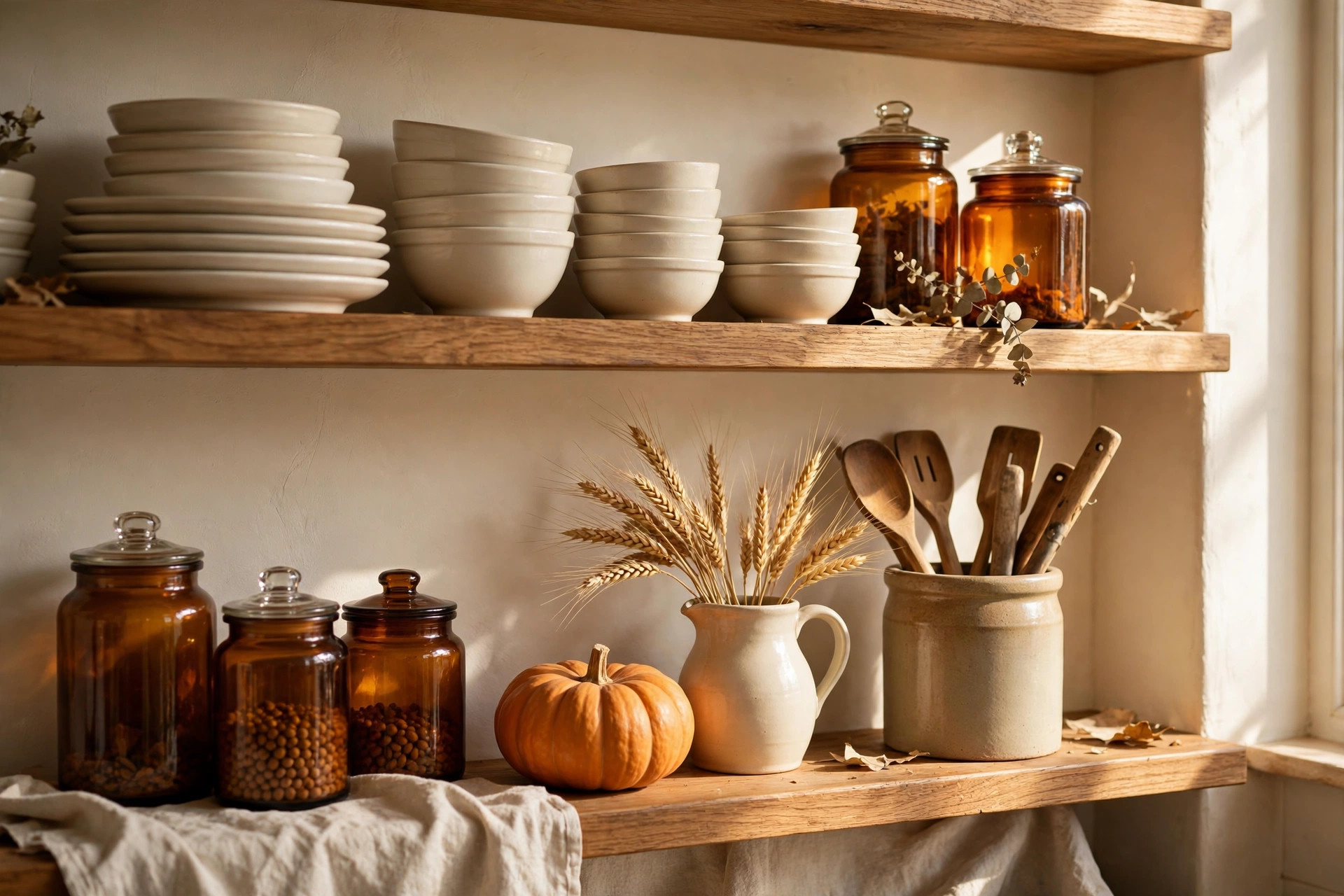
Open shelves turn to visual noise when every inch is filled with pretty things and nothing you use. Work to a rough ratio on each shelf: about 60 percent everyday dishes (stacks of 6–8 white or cream plates and bowls), 30 percent warm material (wood boards, woven baskets, stoneware crocks), and 10 percent seasonal (one small pumpkin, one amber jar, a short stack of linen napkins in rust or olive). On a 30- to 36-inch shelf, that means two dish stacks, one board stood upright at the back, and one seasonal cluster — not a row of pumpkins. Leave 2–3 inches between groups. Shelves are typically 10–12 inches deep and spaced 15–18 inches apart; stand boards upright rather than laying decor flat, where it collects dust and cooking film. Dust every two weeks in fall — grease travels, especially when windows stay closed.
4. Swap shelf and counter textiles, not hardware
The cheapest warmth in a kitchen is textile. Replace summer dish towels with two or three in a heavier weave — linen or a cotton-linen blend, about 18 x 28 inches, $12–$22 for a set of three — in plaid, rust stripe, or deep olive, and fold one over the oven handle with the pattern facing out. Add one washable runner in front of the sink or stove, 20 x 48 inches to 24 x 72 inches ($25–$50), with a non-slip pad underneath ($8–$12). The pad is not optional on tile or wood: a runner that slides under wet feet is worse than cold floors. Choose a low-pile, machine-washable runner in a busy pattern; kitchens drop turmeric, beet juice, and red wine, and a forgiving pattern hides stains until laundry day. Skip shag or thick foam mats — they trap crumbs at the edges.
5. Style the island by footprint, not by pile
An island is a work surface first and a stage second, so style it by footprint. Limit the display to roughly one-third of the island's surface. On a standard 24 x 48 inch island, that is a single tray or board grouping about 12 x 20 inches, set off-center toward the seating side. Start with a large wood board or low tray as the base, add height in the middle (a cake stand, 10–12 inches across, $20–$35, holding faux or real apples), then one low element at the edge — a small bowl of walnuts or a folded napkin stack. That stepped shape leaves the cook's side open for a sheet pan. Never build a display down the full length of an island where people eat breakfast; elbows and mugs will dismantle it daily. If your fall plans include grazing boards for guests, keep that board empty, washed, and stored upright — styling belongs on a separate decorative board, not the one food touches.
6. Add one serving station that earns its place
Finish the kitchen with a single station you will actually use in autumn: a coffee, tea, or soup-mug corner on 18–24 inches of counter near an outlet. A small tiered stand ($22–$38) or a shallow basket holds 4–6 mugs, a jar of tea or coffee, and a folded towel; a tiny amber bottle or mini pumpkin on top is the whole seasonal statement. Fall kitchens get used differently — more hot drinks, more slow soups — and decor that follows use never feels forced. Keep it honest about cords and water: the station belongs at least a few inches from the sink's splash zone, mugs should be fully dry before they go on wood, and scented candles do not belong here at all. Food and drink pick up nearby fragrance, and a cinnamon candle two inches from the sugar jar will flavor more than the room.
Half 2: The dining tablescape, in order
Build the table in this order and it will look layered instead of loaded. The recipe assumes a 36 x 60 inch to 42 x 72 inch table seating four to six; scale the counts, not the proportions, for a larger table.

7. Lay the base: a runner 12–14 inches wide, with real overhang
Start with a runner, not a full tablecloth, if you want the wood to show. Choose one 12–14 inches wide and long enough for a 12-inch drop at each end: table length plus 24 inches. For a 60-inch table, that is an 84-inch runner; for a 72-inch table, 96 inches. Linen and linen-look runners in natural flax, cream, or a soft plaid run $18–$35 and wrinkle in a way that reads relaxed rather than sloppy — press only the ends if you are short on time. Center it carefully; a runner 2 inches off-center makes every later setting look crooked. Watch-out: white and cream runners under a fall menu of squash soup and red wine need a washable fabric — check the label for machine wash cold before you buy, and skip dry-clean-only linen for any table where children eat.
8. Set a low, long centerpiece you can talk over
The rule that saves every dinner: keep the middle of the table under 12–14 inches high, or go deliberately tall and thin. A low, long arrangement suits most fall tables — a 24- to 36-inch line of small pumpkins, votives, and eucalyptus or dried leaves down the runner's center, leaving at least 10–12 inches on each side for plates and serving dishes. The alternative is a single tall, narrow vase (18–24 inches high, with a footprint under 6 inches) of branches, which lifts the eye without blocking faces. What fails is the middle ground: a fat 16-inch arrangement guests must peer around all night. For smaller tables, borrow the proportions from these low fall centerpieces for small dining tables — three well-spaced clusters beat a continuous garland on a 48-inch table. Faux leaves and pumpkins ($15–$30 for a set) last the season; real mini gourds ($1–$3 each) last about 2–4 weeks before soft spots and mold start, faster in a warm room. Check weekly, set them on the runner or a small plate, and compost any that weep — a rotting gourd will stain a tabletop.
9. Place candles with spacing — and distance from everything flammable
Candles do the evening work on a fall table, but they need spacing rules. Use votives or short pillars in glass holders, spaced roughly 8–12 inches apart along the centerpiece, with no candle within 6 inches of a napkin, a dried leaf, or a guest's place setting edge. Glass holders are not just pretty; they contain wax and shield the flame when someone reaches across for the bread. A set of 6–12 amber glass votives runs $14–$24, and unscented or very lightly scented tea lights are the right call at a food table — strong pumpkin-spice fragrance competes with dinner. Never leave the table with candles lit, and trim this idea entirely if small children will be seated: swap in flameless votives with a warm flicker ($12–$20 for six) in the same amber glass, and you lose nothing visually.
10. Anchor each seat with a 13-inch charger
A charger is the layer that makes an ordinary white plate look like a setting. Use 13-inch chargers — woven rattan, wood-look, or matte gold or copper metal, $4–$9 each when bought in sets of four or six — spaced evenly with about 24 inches per place setting from center to center, and 1 inch of charger edge from the table edge. Your dinner plate (10–11 inches) sits centered on it with a visible ring of charger all around. Woven chargers ($28–$45 for six) suit the fall palette best and wipe clean; metal ones feel more formal and show every fingerprint. Chargers are not food surfaces — plates always go on top, and chargers come off before dessert in formal service, though at home most people leave them, which is fine. Buy one spare; a set of six minus one broken charger seats five awkwardly for years.
11. Finish settings with cloth napkins and one detail per seat
Cloth napkins are where color lands at each seat. Cotton or linen napkins, 18 x 18 inches to 20 x 20 inches, cost $16–$28 for a set of six in rust, mustard, olive, or a small plaid — about the price of three months of paper napkins, and they last for years. Fold them simply: a loose rectangle under the fork, or a soft knot on top of the plate if you want the table to feel styled in photos. Wash in cold water and pull from the dryer slightly damp; a soft fold looks like home, board-stiff looks like a restaurant. Add exactly one detail per seat — dried wheat, a cinnamon stick tied with twine, a single leaf, or a place card — and stop. Two or three details per seat is where tables tip into clutter. Leave about 15 inches of depth per setting from table edge to centerpiece so dinner plates, glasses, and elbows all fit without negotiation.
12. Give serving pieces a planned home off the plates
A beautiful table fails at 7 p.m. if there is nowhere for the food to go. Reserve the two ends of the runner or a cleared 12 x 18 inch zone at the table's center for serving bowls, and rehearse it before guests arrive: set the empty bowls and platters you plan to use on the table, confirm they fit alongside the centerpiece, then remove them. If they do not fit — and on a 60-inch table with a 36-inch centerpiece, they often do not — serve from the sideboard instead (idea 14) and shrink the centerpiece by a third. Wood or cork trivets ($10–$18 for a set) under every hot dish protect the runner and wood; linen offers almost no heat protection. This is also where entertaining and grazing connect — the same board logic that makes fall charcuterie board ideas for easy entertaining work at a party works on a weeknight: one board, grouped items, empty space at the edges, and nothing decorative sitting in the food itself.
13. Layer the chairs and the light, not just the tabletop
Guests feel a room at chair and eye level, not from above where photos are taken. Drape one thin throw or a folded plaid blanket over the back of each end chair only (50 x 60 inch throws, $18–$30 each) — doing every chair looks like a showroom and creates laundry; the two end chairs carry the effect. If seat cushions are an option, warm-toned tie-on cushions ($14–$22 each) earn their cost on a two-hour dinner. Then fix the light: a dining fixture should hang with its bottom about 30–36 inches above the tabletop, and warm 2700K bulbs on a dimmer ($12–$18 for a plug-in or replacement dimmer switch, plus bulbs) let you drop the room to candle level without going dark. Cool daylight bulbs over a fall table undo every warm textile below them. Renters: use a warm lampshade on a sideboard lamp and turn the overhead down during dinner.
14. Finish at the sideboard: serving below, one vignette above
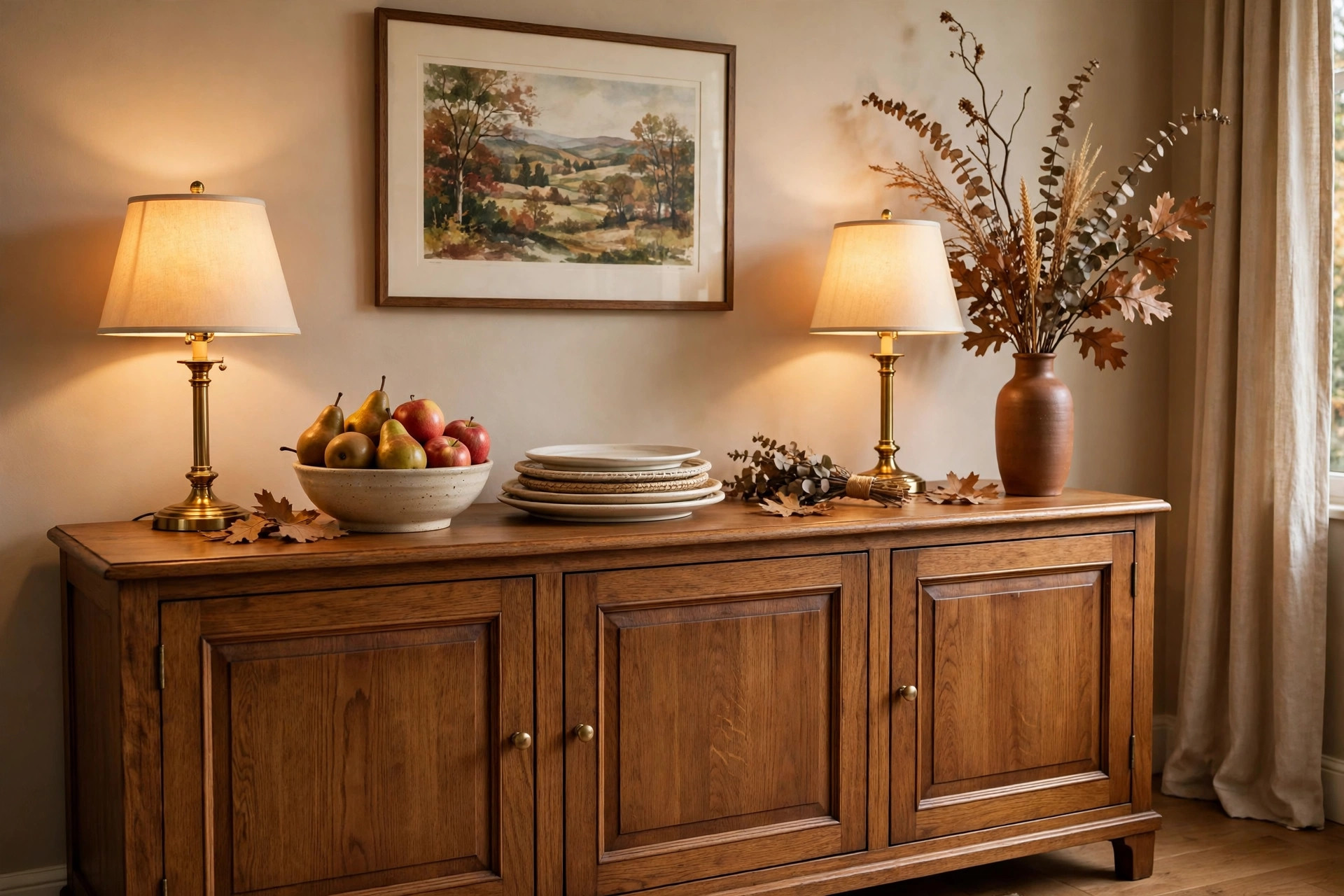
The sideboard or credenza — typically 18 inches deep and 30–36 inches high — is the dining room's second surface, and it should be split by job. Keep the half nearest the kitchen clear for serving dishes, a water pitcher, and the dessert you have not brought out yet. Style only the far half, with a strict grouping: a lamp (for the warm light in idea 13), a stack of extra plates or a covered dish, and one seasonal vignette on a small tray — a medium pumpkin, a short stack of fall cookbooks, or a vase of dried stems trimmed to 14–18 inches. Above it, hang one larger piece — a framed autumn print or wood-framed mirror, 24 x 36 inches — rather than small frames that compete with the table. The watch-out is accumulation: sideboards collect mail and keys within a week. Give the vignette its tray boundary and the serving half a weekly reset.
A quick order of operations
- Week 1, kitchen only: clear the 24-inch prep run, set the tray vignette, swap towels and the sink runner. Cost if you buy new: about $55–$105.
- Week 2, shelves and island: apply the 60-30-10 ratio, set the island footprint, build the drink station. Cost: about $40–$75, mostly the stand and cake stand.
- When you host, the table: runner, centerpiece, candles, chargers, napkins — in that order, about 30 minutes for six settings once you own the pieces. First-time cost: about $110–$190; every year after, almost nothing but fresh gourds and candle refills.
Fall here is not a shopping haul; it is a set of boundaries — clear space where you cook, a tray where you style, a height limit where you talk — with warm materials inside them. Get those right and a modest set of textiles, wood, and amber glass reads as a deliberate autumn room, instead of a display you dismantle to make dinner.


Comments
Post a Comment