
15 Brown Kitchen Ideas That Feel Warm and Cozy, Not Dated
15 Brown Kitchen Ideas That Feel Warm and Cozy, Not Dated
Brown kitchen ideas are having a real moment right now. Searches for warm brown kitchens have surged this autumn as people move away from the all-white, all-gray look that dominated the last decade. And honestly, it makes sense: brown is the color of coffee, walnut, chocolate, and warm bread crust. It is almost impossible for a brown kitchen to feel cold. Most of these brown kitchen decor ideas work with the cabinets you already have — they lean on paint, light, wood tone and styling rather than a remodel.
The catch is that brown can go wrong fast. Too dark, too flat, or mixed with the wrong undertones and your kitchen looks like a 1990s time capsule instead of a 2026 showpiece. The difference between 'dated' and 'delicious' comes down to a few deliberate choices, and this guide walks through all of them with fifteen specific, doable ideas — with the paint shades, prices, and measurements that make each one work instead of just sounding nice.
Brown Kitchen Cabinets That Get the Tone Right
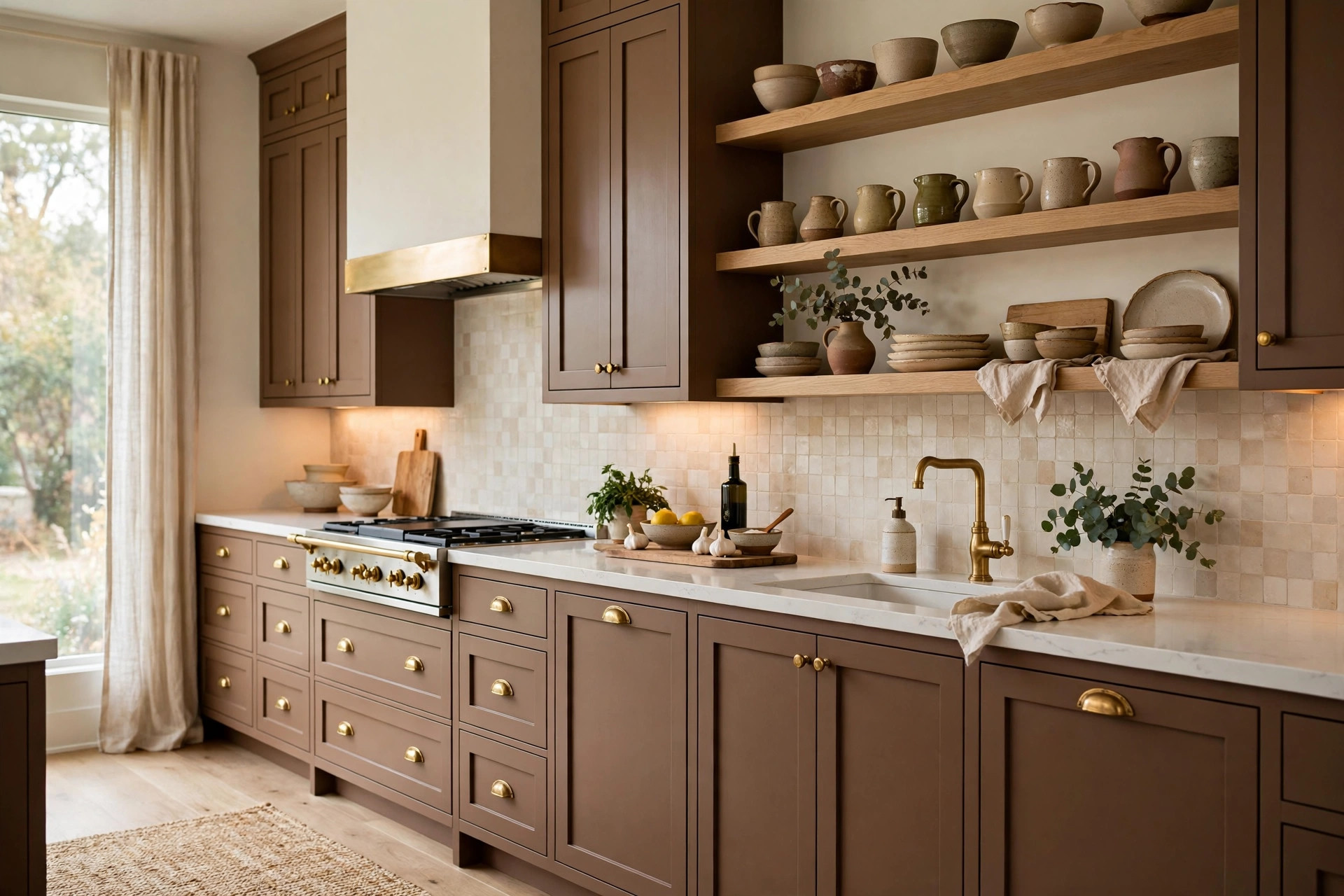
1. Mocha shaker cabinets with unlacquered brass hardware
This is the single safest way into a brown kitchen. A mid-tone mocha (think coffee with cream) on simple shaker fronts reads warm and current, and unlacquered brass pulls add the jewelry. The brass will develop a natural patina over time, which only deepens the warmth. Designers are calling mocha one of the defining kitchen colors of 2026, with shades like Pantone's Mocha Mousse leading the shift.
To copy it exactly: the cabinet colors to swatch are Benjamin Moore Wenge AF-180 (a deep, edible brown), Sherwin-Williams Urbane Bronze SW 7048 (a bronze-brown that goes nearly charcoal in low light), and Farrow & Ball London Clay No. 244 (the warmest of the three). Painting existing cabinets costs roughly $200–$600 in paint, primer, and supplies if you do it yourself, or $1,800–$5,000 professionally for an average kitchen — either way, a fraction of new cabinetry. Size the hardware like a designer: 3¾-inch pulls on doors, 5 to 6½-inch pulls on drawers, and go up to 8–12 inches on wide pot drawers and appliance panels so the proportions look intentional. Unlacquered brass pulls run about $8–$25 each; a whole kitchen's worth is usually a $150–$400 line item.
2. A chocolate brown island under a light stone top
If painting the whole kitchen feels like too much commitment, start with the island. A deep chocolate or espresso island under a light quartz or marble-look top is the lowest-risk way to bring brown in: it gives the room a dark anchor without darkening the walls. Pair it with cognac leather bar stools and the whole corner feels like a cozy bistro.
The proportions matter: the island should be the only dark mass in the room, and the countertop overhang does the social work — leave 12 inches of knee space on the seating side and 36–42 inches of walkway clearance around the island so it never feels like a boulder in a stream. White or cream quartz runs about $75–$100 per square foot installed, which on a typical 3 x 6 ft island top (18 sq ft) lands around $1,350–$1,800; a marble-look laminate or butcher block top cuts that to a third. Keep the island's paint one shade deeper than any other brown in the room so it stays the anchor.
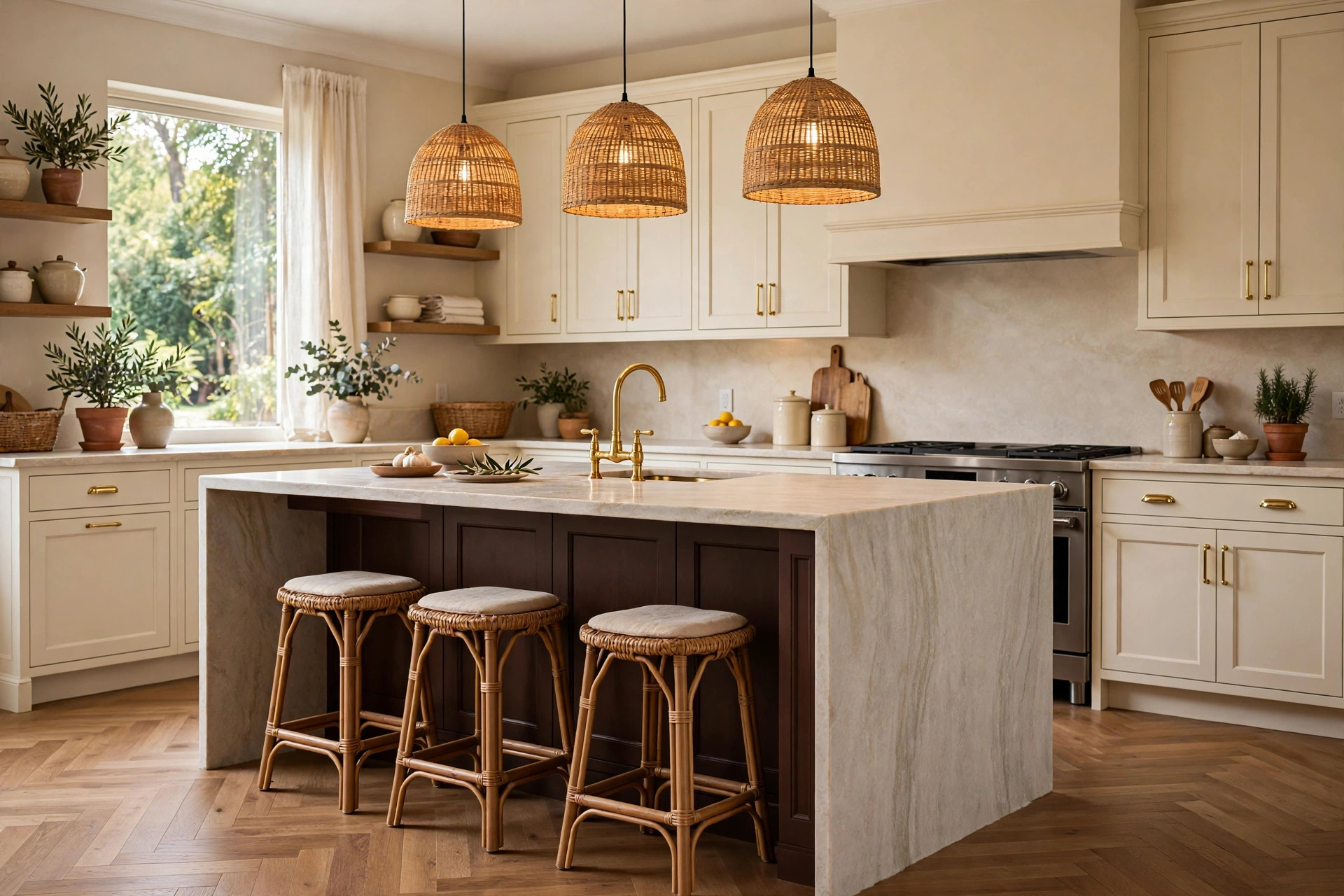
3. Two-tone: espresso base cabinets, cream uppers
Two-tone brown kitchens solve the 'brown box' problem. Dark espresso or walnut on the base cabinets grounds the room, while warm cream or soft beige uppers keep it bright. Keep both browns in the same undertone family (both warm, or both gray-brown), or the kitchen will look patched instead of planned.
The cream half is not any-old-white: reach for Benjamin Moore White Dove OC-17 or Sherwin-Williams Accessible Beige SW 7036, both warm enough to sit beside brown without turning icy — a stark blue-white upper will fight the base cabinets all day. Follow the value rule: the uppers should be at least three shades lighter than the lowers on the paint strip, or the two-tone split reads as a mistake instead of a design. This is also the cheapest full-kitchen transformation on the list, since you are painting cabinets you already own: the two-tone version of idea 1's budget, plus one extra gallon of paint.
4. White oak open shelving on a brown wall
Open shelving in pale white oak against a mocha wall is one of the most photographed kitchen looks of the year, and it earns the attention: the contrast is striking, and the shelves give you a place to display ceramics, glassware, and small plants. If you are renting or cannot commit to paint, lean on renter-friendly small kitchen storage ideas like leaning shelves and rail systems to get a similar layered look without touching the cabinets.
Build them to working dimensions, not photo dimensions: shelves 10–12 inches deep (12 inches swallows a dinner plate; 10 is enough for bowls and glasses), mounted with their underside 18–24 inches above the countertop, and brackets or cleats hitting studs every 16–24 inches — a loaded shelf of stoneware can weigh 30–40 lb. White oak boards run about $8–$15 per linear foot, so a pair of 5-foot shelves is a $100–$180 project. Leave the top shelf for the pretty, light things and keep daily dishes on the lower one, within reach.
Warm Brown Kitchen Materials That Do the Heavy Lifting
5. A wood range hood as the focal point
Instead of a stainless hood that reads like an appliance, a walnut or white-oak range hood becomes the warm centerpiece of the wall. Curved and arched hoods are trending hard this year; even a simple rectangular wood surround softens the hardest-working wall in the kitchen.
Size it right: the hood should be at least as wide as the range (30 or 36 inches for most) and mounted 24–30 inches above the cooktop for gas, 20–24 for electric, with an insert rated around 100 CFM per 10,000 BTU of burner power — a typical home range wants 300–400 CFM. A wood surround is a shell over a standard metal insert, so budget roughly $250–$600 for the insert plus $300–$900 for a built or bought wood cover, and keep every wood surface at the code clearances from the burners. Match the hood's stain to one other wood in the room — the shelves or the island — never introduce a third wood tone.
6. Butcher block counters for instant warmth
You do not need new cabinets to get the brown kitchen feel. A butcher block countertop in warm oak or walnut introduces brown at the exact height your eye rests on, and it pairs beautifully with existing white or cream cabinets. Oil it, don't varnish it, so the surface develops a rich, lived-in glow.
The numbers: butcher block runs about $40–$100 per linear foot depending on species (IKEA's Karlby walnut-effect slab is the budget benchmark at roughly $230 for a 98-inch length; solid walnut sits at the top of the range). Standard depth is 25–25.5 inches to cover base cabinets with a small overhang. Maintenance is the honest trade: oil with food-safe mineral oil monthly for the first season, then every 2–3 months, sand out stains with 220-grit and re-oil the spot — a 20-minute job. Keep it out of the sink's splash zone if you can; a stone or steel insert around the sink is how most people make butcher block survive family life.
7. Terracotta or handmade zellige backsplash in warm browns
Glossy handmade tiles in tobacco, caramel, or rust catch the light and make the whole wall shimmer. The slight variation in each tile is what keeps brown from looking flat, which is the whole secret of this trend: texture beats flatness every time.
Plan the layout with real tile math: classic zellige comes in 4 x 4 inch squares (9 tiles per square foot, $15–$30 per sq ft for genuine handmade, $8–$15 for convincing lookalikes), and a standard backsplash zone — the 18 inches between counter and uppers — is roughly 25–30 sq ft in an average kitchen, so $400–$900 in tile for the handmade version. Order 15% extra: shade variation between boxes is real, and you want to blend tiles from several boxes as you install so no patch looks like a different batch. Use warm gray or sand-colored grout, not bright white — white grout against brown tile reads as a checkerboard.
8. A walnut coffee-station niche
Carve out one walnut-lined niche or a single open cabinet as a dedicated coffee station. A small run of wood in a mostly painted kitchen feels intentional and luxurious, like the kitchen equivalent of a watch pocket. Style it with ceramic canisters and a small tray and it becomes the coziest corner of the room.
Give it working dimensions: 24–36 inches of counter width is enough for a machine, grinder, and canisters; 18 inches of clearance above the counter fits most espresso machines under an upper cabinet, and a niche lined in walnut veneer panels costs about $60–$150 in materials. Put the outlet inside the niche if you are building it — a coffee station whose cord drapes across the counter loses the whole tailored effect. Of all fifteen ideas, this one delivers the most daily pleasure per dollar; see our kitchen coffee station ideas for eleven ways to style it out.
Warm Brown Kitchen Lighting and Details
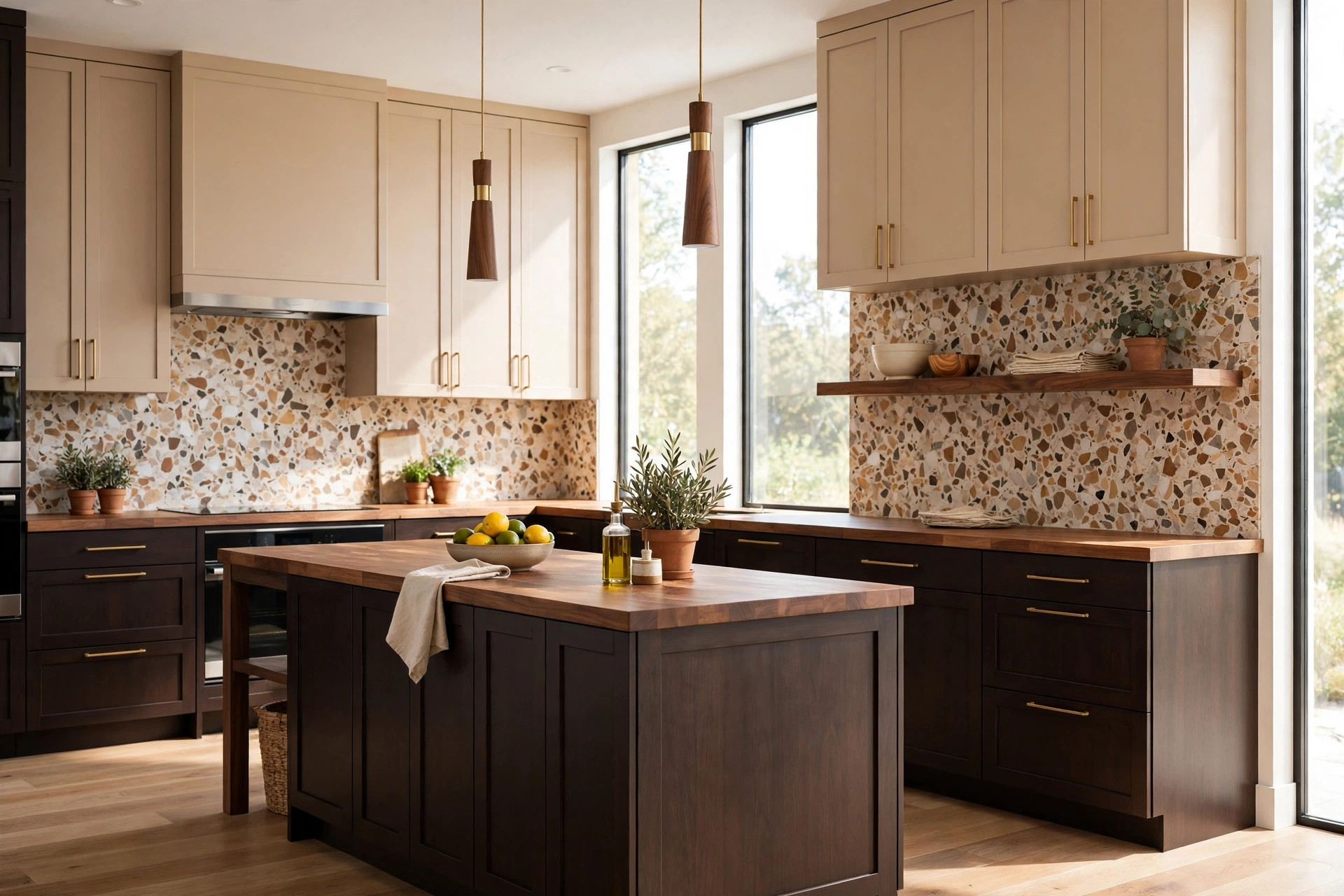
9. Warm layered lighting (this is non-negotiable)
Brown absorbs light, so lighting makes or breaks the whole scheme. Layer it: warm under-cabinet LED strips (2700K-3000K) to wash the backsplash, pendants over the island on dimmers, and one decorative sconce or picture light on open shelving. A brown kitchen with flat single-source lighting looks muddy; the same kitchen with layers looks like a restaurant.
Put numbers on the layers: under-cabinet LED tape costs $15–$30 per 16-foot roll and should sit toward the front edge of the cabinet underside so it washes the backsplash instead of pooling on the counter; pendants hang 30–36 inches above the countertop (bottom of the shade), spaced so their light pools overlap; and everything — everything — goes on dimmers, because a brown kitchen at 100% brightness looks like a showroom and at 60% looks like the bistro you wanted. If you change nothing else on this page, change the bulbs: 2700K warm white everywhere, no daylight bulbs, no exceptions.
10. Unlacquered brass faucets and fixtures
Chrome and black can fight with brown. Unlacquered brass or aged bronze works with it, picking up the same golden undertones. A brass faucet against mocha cabinets is the kind of detail people photograph without knowing why.
Budget and care, honestly: an unlacquered brass faucet runs $200–$600 from the quality brands, roughly double a chrome equivalent, and it is a living finish — it will spot, darken, and develop fingerprints that polish out with a soft cloth and lemon if you want the shine back, or stay if you like the patina. Match the family, not the exact finish: faucet, cabinet pulls, and pendants should all sit in the warm-metal family (brass, bronze, gold tones at similar depths), but they do not need to be identical products. Avoid pairing brass with cool gray-brown cabinets; brass needs a warm brown beside it.
11. A runner in warm rust or terracotta tones
Floors are the forgotten brown. A washable runner in rust, terracotta, or warm stripe down the galley adds pattern and warmth at ankle height, where the room often feels coldest. It is also the cheapest idea on this list.
Buy by the tape measure: a runner should span most of the run between sink and range, leave 3–6 inches of floor showing on each side, and in most galley kitchens that means a 2.5 x 8 ft runner (about $60–$150 for a good washable one) or a 2 x 10 ft in longer runs. Machine-washable is not a nice-to-have in a kitchen — it is the feature, because a runner in front of a sink lives a hard life. Choose a low, flat weave (no shag) so it vacuums clean and cabinet doors and drawers clear it.
12. Fluted wood on the pantry door or island back
Fluted and reeded wood panels add shadow lines that give brown depth without adding darkness. Use them on a pantry door, the back of the island, or a single accent wall. The vertical rhythm reads modern, not rustic.
Two ways to get it: flexible fluted MDF/wood-veneer panels (about $80–$180 per 4 x 8 ft sheet, paint-grade or pre-finished in oak and walnut) that glue and pin over a flat surface in an afternoon, or the slower craft version — individual half-round or tambour strips applied one by one. On an island back, a standard island needs roughly two sheets. Keep the flutes vertical (horizontal fluting reads as siding) and seal the bottom edge well anywhere near a sink, because those grooves collect splashes with enthusiasm.
Styling a Brown Kitchen So It Feels Collected, Not Flat
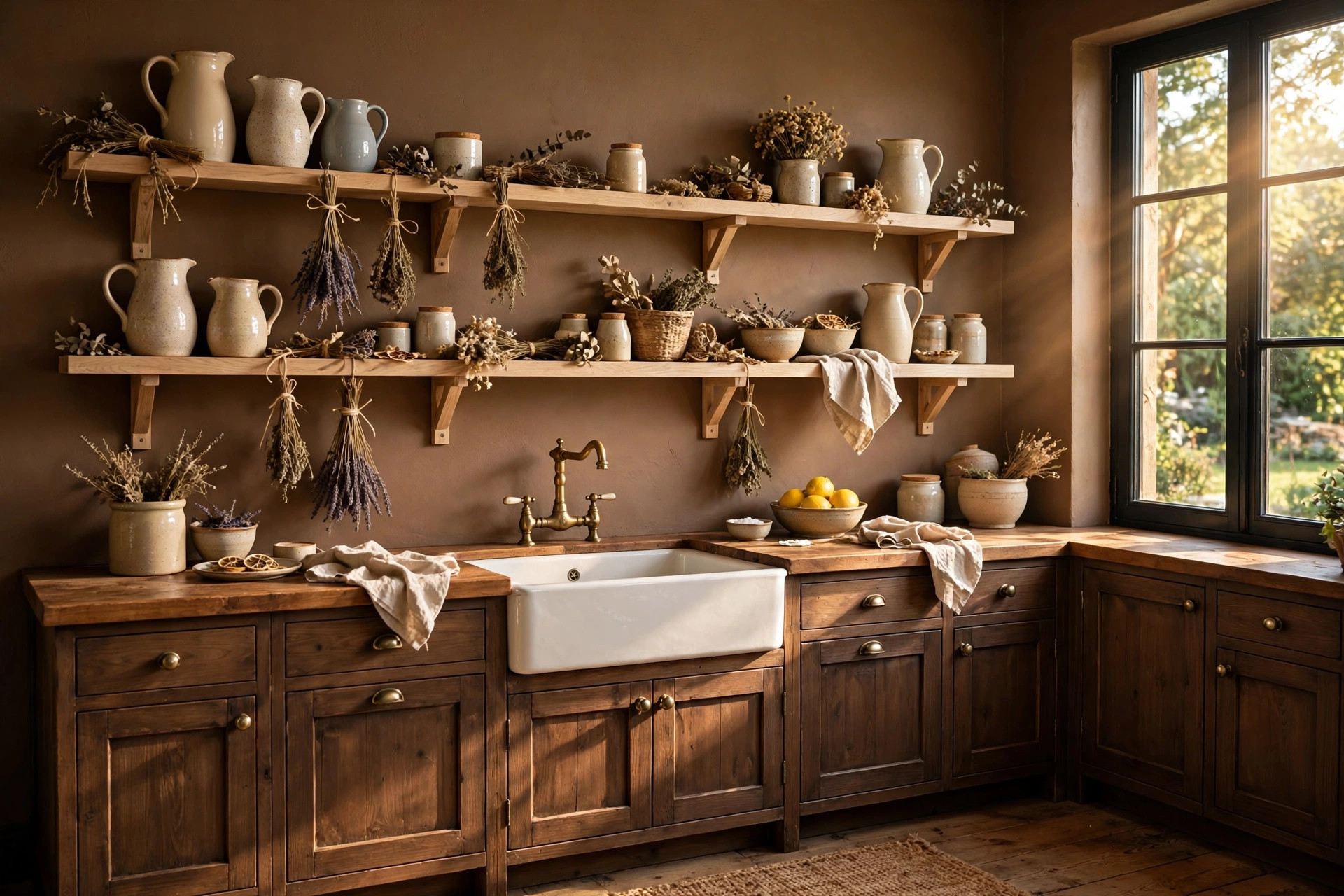
13. Styled vignettes: ceramics, boards, dried herbs
Brown kitchens beg for natural accessories: stacked wooden cutting boards, handmade ceramic bowls, a crock of wooden spoons, dried herbs hanging by the stove. These are the collected details that keep the palette from reading as one flat color. For seasonal styling, see these warm fall kitchen and dining decor ideas, which layer perfectly over a brown base.
Compose them like a stylist: group in threes with one tall, one medium, one low piece; lean the largest cutting board (16–20 inches) against the backsplash as the backdrop, stack two smaller boards in front, and set one living thing — a $6 herb plant in a terracotta pot — at the edge. Keep vignettes to the corners and the dead zones beside the stove and sink; the counter between them stays empty, because a brown kitchen reads "collected" only when half its surfaces are bare.
14. Bring in contrast: cream, not more brown
The most common brown kitchen mistake is going all-in: brown cabinets, brown counters, brown floors, brown backsplash. The fix is contrast. Pair your browns with something light (cream uppers, a pale stone counter, a white plaster range hood) so the brown reads as a choice, not an accident. One light element changes everything.
Work to a ratio: roughly 60% brown, 30% light neutral, 10% accent is the split most successful brown kitchens land on. If your cabinets and floors are both brown, the counter and backsplash must be the 30% — a pale stone or cream tile is not optional in that combination, it is structural. Test it with your phone: take a photo of the room, squint at it, and if you cannot find the light third, the kitchen will feel heavy no matter how good each piece is individually.
15. Finish with a gathering moment
End the room the way you use it. A brown kitchen wants a reason to linger: a small bistro table with two chairs, a styled serving tray on the island, or a board ready for guests like these fall charcuterie board ideas. Warm color plus a warm invitation is what makes the room work.
Keep the moment genuinely ready, not staged: a tray (18–24 inches) that holds a carafe, two glasses, and a small bowl lives on the island permanently; a bistro set needs only about 30 inches of table diameter and 24 inches of pull-out room per chair. The detail that sells it is warmth at face height — one low pendant or a small lamp on the counter near the gathering spot, on the same 2700K dimmer circuit as idea 9. Brown kitchens are evening rooms; furnish them for 7 PM, not for noon.
What to Avoid in a Brown Kitchen
- Mixing warm and cool browns: pick one undertone family and commit. Gray-brown cabinets with orange-brown floors will always clash.
- Flat finishes everywhere: if the cabinets are matte, make the backsplash glossy. Brown needs light play to stay rich instead of dull.
- Skipping the lighting plan: brown drinks light. Budget for under-cabinet strips and dimmers before you pick the paint.
- Going too dark in a north-facing room: in low natural light, choose a mid-tone mocha rather than espresso, or the room goes flat by 3pm. Hold paint chips against the cabinet at 9 AM and 4 PM before committing — brown shifts more across the day than any other neutral.
- Chrome and bright-white partners: cool metals and stark blue-whites make warm browns look muddy by comparison. Warm whites (White Dove OC-17, Accessible Beige SW 7036) and warm metals keep the family together.
- Honey oak uppers with espresso lowers: the gap between the two browns is too wide for a two-tone to read as planned. Keep the split within one undertone family and at least three shades apart — close-but-not-equal is the worst of both.
For more on where this trend is heading, Livingetc's 2026 kitchen color trends coverage tracks how chocolate, tobacco, and caramel tones moved from runways to cabinetry, and this detailed brown kitchen paint guide breaks down specific shades by light direction. The takeaway is consistent: brown is back, but the 2026 version is soft, edible, and layered, never heavy.
Brown Kitchen Ideas: FAQ
Do brown kitchens make a small kitchen look smaller?
Only if you go dark everywhere with poor lighting. A mid-tone brown on lower cabinets with light uppers and good under-cabinet lighting can actually make a small kitchen feel richer without shrinking it. The two numbers that protect a small kitchen are the 60/30/10 contrast split from idea 14 and 2700K layered light from idea 9 — get those right and even an espresso base stays friendly.
What colors go with a brown kitchen?
Cream, warm white, soft beige, and pale stone are the safest partners — name them Benjamin Moore White Dove OC-17 and Sherwin-Williams Accessible Beige SW 7036. For accents, bring in brass, cognac leather, terracotta, and deep green. Avoid pairing brown with gray unless the brown has a gray undertone, and avoid chrome and stark blue-whites, which read cold against it.
How much does it cost to get a brown kitchen without renovating?
The paint-led route — cabinets repainted in a mocha or bronze-brown, new unlacquered brass hardware, under-cabinet lighting, and a runner — lands around $500–$1,200 DIY or $2,200–$5,500 with the painting done professionally. The single most expensive optional upgrade on this page is the stone island top at $75–$100 per square foot installed; everything else is paint, wood, tile, and light.
Is a brown kitchen a passing trend?
Brown is a classic neutral that cycles in and out of fashion, but the current version, soft mochas and warm walnuts rather than heavy mahogany, is built on timeless materials. A walnut island will not look wrong in ten years; a trendy paint color might. If you are nervous, put the brown in the permanent-but-quiet places (wood, tile, stain) and keep paint — the five-year layer — in the creams.
What are the best brown kitchen decor ideas for a small kitchen?
Keep the brown low and the light high: a mid-tone mocha or espresso on the base cabinets, cream uppers, and warm 2700K under-cabinet lighting. Hold the 60/30/10 split from idea 14 — about 60% brown, 30% light neutral, 10% accent — and choose one warm metal (brass or bronze) for hardware and fixtures. In a small kitchen the runner and the backsplash carry more warmth per dollar than any cabinet change.
Choosing the floor to go with those warm brown tones? Our guide to kitchen runner rug ideas that make a small kitchen feel longer walks through 12 runner styles with exact sizes and prices — including the washable and natural-fibre options that sit best against brown cabinetry and wood floors.


Comments
Post a Comment