
11 Kitchen Coffee Station Ideas for a Cozy Morning Corner
11 Kitchen Coffee Station Ideas for a Cozy Morning Corner
The best kitchen coffee station ideas are not really about decorating. They are about the first ten minutes of your day: no hunting for filters, no mugs buried behind the cereal, no cord trailing through a puddle by the sink. When everything for one good cup lives in one defined spot, mornings get calmer — and, almost as a side effect, the corner starts to look like the cozy café nook you kept saving photos of.
This list gives you 11 ways to build that corner, with the real numbers that decide whether a station works: counter width per setup, the cabinet clearance that catches people out, where storage should go, and how to keep cords invisible. There are options for 18 inches of counter and for renters with no counter at all.
Before You Buy Anything: The Three Measurements That Matter
Most disappointing coffee stations fail on measurements, not style. Check these three before you move a single mug:
- Counter depth: standard kitchen counters are 24 to 25 inches deep. A typical drip machine is 12 to 14 inches deep, which leaves you a comfortable working strip in front. An espresso machine plus a knock box and tamper can eat 18 inches — measure the full working footprint, not just the machine.
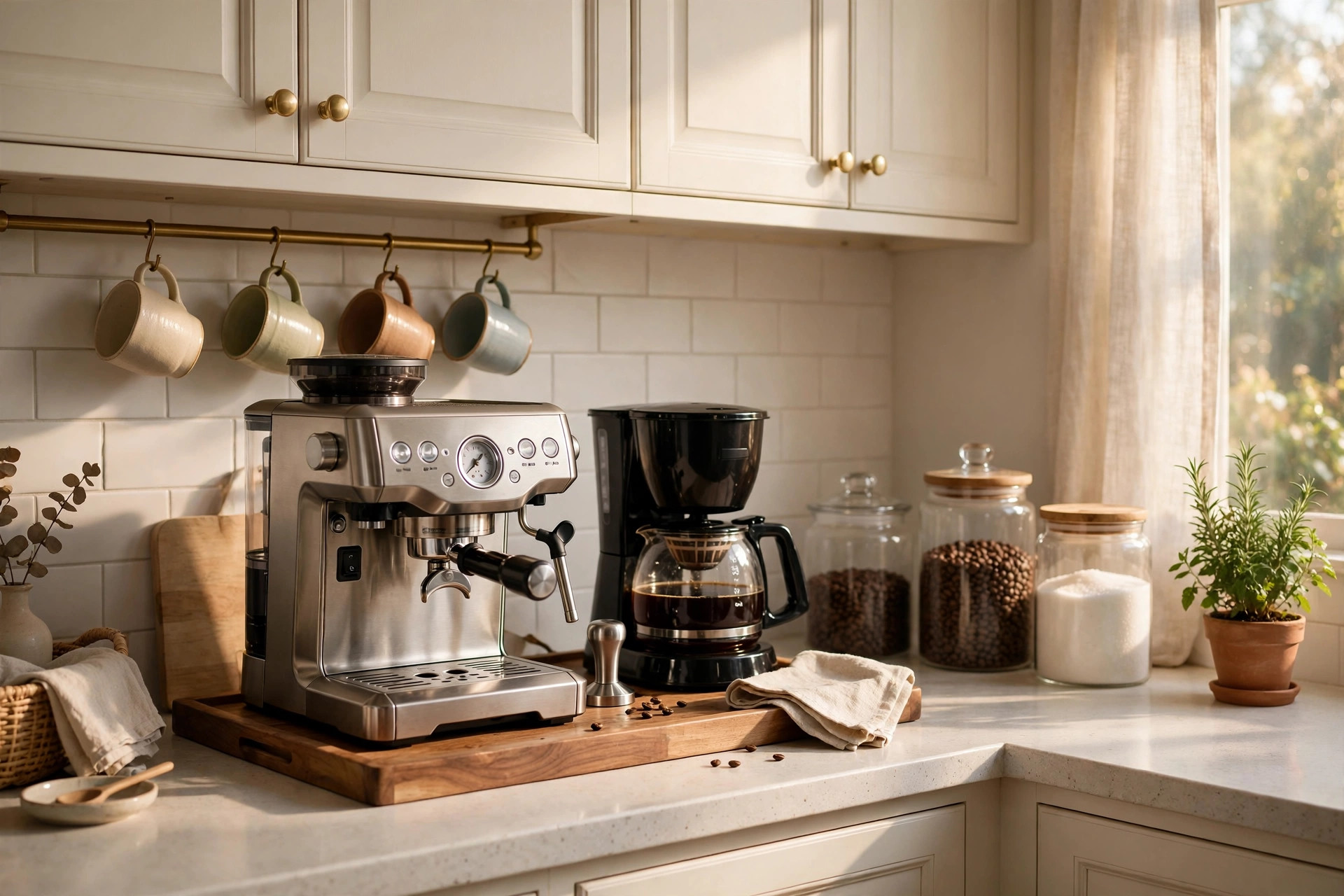
- Cabinet clearance: the standard gap between the countertop and the bottom of the upper cabinets is 18 inches. Many espresso machines stand 14 to 17 inches tall, and their water tanks lift up and out. Measure yours with the lid open and the tank raised. If it does not clear, plan to slide the machine forward for refills — and choose a setup that lets it slide (see the tray trick in idea 1).
- Station width: about 18 inches is enough for a single-serve machine on a tray with one canister. Around 24 inches fits a drip maker plus beans, sugar, and mugs. An espresso setup with a grinder wants 30 to 36 inches to breathe.
Placement matters as much as size. Designers quoted by Realtor.com recommend giving the station its own defined space, close to water but out of the main cooking work zone — ideally at the end of a counter run, near an outlet, where a half-awake person making coffee never has to cross paths with someone frying eggs.
11 Kitchen Coffee Station Ideas, From Tiny Trays to Full Cabinet Nooks
1. The Tray Station: A Complete Setup in 18 Inches
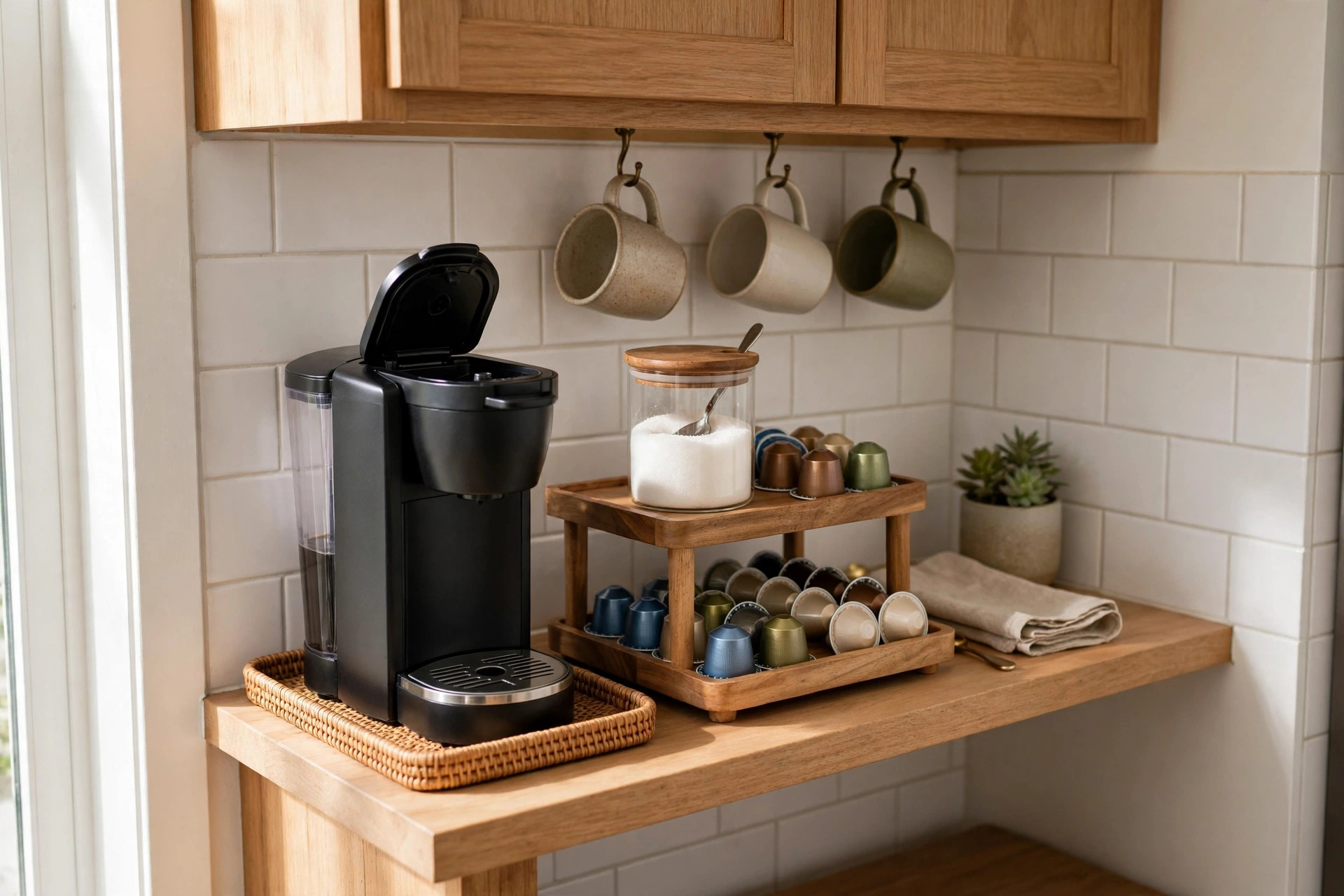
If you take one idea from this list, make it this one. Put a tray — roughly 18 by 12 inches for a single-serve machine, up to 24 by 16 inches for a drip setup — on the counter, and let the tray be the boundary. Machine on the tray, one airtight canister of beans or pods beside it, sugar in a small lidded jar, done. Anything that does not fit on the tray does not live in the station.
The tray does three jobs. It makes scattered objects read as one intentional zone. It catches the drips that otherwise stain the counter. And it lets you slide the whole station forward to lift the machine's lid under the cabinets, then push everything back in one motion. Choose a tray with low sides and handles that survives a daily wipe-down.
2. The Corner Station That Steals Back Dead Space
The corner where two counter runs meet is usually where the bread box goes to be forgotten. It is also the best coffee real estate in a small kitchen: deep, out of the traffic lane, and naturally angled toward the room. Turn the machine at a slight diagonal, back it into the corner, and fan the supporting pieces around it — canisters behind, mugs to one side, spoons in a small crock to the other.
Because a corner is deeper than a straight run (30 inches or more on the diagonal), it is often the only spot where an espresso machine fits with room to work in front of it. Add a small corner shelf or tiered riser in the back for syrups and spare cups, and the dead zone becomes the hardest-working spot in the kitchen.
3. Go Vertical: Shelves and Mug Hooks Above the Machine
When the counter is small, the wall above it is the storage. One floating shelf 24 to 30 inches long, mounted above the station, holds canisters, a French press, and spare mugs. Hooks screwed or clamped under that shelf hold the four mugs you actually use, handles out, ready to grab. The same rules scale up to a whole wall of shelves — our small kitchen open shelving ideas cover heights, groupings, and the empty space that keeps them calm.
Keep two rules and this never looks cluttered. Only daily items earn the shelf — the waffle maker stays in a cabinet. And keep the fixings honest: into studs where you can, or with proper anchors, because ceramic mugs plus glass jars add up. Renters can use an over-the-counter stand or tension shelf with no screws — the same thinking behind these renter-friendly small kitchen storage ideas.
4. The Cabinet Nook: A Coffee Bar Behind Closed Doors
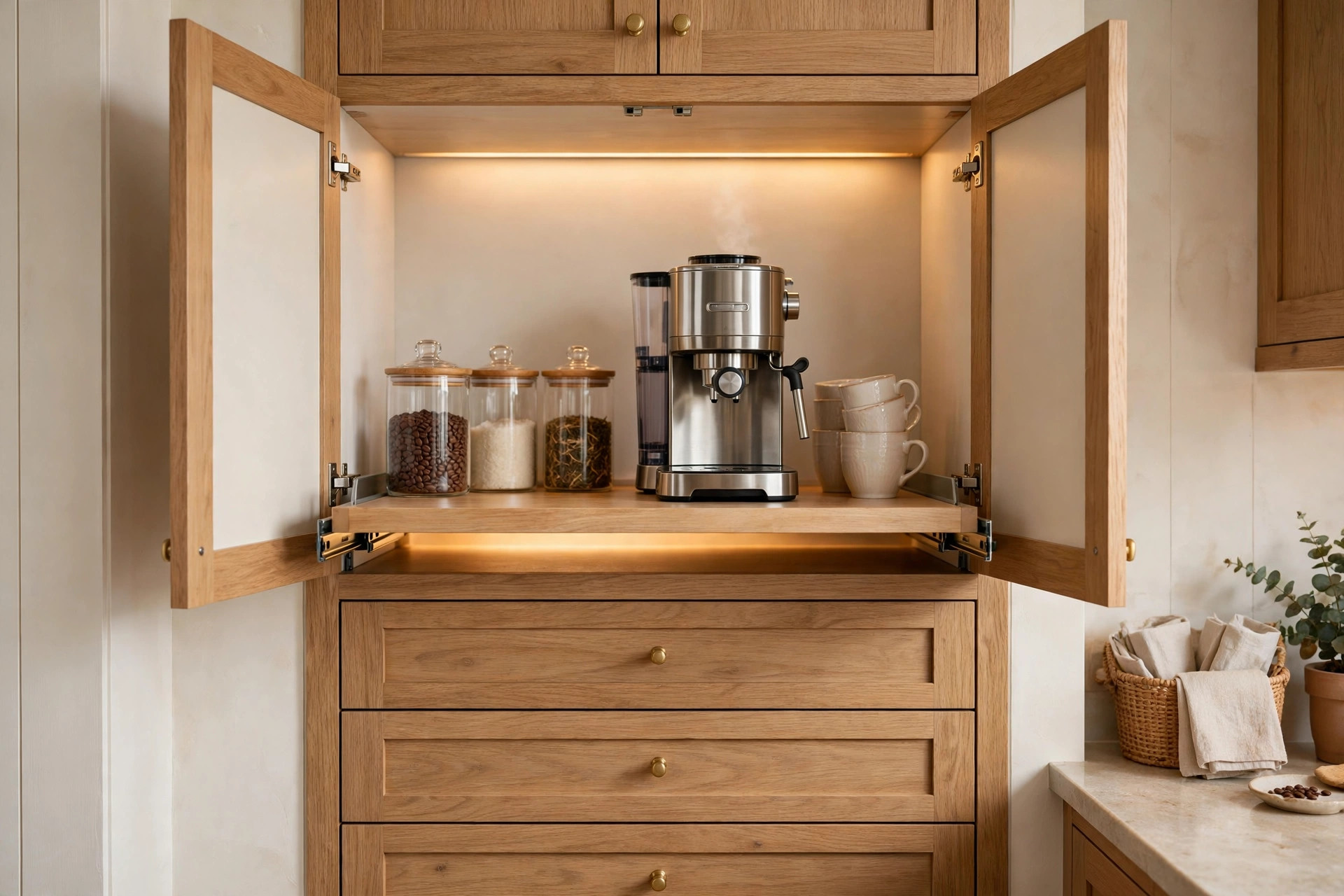
For a truly clear counter, move the station inside a cabinet. A wide upper or a tall pantry cabinet with an outlet nearby becomes a coffee nook: machine on the cabinet's base shelf, mugs on a shelf above, pods and filters in a shallow basket beside it. Open the doors in the morning, close them at night, and the kitchen looks untouched. Large photo tours like The Spruce's coffee bar ideas show this format at renovation scale, but a single existing cabinet gives you the same effect for free.
Two details make or break it. Ventilation: leave the doors open while the machine is hot, never close a hot machine into a tight box. And refilling: check the tank fills from the front, or put the machine on a pull-out shelf so it glides toward you. A battery motion light stuck inside makes early mornings easier — it switches on when you open the doors.
5. The Rolling Cart Station for No-Counter Kitchens
No counter to give? Give the station its own furniture. A rolling cart 24 to 30 inches wide and about 14 to 16 inches deep holds a compact machine on top, canisters and mugs on the middle tier, and backup supplies — extra beans, filters, the good biscuits — on the bottom. Park it against a wall or at the end of a cabinet run, plugged into the nearest outlet, and wheel it out of the way when you need the floor space.
Carts are also the friendliest option for renters, because nothing is fixed. Look for locking wheels, a top tier with a raised edge so the machine cannot wander, and metal or sealed wood that shrugs off splashes. Parked next to your eating spot, it pairs naturally with a small kitchen dining nook — coffee within arm's reach of the table is a genuine morning luxury. Warm sealed wood pairs especially well with the tones in our brown kitchen ideas, which show how mocha cabinets carry that same warmth.
6. The Drawer Station: Hide the Small Stuff Directly Below
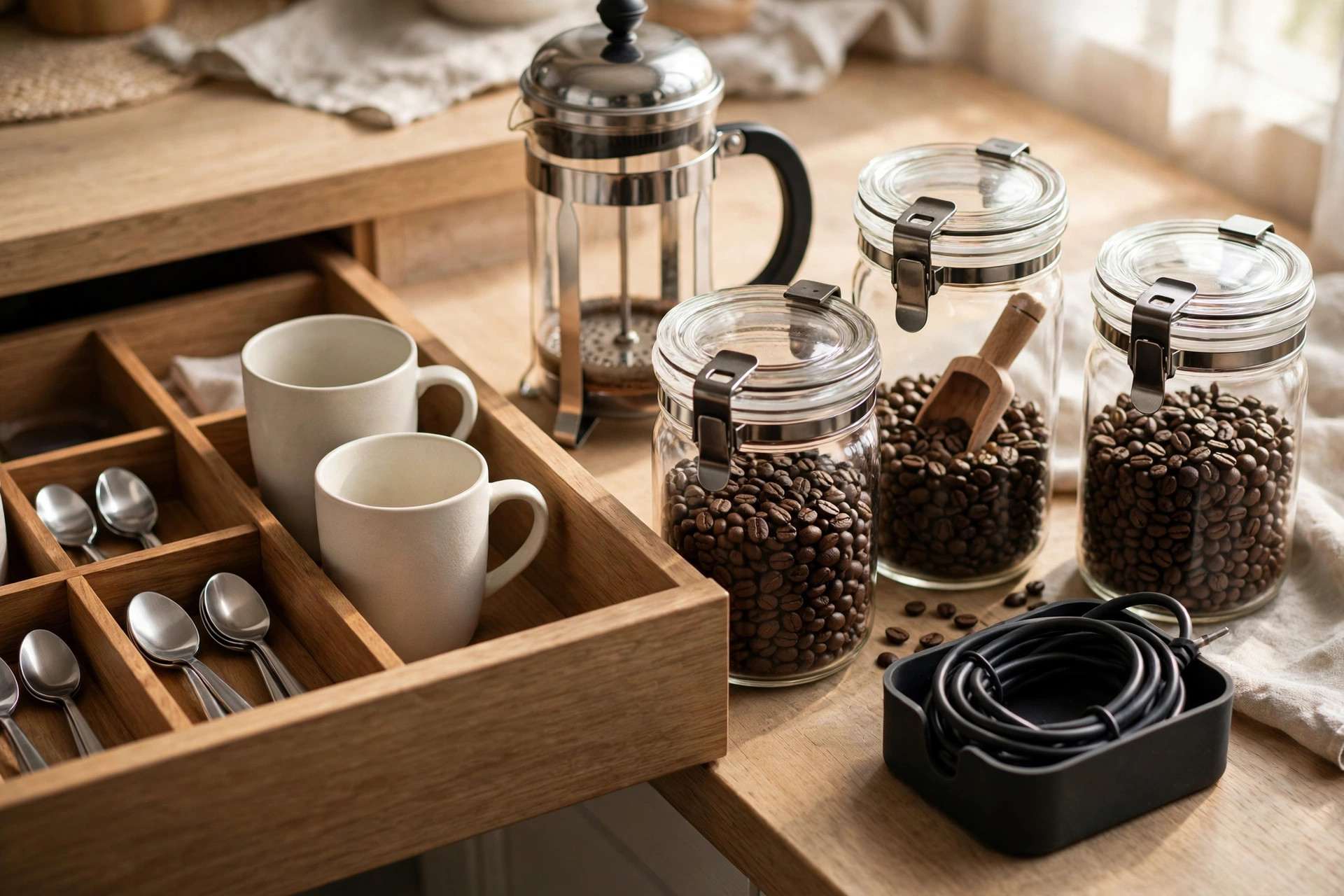
Counters look messy because of the small stuff: pods, filter papers, sugar packets, teaspoons, the little brush for the grinder. The fix is to claim the one drawer directly under or beside the station and divide it properly. A simple drawer insert with three or four compartments turns it into a coffee drawer — pods in one section, filters stacked flat in another, spoons and stirrers in the narrow slot.
This one change clears more visual clutter than any styling trick, because it removes a dozen tiny objects from sight while keeping them two seconds from your hand. If the drawer is deep, stand a small airtight canister in it for beans and keep only a pretty day's-worth jar up top.
7. Layer the Styling in the Right Order
Cozy is not an accident; it is a sequence. Once the practical pieces are placed, style the station in layers, back to front:
- Backdrop: a small framed print, a leaning cutting board, or a section of peel-and-stick tile behind the machine gives the zone an edge.
- Height at the back: the tallest canisters and a plant go behind the machine, never in front of it.
- The warm layer: a folded linen towel, a wooden scoop resting on the canister, warm-white under-cabinet light. Light is the single biggest cozy upgrade — a simple stick-on LED strip under the cabinet above the station makes 6 a.m. feel gentle instead of fluorescent.
- One living thing: a small potted herb or a trailing plant on the shelf. Keep it small enough that watering it never means moving the machine.
Stop at one or two decorative objects beyond the working pieces. The charm comes from everything looking used and loved, not staged.
8. The Espresso Corner: Give the Grinder Its Own Footprint
If you make espresso, plan the station around the mess, not just the machines. Grinders scatter. Put the grinder on a washable mat or a low tray of its own, keep a small brush hooked beside it, and leave a clear 8 to 10 inches of counter in front of the espresso machine for tamping and knocking out the puck. A knock box that slides under the machine's drip tray saves several inches over a standalone one.
Storage for espresso gear is specific: beans in an airtight, opaque canister away from the machine's heat; milk jugs and thermometers in the coffee drawer (idea 6), not scattered on the counter. Total honest footprint: 30 to 36 inches of width. If you do not have it, idea 5's cart, parked permanently, beats a cramped counter every time.
9. Tame the Cords Once, Properly
Nothing unravels a styled station faster than a nest of cords. Machine, grinder, and a light strip can mean three cables competing for one outlet. Sort them once:
- Run each cord straight back to the backsplash, then along it to the outlet, held by small adhesive cable clips every 8 to 10 inches.
- Coil any excess length and secure it with a reusable tie behind the machine — never leave loops hanging where they can catch a kettle handle.
- Leave deliberate slack in the machine's cord, enough to slide it forward for refilling without unplugging.
- Keep every cord off the sink side of the station, and never let one drape across the path between sink and stove.
If two appliances share one outlet on rotation, that is fine — but plug in the one you use and store the other's cord coiled on its hook, rather than leaving both plugged into a dangling power strip behind the canisters.
10. The Guest-Ready Station: Coffee and Tea Together
A station that only serves its owner is half finished. Add a small guest layer: a decaf option in a labeled canister, tea bags in a divided box, honey in a jar, and two good mugs that are not anyone's personal favorite. When visitors can help themselves without asking where anything is, the station has done its job.
Set this guest layer on the shelf or the cart's middle tier, separate from your daily zone, so guests never disturb your setup. If your dining table sits nearby, borrow a cue from these everyday dining table centerpiece ideas — a low, simple table center leaves room for coffee things when you are serving a group.
11. The Five-Minute Weekly Reset That Keeps It Cozy
Every coffee station slowly drifts toward chaos: sugar migrates, empty pod boxes pile up, the drip tray develops that smell. A five-minute weekly reset stops it. Empty and wash the drip tray. Wipe the tray under the machine. Check bean and filter levels and note replacements then, not on a workday morning. Decant refills into airtight canisters — beans keep their flavor far longer sealed than in an open bag.
Once a month, descale the machine if your water is hard, following the manufacturer's instructions. That is the whole burden — five minutes a week is the price of a corner that still makes you happy in month six.
Kitchen Coffee Station Cheat Sheet
| Setup | Counter width needed | Best for |
|---|---|---|
| Single-serve tray station | ~18 inches | Tiny counters, one coffee drinker |
| Drip maker + canisters + mugs | ~24 inches | Most kitchens, couples |
| Espresso machine + grinder | 30-36 inches | Serious home espresso |
| Cabinet nook | 0 inches of counter | Clear-counter minimalists |
| Rolling cart (24-30" wide) | 0 inches of counter | Renters, no-counter kitchens |
| Clearance to upper cabinets | 18 inches (standard) | Measure machine with lid/tank open |
Kitchen Coffee Station FAQs
How much counter space do I really need for a coffee station?
Less than you think. A single-serve machine on a tray works in about 18 by 12 inches, a drip setup in 24 inches of width. Only espresso with a separate grinder genuinely needs 30 inches or more — and if you do not have it, a cart or cabinet nook beats a cramped counter.
Where should a coffee station go in a small kitchen?
At the end of a counter run, in an underused corner, or on a cart against a wall — near an outlet and reasonably near the sink, but outside the sink-to-stove path where cooking happens.
How do I build a coffee station with no counter space?
Use furniture or storage instead: a rolling cart, a cabinet converted into a nook, or a wall shelf wide enough for a compact pour-over setup with a kettle kept in a cabinet below. The station needs a stable surface at a comfortable height and access to an outlet — it does not need to be a countertop.
What should be stored at a coffee station, and what should not?
Keep only what a normal morning uses: the machine, beans or pods for the next few days, sugar, filters, spoons, and your daily mugs. Backups, bulk beans, and rarely used gear belong in a cabinet or pantry. Airtight canisters matter more than pretty open jars — coffee stales quickly once air gets to it.
The Bottom Line
The best kitchen coffee station ideas all do the same thing in different sizes: they give one daily ritual a defined home. Measure the clearance before you commit, let a tray or a piece of furniture set the boundary, store the small stuff in a drawer, run the cords along the backsplash once and forget them, and finish with light and one green thing. It will pay you back every single morning.
Working on the rest of the kitchen and dining space too? Browse all of our Kitchen & Dining ideas for small-space layouts, storage, and table styling that pair well with your new morning corner.


Comments
Post a Comment