
10 Video Call Background Ideas for a Professional Home Office
Your video call background is doing more talking than you think. Before you say a word, the rectangle of wall behind you has already told the room whether you are organized, senior, and worth listening to — or broadcasting from a pile of laundry. The good news: the camera only sees a narrow slice of your home office, roughly the 4 to 6 feet directly behind your chair. You do not need a beautiful office. You need one beautiful wall.
These ten video call background ideas are all real, physical setups — no fake digital offices — arranged from the classic bookshelf to the five-minute curtain fix. Each one includes the sizes, prices, and placement details that actually make it work on camera, because a background that looks great in the room can still fail on screen if the scale is wrong.
First, Set the Frame: Camera Position Beats Decor
Before you buy anything, fix the geometry. Raise your camera to eye level — a stack of books or a $20 laptop stand — because a low camera makes any background loom and tilt. Sit roughly 3 to 5 feet in front of your backdrop: closer than 2 feet and you fill the frame and cast shadows on the wall; farther than 6 feet and the background becomes the subject. Light your face from the front (a window or lamp facing you, never a window behind you, which turns you into a silhouette) and then open your meeting app's preview and look only at the edges of the frame. Whatever creeps in at the edges — doors, laundry, a hallway — is what your background has to hide. If your office layout itself is still unsettled, settle that first with these small home office layout ideas, then style the wall the camera sees.
1. The Styled Bookshelf (The Classic for a Reason)
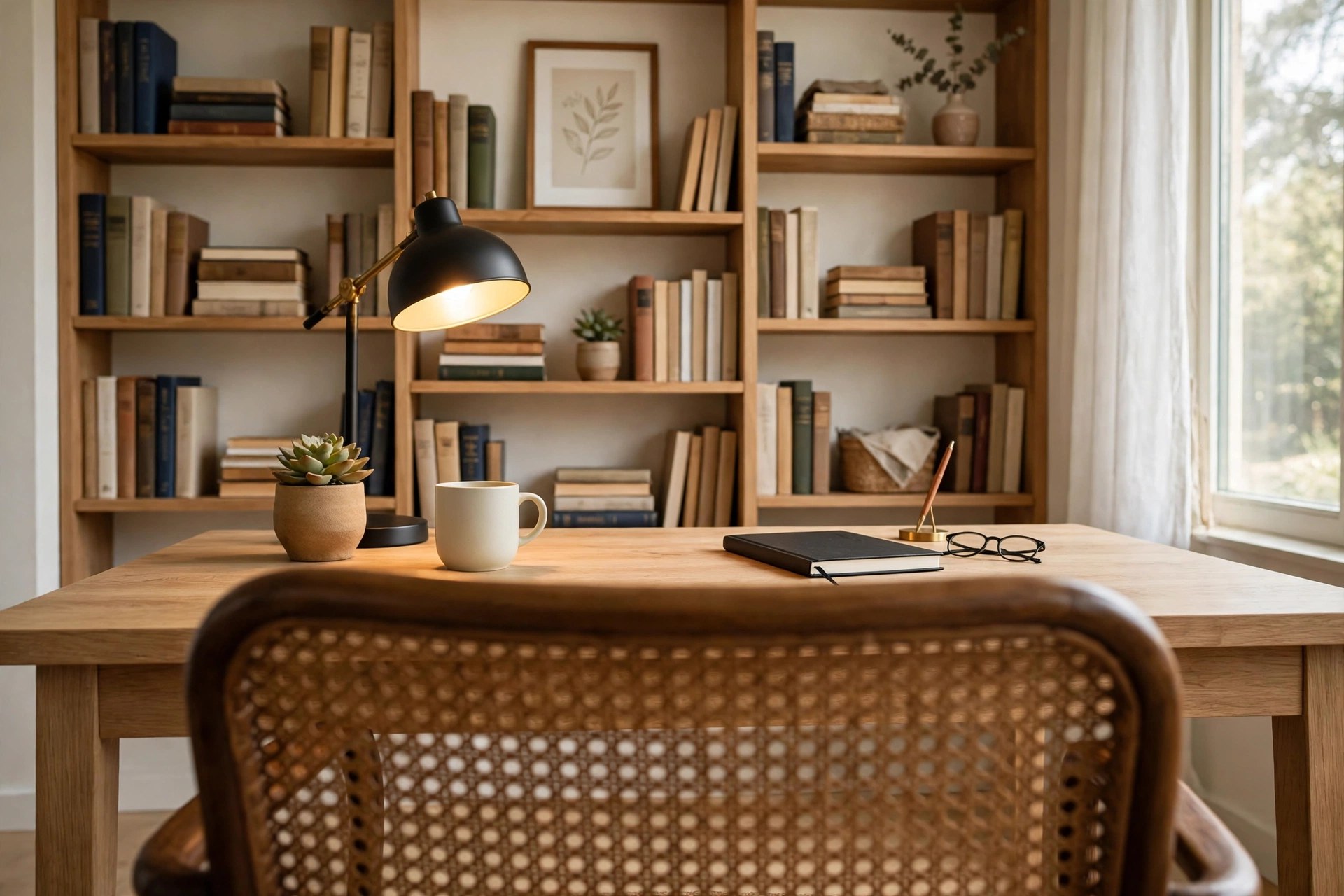
A bookshelf reads "credible" on camera faster than anything else, which is why it is the backdrop executives keep coming back to. The setup that works: a bookcase 30 to 36 inches wide centered behind you (an IKEA Billy is about $70–$90; a solid wood case runs $200–$400), filled about two-thirds with books and one-third with objects — a small plant, a ceramic vase, one framed photo. Arrange books mostly upright with a few horizontal stacks to break the rhythm, and turn the loudest, brightest spines to the back row or remove their jackets. Keep the shelf 3 to 4 feet behind your chair so the titles blur slightly; a shelf right against your shoulders looks like it is growing out of your head. One warning: a real shelf you actually use will drift into mess. Assign the two shelves inside the camera frame as "stage shelves" that nobody is allowed to grab books from.
2. A Painted Accent Wall and One Oversized Print
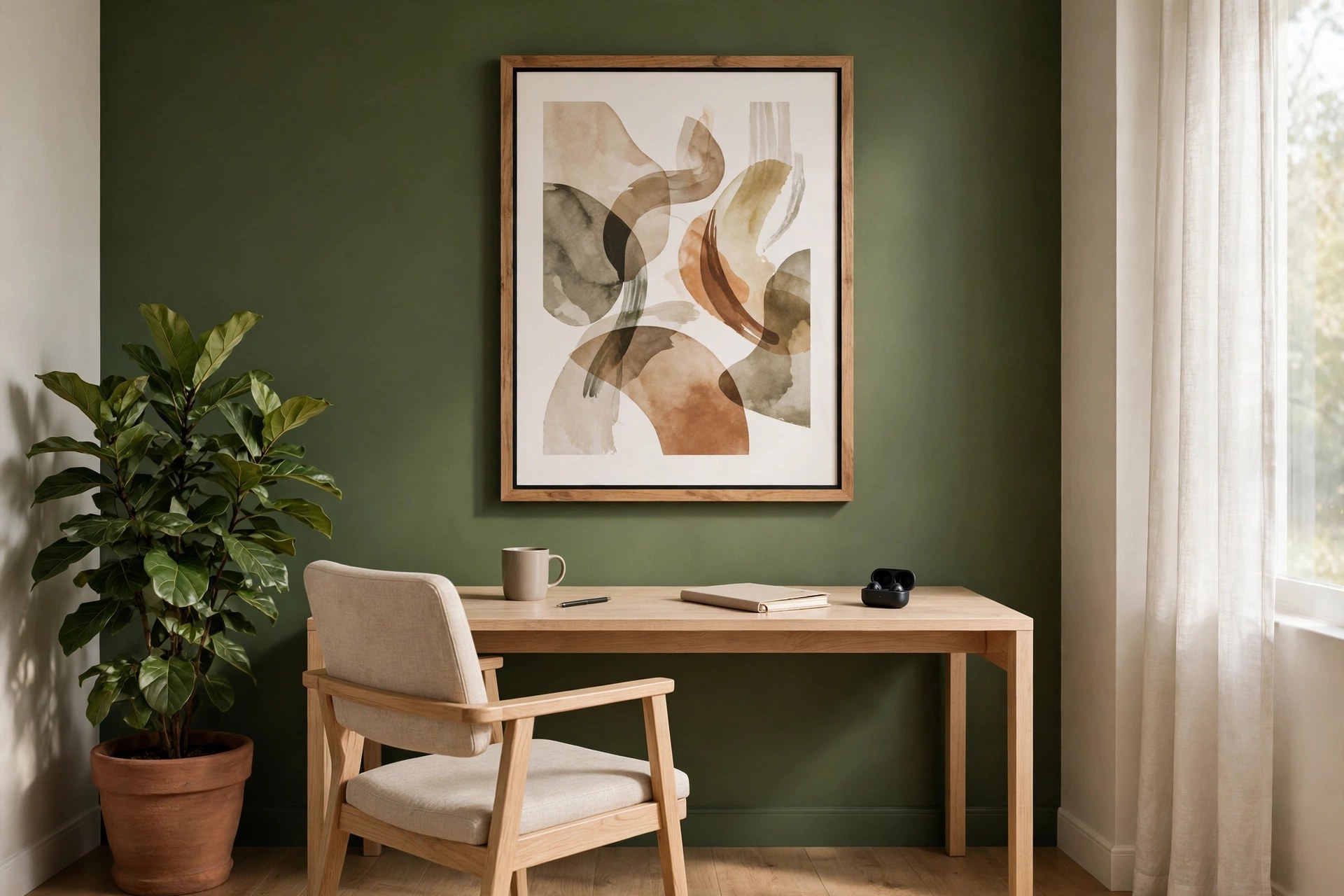
The cleanest modern background is a single deep-colored wall with one large piece of art. Paint just the wall behind your desk in a matte or eggshell deep green, navy, or warm charcoal — one gallon ($30–$45) covers it, and matte finishes are non-negotiable because satin and gloss bounce light into the lens. Hang one print at least 24 x 36 inches, centered on your seated head height (the center of the frame should sit around 57–60 inches from the floor). Anything smaller than 18 x 24 reads as a postage stamp on camera. Abstract, landscape, or architectural prints work; word art and busy patterns fight with your face for attention. This is also the cheapest permanent upgrade on this list, and it pairs well with the styling ideas in our guide to home office wall decor.
3. Wood Slat or Acoustic Panels
Vertical wood slat panels are the background of the moment, and unlike most trends they solve two problems at once: the camera loves the regular shadow lines, and the felt backing genuinely absorbs echo, so you sound better on calls too. Panels typically come 24 inches wide by 96 inches tall and run about $100–$200 each; two or three panels cover the camera's view behind a standard desk. Walnut and white oak are the safest tones. Renters can mount them on two horizontal battens screwed into studs instead of gluing, so the wall survives your deposit. If your calls are recorded or you present often, this is the background that most improves how professional you sound and look for the money.
4. The Floor-to-Ceiling Curtain
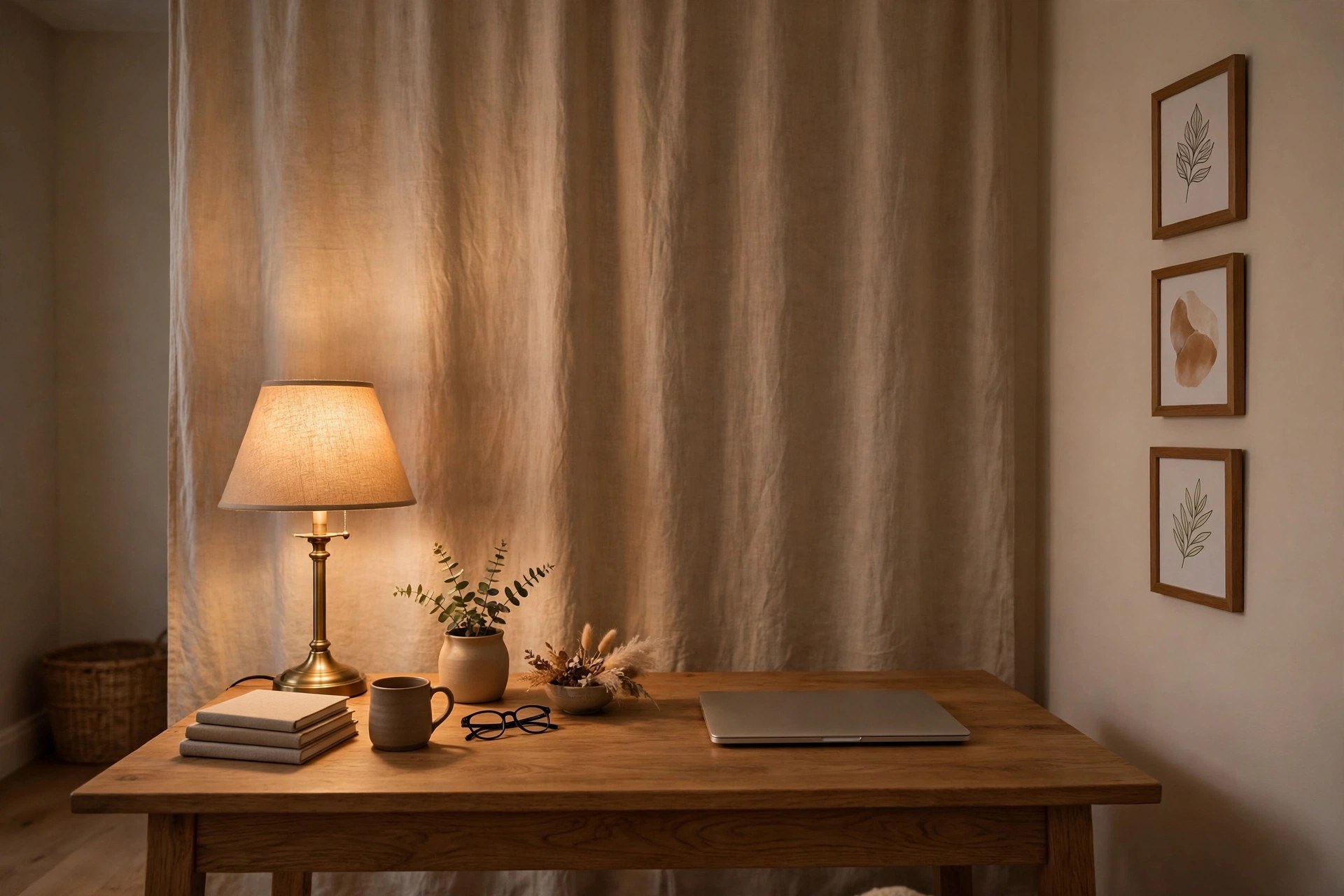
When the wall behind you is hopeless — a closet door, a window with an ugly view, a partner's side of the bedroom — hang a curtain and delete it. A ceiling-mounted track or a simple tension rod plus two linen-look curtain panels (about $25–$60 total) gives you a soft, neutral backdrop in under an hour. Choose warm white, oatmeal, or pale gray; avoid pure white, which blows out on camera, and avoid busy patterns. Run the curtain the full width of the camera frame plus a foot on each side, and let it hang as flat as you can — deep folds create shadow stripes that can look stripey on video. This is also the best backdrop for renters, because it comes down without a single hole.
5. A Folding Room Divider
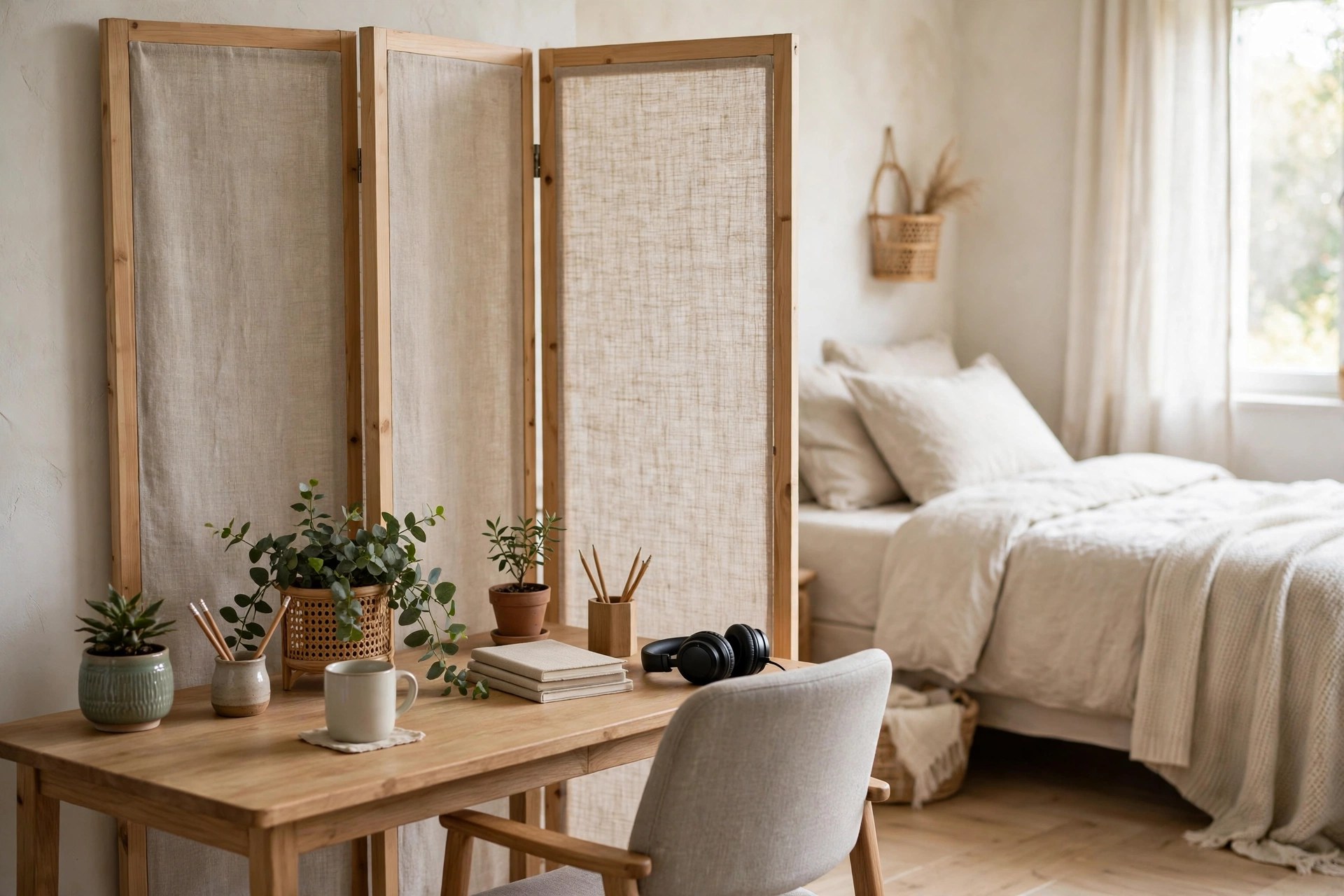
If your desk lives in a bedroom, living room, or studio corner, a three- or four-panel folding screen ($80–$150 for wood-and-linen styles) builds you an instant "office" the camera believes in. Set it 3 to 4 feet behind your chair, angled slightly rather than flat against the wall — the fold creates gentle depth that reads far richer on screen than a flat surface. Look for panels at least 5.5 feet tall so the top edge stays out of frame when seated. The divider earns its keep off-camera too: it hides the bed during the workday and folds away when guests come. Of all ten ideas, this is the one that changes how the room works, not just how it photographs.
6. A Tight, Deliberate Gallery Wall
Gallery walls fail on camera when they sprawl. The version that works is a tight grid — six to nine frames in matching frames (black, white, or one wood tone), hung inside a rectangle roughly 4 feet wide by 3 feet tall, centered behind you. Keep frame sizes to two: for example six 8 x 10s around one 11 x 14. Use prints with matte, non-glare acrylic instead of glass; glass turns your ring light or window into a white flare in the middle of your call. Family photos are fine in a home office, but on client calls, landscapes, maps, and abstract prints keep the focus on you. Space frames 1.5 to 2 inches apart — wider spacing reads as random, tighter reads as designed.
7. The Plant Corner
One tall, healthy plant is the fastest way to make a background feel alive: a fiddle-leaf fig, a snake plant, or a tall dracaena (4 to 5 feet, $40–$90 at garden centers) placed in the corner of the frame, slightly behind and to one side of you. Green reads calm and competent on screen, and the organic shape softens the hard rectangles of desk, monitor, and door frames. Add one small plant on a shelf or desk edge for a second note of green. Two rules: keep the plant out of direct backlight from a window (it silhouettes into a black blob), and do not let a leaf appear to sprout from your head — shift the pot a foot sideways and check the preview. Skip this idea if you cannot keep a plant alive; a dead plant on camera says the opposite of everything you want.
8. Bookshelf Wallpaper or a Printed Backdrop — With Honest Warnings
The budget internet is full of 7 x 5 ft printed bookshelf backdrops for $15–$40, and they can work — but only under specific conditions. On a high-resolution webcam in good light, a printed backdrop reads flat and slightly fake, and vinyl wrinkles reflect light in telltale streaks. If you go this route, choose fabric over vinyl, hang it drum-tight, sit at least 4 feet in front of it, and light it evenly. A better version of the same idea is bookshelf wallpaper or any large-scale patterned wallpaper on the one wall section behind your desk: it has real texture and shadow, so it survives HD. What to avoid entirely: green screens for everyday calls (edge halo around your hair gives you away instantly) and step-and-repeat logo banners, which read as a trade-show booth, not an office.
9. The Credenza-and-Lamp Arrangement
For a background with genuine depth, place a low credenza or console table (36 to 48 inches wide) against the wall behind you, then style three things on it: a stack of two or three large books, one sculptural object or vase, and a small lamp with a warm bulb. The lamp matters more than anything else on the surface — its glow at the edge of the frame adds the warmth and depth that flat walls lack, and it balances window light on bright days. Keep the arrangement asymmetric (lamp to one side, books to the other) and keep the surface at least two-thirds empty. Crowded surfaces read as clutter at webcam resolution, even when they look curated in person. If desk clutter is your real problem, fix that too with these small home office desk storage ideas.
10. A Virtual Background, Done Properly
Sometimes the room truly cannot work — a shared studio, a renovation, a hotel. A virtual background is acceptable then, but do it properly: choose the plain blur first (it is the most honest and the least distracting), or a simple, bright, unfussy office image at 1920 x 1080 or larger. Sit close to a plain wall, light your face evenly, and wear a color that contrasts with your background so the software keeps your edges clean. Avoid virtual backgrounds with bookshelves full of fake books, city skylines, and anything with words or logos. And skip them for your most important calls if you possibly can — the moment your hand disappears into a fake bookcase, the room notices the technology instead of you.
Lighting: The Half of the Background Everyone Skips
Every idea above fails with bad light. You need one light source aimed at your face from in front of or beside the camera: a window is perfect (face it, or sit at 45 degrees to it), otherwise a 10-inch ring light or a simple desk lamp with a daylight bulb (about 5000K) at roughly $25–$40. Never sit with a window or bright lamp behind you — the camera exposes for the bright background and turns you into a shadow. If your background includes a lamp (idea 9), keep your face light brighter than it, so you stay the brightest thing in the frame. Test at the actual time of day of your calls; a background that looks warm at 9 AM can glare at 3 PM.
The Five-Minute Pre-Call Check
- Open the camera preview and scan the frame edges, not your face — that is where backgrounds fail.
- Check nothing appears to grow out of your head: plant leaves, shelf corners, picture frames.
- Remove anything personal you would not hang in a real office: laundry, dishes, mail piles.
- Confirm the door in frame is closed, and housemates know you are live.
- Glance at your lighting: face lit, background calm, no window blown out behind you.
Video Call Backgrounds: Your Questions
How far behind me should the background be?
Three to five feet is the sweet spot. Closer than about two feet, you cast shadows on it and it competes with you; farther than six feet, the camera starts showing the whole room, including everything you meant to hide.
My office is a corner of my bedroom. What works best?
The folding divider (idea 5) or the curtain (idea 4). Both create a visual wall between "bedroom" and "office" for the camera, and both come down or fold away so the room still works as a bedroom. Angle the desk so the camera faces the divider, never the bed.
Are virtual backgrounds unprofessional?
Blur is fine anywhere. A realistic fake office is acceptable in casual internal calls but risky with clients, because edge glitches around your hair and hands are visible even when you cannot see them. A tidy real background, even a plain painted wall, beats a perfect fake one.
What is the cheapest background that still looks professional?
The painted accent wall with one large print (idea 2): about $50–$80 all-in, one afternoon, and it looks deliberate rather than decorated. If you cannot paint, the linen curtain (idea 4) does the same job for about the same money with zero commitment.


Comments
Post a Comment