
12 Small Bathroom Paint Color Ideas That Make It Feel Bigger
A small bathroom rarely needs more space — it needs fewer visual stops. The right small bathroom paint color ideas bounce light around the room, blur the corners where walls meet ceiling, and make tile, vanity and mirror read as one calm surface instead of five competing boxes.
Paint is also the cheapest change in here: one gallon, a good roller and a weekend. Below are twelve colours with named shades, LRV values, real costs and the watch-outs that decide whether a colour opens the room up or closes it in.
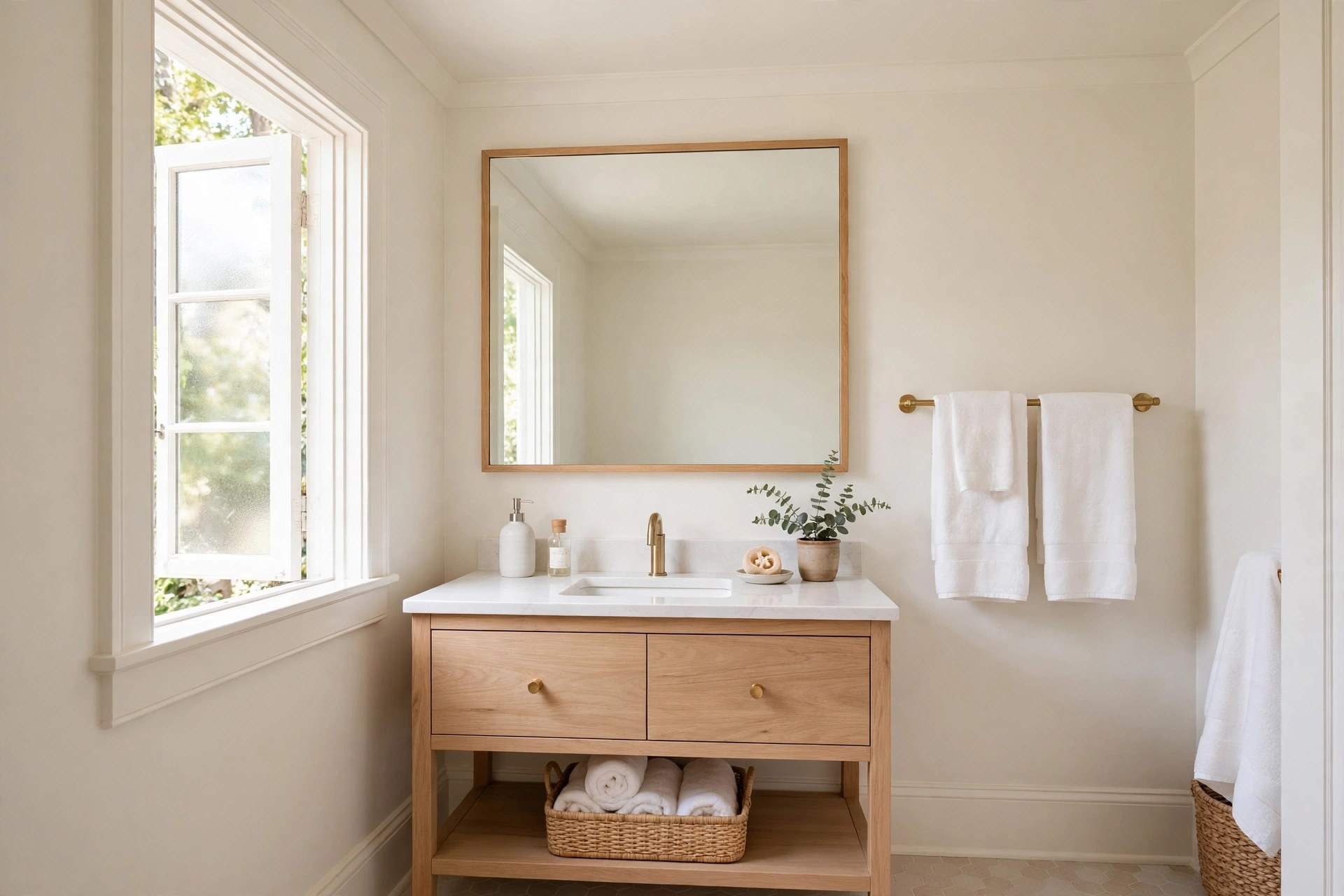
Paint works hardest when fixtures help it, so check your mirror against our guide to small bathroom mirror ideas that make a tiny room feel bigger — a large, plain mirror doubles the light any light colour reflects.
Paint Rules That Actually Make a Small Bathroom Feel Bigger
Start with light reflectance value, or LRV, printed on every paint chip as a number from 0 to 100. Keep the main wall colour at LRV 55 or above, so it reflects more light than it absorbs. Go lower only on purpose — the deliberate dark accent in idea 11 — never by accident because a chip looked paler in the store.
Designers start with warm whites at LRV 75 to 85, because cool whites turn grey and clinical under bathroom lighting, a point covered in Apartment Therapy on small bathroom paint ideas and The Spruce on paint colour ideas for a small bathroom. Second rule: monochromatic — walls, ceiling and trim the same colour, or within two shades, and the seams disappear. Use eggshell or satin bathroom paint — flat paint marks and mildews in steam; these wipe clean and help light move.
Finally, test before you commit. Brush a large chip — at least 12 by 12 inches — on two walls, and check it against tile and grout in daylight and under your vanity light at night, because warm bulbs turn clean whites yellow. A $6 sample pot is cheap insurance.
12 Small Bathroom Paint Color Ideas That Make It Feel Bigger
Every idea below assumes one gallon of mid-range bathroom paint at $45 to $75, plus $15 to $25 for tape, a roller and a sample pot. Undertones matter more than the family name, so the named shades are the safe starting point.
1. Warm White, the Reliable Light Multiplier
Warm white is the safest place to start because it reflects the most light while still feeling soft against skin in the mirror. Try Benjamin Moore White Dove OC-17, LRV 83, or Swiss Coffee OC-45, LRV 81, both creamy without reading yellow. Paint walls, ceiling and trim the same shade for the seamless effect from the rules above. One gallon, $55 to $75, covers most small bathrooms in two coats. Watch-out: in a north-facing room with grey tile, test carefully — warm white over cool grey grout can look slightly peach at midday.
2. Soft Greige for Warmth Without Yellow
Greige — grey plus beige — suits bathrooms where pure white feels stark against warm wood vanities or cream floor tile. Benjamin Moore Balboa Mist OC-27, LRV 67, and Edgecomb Gray HC-173, LRV 63, are the proven pair: light enough to open the room, warm enough to flatter. Greige also hides the slight colour variation in older grout better than white does. Budget $50 to $70 a gallon. Watch-out: greige turns muddy under weak, warm bulbs, so pair it with daylight-balanced vanity bulbs around 3000 to 4000K and test the chip at night first.
3. Pale Sage, Calm Colour That Still Reads Light
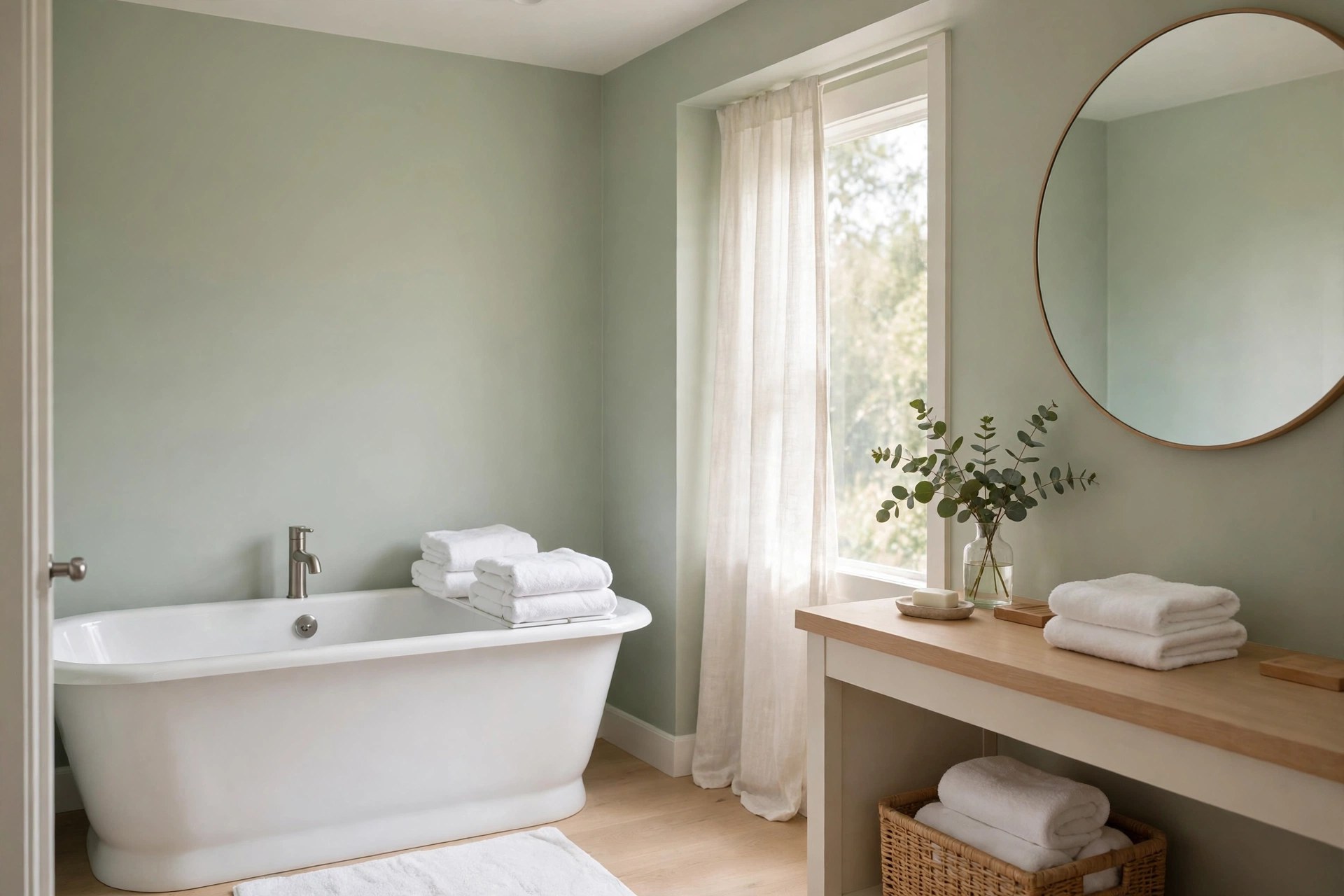
Pale sage brings in nature without darkening the room, which is why it suits windowless bathrooms that need a hint of the outdoors. Benjamin Moore October Mist 1495, LRV 56, is the balanced starting point; go one step lighter on the chip strip if your room has no window at all. Sage sits comfortably beside white sanitaryware, chrome and light oak. Cost is the standard $45 to $70 a gallon. Watch-out: sage can clash with pink-toned or orange-toned tile, so hold the chip directly against the tile, not just against a white sink.
4. Misty Blue for a Fresh, Airy Ceiling Effect
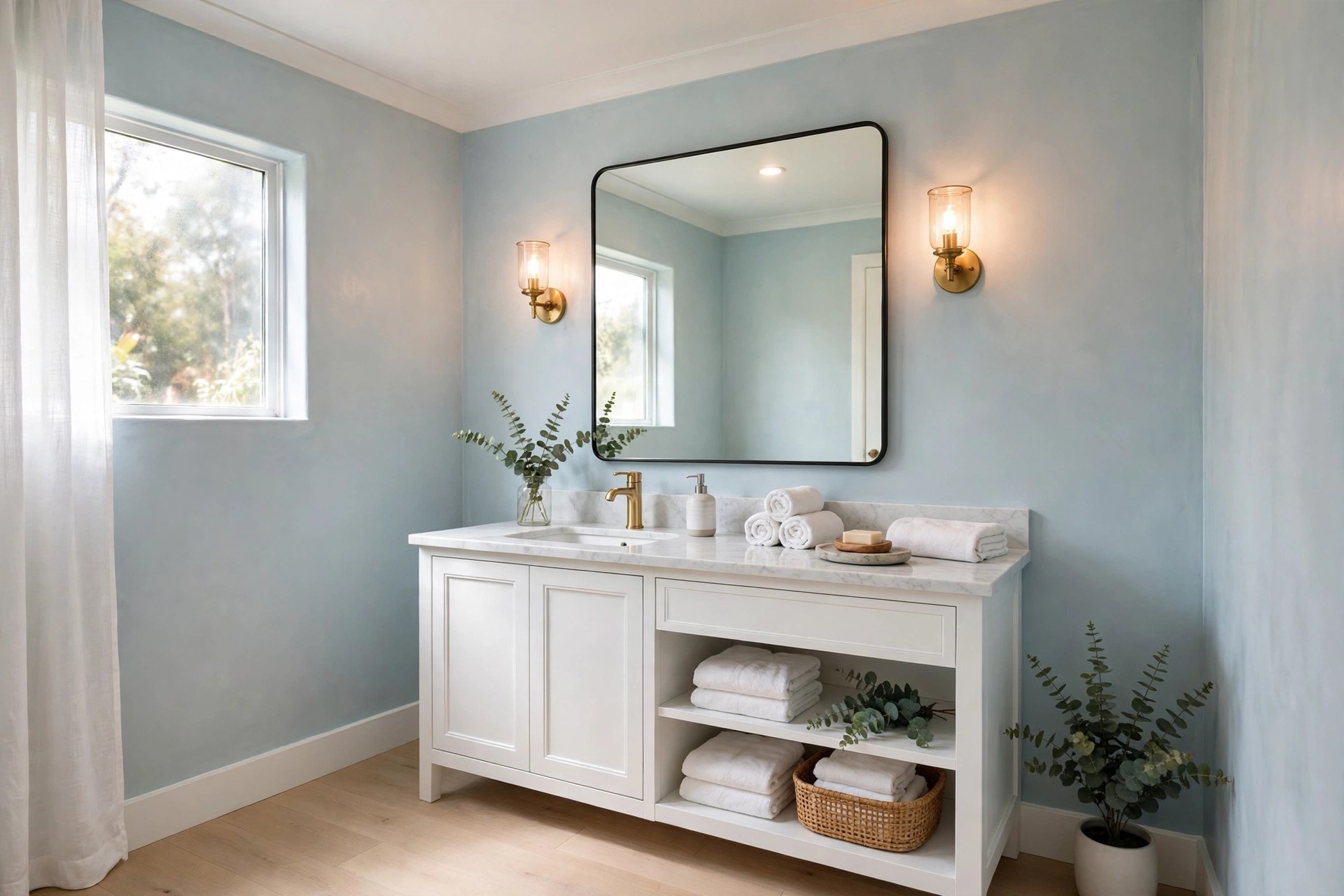
Misty blue tricks the eye the way a pale sky does: the walls seem to recede. Benjamin Moore Beach Glass 1564, LRV 54, and Palladian Blue HC-144, LRV 51, both stay soft rather than nautical. Misty blue is especially good in bathrooms with white tile and chrome, where it adds colour without adding visual weight. Expect $50 to $75 a gallon for a quality bathroom finish. Watch-out: blue intensifies in small, enclosed spaces, so choose the shade that looks almost too pale on the chip — it will deepen once all four walls surround you.
5. Pale Aqua, the Spa Colour Done Lightly
Pale aqua sits between blue and green and gives that clean, spa feeling without the coldness of a true blue. Sherwin-Williams Rainwashed SW 6211, LRV 59, is the reliable version — noticeable colour, still firmly in light territory. It pairs beautifully with white towels, pale stone and brushed nickel. One gallon runs $48 to $72. Watch-out: aqua turns minty and dated beside yellow-cream tile, so this shade works best with true white or light grey tile and grout. Test a large chip across a full corner before buying the gallon.
6. Soft Blush That Flatters Skin in the Mirror
Blush is the most forgiving colour at the vanity mirror, warming skin tones instead of washing them out the way grey and blue can. Benjamin Moore First Light 2102-70, LRV 71, is pale enough to behave almost like a white while still reading as colour. It suits small bathrooms with brass or gold fixtures particularly well. Budget $50 to $70 a gallon. Watch-out: blush slides quickly toward nursery pink in bright southern light, so in a sun-filled room choose the greyer, dustier chip on the strip and check it at noon.
7. Light Taupe for a Grown-Up, Hotel Feel
Light taupe reads more designed than white and more relaxed than grey, giving a small bathroom that quiet hotel finish. Sherwin-Williams Modern Gray SW 7632, LRV 62, and Accessible Beige SW 7036, LRV 58, both stay light while adding real depth beside white sanitaryware. Taupe is a strong choice when the floor tile is busy, because it calms everything above it. Cost: $48 to $70 a gallon. Watch-out: taupe needs decent light to stay elegant — in a windowless room, keep it at the lighter end and upgrade the vanity bulbs first.
8. Periwinkle, the Unexpected Pale That Works
Periwinkle — a soft blue-violet — is the surprise on this list: pale enough to enlarge, interesting enough to remember. Benjamin Moore Lavender Mist 2070-60, at around LRV 55, keeps the violet whisper-light rather than themed. It looks particularly good with white wainscot, marble-look tile and chrome. Expect $50 to $75 a gallon, and always buy a sample first with this family. Watch-out: periwinkle shifts dramatically between daylight and warm evening light, blue by day and lavender by night, so view the test chip carefully at both times before committing.
9. Sea-Salt Green-Blue, the Proven Crowd-Pleaser
Some shades become standards because they work almost everywhere, and Sherwin-Williams Sea Salt SW 6204, LRV 64, is the green-blue example. It changes gently with the light — greener in daylight, softer grey-blue at night — which keeps a tiny room feeling alive rather than flat. It pairs with white, light wood and both chrome and brass. A gallon costs $52 to $75. Watch-out: Sea Salt is so popular because of that chameleon quality, but the same quality means it can lean greener than expected beside blue tile, so test against your actual tile.
10. Colour-Drenching: Walls, Ceiling and Trim in One Shade
Colour-drenching means painting everything — walls, ceiling, trim and even the door — in a single colour, so there are no white seams breaking the room into pieces. Choose a mid-light shade you already love from this list, such as Balboa Mist, Sea Salt or Beach Glass, and use satin on trim and eggshell on walls in the same colour. The ceiling trick alone can make low ceilings feel higher. Budget $70 to $110 for the extra paint. Watch-out: drenching in anything below LRV 40 stops feeling seamless and starts feeling dark, so keep this technique light.
11. Deep Teal or Navy, the Deliberate Jewel Box
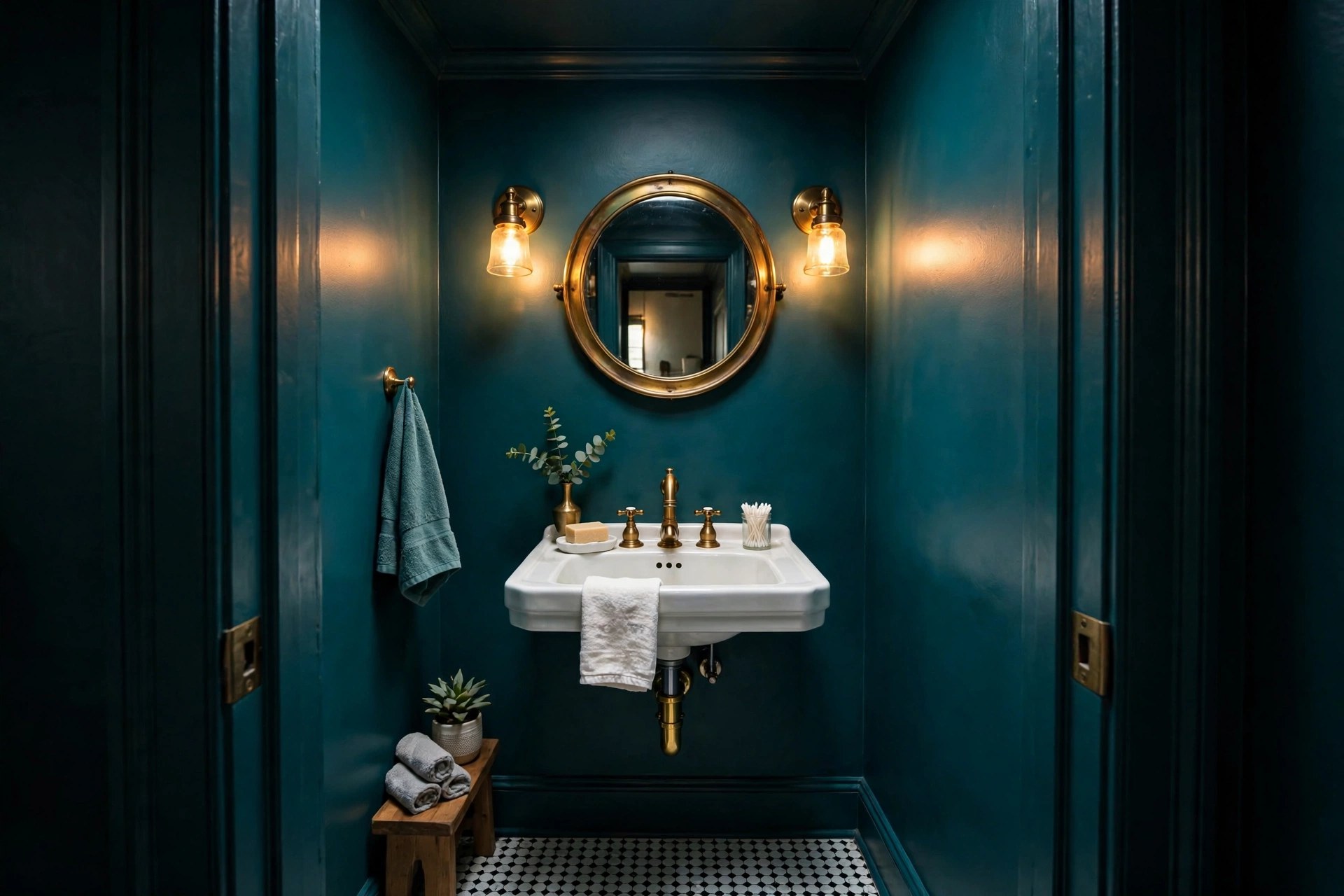
Dark colour does not enlarge a small bathroom — it does something different and, done deliberately, just as good: it turns the room into a jewel box where the edges disappear into shadow. Benjamin Moore Aegean Teal 2136-40, LRV 19, or Hale Navy HC-154, LRV 6, with a large mirror, warm metallic fixtures and strong lighting, reads intentional and expensive. Cost is the usual $50 to $75, though dark shades often need a tinted primer, adding $20. Warnings: never do dark by halves, never pair it with weak lighting, and expect every watermark to show — satin finish is essential here.
12. Two-Tone With a Wainscot Line
Two-tone painting splits the wall at wainscot height, around 36 to 42 inches: a deeper or more practical colour below, a pale colour above and across the ceiling. The classic version is White Dove above and Sea Salt or Beach Glass below; the bolder version reverses it, with the deeper shade low where splashes land. The horizontal line makes walls feel wider and the pale top keeps the room light. Budget $80 to $120 for two colours. Watch-out: keep the dividing line dead level and run it around the whole room — a line that stops mid-wall looks like a mistake.
Mistakes That Make a Small Bathroom Feel Smaller
Using a colour that is too dark, too saturated or simply untested. A saturated coral or deep grey chosen from a small chip can halve the felt size of the room. Light is the partner paint cannot work without, so pair any new colour with our guide to small bathroom lighting ideas that brighten a tiny room and judge the colour only under your actual lighting.
Ignoring the fixed colours. Tile, grout and floor do not change when the walls do, so paint that fights their undertone makes the room look off. Visible towels act like extra wall colour too, which is why our bathroom towel storage ideas for small spaces stick to a calm palette.
Skipping the finish rules. Flat paint in a steamy bathroom absorbs moisture, shows splash marks and can mildew within a season; eggshell or satin costs a few dollars more and wipes clean for years. Paint the ceiling in the same finish family, not leftover flat from another room. For more small-room finishes, browse the Bathroom collection.
Questions People Ask
What is the best paint colour for a small bathroom with no window?
A warm white or pale greige at LRV 70 or above, such as White Dove OC-17 or Balboa Mist OC-27. Avoid cool blue-whites, which turn grey without daylight, and use daylight-balanced vanity bulbs so the tested colour is the colour you see.
Should a small bathroom ceiling be painted the same colour as the walls?
Usually, yes. The same colour, or within two shades of the walls, removes the hard white seam where wall meets ceiling, so the surfaces read as one larger volume. It is the core of colour-drenching, and it helps low ceilings most.
What paint finish is best for a small bathroom?
Eggshell or satin bathroom paint. Both resist steam and mildew far better than flat finishes, wipe clean after splashes, and reflect a soft sheen that helps light move. Use satin on trim and in dark colours, where marks show most.
Can a small bathroom handle a dark colour like navy or teal?
Yes, but only as a deliberate choice. Dark teal or navy will not make the room feel bigger; it makes the corners disappear and turns the space into a jewel box. It needs a big mirror, warm metallic fixtures, strong lighting and a satin finish.
Start with the light, safe wins — warm white, greige, sage or sea-salt — tested against your tile, and save the dark jewel box for drama on purpose. One well-chosen gallon beats any weekend renovation.


Comments
Post a Comment