
12 Small Kitchen Spice Storage Ideas You Can Actually Find Fast
Thirty jars in one dark cabinet, and the cumin is always at the back. Small kitchens rarely lack spices — they lack a system where each jar is seen and reached in seconds. The best small kitchen spice storage ideas fix the finding, not just the storing: one shallow layer, labels facing you, everyday jars one step from the board.
You do not need a bigger kitchen or matching jars. You need the right-shaped organizer for the space you have — a drawer, a door, one shelf. Below are twelve, with real widths, costs, and watch-outs.

Start with the drawer cooks reach for first, using our guide to small kitchen drawer organization ideas — spice storage works when that drawer is planned as one system, not filled jar by jar.
Store First: Cool, Dark, Dry — and Visible at a Glance
Keep spices cool, dark, and dry. Heat, light, and steam fade flavour and colour, so the cabinet above the stove or beside the oven vent is the worst home in the kitchen, however handy it feels. Choose a drawer or cabinet on the prep side, away from stove heat and window light — and keep it to one layer you can scan in a single look.
Match the organizer to the space. Roundups like Magic Wand Organizing on spice organization ideas and Real Homes on how to store spices in a small kitchen agree on the shortlist: tiered risers for shelves, turntables for deep corners, drawer inserts for shallow drawers, door racks for wasted door backs, and magnetic tins for fridge steel. Measure width, depth, and closing clearance first, then pick.
Label for the angle you view from: on the lid in a drawer, on the front on a shelf, big enough to read without picking the jar up. Sort alphabetically, or group by cuisine if that is how you cook. When you decant, write the purchase or decant date on the bottom of each jar, so its age is never a guessing game.
12 Small Kitchen Spice Storage Ideas
Match the idea to the space actually free. Most kitchens need one main system below, plus one overflow spot for packets and refills.
1. An Angled Tiered Drawer Insert Beside the Prep Zone
A tiered insert angles jars in three or four rising rows inside a shallow drawer, so every label shows and nothing hides behind anything else. Most inserts are expandable from 12 to 24 inches wide and fit drawers at least 3 to 4 inches deep; standard spice jars, roughly 4 inches tall, lie without catching the drawer above. Cost: $15 to $35 in bamboo or plastic. Watch-out: measure the drawer's inside depth front to back before ordering — an insert half an inch too long means a drawer that never closes.
2. A Turntable in the Deep Corner Cabinet
A lazy Susan solves the cabinet corner where jars go to be forgotten. One spin brings the back row to the front, which suits deep base cabinets and tall pantry shelves. A 10 to 12 inch turntable holds about 12 to 16 standard jars; an 18 inch model suits a true corner cabinet. Cost: $10 to $25, or $20 to $40 for a two-tier version. Watch-out: jars near the rim can topple when you spin fast — choose a model with a raised lip or a non-slip surface, and spin gently.
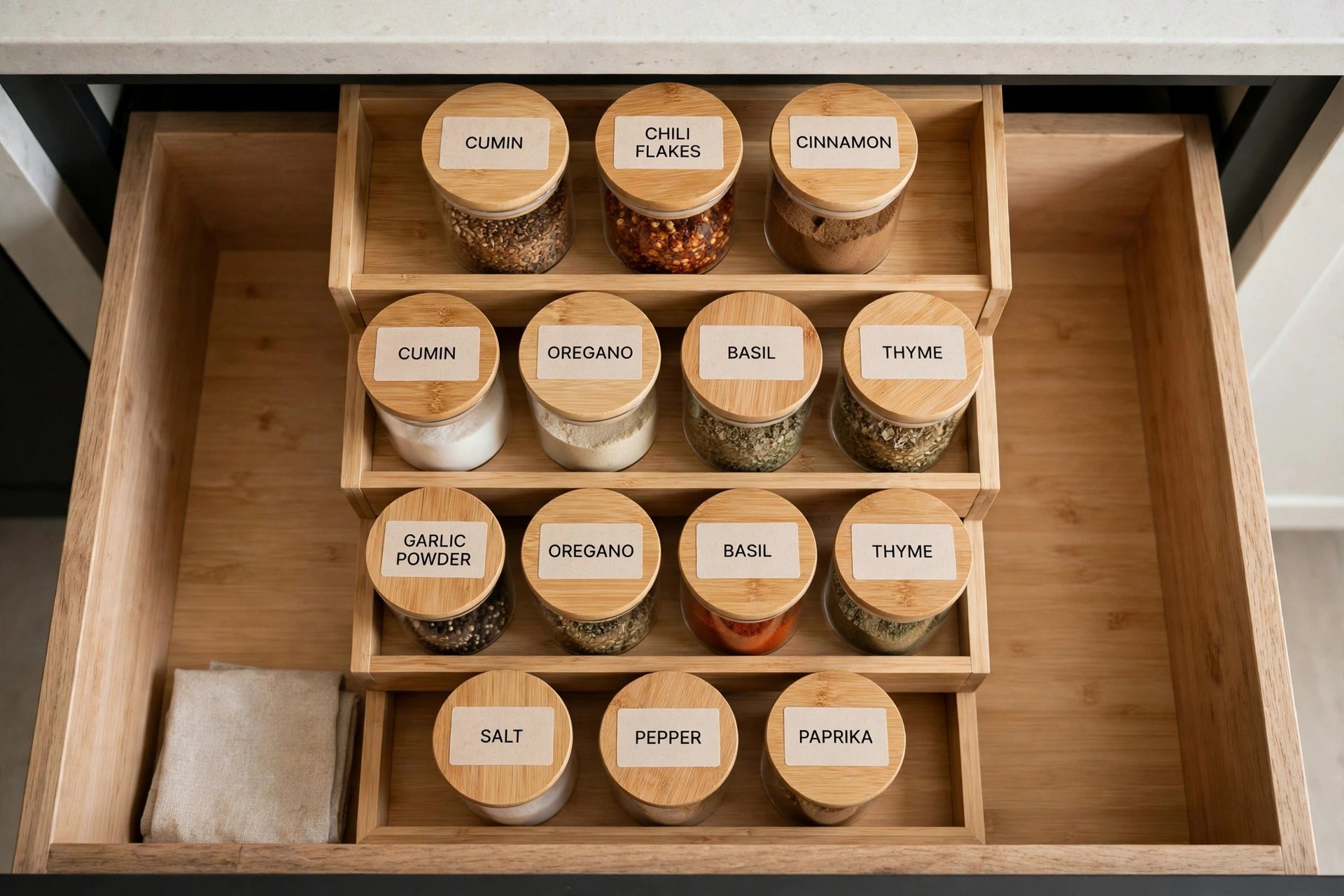
3. A Stadium Tiered Riser on One Cabinet Shelf
A three-step riser turns one flat cabinet shelf into stadium seating: back row highest, front row lowest, every label readable without moving a single jar. Most risers are 10 to 15 inches wide and about 4 inches deep per step, and expandable versions stretch to fit wider cabinets. Keep the everyday spices on this shelf and move bulk bags elsewhere. Cost: $12 to $28. Watch-out: check the total height — riser plus tallest jar must clear the shelf above, and tall grinder bottles often need to live on the front step instead.
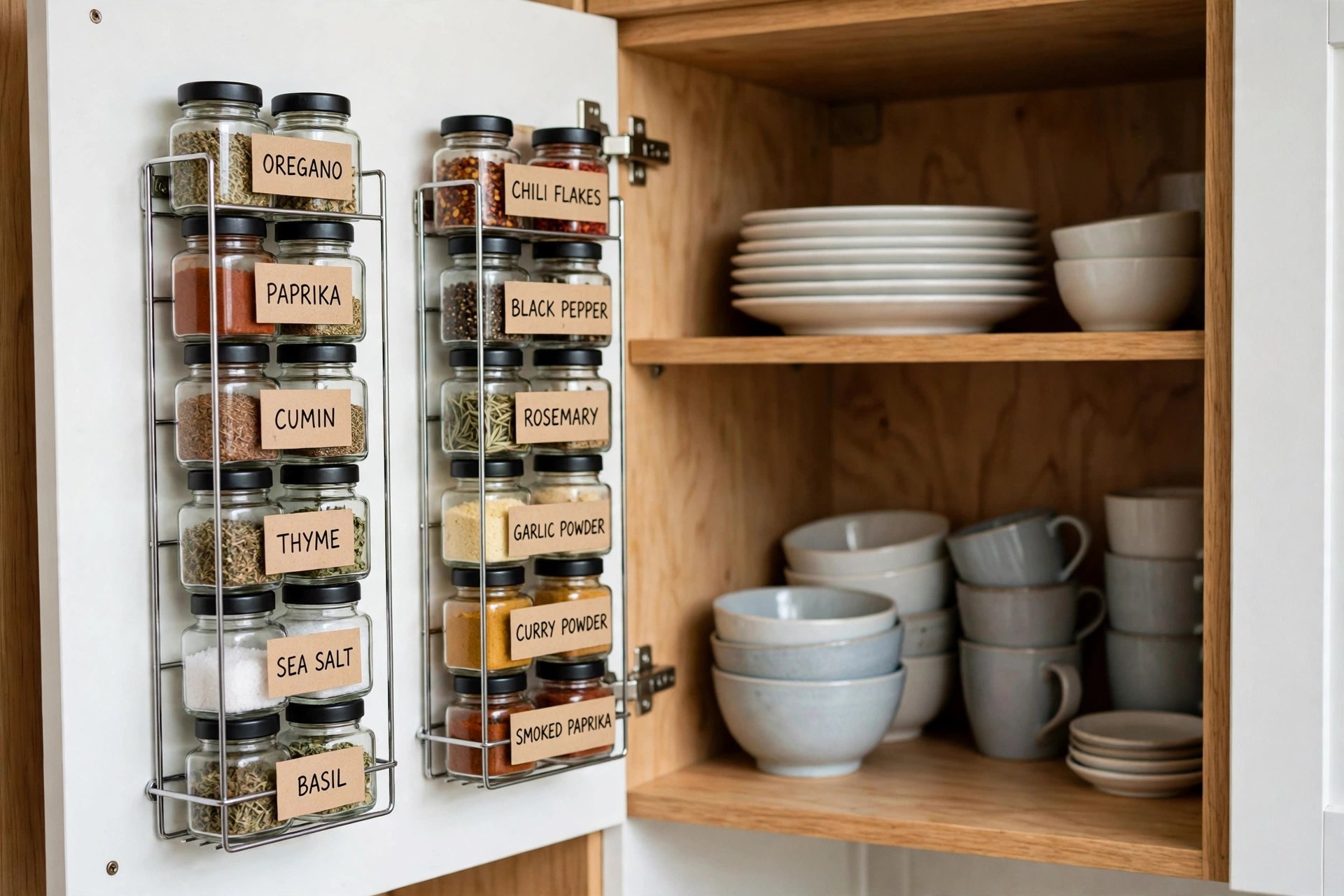
4. A Rack on the Inside of a Cabinet Door
The back of a cabinet door is flat and almost always empty. A mounted or over-door rack with three or four narrow shelves, each about 3 to 4 inches deep, holds 16 to 24 small jars in space that was doing nothing. Put it on the door nearest the prep area, not the sink. Cost: $18 to $40 for a mounted rack. Watch-out: measure the gap — the loaded rack must clear the cabinet's inside shelves when the door closes, and heavy glass jars belong on the lowest shelf, not the top one.
5. Magnetic Tins on the Fridge Side or a Steel Strip
Round tins with magnetic backs and clear lids turn the side of the fridge, a steel board, or a strip into a spice wall read at a glance. Most tins hold 1.5 to 2 ounces — enough for everyday spices you refill often — and a set of 12 to 24 builds the display. Cost: $20 to $45 for a set with labels. Watch-out: keep tins away from the stove end of the kitchen, since heat and steam still fade spices on a wall, and check the magnets hold when the fridge door slams.
6. A Narrow Pull-Out Filler Cabinet
That awkward 6 to 9 inch gap beside the stove or fridge can take a slim pull-out unit with two or three wire shelves sized to spice jars. The whole collection rolls out to you, so depth stops being a problem — nothing sits behind anything. Ready-made pull-outs cost $60 to $150; a carpenter-built filler costs more. Watch-out: the popular spot beside the stove is also the hottest, so use this for oils and your most-used cooking spices you turn over fast, and keep delicate herbs and blends in a cooler drawer instead.
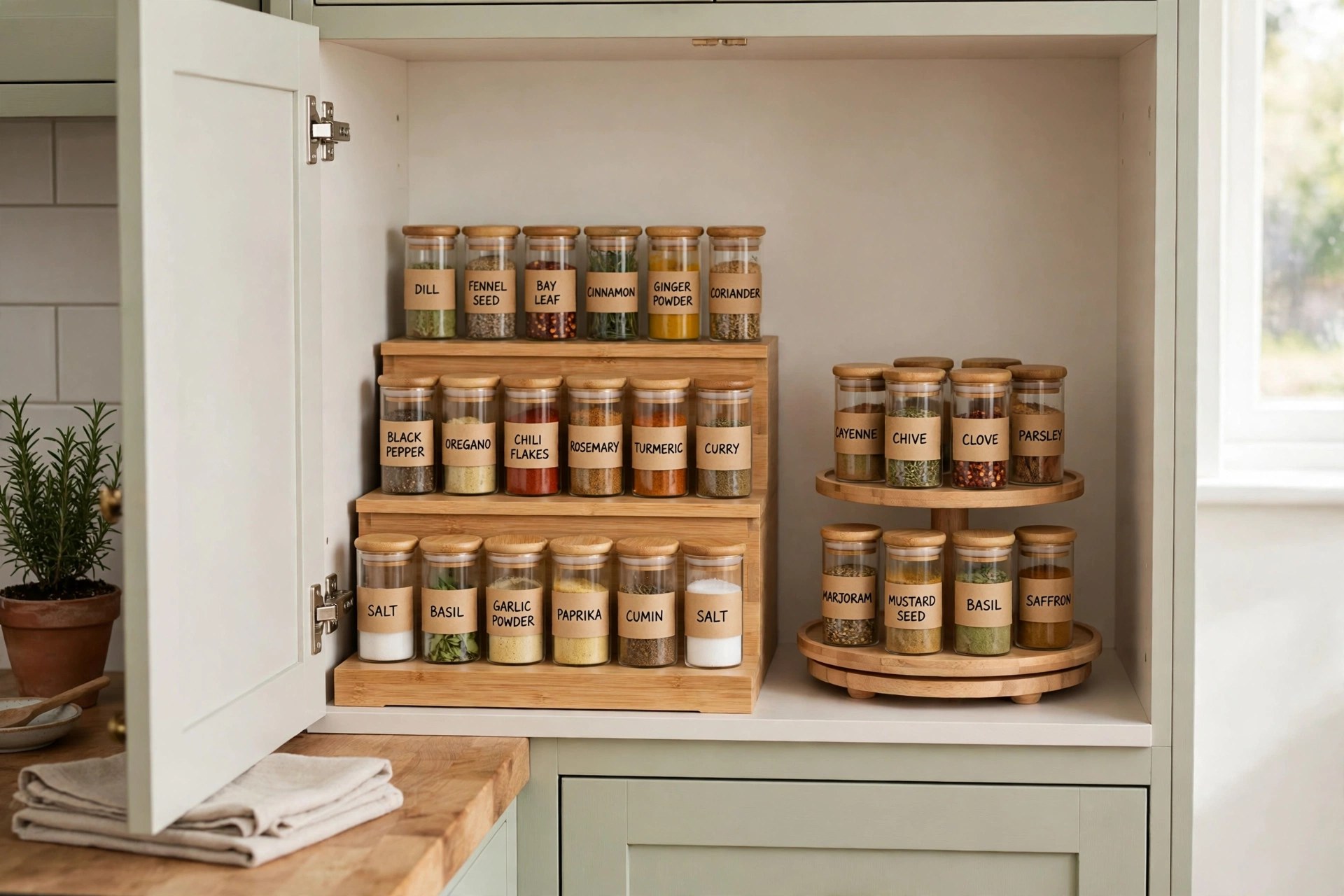
7. An Under-Shelf Basket That Doubles a Shelf
A wire basket that hooks over a cabinet shelf and hangs beneath it creates a second, shallow storey in tall shelf gaps — perfect for short jars and tins wasting the air above a normal row. Most baskets are 10 to 14 inches wide and hang about 5 to 6 inches below the shelf. Cost: $8 to $18 each. Watch-out: the shelf above must be sturdy and at least three-quarters of an inch thick for the hooks to grip, and place it mid-cabinet, not above head height where a jar can drop.
8. A Wall Rail With Clips and Small Jars
A simple kitchen rail, 16 to 24 inches long, mounted on a free stretch of wall or the side of a cabinet, holds small hanging jars, clip-on pots, or a narrow ledge shelf of spices at eye level. It frees an entire drawer, though renters should skip the screws. Cost: $25 to $60 for rail, hooks, and containers. Watch-out: mount into studs or proper wall plugs — a loaded rail is heavier than it looks — and keep it at least 18 inches from the hob, clear of splashes and rising steam.
9. Clear Bins Grouped by Cuisine on a Pantry Shelf
If spices live in the pantry, stop lining them up loose. Two or three clear, open-front bins, each about 10 inches wide, grouped by how you cook — baking, everyday savoury, chilli and blends — let you pull a whole group to the counter in one move. Labels on the bin fronts do the finding. Cost: $10 to $24 for a set. Watch-out: bins only work if they come back out easily; a bin wedged tight between shelf edges will be left on the counter, and the system quietly collapses.
10. A Compact Countertop Carousel for the Daily Eight Only
Countertop storage is a trap in a small kitchen — unless it is strictly rationed. A compact rotating carousel or two-tier stand, about 8 to 10 inches across, holding only the six to ten spices you use almost daily, earns its footprint by saving a drawer trip every meal. Everything else lives elsewhere. Cost: $20 to $45. Watch-out: the ration is the idea. The moment the carousel becomes overflow for twenty jars, it is just clutter with a motor — audit it monthly and demote anything you have not touched.
11. A Packet File Box for Sachets and Refill Pouches
Half the spice mess is not jars at all — it is packets, sachets, and half-used refill pouches slumped in a drawer. Stand them upright in a narrow file-style box or divided container, tallest at the back, grouped by type, and flick through them like index cards. A box about 8 to 10 inches long fits a drawer or one pantry corner. Cost: $6 to $15. Watch-out: fold and clip open pouches tightly, and file them in front of the jar they refill, so the backup gets used before a new one is opened.
12. Split the Collection: Everyday Set Here, Backups Cool and Dark
The system that keeps every other idea on this list working: keep only one working set — the jars you cook from — in the prime spot near prep, and store backup refills, bulk bags, and rarely used spices in one cool, dark box elsewhere. The prime zone stays shallow, visible, and fast because it never has to hold everything you own. Cost: $0 to $12 for one lidded box. Watch-out: check the backup box before you shop. Most duplicate spice purchases happen because the refill was invisible, not because it did not exist.
Mistakes That Make Spices Slow to Find — and Quick to Fade
Storing everything above the stove. It is closest to the cooking and worst for the spices: heat rises, steam condenses, flavours flatten months early. Move the main set somewhere cooler, and give overflow a proper home with our small kitchen pantry organization ideas instead of spreading jars across three warm cupboards.
Buying an organizer before measuring. Spice products are sold by hopeful names, not by your drawer's inside dimensions, shelf heights, or door clearances — hence the returns and forced fits. Measure first, buy once, and keep counters out of it with our small kitchen counter organization ideas, which keep storage inside cabinets, not on top of them.
Decanting into pretty jars and throwing the dates away. A jar with no name on its lid and no date on its bottom becomes a mystery within a month — paprika or chilli powder, and how old? Label every lid, date every decant, sniff before refilling. Browse the Kitchen & Dining collection for more small-kitchen systems that stay usable.
Questions People Ask
Where should spices not be stored in a small kitchen?
Not above or beside the stove, not by the oven vent, not over the kettle or dishwasher, and not on a sunny windowsill. Heat, steam, and light fade spices fastest. A drawer or cabinet on the prep side — near the board, clear of the hob — is the sweet spot.
Drawer or cabinet — which is better for spices?
A shallow drawer with an angled insert is usually fastest: you read every lid at once and nothing hides. A cabinet wins when no drawer is spare, provided a riser, turntable, or door rack keeps it one visible layer. A deep, unorganized version of either is equally slow.
Should I decant spices into matching jars?
Only if you label and date them. Matching 2 to 4 ounce jars make drawers and risers work properly and waste less space than mixed shapes. Write the name on the lid and the date on the bottom as you fill — skip either step and decanting creates mysteries instead of order.
How long do ground spices stay good?
Rarely unsafe, but they go quiet. Ground spices give their best flavour for about 6 to 12 months once opened; whole spices last noticeably longer, especially cool, dark, and dry. Test by smell: crush a pinch — if it smells faint and dusty, replace it and buy smaller amounts.
Pick the one space you can free — a drawer, a door, one shelf — measure it, and give it one of these systems. The win is reaching for the cumin once, and touching it first time, every time you cook.


Comments
Post a Comment