
12 Small Living Room Bookshelf Styling Ideas That Look Curated
A bookshelf in a small living room has two jobs at once: store your books and daily clutter, and look like part of the room rather than storage that wandered in. The best small living room bookshelf styling ideas are not about buying more decor. They are about editing — leaving space empty, grouping what stays, and choosing a shelf that fits the wall without eating the floor.
You do not need a designer or matching sets. You need a few ratios, the right shelf depth, and the discipline to stop adding things. Below are twelve ideas with real depths, costs, and watch-outs that keep small shelves calm instead of crowded.
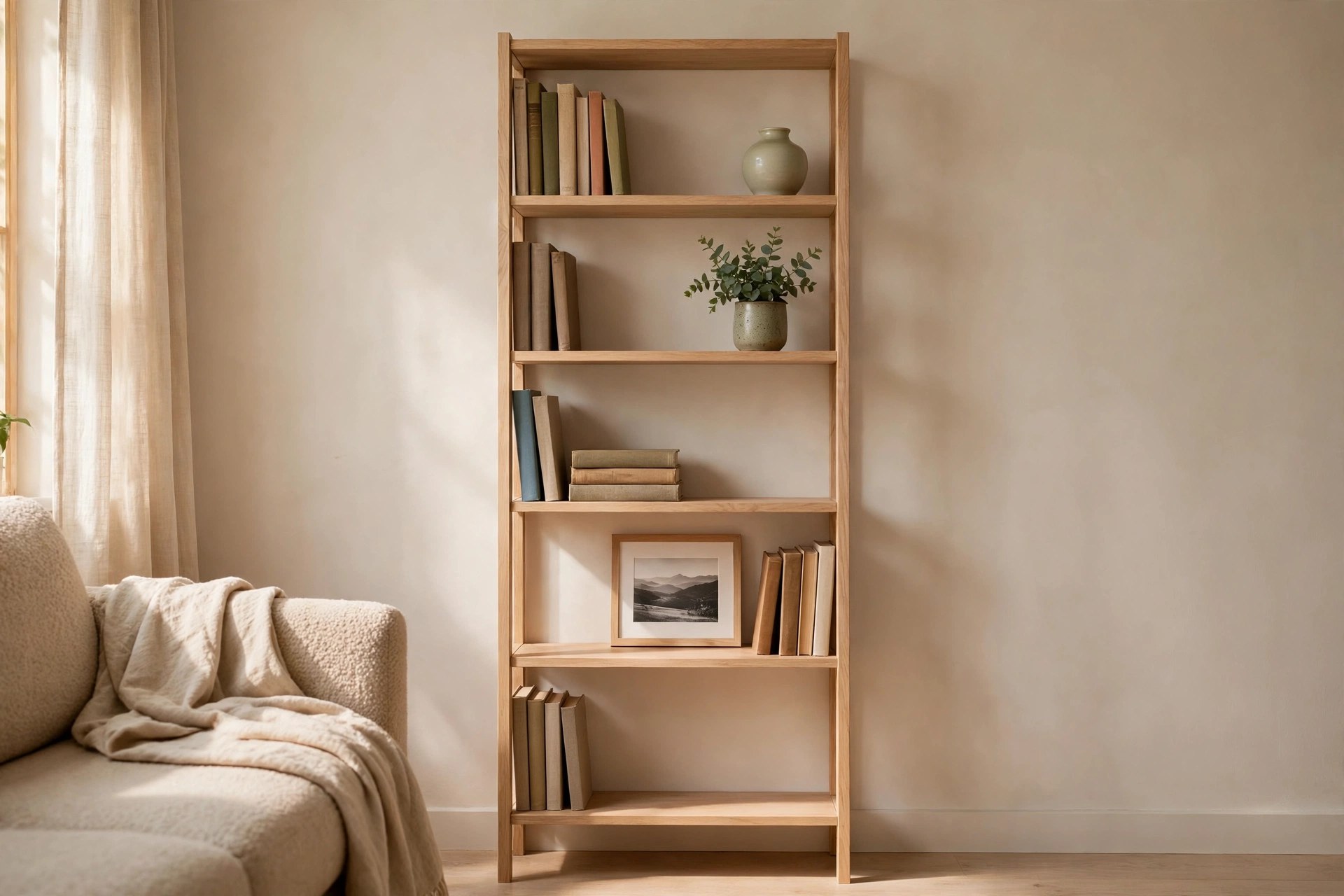
Plan the shelf and the wall around it together, using our guide to small living room gallery wall ideas — one strong arrangement beats two competing ones.
Start With the Rules: Empty Space, the 60-30-10 Split, and the Right Depth
Rule one: leave roughly 30 percent of every shelf empty. That breathing room is the biggest difference between a curated shelf and a stuffed one. Rule two: aim for a 60-30-10 split — about 60 percent books, 30 percent decor (vases, bowls, framed pieces), and 10 percent personal items like photos and travel finds.
Rule three: size the case to the room. A depth of 8 to 10 inches is plenty for paperbacks, most hardcovers, and decor, without jutting into walkways. Styling guides like Aura Decor Living on bookshelf styling ideas and The Decor Guide on bookshelf ideas land on the same fundamentals: group in odd numbers, vary heights, repeat one colour across shelves, and leave space around each group.
Finally, think tall and narrow before wide and low. A 24 to 30 inch wide bookcase rising 60 to 72 inches uses vertical space a small room can spare; a wide, low case competes with the sofa's visual band. Leave at least 2 inches of clearance on each side so the piece looks chosen, not wedged in.
12 Small Living Room Bookshelf Styling Ideas That Look Curated
Work from the biggest decisions down: the case first, then the books, then the layers. Most of this uses things you already own.
1. Leave 30 Percent of Every Shelf Empty
Start by taking everything off, then put back less than you think. Fill roughly two-thirds of each shelf and leave the rest clear — a gap beside a stack, an empty stretch at one end, or one object on its own. On a 30-inch shelf, about 9 to 10 inches stay empty. That space is what makes the remaining pieces read as chosen. Cost: $0, plus donating a small box of books. Watch-out: empty space only works when what remains is grouped tightly; singles scattered across a shelf just look unfinished, not airy.
2. Choose a Tall, Narrow Case With a Slim 8 to 10 Inch Depth
In a small room, footprint matters more than storage volume. A tall, narrow bookcase — 24 to 30 inches wide, 60 to 72 inches tall — stores nearly as much as a wide one on half the wall. A depth of 8 to 10 inches fits hardcovers and a small plant, sitting beside a doorway or behind a sofa arm. Flat-pack versions cost $60 to $140. Watch-out: tall and narrow can tip, so anchor it with the supplied strap or a $10 anti-tip kit, especially with children or pets around.
3. Follow the 60-30-10 Split: Books, Decor, Personal Pieces
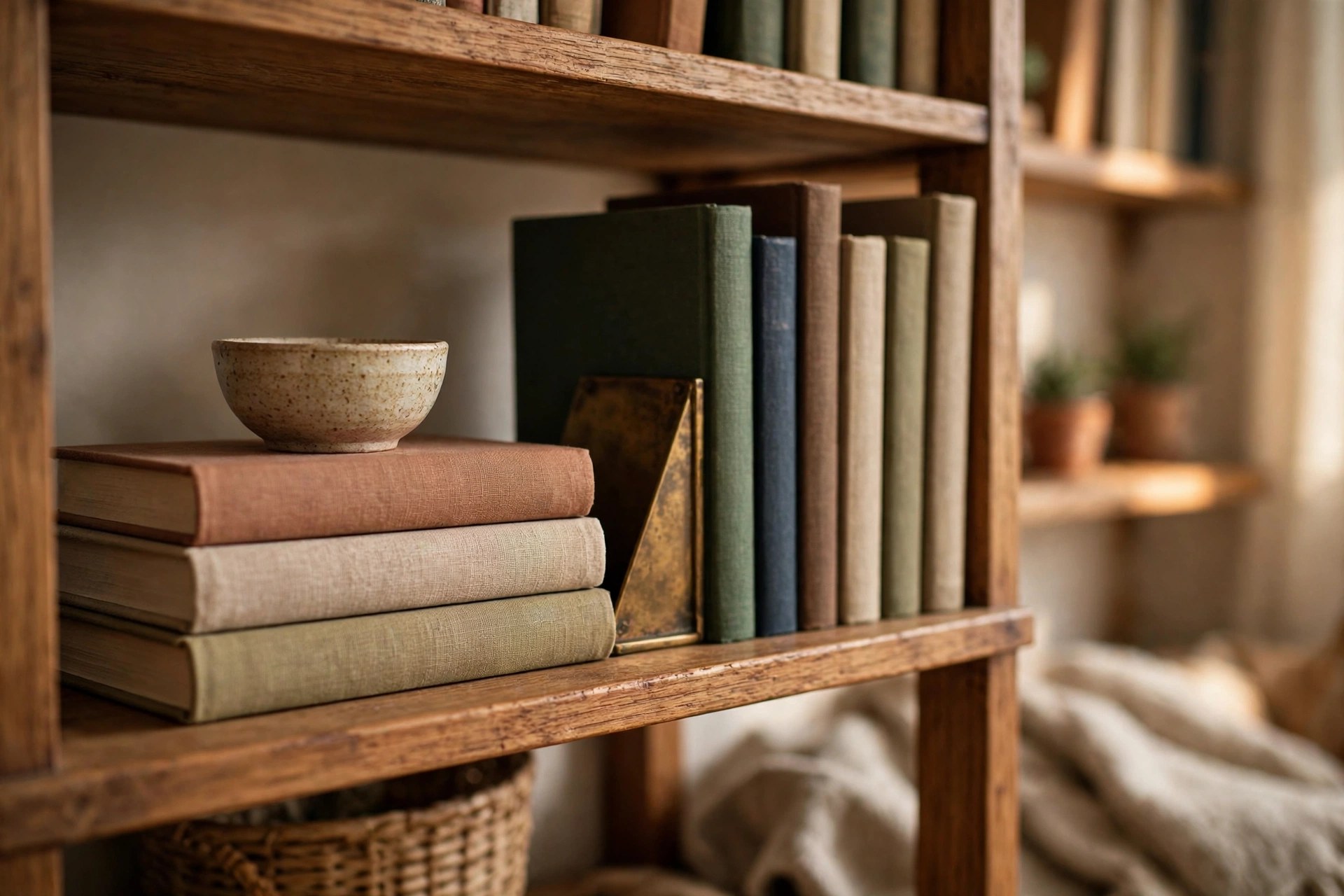
Count the styled surface in three parts. About 60 percent books, 30 percent decor — a vase, a bowl, a small sculpture, a framed print — and 10 percent personal: one or two photos, a souvenir, something with a story. That last slice keeps a shelf from looking like a shop display, so do not skip it — but five framed photos on one shelf reads as a mantel, not a bookcase. Cost: $0 to rearrange what you own. Watch-out: cluster personal pieces on one or two shelves instead of scattering them everywhere.
4. Mix Upright Rows With Horizontal Stacks
All-upright books look like a library; all-stacked books look like a pile. The curated look mixes both on every level. Stand upright books for about half a shelf, end the run with a bookend or a heavy object, then lay a horizontal stack of two to four books nearby with one small item on top — a candle, a tiny plant, your reading glasses. Cost: $0 with your own books; metal bookends run $12 to $20 a pair. Watch-out: stacks taller than four books start to look like storage again.
5. Put Baskets on the Bottom Shelf for the Ugly Essentials
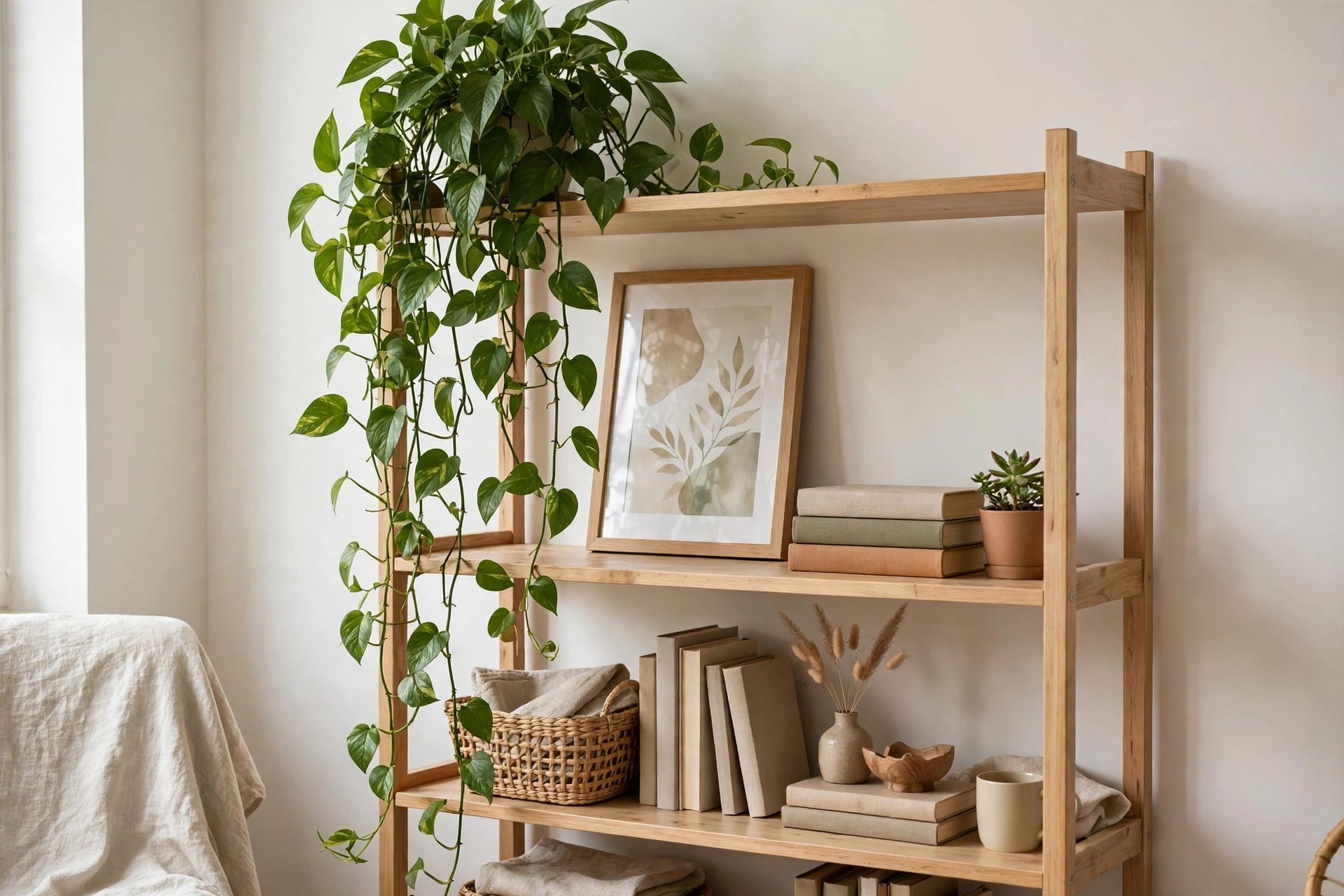
Remotes, chargers, coasters, game controllers, the dog's lead — a living room shelf can hide all of it if the bottom shelf belongs to baskets. Choose two or three that fill the shelf width snugly, in one material and colour, lidded if the clutter is visual chaos. Woven seagrass or felt baskets in the 10 to 12 inch range cost $12 to $25 each. The bottom shelf is right for them: heaviest items low, clutter below eye level. Watch-out: measure the shelf opening first; a basket 1 inch too tall will not fit.
6. Add One Plant Per Two Shelves, Trailing First
Greenery softens all those straight lines and hard spines. A trailing pothos on the top shelf, spilling 12 to 18 inches down the side, does more for a bookcase than any ornament. Add one small upright plant — a snake plant or a 4-inch potted fern — a couple of shelves below, and stop there. Real plants cost $8 to $20 each; good faux trailing stems run $15 to $30. Watch-out: check the light honestly; a dark wall slowly kills sun-loving plants, so choose low-light varieties or quality faux.
7. Group Books by Colour in Loose Blocks
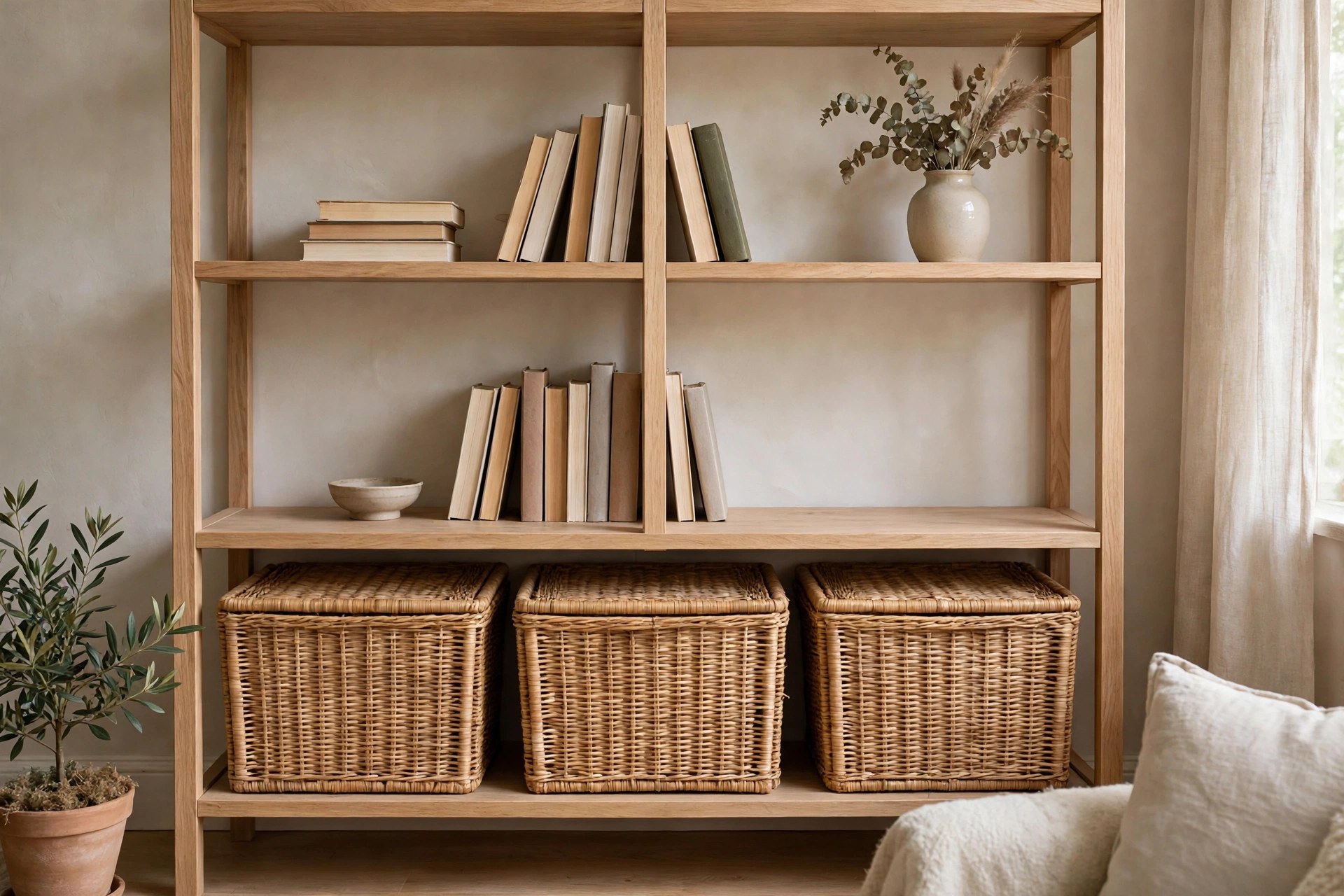
You do not need a strict rainbow, which can look staged, but loose colour blocking calms a shelf instantly. Sort books into rough families — warm neutrals together, dark spines together, one block of blue or green — and spread the blocks across different shelves so colour repeats down the case. Removing torn, shiny dust jackets often reveals calmer cloth spines underneath. Cost: $0. Watch-out: keep series together; splitting a matching set across shelves for the sake of colour will annoy you every time you reach for the next volume.
8. Style in Odd-Numbered Groups of Three
Decor looks deliberate in threes. Build small vignettes: a vase, a short stack of two books, and a small bowl — or a framed photo, a candle, and a tiny plant. Keep the three items at different heights, tall, medium, low, and let the group occupy one clear zone with space on both sides — tight clusters, generous gaps. One group per shelf is enough, and pieces cost $8 to $30. Watch-out: threes on every shelf feel mechanical; vary one shelf with a pair or a single strong object.
9. Anchor Each Shelf With One Larger Piece
Small items alone make shelves look bitsy. Give each shelf one anchor: a substantial vase 8 to 12 inches tall, a medium framed print leaned at the back, a ceramic bowl, or a short stack of oversized art books. Place the anchor first, and alternate it left and right as you move down the case, in a gentle zigzag. Then add at most two smaller pieces beside it. A decent anchor vase costs $20 to $45. Watch-out: an anchor nearly as deep as the shelf leaves no room in front; keep 2 inches spare.
10. Lean Art and Photos at the Back for Depth
Leaning a framed print against the back panel, with books or a small object overlapping its front edge, adds a layer that makes a shallow shelf feel deep. It works especially well on 8 to 10 inch shelves, where decor cannot sit in front of upright books. Use frames between 5 by 7 and 11 by 14 inches, and choose one image per shelf, not a gallery. Frames cost $10 to $25. Watch-out: secure tall frames with a museum putty dot at the base, about $6 a pack, so a bumped shelf does not send glass sliding forward.
11. Hide Everyday Clutter in Book Boxes and Lidded Storage
Some daily essentials are simply not pretty: spare cables, batteries, the TV manual, nail clippers. Hollow book boxes and lidded storage boxes in your palette swallow them while reading as decor. Keep one box per shelf at most, around 8 by 11 inches for remotes and chargers, and label the inside lid so the system lasts. Book boxes cost $12 to $22 each. Watch-out: if every shelf hides clutter in boxes, the case stops being a bookshelf; cap hidden storage at the basket shelf plus one or two boxes elsewhere.
12. Light the Shelves, Then Edit Them Monthly
Two finishing moves keep the look. First, light: a warm LED strip under one or two shelves, or a small rechargeable picture light above the case, turns books into a feature after dark and makes a small room feel layered. Battery or USB strips cost $15 to $30 and need no wiring. Second, editing: once a month, remove one thing per shelf — the burned-down candle, the souvenir that lost its meaning. Watch-out: keep colour temperature at 2700K to 3000K; cool white light makes wood and paper look grey and clinical.
Mistakes That Make a Small Bookshelf Look Messy
Overfilling every inch. Treating the shelf as pure storage, books pushed spine-to-spine across all of it, is the most common mistake — the same small-room storage problem our small living room storage ideas tackle piece by piece. If books genuinely overflow, the answer is a second slim case or an honest edit of the collection, not tighter packing.
Choosing a case too deep or too wide for the wall. A 12 to 14 inch deep, 48 inch wide bookcase can swallow a short wall and crowd whatever sits beside it — the same trap we flag in our small living room console table ideas. Mock the footprint up with painter's tape before buying; ten minutes with tape has saved more small rooms than any styling trick.
Lining everything up at one height, with nothing personal. Identical-height rows with decor spaced like a shop shelf look tidy in photos and lifeless in a room. Vary the heights, lean one frame, trail one plant, and keep that honest 10 percent of personal pieces in the mix. For more compact-room finishes, browse the rest of the Living Room collection.
Questions People Ask
How much empty space should a styled bookshelf have?
About 30 percent of each shelf. In practice, that means one clear gap of 8 to 10 inches per shelf. If your books fill the case completely, remove one box and live with the gaps for a week; the calm is usually worth more than the storage.
What depth should a bookshelf be in a small living room?
Between 8 and 10 inches suits most small living rooms. That depth holds paperbacks, most hardcovers, baskets, and small decor while keeping walkways clear. Choose 12 inches only for oversized art books or board games, and check it will not crowd the sofa or doorway first.
How do I style shelves when I have a lot of books?
Books at 60 percent still leaves room to style. Break long upright runs with one horizontal stack per shelf, group spines into loose colour blocks, and reserve the bottom shelf for baskets holding non-book clutter. If books fill over 80 percent, style just the top and eye-level shelves and let the rest be honest library shelves.
What should go on the bottom shelf of a living room bookcase?
The heaviest and least pretty things: baskets or lidded boxes of remotes, chargers, and games, plus your largest books laid flat. Weight low keeps a tall, narrow case stable. Keep plants and fragile ceramics higher up, away from feet, vacuum cleaners, and pets.
Start with the edit, not the shopping. Take everything off, put back 60 percent books, 30 percent decor, and 10 percent pieces that are yours, leave a third of every shelf breathing — and the bookcase you own will look curated by tonight.


Comments
Post a Comment