
12 Small Living Room Gallery Wall Ideas That Feel Curated
A gallery wall in a small living room usually fails for one of two reasons: the frames creep too high, or every frame is a different size, finish and distance from its neighbour, so the wall reads as clutter instead of a collection. The small living room gallery wall ideas that actually feel curated follow a handful of numbers, not a talent for art. Hang the centre of the grouping at eye level, keep the gaps between frames identical, and size the whole arrangement to the sofa below it, and even six inexpensive frames look deliberate. These twelve ideas walk you through it in order.
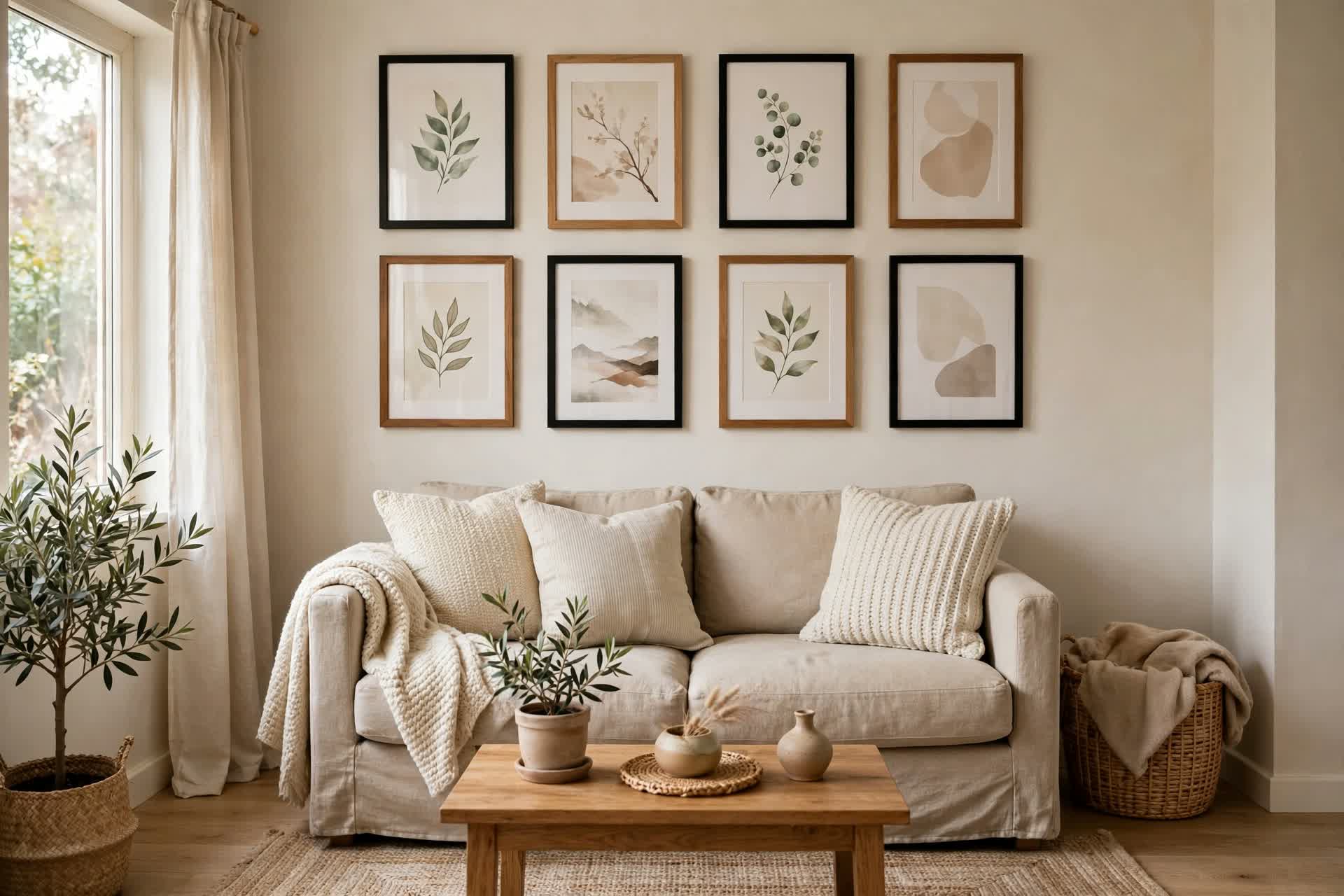
Plan First: The Four Measurements Behind Every Idea Below
Before a single nail goes in, take four measurements. They decide the layout, the frame count and whether the finished wall looks balanced or accidental.
- Centre height: the middle of the grouping sits at 57 to 60 inches from the floor (145 to 155 cm). That is average eye level. Measure to the centre of the whole arrangement, not the top frame, and mark it with painter's tape before anything else.
- Spacing: 2 to 3 inches between every frame, in every direction. Consistency matters more than the exact number. Pick 2 inches for a tight, modern grouping or 3 inches for a looser one, then never vary it inside the same wall.
- Width over furniture: above a sofa, the grouping should span about two-thirds of the sofa's width. On a 72-inch sofa that means a 48-inch arrangement. Much narrower looks lost; much wider crowds the arms of the sofa.
- Height above the sofa back: leave 6 to 8 inches between the sofa back and the lowest frame. Less than 6 inches and heads bump frames; more than 8 and the art floats away from the furniture it belongs to.
For layout options before you commit, this guide to 12 ways to display a gallery wall shows how different arrangements change the feel of the same frames. CanvasDiscount's gallery wall ideas are a useful second reference for mixing print sizes without losing the thread. Both reinforce the rule used throughout this list: one anchor piece, a strict spacing rule, and no more than two frame finishes per wall.
12 Small Living Room Gallery Wall Ideas That Feel Curated
1. Start With One Anchor Piece, the Largest Frame You Own
Every curated wall has a centre of gravity. Choose your largest piece, ideally 16 by 20 inches or bigger in a small room, and hang it first, slightly off-centre or dead centre depending on the layout below. Everything else is chosen to support it: smaller frames echo its colours or subject, and nothing else competes at the same size. Without an anchor, a wall of equal small frames reads as a noticeboard, no matter how neatly you hang it.
2. Plan the Whole Wall on Kraft Paper Before Drilling
This is the step that saves your plaster. Trace every frame onto a roll of kraft paper (about $6 a roll), cut out the templates, and tape the arrangement to the wall with painter's tape. Live with it for a day. When the templates feel right, mark each nail position through the paper, remove the templates, and drive the nails exactly on the marks. Renters can follow the same plan with adhesive hanging strips rated for each frame's weight, usually $4 to $8 a pack.
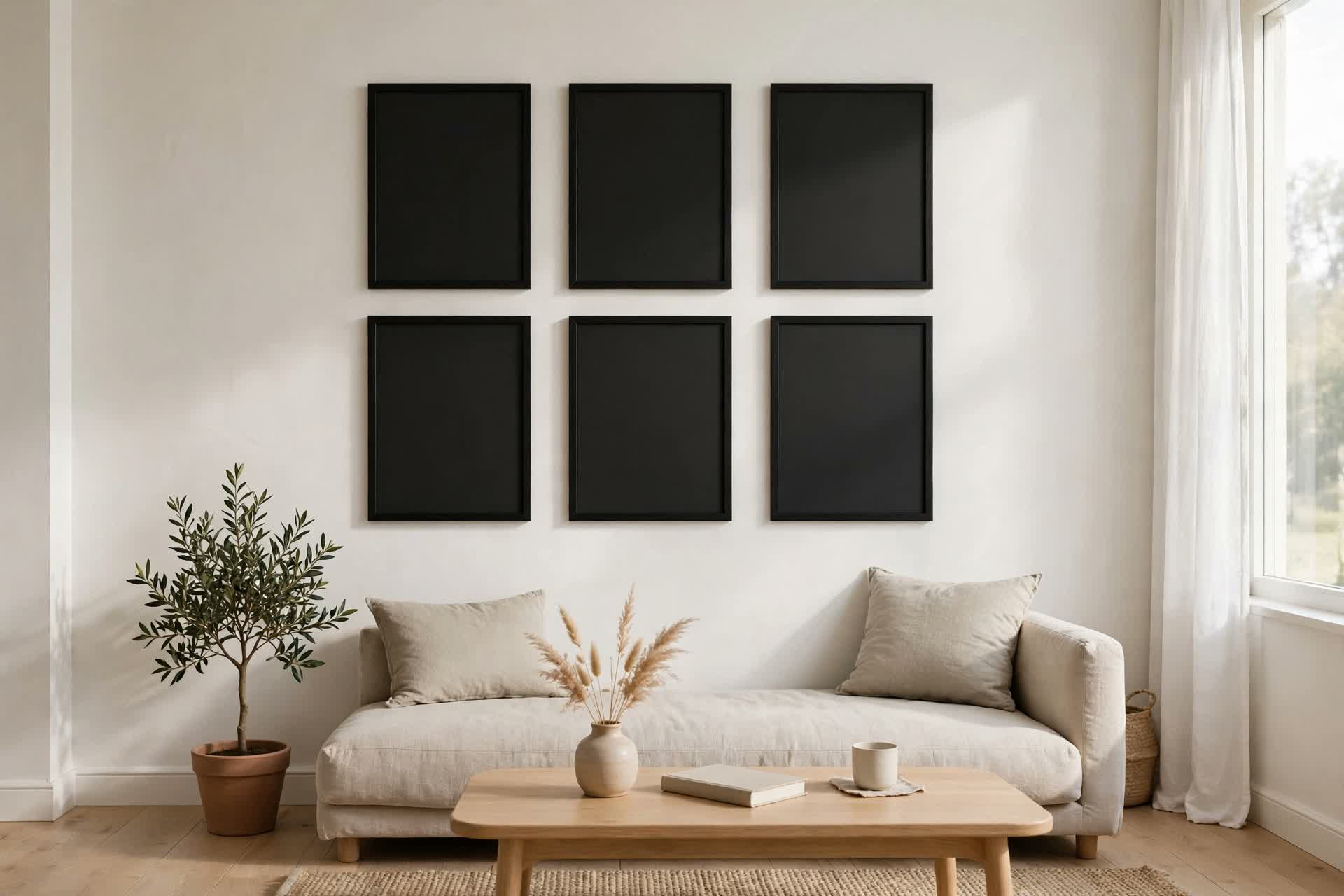
3. Hang the Centre of the Grouping at 57 to 60 Inches
The most common gallery wall mistake is hanging by the top frame instead of the centre, which pushes the whole arrangement toward the ceiling. Find the vertical centre of your taped arrangement, set it at 58 inches as a safe middle value, and build outward from the anchor piece. What you cannot do is guess: a grouping centred at 66 inches looks wrong in every photograph and nobody can say why. Measure it, tape it, then hang it.
4. Keep Spacing at 2 to 3 Inches, and Never Vary It
Uneven gaps are what separate a curated wall from a corridor in a rental listing. Cut a spacing stick from cardboard at exactly 2 inches (or 3, if your wall is wide) and use it between every pair of frames as you hang, rather than trusting your eye frame by frame. Small errors compound: a quarter-inch drift per frame becomes a visibly slanted row by the sixth frame. It takes ten extra minutes and it is the detail visitors register most.
5. Size the Arrangement to Two-Thirds of the Sofa Width
Above a sofa, proportion does the curating for you. Measure the sofa, multiply by two-thirds, and treat that as the target width of your grouping: 48 inches over a 72-inch sofa, about 40 inches over a 60-inch loveseat. Hold the height in check too: a grouping 24 to 36 inches tall suits most small rooms. If your frames do not reach the target width, spread the spacing to the full 3 inches or add one medium frame at each end rather than shrinking the whole wall into the middle.
6. Leave 6 to 8 Inches Between the Sofa Back and the Lowest Frame
Frames hung directly behind a sofa live a hard life: heads lean back, cushions get fluffed into them, and tall guests knock them crooked. A 6 to 8 inch gap keeps the lowest frame clear of all of it while still tying the art to the sofa visually. Measure from the top of the sofa back, not the seat, and if your sofa has loose back cushions, measure with the cushions plumped, because that is their real height.
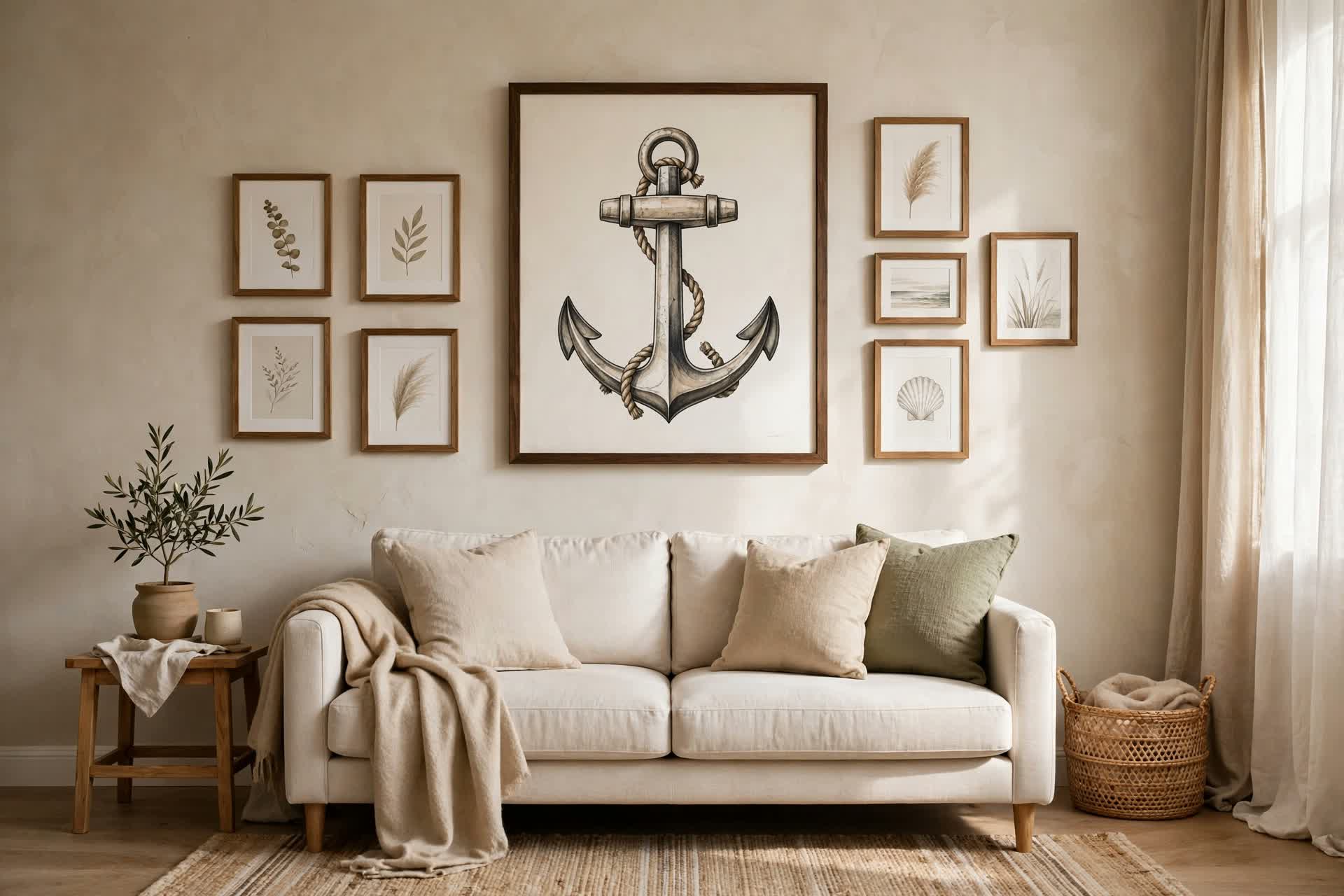
7. Choose a Strict Grid When You Want Calm and Order
A grid, two rows of three or three rows of three in identical frames, is the most forgiving layout in a small room because it asks nothing of your styling instincts. Use the same frame, the same mat size and prints from one family: black and white photographs, botanical prints, or a single colour palette. Keep the 2-inch spacing exact, because a grid shows errors a loose layout hides. Grids suit modern and minimalist rooms, renters who want one box of matching frames (sets of six run $25 to $45), and anyone whose other decor is already busy. Pair a calm grid with the window treatment ideas in our guide to small living room curtain ideas and the whole wall end of the room settles down.
8. Choose a Salon Layout When You Want a Collected Feel
Salon style, mixed sizes fitted together like a puzzle, is the classic collected look, and it works in small rooms if you keep two disciplines: the outer edge of the grouping forms one clean rectangle or an even stepped shape, and the 2 to 3 inch spacing never changes. Build it on the kraft paper first (idea 2), anchor in the middle, then fill outward, largest to smallest. Salon layouts reward mixing in one or two non-print pieces, covered in idea 11.
9. Limit the Whole Wall to Two Frame Finishes
Three or more frame finishes is the fastest route to a wall that feels accidental. Pick two at most: black and light oak, white and brass, walnut and black. Repeat each finish at least twice so it reads as a decision rather than a leftover. If your frames are a mixed inherited set, one can of spray paint (about $6) in matte black unifies the odd ones in an afternoon.
10. Use Picture Ledges When You Rent or Like to Rearrange
Two picture ledges, each 24 to 36 inches long and $15 to $30, give you a gallery wall with two screw holes instead of twelve. Frames lean on the ledge, overlapped slightly, and you can swap prints seasonally or shuffle the order in five minutes without touching a nail. Keep the same rules: ledges level with each other, the arrangement centred near 58 inches overall, and the largest piece placed first. Ledges are also the safest option above a sofa in a household with small children, because nothing hangs to be knocked off its hook.
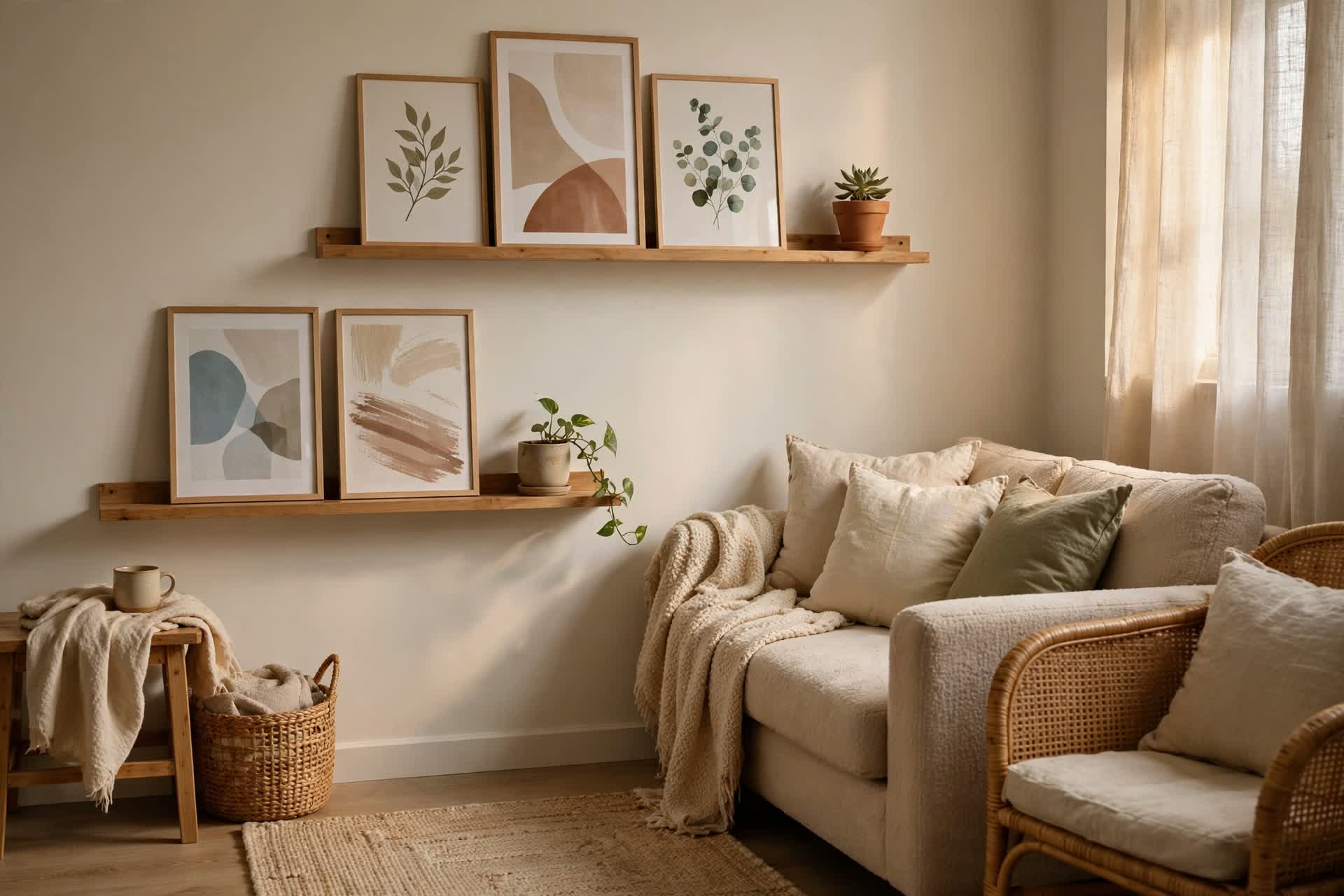
11. Mix in One Mirror or Object Piece for Depth
A wall of flat prints can feel one-dimensional. One piece with depth fixes it: a small round mirror (12 to 16 inches), a woven wall hanging, a shallow shadow box or a small wooden relief. A mirror earns its place twice in a small room, bouncing window light back into the seating area; if that appeals, our roundup of living room mirror ideas shows how to size one against a sofa wall. One object piece is the dose: two or three turns the wall into a display shelf with identity issues.
12. Edit Down by One Frame at the End
When the wall is hung, step back to the doorway, the viewpoint every guest gets first, and remove one frame: the weakest print, the one that duplicates a colour, or the one crowding a corner. Curated walls almost always have slightly less on them than the first draft. Fill the nail hole with a dab of white filler ($4 a tube) and the gap becomes intentional white space that lets the anchor piece breathe. Live with the edited wall for a week before deciding anything is missing.
Quick Picks: Match the Layout to Your Room
Busy room, patterned rug, lots of colour already? Choose the strict grid (idea 7) in matching frames and let the wall be the calmest thing in the room. Plain room, neutral sofa, little pattern anywhere? The salon layout (idea 8) adds the character the room is missing. Renting, or redecorating twice a year? Picture ledges (idea 10), no contest. If the budget is a single purchase, spend it on the anchor print: size is what the eye reads first.
Gallery Wall Mistakes That Make a Small Room Feel Cluttered
Five mistakes undo everything above: hanging the centre too high, usually by measuring to the top frame; random spacing that drifts a little more with every frame; arrangements that are too small for the sofa, floating in the middle of a wide wall; three or more frame finishes competing; and frames hung closer than 6 inches above the sofa back, knocked crooked weekly. Every one of them is a measurement problem, not a taste problem, which is good news: a tape measure, a kraft paper template and a cardboard spacing stick fix all five in one afternoon. For more ways to make a compact room work harder, browse our Living Room ideas archive.
Start this weekend with the paper, not the hammer: trace your frames, tape the arrangement at a 58-inch centre, and only drill when the paper version already looks right from the doorway.


Comments
Post a Comment