
12 Small Living Room Plant Ideas That Add Life Without Clutter
The best small living room plant ideas do one simple thing: they add green in the places your room already has spare — a shelf edge, an empty corner, the end of a sofa — instead of taking over the floor. If your living room feels flat but you cannot spare another square foot, plants are not the problem. Placement is. Pick the right plant, in the right size pot, for the light you actually have, and a tiny room can hold a surprising amount of life without ever feeling crowded.
This guide gives you 12 specific ideas, not vague inspiration. Every idea names the plant, the pot size in inches, where it goes, what light it needs, and roughly what it costs in the US. There are options for low-light rooms, bright rooms, beginners who forget to water, and homes with cats and dogs. Start with three ideas. You can always add more later — that restraint is exactly what keeps a small room calm.
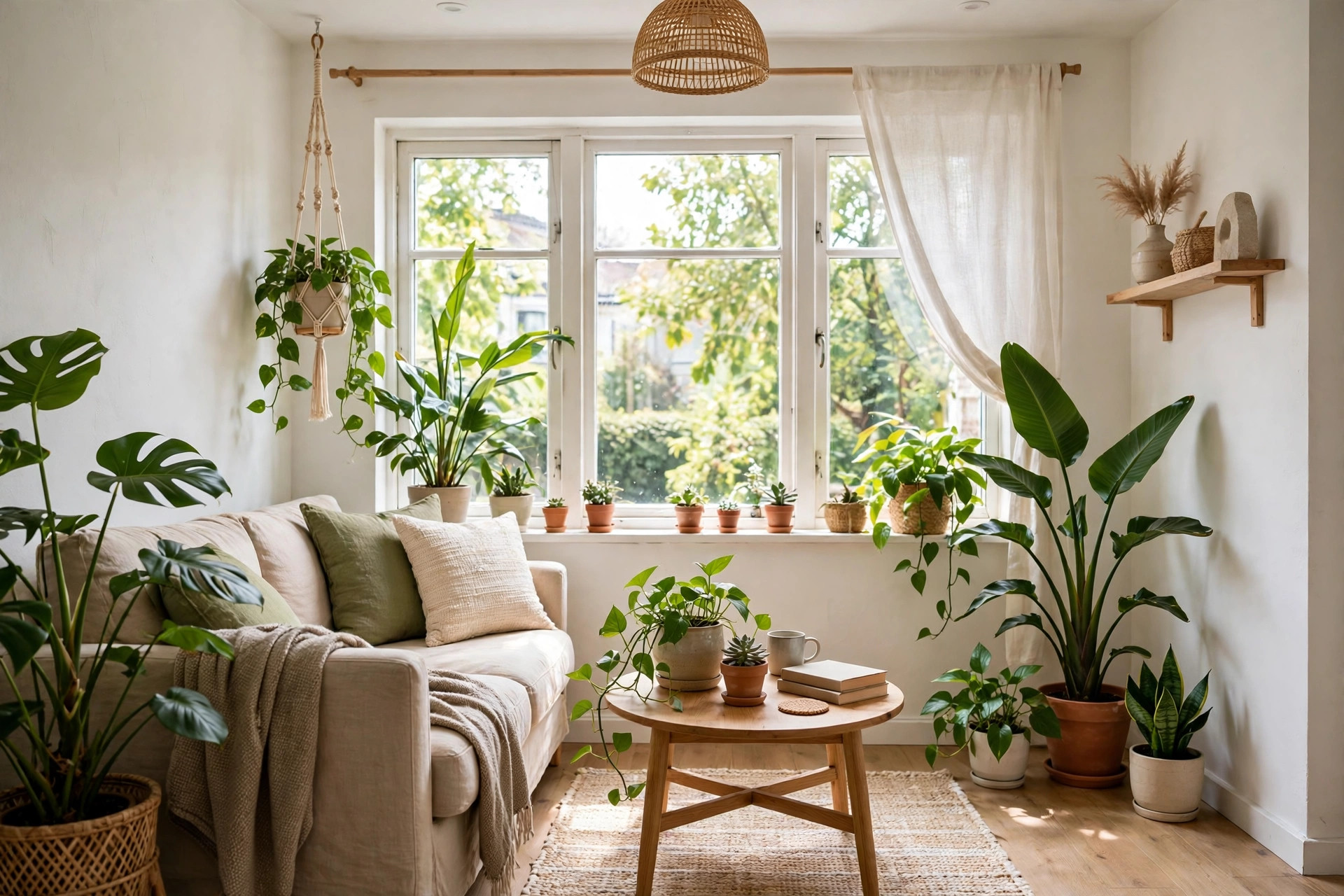
Before You Buy: The 10-Minute Light and Space Check
Do not buy a plant because it looked good in a shop. Spend ten minutes checking light and space first, and you will save money and avoid the slow decline that makes people say they cannot keep plants alive.
Read your light honestly
Stand where the plant will live at midday and look toward the window. If you can see daylight but there is no direct sunbeam on that spot, that is low to medium indirect light. Most of the reliable small-space plants — snake plant, ZZ plant, pothos, cast iron plant, and parlor palm — are happy there.
- North-facing window: soft indirect light all day. Best for pothos, snake plant, ZZ plant, cast iron plant, and ferns.
- East-facing window: gentle morning sun, then indirect light. Good for almost everything on this list, including monstera and peperomia.
- South or west-facing window: the brightest light. Good for a fiddle leaf fig, rubber plant, and succulents, but move tender leaves a foot or two back so they do not scorch.
- No daylight at all: no live plant will thrive long-term without a grow light. That is not a failure on your part. It is just how plants make food. Either add a small grow bulb or choose a different spot.
For more on matching plants to dim rooms, this guide to the best low-light houseplants is worth reading — especially its point that low light still means some daylight.
Measure the footprint, not just the plant
A plant in a 6-inch nursery pot is rarely 6 inches wide once the leaves spread. Add at least 4 to 6 inches all around for growth and air flow. In a small living room, the clutter rules are simple:
- One floor plant per room is usually enough. Two only if they are in opposite corners.
- Keep walkways completely clear. No pots where feet, vacuum cleaners, or toddlers need to pass.
- Use one plant per zone: one tall, one on the coffee table, one trailing from a shelf. That spread reads as intentional. Five plants clustered on one side table reads as mess.
- Limit yourself to two or three pot styles — for example white ceramic and woven baskets — and repeat them. Matching pots calm a collection down instantly.
If you are also working on layout, these small living room corner ideas pair well with the corner plant ideas below, because a plant only helps a corner if the furniture around it is already working.
12 Small Living Room Plant Ideas
1. One slim snake plant beside the sofa
Plant: Snake plant (Dracaena trifasciata, also sold as Sansevieria). Pot: 6-inch, tall and narrow. Cost: about $18 to $35 for the plant, $12 to $25 for a simple ceramic pot. Light: low to bright indirect.
This is the safest first plant for a small room. Snake plants grow straight up, not out, so a 6-inch pot tucked beside a sofa arm takes up less floor than a side table lamp base. The stiff, striped leaves add height and a clean, modern line without softening into the cushions.
Water only when the soil is completely dry — usually every 3 to 4 weeks in winter and every 2 to 3 weeks in summer. Overwatering kills more snake plants than neglect ever will. Use a pot with a drainage hole and empty the saucer after watering.
Pet note: snake plants are toxic to cats and dogs if chewed. If your pet nibbles leaves, skip this one and use a parlor palm in the same spot instead.
Clutter rule: one slim plant beside the sofa. Do not add a second floor plant on the same side of the room.
2. A trailing pothos on a high floating shelf
Plant: Golden pothos or plain green pothos. Pot: 6-inch. Cost: about $15 to $28. Light: low to medium indirect — plain green types handle lower light better than heavily variegated ones.
Pothos earns its place because it uses air, not floor. Put it on a high shelf, let two or three stems trail down 18 to 30 inches, and trim the rest. That falling green softens a hard shelf line and draws the eye up, which makes low ceilings feel a little higher.
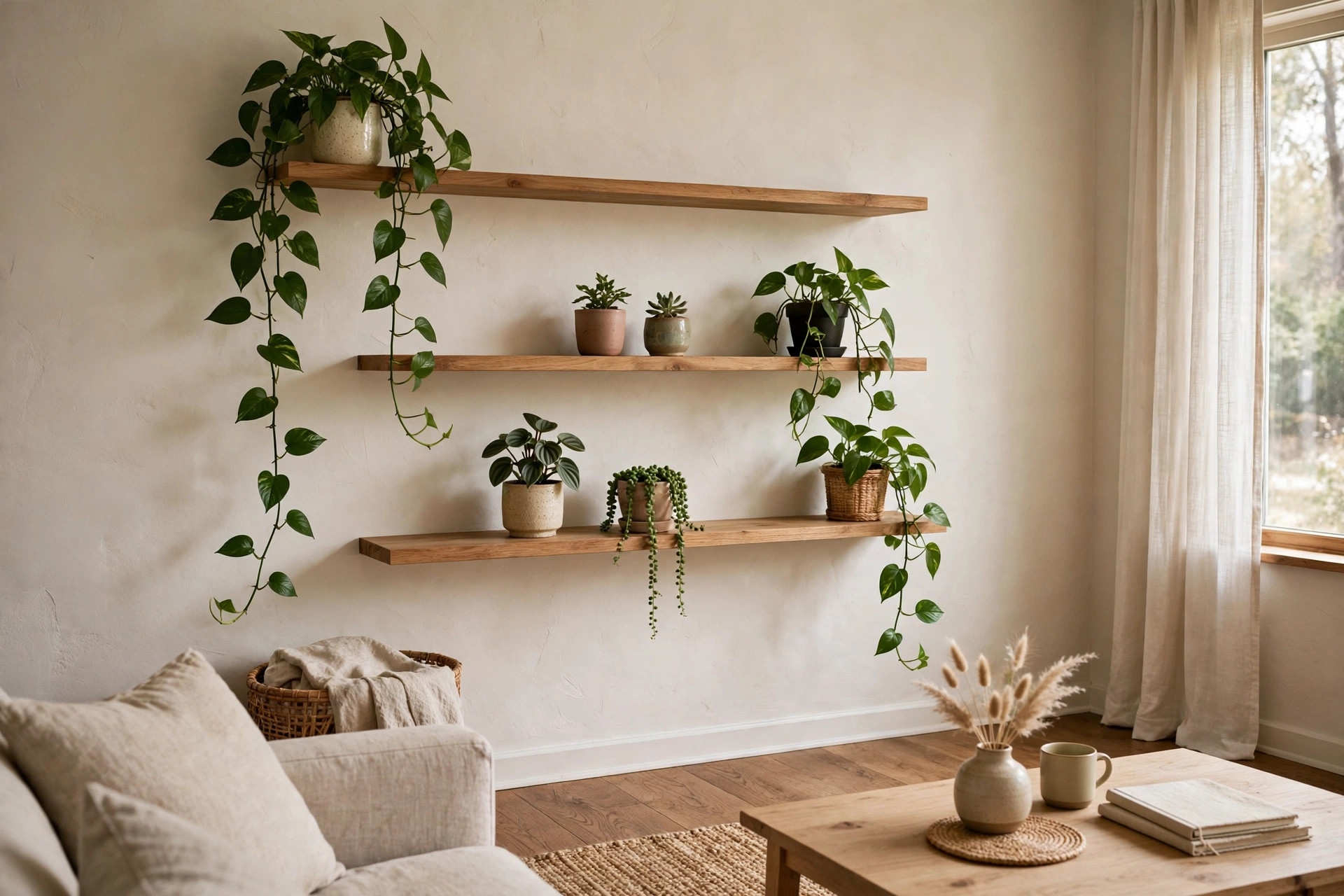
Pet note: pothos is toxic if chewed. The high shelf is not just a styling choice here, it is the safety plan. Keep cuttings and fallen leaves picked up, and choose a spider plant instead if your cat climbs shelves.
3. A ZZ plant for the darkest usable corner
Plant: ZZ plant (Zamioculcas zamiifolia). Pot: 6-inch to start, 8-inch when it outgrows it. Cost: about $20 to $40. Light: low indirect to bright indirect.
Every small living room has a corner that gets daylight but never gets sun. That is ZZ plant territory. Its glossy leaflets reflect what light there is, so the corner looks brighter, and its thick underground rhizomes store water, which is why it forgives a forgotten watering better than almost any other leafy plant.
Pet note: ZZ plants are also toxic if eaten in quantity. Place it where pets do not chew, or swap in a cast iron plant, which is pet-safer and equally tough in low light.
4. One corner anchor plant in a woven basket
Plant: Fiddle leaf fig (small tree form), dracaena, or a bird of paradise for brighter rooms. Pot: 10-inch nursery pot inside a woven basket cachepot. Cost: about $50 to $90 for a 10-inch fiddle leaf fig, $18 to $40 for the basket. Light: bright indirect, near a window.
If you only buy one larger plant, buy this one. A single upright plant about 3 to 4 feet tall fills the dead corner next to a sofa or media unit and gives the whole room a focal point. Designers who work in small spaces make the same point — one high-impact statement plant beats ten small ones scattered around, a principle also covered in this roundup of living room ideas with indoor plants.
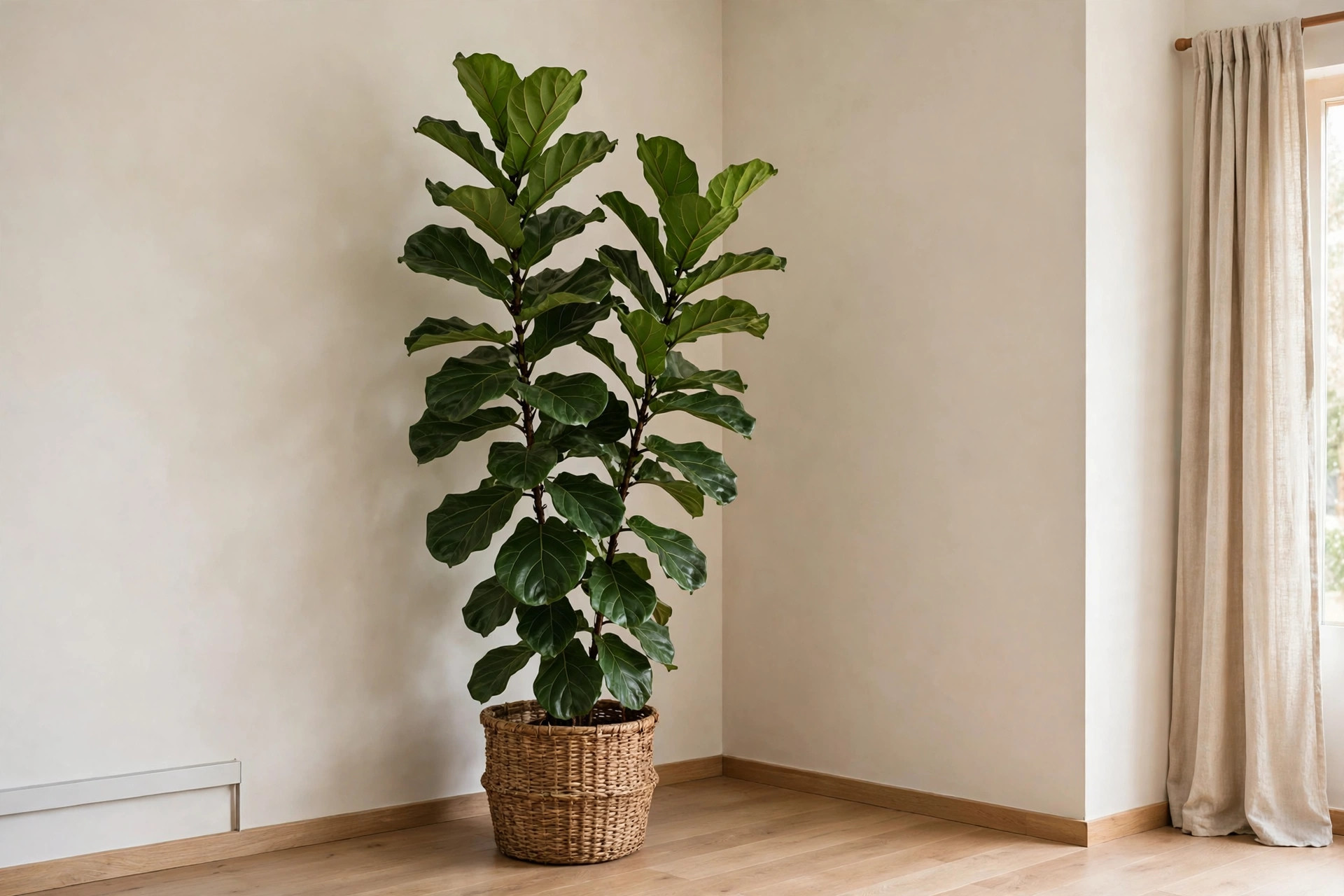
Clutter rule: if you add a corner anchor, remove something else from that corner. The plant replaces decor, it does not join a pile of it. For more ways to use that same corner well, revisit those corner ideas linked above and pick one layout, not three.
5. A single small plant on the coffee table — on a tray
Plant: Peperomia, small fern, or a 4-inch calathea. Pot: 4-inch. Cost: about $8 to $18. Light: medium indirect, away from direct sun patches on the table.
A coffee table can hold exactly one plant well. The trick that stops it becoming clutter is a tray. Put the plant, a candle or small stack of books, and nothing else on a tray about 12 to 14 inches across. The tray creates a boundary. Everything inside it looks chosen; everything outside it stays usable for mugs, remotes, and feet-up evenings.
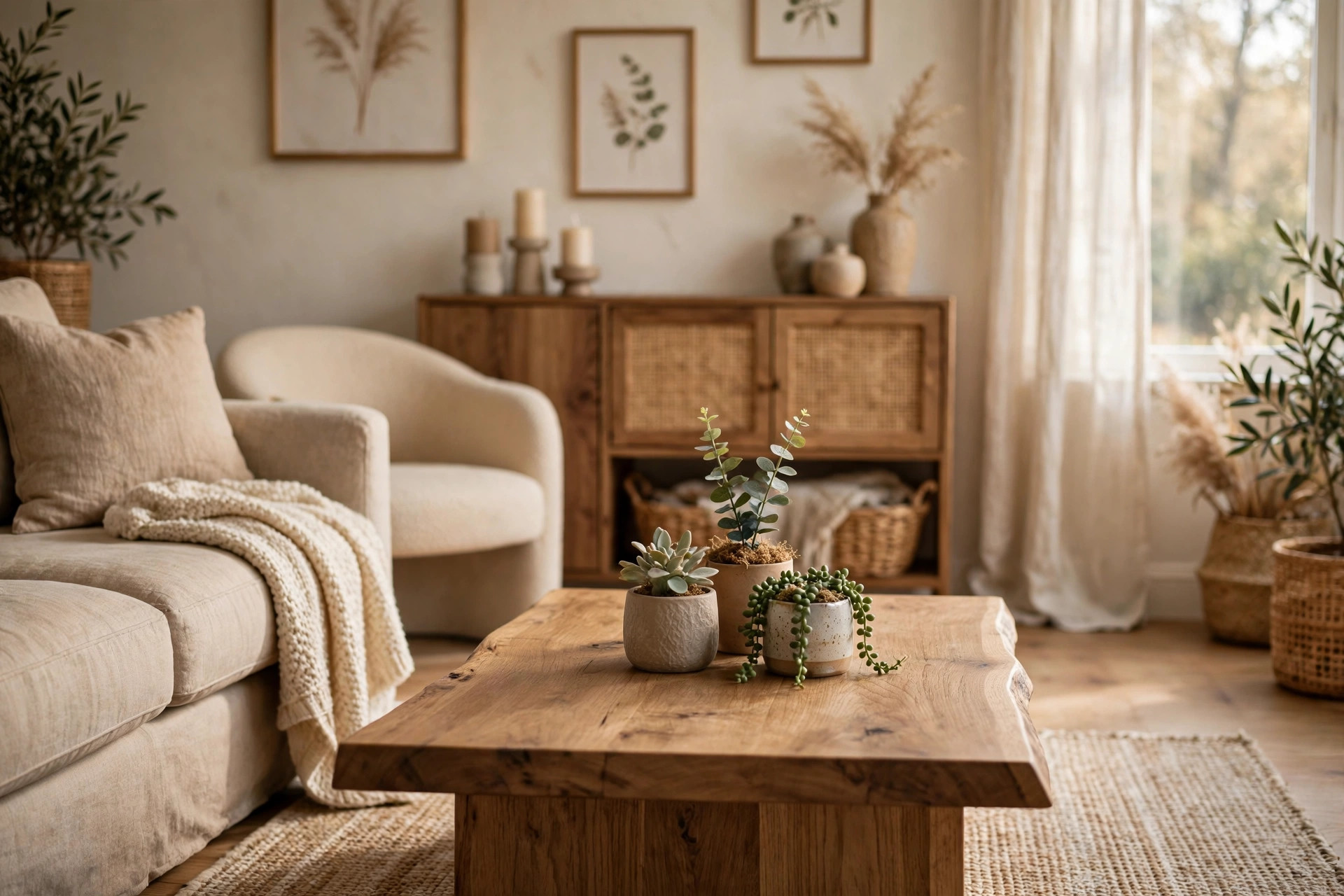
Peperomia stays compact and is non-toxic to cats and dogs, which is why it works so well here. Style it alongside the surface underneath, too. The right rug size changes how grounded a coffee table arrangement feels, as shown in these small living room rug ideas — a plant cannot fix a table that is floating on the wrong rug.
6. A parlor palm to soften the side of the sofa
Plant: Parlor palm (Chamaedorea elegans). Pot: 6-inch or 8-inch. Cost: about $18 to $38. Light: medium indirect, out of hot direct sun.
Keep the soil lightly moist, never soggy, and keep it away from radiators and cold drafts. Brown leaf tips usually mean the air is very dry or watering has been uneven, not that the plant is dying.
Pet note: parlor palm is non-toxic to cats and dogs, which makes it one of the best direct swaps in this whole list — use it anywhere you were tempted to put a snake plant, ZZ plant, or dracaena in a pet home.
7. A tiered plant stand that uses one square foot well
Plants: three small plants at three heights — for example a 4-inch fern on top, a 4-inch peperomia in the middle, a 6-inch spider plant at the bottom. Stand cost: about $35 to $75. Light: medium indirect, beside a window or sofa.
A tiered stand is the one exception to the "do not cluster" rule, because the stand creates order. One square foot becomes three levels — largest at the bottom, smallest at the top. Place it beside the sofa and stop there.
8. A spider plant hanging near the window
Plant: Spider plant (Chlorophytum comosum). Pot: 6-inch hanging pot. Cost: about $14 to $26. Light: medium to bright indirect — stripes are crisper in brighter light.
Hanging plants are free decor in floor-space terms. A spider plant throws out arching leaves and dangling babies you can pot up for free. One hanger is charming; three at the same height turns a window into a curtain you have to water. Hang it from a proper hook rated for a wet pot.
Pet note: spider plants are non-toxic to cats and dogs, though cats love batting the dangling babies — hang it just out of easy paw reach if that will annoy you.
9. A cast iron plant where nothing else survives
Plant: Cast iron plant (Aspidistra elatior). Pot: 6-inch or 8-inch. Cost: about $25 to $45 — pricier because it grows slowly. Light: low indirect, out of strong sun which can mark the leaves.
The name is earned. Cast iron plants tolerate dim light and irregular watering with little complaint. Their broad, dark, glossy leaves look substantial next to a reading chair. Dust the leaves monthly so they can use the light they get, and pair it with a gallery wall using these small living room gallery wall ideas.
Pet note: cast iron plant is generally listed as non-toxic, making it a rare low-light and pet-safer combination.
10. A small monstera on a stand, not on the floor
Plant: Monstera deliciosa, young plant. Pot: 6-inch to start, on a 12 to 18-inch plant stand. Cost: about $20 to $38 for a young plant, $20 to $35 for a stand. Light: bright indirect.
A young monstera gives you those famous split leaves without the jungle takeover — but only if you plan for growth. On a stand beside the sofa it sits at cushion height, where you actually see the leaves, and the stand keeps the pot off a rug that would otherwise stay damp underneath.
Pet note: monstera is toxic if chewed. The stand helps, but determined climbers need a different plant.
11. A rule-of-three grouping on a sideboard or media unit
Plants: one upright (4-inch snake plant or ZZ cutting-size plant), one leafy (4-inch peperomia), one trailing (4-inch pothos or string of hearts). Cost: about $30 to $55 for all three in 4-inch pots. Light: medium indirect.
Odd numbers look natural and even numbers can look forced — that is why designers group in threes. On a media unit, place the upright plant at one end, the trailing plant at the other so it softens the edge, and the leafy one in the middle, slightly forward. Vary the heights by at least 3 to 4 inches between plants or the grouping reads as a single green blob.
12. A windowsill line of tiny succulents — only in real sun
Plants: echeveria, haworthia, or small jade. Pots: 2.5-inch to 4-inch, with drainage. Cost: about $5 to $12 each. Light: direct sun, south or west sill.
This is the only idea on the list that demands sun, and it fails quietly without it. Succulents on a dim sill stretch out pale and leggy within weeks. On a genuinely sunny sill, however, a line of three tiny pots costs almost nothing, takes up a 4-inch-deep strip nobody else was using, and needs water only every 2 to 3 weeks.
Choose haworthia if you have pets — it looks like a small aloe but is non-toxic, while aloe itself is not pet-safe. Jade is also toxic to pets, so move it to a sill pets cannot reach or skip it.
Line up three, not seven. A windowsill collection grows by stealth, one gift plant at a time, until you cannot open the window. Set your number now and stick to it: when a new one arrives, an old one moves to a friend.
A Simple Budget Plan: What $50, $100, and $175 Buy
- About $50: one 6-inch pothos for a shelf ($20), one 4-inch peperomia for the coffee table ($12), and one matching pot set ($18). Two zones covered, zero floor space used.
- About $100: add a 6-inch snake plant beside the sofa ($28) and a simple plant stand ($25). Now you have height, a shelf, and a table covered.
- About $175: add one 10-inch corner anchor plant in a woven basket ($75 combined). The room now has a focal point and you should stop buying for at least a month and see how the light and watering actually work in your home.
Pet-Safe Quick Reference
- Generally non-toxic choices in this list: parlor palm, spider plant, peperomia, calathea, Boston fern, cast iron plant, haworthia.
- Keep out of reach or avoid with nibbling pets: pothos, snake plant, ZZ plant, monstera, fiddle leaf fig, jade, peace lily.
- Rule that actually works: toxic does not automatically mean banned — it means placed honestly. High shelf, hanging pot, or a room pets do not enter unsupervised. Safe does not mean edible either; a pet that eats a lot of any plant can still get an upset stomach, so discourage chewing regardless.
Common Mistakes That Make Plants Look Like Clutter
Scattering single plants everywhere
One small pot on every surface is the number one cause of plant clutter. Group by zone, use the rule of three in one place, and leave other surfaces completely plant-free. Empty space is part of the design.
Buying for the light you wish you had
A fiddle leaf fig in a north-facing room with one small window will drop leaves no matter how carefully you water it. Match the plant to the window you have today, not the renovation you are planning.
Watering on a schedule instead of by feel
Plants in low light drink slowly, and a pot that was dry in five days in June may stay wet for two weeks in December. Push a finger an inch into the soil. Dry means water thoroughly, drain fully, and empty the saucer. Wet means walk away.
Skipping drainage to use a pretty pot
That beautiful pot without a hole is a cachepot, not a home. Keep the plant in its nursery pot, set it inside, and lift it out to water. Sitting in trapped water causes root rot, yellow leaves, and a musty smell that no amount of fresh decor will cover.
Frequently Asked Questions
How many plants should a small living room have?
For most small rooms, 3 to 7 plants is the sweet spot: one tall anchor, two or three mid-size, and one trailing plant. If it feels busy, remove one.
What is the easiest plant if I forget to water?
A ZZ plant or a snake plant in a 6-inch pot. Both store water, tolerate low light, and are happiest when you water every 2 to 4 weeks rather than every week. Set a monthly phone reminder and check the soil first — even forgiving plants need an occasional drink.
Can I keep plants in a living room with almost no natural light?
Only with help. Move plants as close to the window as the room allows, choose cast iron plant, ZZ plant, or snake plant, and consider a small grow bulb in a lamp you already use for a few hours a day. In a room with no window at all, a good-quality faux plant in that one spot is a more honest choice than watching a live one fade.
Start With Three, Then Stop and Look
Pick one idea for height, one for a shelf, and one for the coffee table. Live with those three for two weeks before buying more — which corner still looks empty tells you what, if anything, comes next.
Plants should make a small room feel more alive, not more managed. Fewer plants, in the right sizes and light, in calm matching pots — that is the secret.


Comments
Post a Comment