
12 Small Patio Grill Station Ideas That Keep Cooking Tidy
A small patio does not need a full outdoor kitchen to cook well outside. It needs one good cooker, one clear worktop, and a place for every tool to land. The best small patio grill station ideas are not about squeezing in more equipment. They are about choosing less, arranging it tightly, and keeping the cooking zone tidy enough that a weeknight dinner feels easy instead of chaotic.
You do not need built-in counters or a contractor. You need a compact grill that earns its footprint, a trolley or shelf for prep, and storage that works vertically. Below are twelve ideas with real sizes, costs, and watch-outs, plus the safety clearances that matter most.
A grill station works best when the rest of the patio is planned with it, so pair this setup with our guide to small patio storage ideas that hide the clutter — one tidy system beats two competing ones.
Start With the Plan: One Cooker, One Worktop, One Clear Zone
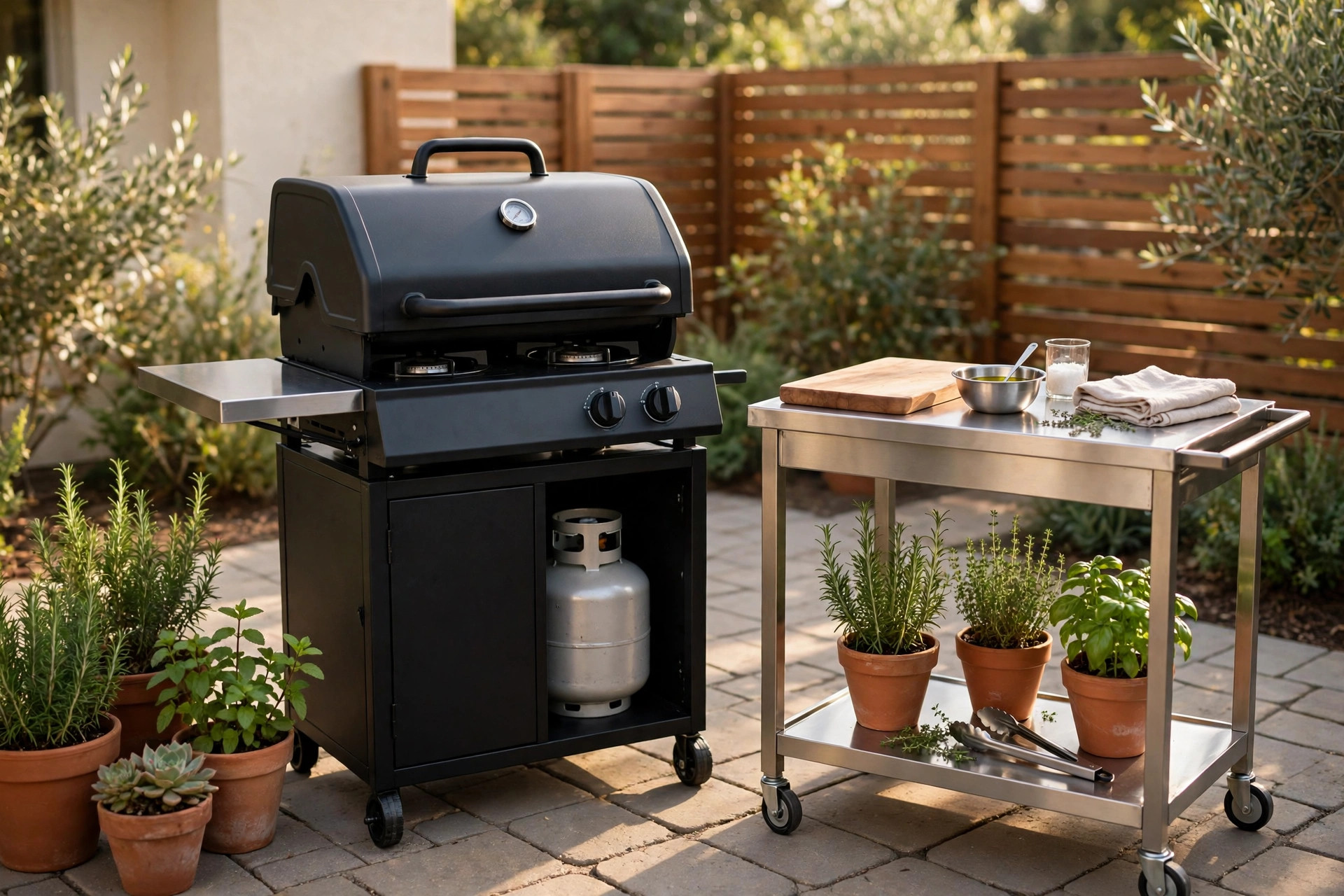
Rule one: pick one compact cooker and let it do the main job. One cooker beats three specialists on a small patio every time. A classic kettle grill, a small kamado, a 2-burner gas grill, or even a tabletop pizza oven can each handle most family cooking on its own — what a small patio cannot handle is all four lined up with no room left to stand.
Rule two: every grill needs a worktop beside it. Food travels from fridge to board to grill to plate, and without a landing surface it ends up balanced on chairs and low walls. Guides like Blaze and Graze on small garden outdoor kitchen ideas and Garden Space Decor on small BBQ area ideas land on the same fundamentals: add worktop with a prep trolley or folding shelf, use corners and walls in an L-shape, and let shelves and hooks carry the tools.
Rule three: protect the clear zone around the cooker. Keep the grill on a level, non-flammable surface with open space in front and nothing heat-sensitive crowding the sides or lid. Measure before buying: a total run of 5 to 7 feet usually holds the grill, a trolley, and storage without blocking the door or seating.
12 Small Patio Grill Station Ideas That Keep Cooking Tidy
Work from the biggest decision down: the cooker first, then the worktop, then the storage. Most of this uses things you already own or can add one piece at a time.
1. Choose One Compact Cooker That Does the Main Job
Decide what you cook most, then buy the single cooker that does it best. A 22-inch kettle grills, roasts, and smokes for $120 to $220. A small kamado adds steady low heat for $300 to $600. A 2-burner gas grill lights instantly on weeknights, around $200 to $400, and a tabletop pizza oven suits pizza households for $250 to $450. Watch-out: a cooker wider than 30 inches rarely fits with a worktop beside it — measure the lid swing first.
2. Add a Prep Trolley as Your Worktop
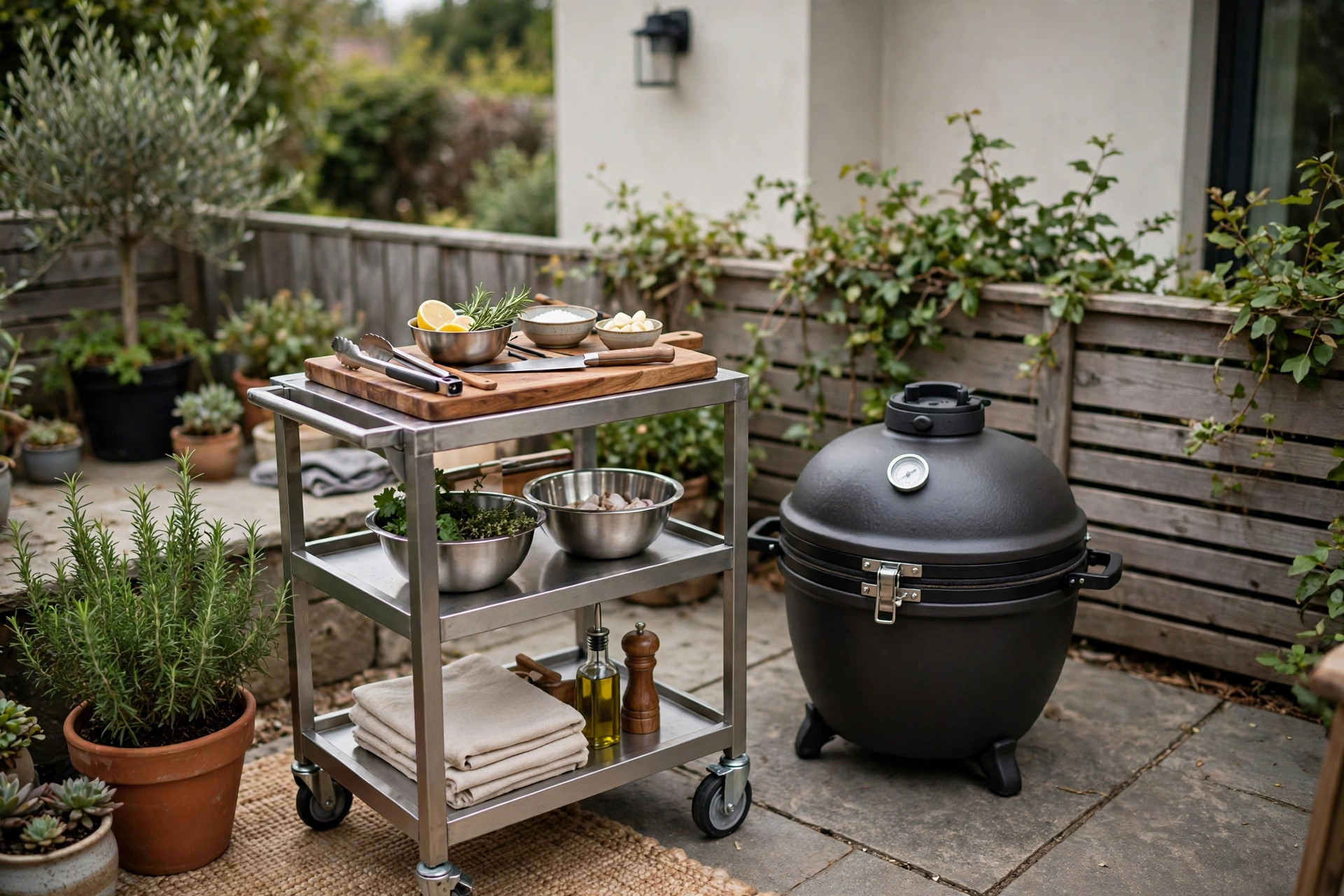
A rolling prep trolley is the hardest-working piece in a small station. Parked beside the grill, its top is your chopping and landing surface; its lower shelves hold bowls, boards, oil, and towels. A stainless or sealed-wood trolley 24 to 32 inches wide and 18 inches deep costs $70 to $180 and needs no installation. Watch-out: choose lockable casters and a flat, food-safe top — a trolley that rolls mid-chop quickly stops being useful.
3. Fit a Folding Shelf Where a Trolley Cannot Go
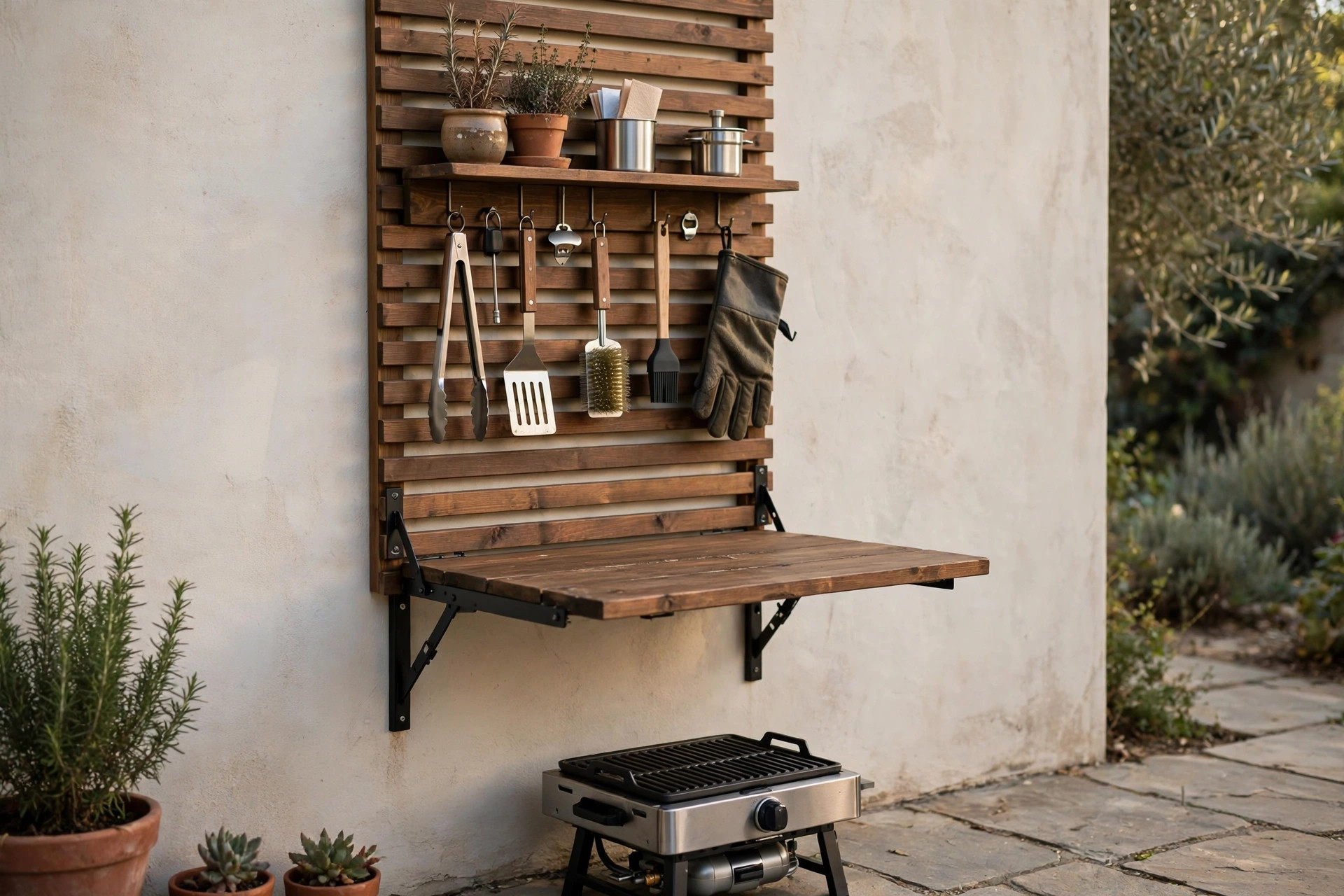
When floor space is too tight for a trolley, a folding shelf gives you a worktop that disappears. Mount a fold-down bracket shelf beside the grill, or choose a grill with folding side shelves that lift for cooking and drop for storage. A wall-mounted shelf around 24 by 16 inches costs $35 to $90 fitted. Watch-out: fix brackets into studs or masonry, not thin fence boards, and set it just below the grill's cooking height.
4. Claim the Corner With an L-Shaped Layout
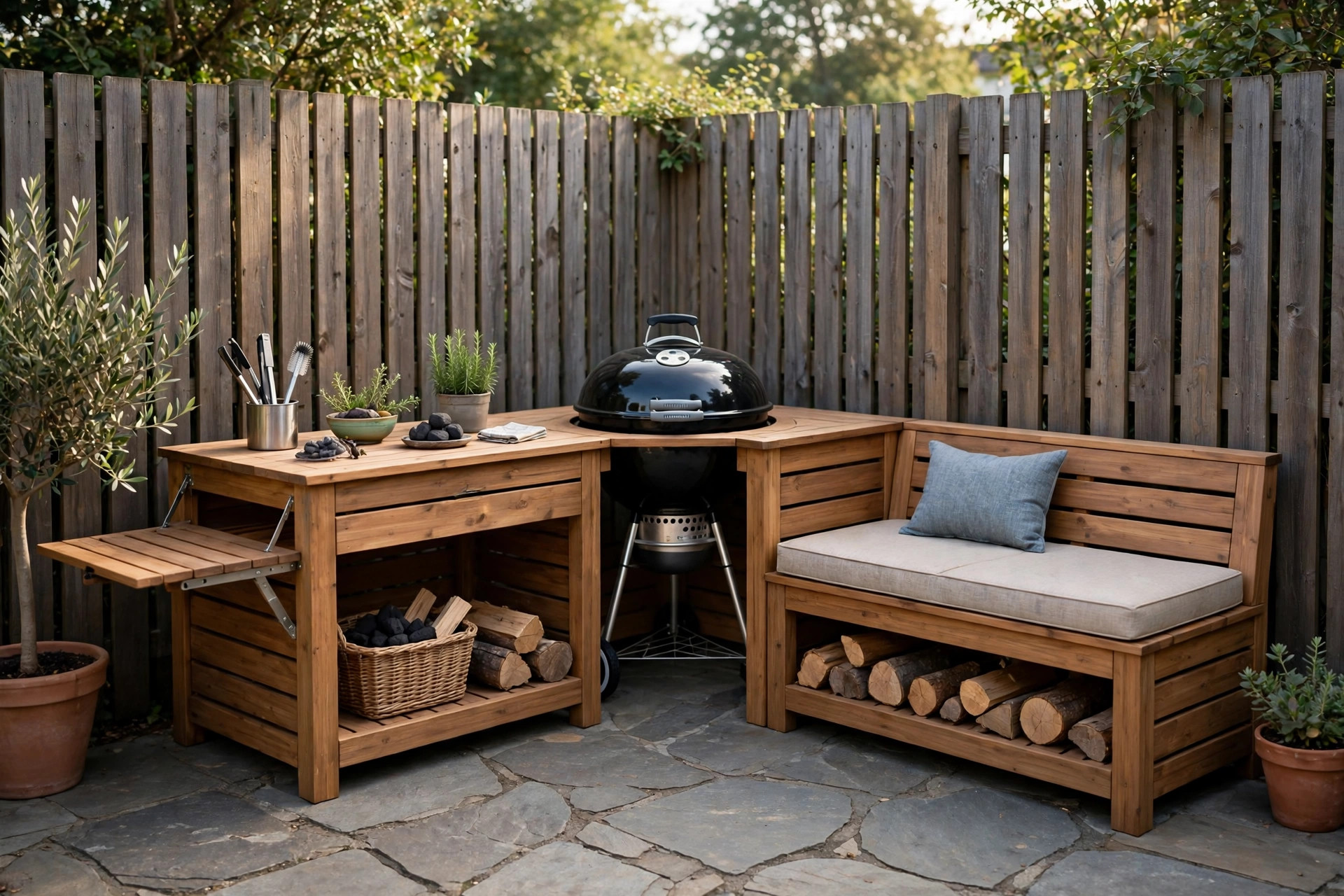
Corners are dead space for seating but perfect for cooking. Set the grill along one short side, then run the trolley or counter along the adjoining wall to form an L. The cook stands in the crook with heat on one side and prep on the other, turning instead of walking. Cost: $0 to rearrange what you own. Watch-out: a corner traps heat and smoke, so pull the grill forward from fences and walls — see the safety section below — and never tuck it under a low overhang.
5. Hang Tools on Hooks Above and Beside the Grill
Tongs, spatula, brush, and gloves should hang, not pile up on the worktop. A rail with S-hooks beside the station, or sturdy hooks under a shelf, keeps the tools you actually use within reach and off your chopping surface. A 24-inch rail kit costs $15 to $35. Watch-out: hang tools beside the grill, not above it — heat and grease coat anything over the grate, and reaching across a hot lid is a burn waiting to happen.
6. Go Vertical With Shelves for Rubs, Trays, and Boards
Small stations run out of floor long before they run out of wall. One or two narrow shelves above the prep area hold spice rubs, a tray stack, boards stood upright, and a herb pot or two. Keep shelves 8 to 10 inches deep so nothing overhangs the worktop, heaviest items lowest. Outdoor-rated shelves cost $20 to $50 each. Watch-out: use weatherproof brackets and sealed wood or metal; indoor shelves swell and rust through one wet season outside.
7. Let a Storage Bench Do Two Jobs
The smartest small-patio pieces do two jobs at once. A storage bench holds cushions inside, offers a seat while food rests, and its flat top works as an extra landing surface for a cooked platter. Weatherproof bench boxes 40 to 48 inches wide cost $90 to $220 — one piece replacing a box, a seat, and a side table. Watch-out: keep fuel in its own separate, ventilated store — never sealed inside a bench people sit on, and never against the grill.
8. Pick a Trolley That Rolls Away After Cooking
A trolley earns its place twice when it moves. During cooking it is your worktop; afterwards it rolls against the wall or into the shed, freeing the patio for chairs or a clear path to the door. Choose a narrow model, 16 to 18 inches deep, that fits through your gate, with two fixed and two swivel casters. Watch-out: oil the casters once a season and store it under cover, or the wheels and top weather fast on open paving.
9. Add a Fold-Down Prep Counter on the Wall
A fold-down counter is the fixed version of the folding shelf, sized for real prep. A hinged panel around 36 by 18 inches, mounted at about 36 inches high, gives room for a board, two bowls, and a tray — then folds flat to a 3-inch profile. Ready-made outdoor fold-down tables cost $80 to $180. Watch-out: fit a positive latch or support legs rated for chopping weight; a counter that flexes under a knife is worse than none.
10. Store Fuel and Tools in Weatherproof Boxes
Damp charcoal will not light properly, and tools left out rust. Give fuel and tools one weatherproof home: a sealed deck box near — but not touching — the station. Keep charcoal in its bag inside the box, gas bottles upright and outdoors as their makers direct, and tools in a caddy you can carry in one trip. Deck boxes cost $50 to $130. Watch-out: never store fuel or gas bottles indoors, in direct sun, or underneath the grill itself.
11. Set Up a Landing Zone for Hot and Finished Food
Tidiness during cooking comes down to one habit: raw food arrives on one tray, cooked food leaves on a different one, and both have a set place to land. Reserve the end of the trolley as the landing zone, marked by a heatproof mat that lives there permanently. A silicone or metal mat costs $10 to $20. Watch-out: keep raw and cooked trays different colours, and wash the mat after every session.
12. Finish With a Cover and a Five-Minute Clean-Down
A station stays tidy when closing it is quick. Brush the grate while warm, empty ash only when fully cold into a metal container, wipe the worktop, hang the tools back on their hooks, and pull a fitted cover over the grill. A decent cover costs $25 to $60 and doubles the cooker's life on an open patio. Watch-out: let the grill cool fully before covering it, and tip standing water off the cover after rain.
Safety First: Clearance, Heat, and Fuel Storage
Small spaces make safety distances more important, not less. Keep the grill well clear of fences, sheds, wooden structures, and overhanging plants — follow the manufacturer's stated clearance, and as a working rule allow at least 3 feet of open space around and above the cooker, more for charcoal. Never grill under a covered porch roof, awning, or low tree canopy, and never leave a lit grill unattended.
Set the station on level paving or a grill mat, away from the main walkway so guests do not brush past a hot lid. Store gas bottles upright, outdoors, and disconnected when the season ends; keep charcoal dry and cool. Dispose of ash only when completely cold — charcoal can stay hot for 24 hours — into a metal container kept outside, away from fences and bins.
Mistakes That Make a Small Grill Station Messy
Buying three specialist cookers for a 6-foot patio. Each one arrives with its own tools, fuel, and cover, and the station becomes a storage yard — the same sprawl problem our backyard privacy ideas for small yards solve on the boundary, one cooker solves at the grill.
Forgetting the worktop. A grill with nowhere to put a board or a tray forces food onto chair arms and the ground. If you change only one thing, add the trolley or folding shelf first — it tidies every cook that follows, and it pairs naturally with the seating layouts in our small front porch seating ideas.
Pushing the grill tight against a fence to save space. It saves inches and risks the fence, the plants behind it, and the cook's working room. Pull it forward, use the wall for shelves and hooks instead of heat, and browse the rest of the Outdoor & Porch collection for layouts that give a small station proper breathing room.
Questions People Ask
What is the best grill for a small patio grill station?
The one that matches how you cook most. A 22-inch kettle is the most versatile single choice for grilling and roasting; a 2-burner gas grill wins for fast weeknight cooking; a small kamado suits low-and-slow fans; a tabletop pizza oven fits households that mostly cook pizza and flatbreads. Any of them beats a collection of specialists sharing one small patio.
How much space do I need for a small grill station?
A run of about 5 to 7 feet is enough: roughly 30 inches for a compact grill, 24 to 32 inches for a trolley or folding counter, and a little storage at the end. Keep at least 3 feet of clearance around and above the cooker, and leave the doorway and main path completely clear.
Can I put a grill station in the corner of a small patio?
Yes — corners are often the best spot, arranged as an L with prep along one wall and the grill along the other. The checks are heat and air: pull the grill forward from fences and walls to the maker's clearance, keep it out from under overhangs and planting, and make sure smoke drifts away from your seating and your neighbours' windows.
How do I store charcoal and tools outside without them rusting or getting wet?
Use one weatherproof, lidded store: charcoal stays in its sealed bag inside a deck box, tools live in a carry caddy on a shelf or hook rail under cover, and gas bottles stand upright outdoors as directed. A fitted grill cover plus the five-minute clean-down in idea 12 keeps the cooker itself dry and ready.
Start with one cooker and one worktop. Add hooks, a shelf, and a weatherproof box as you see what your cooking actually needs — and a patio that felt too small to cook on becomes the tidiest kitchen you own.


Comments
Post a Comment