
Small Bedroom Rug Placement Ideas: 9 Layouts That Work
In a small bedroom, the rug is the largest piece of "furniture" you will ever buy for the floor — and the one most often bought the wrong size. A rug that is too small makes the bed look stranded; a rug pushed into the wrong third of the room makes the whole space feel lopsided, even when every other choice is right. The fix is not taste, it is geometry. Below are the nine layouts that actually work in small bedrooms, each with the rug size it needs and the rooms it suits, so you can measure once and buy once.
The Three Numbers That Decide Everything
18–24 inches: how far the rug should extend beyond the sides and foot of the bed. That border is your soft landing zone when you get up, and it is what makes the bed and rug read as one composition. Under 18 inches, the rug looks like it is hiding under the bed; over about 36 inches in a small room, it starts impersonating wall-to-wall carpet.
8–18 inches: the border of bare floor to leave between the rug's edges and the walls or baseboards. That frame of floor is what keeps a rug looking intentional instead of crammed in. In a truly tiny room, 6–8 inches is acceptable; never let a rug touch two opposite walls.
12–18 inches: where the rug starts at the head of the bed. For most layouts the rug begins 12–18 inches below the headboard line — roughly in front of the nightstands — rather than disappearing under the pillows where nobody sees or steps on it.
And the size table that follows from those numbers (mattress widths: twin 38 in, full 54 in, queen 60 in, king 76 in): a twin works with a 5 x 7 or 6 x 9; a full wants a 6 x 9; a queen needs an 8 x 10 (about 30 inches showing on each side); a king needs a 9 x 12 minimum. A 5 x 7 under a queen leaves only 18 inches on each side and barely 16 at the foot — the classic "postage stamp" mistake, and the single most common reason a bedroom rug looks wrong.
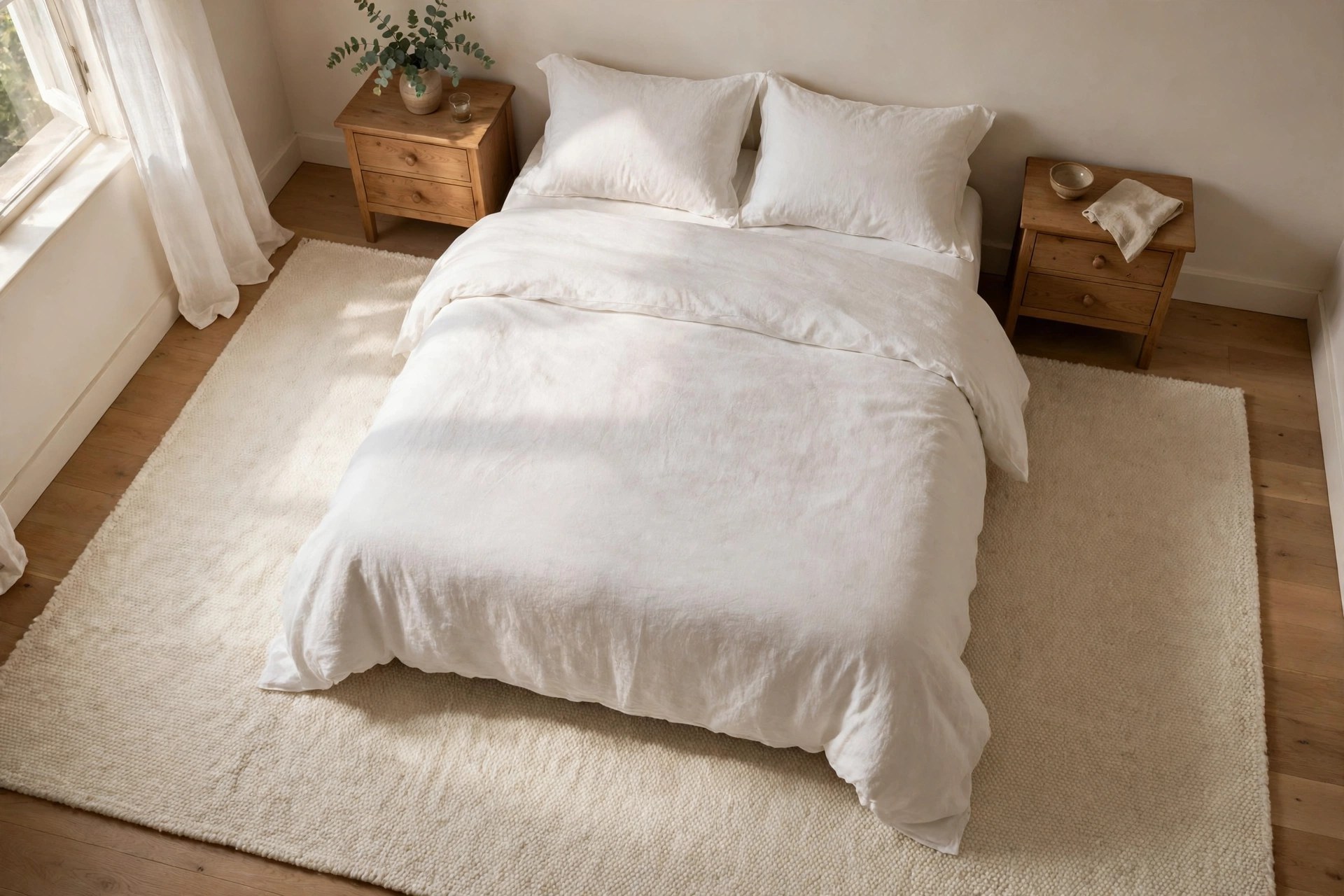
Layout 1: The Full Under-Bed (Bed and Nightstands On)
Rug: 9 x 12 for a queen, 10 x 14 for a king. How: the rug runs from just below the headboard to well past the foot, wide enough that the nightstands stand on it too, with 24–36 inches showing on each side. Best for: the largest "small" bedrooms (roughly 11 x 13 ft and up) and anyone who wants the bed zone to feel like one finished island. Watch out: this is the most expensive layout and the hardest to clean under; in a genuinely small room it can swallow the floor border rule entirely.
Layout 2: The Three-Quarter Standard (Nightstands Off)
Rug: 8 x 10 for a queen, 9 x 12 for a king. How: slide the rug under the bed so its top edge sits just in front of the nightstands, about 12–18 inches down from the headboard. You get roughly 30 inches of rug on each side of a queen and a generous sweep past the foot. Best for: most small bedrooms — this is the default right answer, the layout designers reach for first, because the rug does all its visible work where feet actually land. Watch out: measure from the nightstand fronts, not the wall, or the rug will end up 6 inches too far under the bed.
Layout 3: The Lower-Third Flow
Rug: one size down from Layout 2 — an 8 x 10 can serve a king here. How: only the lower third of the bed sits on the rug; the rest of the rug flows out past the foot toward the room. Best for: showing off beautiful wood floors near the headboard, using a patterned rug you want seen rather than covered, or making a smaller (cheaper) rug work under a bigger bed. Watch out: keep at least the front legs and a good third of the bed's length on the rug, or it reads as an accident instead of a choice. Our small living room rug ideas use the same lower-third trick for sofas.
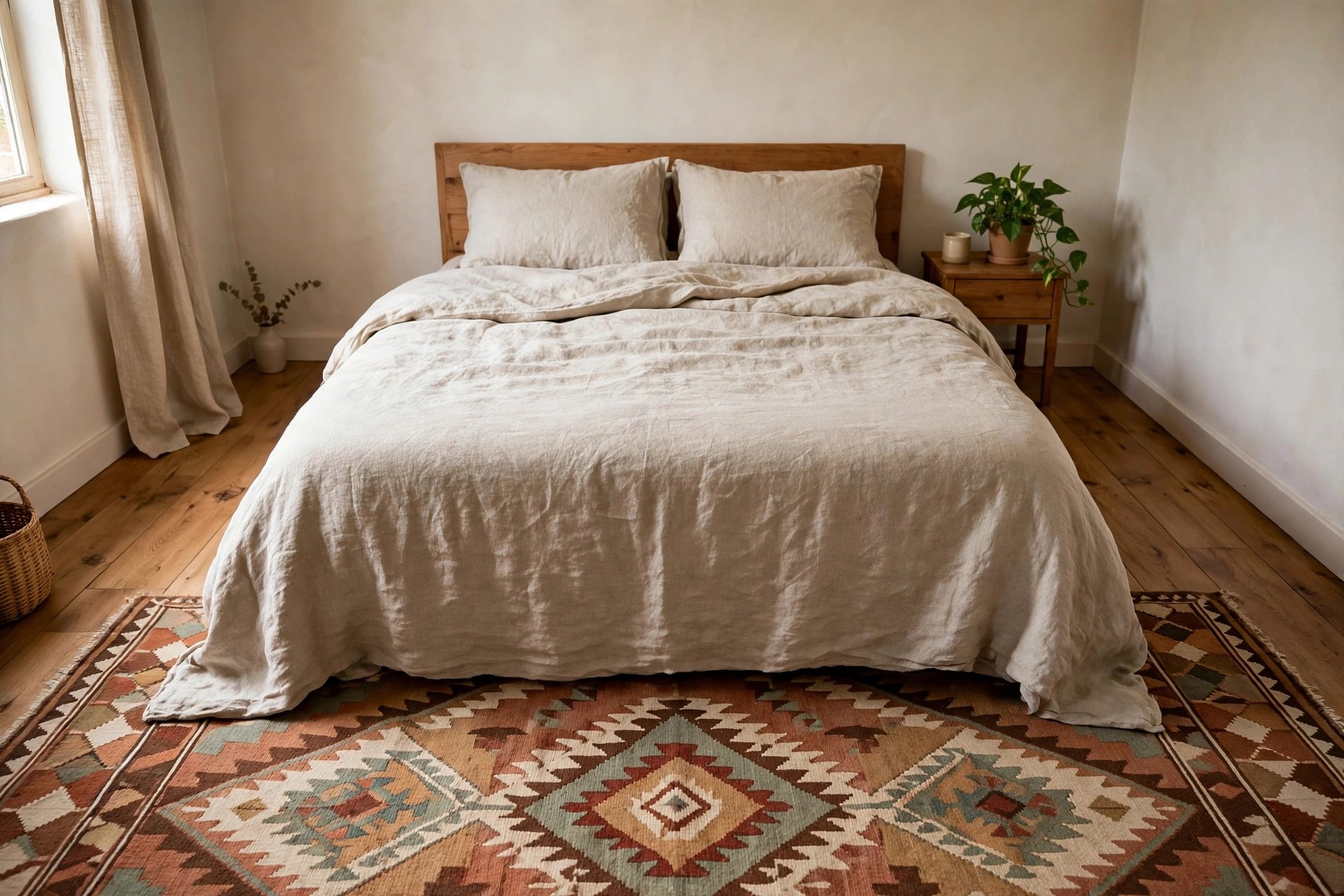
Layout 4: Twin Runners
Rugs: two runners, each about 2.5 x 7 or 2.5 x 8 ft. How: one runner along each side of the bed, aligned with the bed's length or extending slightly past the foot, with the bed itself on bare floor. Best for: narrow bedrooms where a full-width rug would leave no floor border, tight budgets (two runners cost a fraction of a 9 x 12), and renters who want an easy wash-and-shake routine. Watch out: runners must be wide enough to land both feet on — 2.5 feet minimum; a 2-foot runner feels like a balance beam at 6 AM.
Layout 5: The One-Side Runner (Bed Against the Wall)
Rug: one runner 2.5 x 8, or a 4 x 6 laid lengthwise. How: when the bed is pushed against a wall — daybeds, kids' rooms, studio corners — a single rug runs along the open side where feet land. Best for: the smallest bedrooms and guest corners where only one side of the bed is used. Watch out: let the rug extend 6–12 inches past the foot of the bed so the landing zone covers how you actually swing out of bed. If the whole room layout is still in flux, our small bedroom layout ideas will help you place the bed first, then the rug.

Layout 6: The Foot-of-Bed Layer
Rug: a wide runner or small rug, 3 x 5 to 4 x 6, laid horizontally across the foot. How: nothing goes under the bed at all; the rug lives entirely at the foot, like a landing strip where you stand to dress. Best for: rooms so small that Layouts 1–3 would break the floor-border rule, and for adding pattern to a room whose sides are blocked by doors, radiators, or wardrobes. Watch out: it must be wide enough to span most of the bed's width (at least two-thirds), or it looks like a bath mat that wandered in.
Layout 7: The Layered Pair (Small over Large)
Rugs: a large flat base (8 x 10 jute or low-pile neutral) plus a smaller patterned or vintage-style rug (5 x 7) centered over the lower half. How: the base rug follows Layout 2 geometry; the smaller rug sits on top, aligned with the foot half of the bed. Best for: getting the look of a big patterned rug at half the price — pattern is expensive by the square foot, jute is not — and for renters covering ugly rental flooring in two moves. Watch out: keep both rugs low-pile (total stack under about 3/4 inch) so the bedroom door still swings and nobody trips on the top rug's edge; a rug pad between layers stops the creep.
Layout 8: The Reading-Corner Anchor
Rug: 4 x 6 or 5 x 7, placed away from the bed. How: when the bed wall is completely claimed by wardrobes or a desk, skip the under-bed rug entirely and anchor a second zone instead — under a reading chair and side table in the corner, squared to the walls or angled 45 degrees in a boxy room. Best for: small bedrooms that double as something else, where the corner is the room's second job. It pairs naturally with a proper small bedroom reading corner. Watch out: the chair's front legs (or all four) should sit on the rug — a rug floating near furniture, touching nothing, reads as lost.
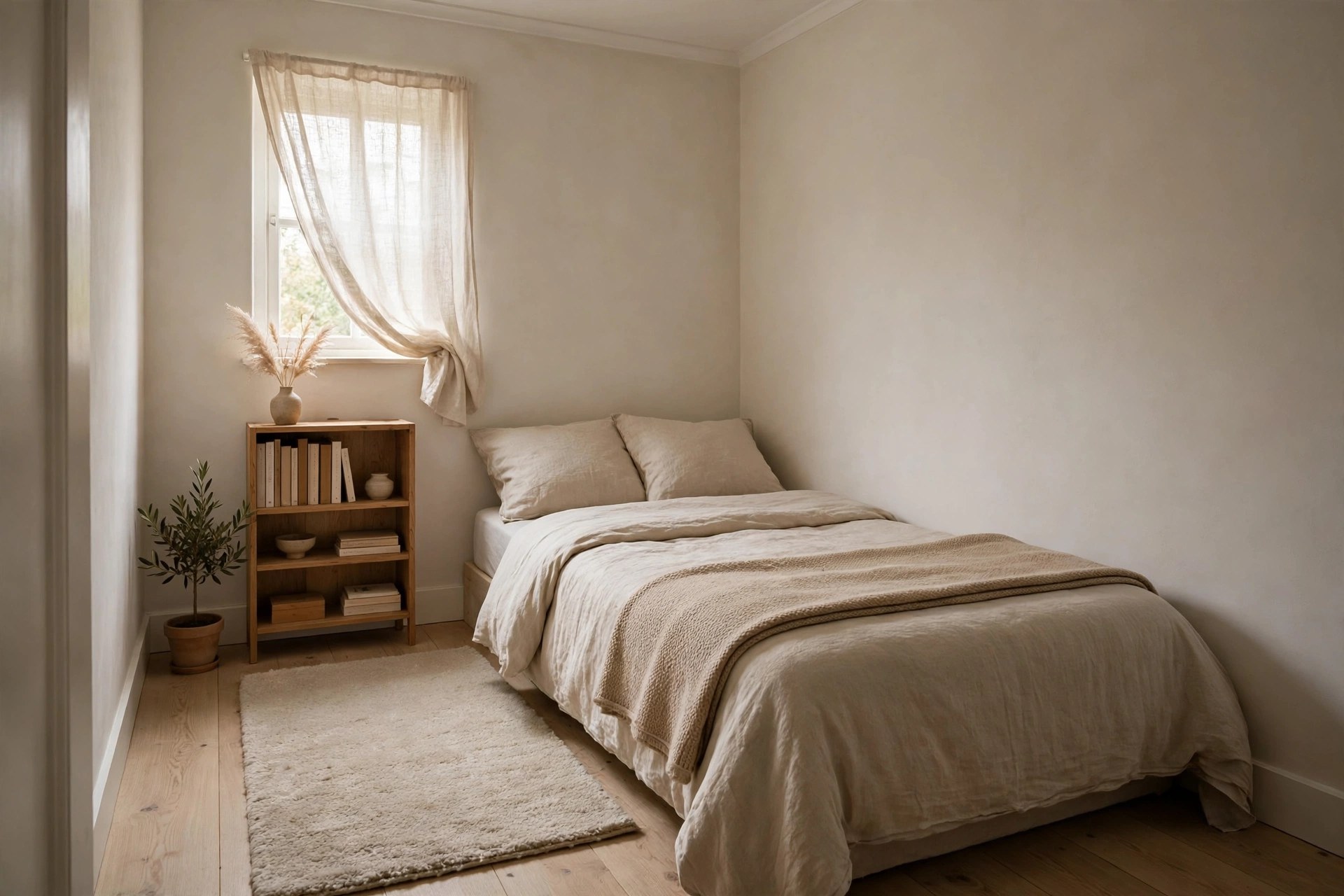
Layout 9: The Near Wall-to-Wall
Rug: custom-feel oversize — for a 10 x 11 ft room, a 8 x 10 or 9 x 10.5 leaving a near-even 6–12 inch border on all sides. How: the rug covers almost everything, deliberately, turning a chopped-up tiny floor into one calm surface; the bed sits wherever the layout needs it. Best for: very small or oddly shaped bedrooms, cold floors, and rooms with damaged flooring you would rather not see. Watch out: choose a low, dense pile you can vacuum easily, because this rug is now effectively your floor — and confirm every door clears the pile plus pad (about 1/2–3/4 inch total) before you commit.
Pads, Pile, and the Practical Print
Every layout above works better on a rug pad: a felt-and-rubber pad about 1/4 inch thick, cut 1–2 inches smaller than the rug on all sides, stops sliding, silences footsteps, and adds the cushioned feel people wrongly credit to thick pile. Keep pile low in the bedroom — 1/4 to 1/2 inch — because doors must clear it, wheeled nightstands and laundry baskets must roll over it, and low pile vacuums properly. Rotate the rug 180 degrees every six months so the foot-of-bed traffic lane does not wear a permanent path, and if two layouts both fit your measurements, choose by where your feet land at 6 AM, not by the product photo.
Rug Placement Questions
Can a rug be too big for a small bedroom?
Yes — when it breaks the floor-border rule and touches walls on multiple sides without being a deliberate near wall-to-wall (Layout 9). A rug wedged edge-to-edge looks like a carpet remnant; a rug with a clean, even border of visible floor looks chosen.
Should nightstands sit on the rug?
Only in the full under-bed layout, and only if the rug is big enough that they sit fully on it. A nightstand half-on, half-off wobbles and looks wrong. For most small bedrooms, Layout 2 — nightstands off, rug starting just in front of them — is the cleaner answer.
What if my bedroom door opens onto the rug?
Measure the door's swing clearance before buying: door bottom to floor is often only 1/2–3/4 inch. Low pile (1/4–1/2 inch) plus a thin pad fits most doors; if the door drags, move the layout so the rug starts past the swing, or choose the runner layouts, which can dodge the swing entirely.


Comments
Post a Comment