
12 Cozy Winter Entryway Decor Ideas That Welcome You Home Warm
Winter is the season your entryway works hardest, and it is also the season it is most likely to fall apart. Wet boots, dripping coats, gloves in every pocket, and darkness by late afternoon all land in the smallest, most overlooked space in the home. The best winter entryway decor ideas solve that chaos first and look beautiful second, because in winter the two are linked: an entry that handles meltwater, heavy coats, and cold floors well will automatically feel warm and welcoming every time you walk through the door.
You do not need a large foyer or a big budget. Most of the twelve ideas below cost between $10 and $120, many use things you already own, and renter-friendly versions need no drilling at all. The plan is simple: split the entry into a wet zone and a dry zone, give every winter item one clear home, layer warmth underfoot and in the lighting, then finish with the touches, a big mirror, baskets, and one sprig of plain greenery, that make it feel like a room instead of a dumping ground.
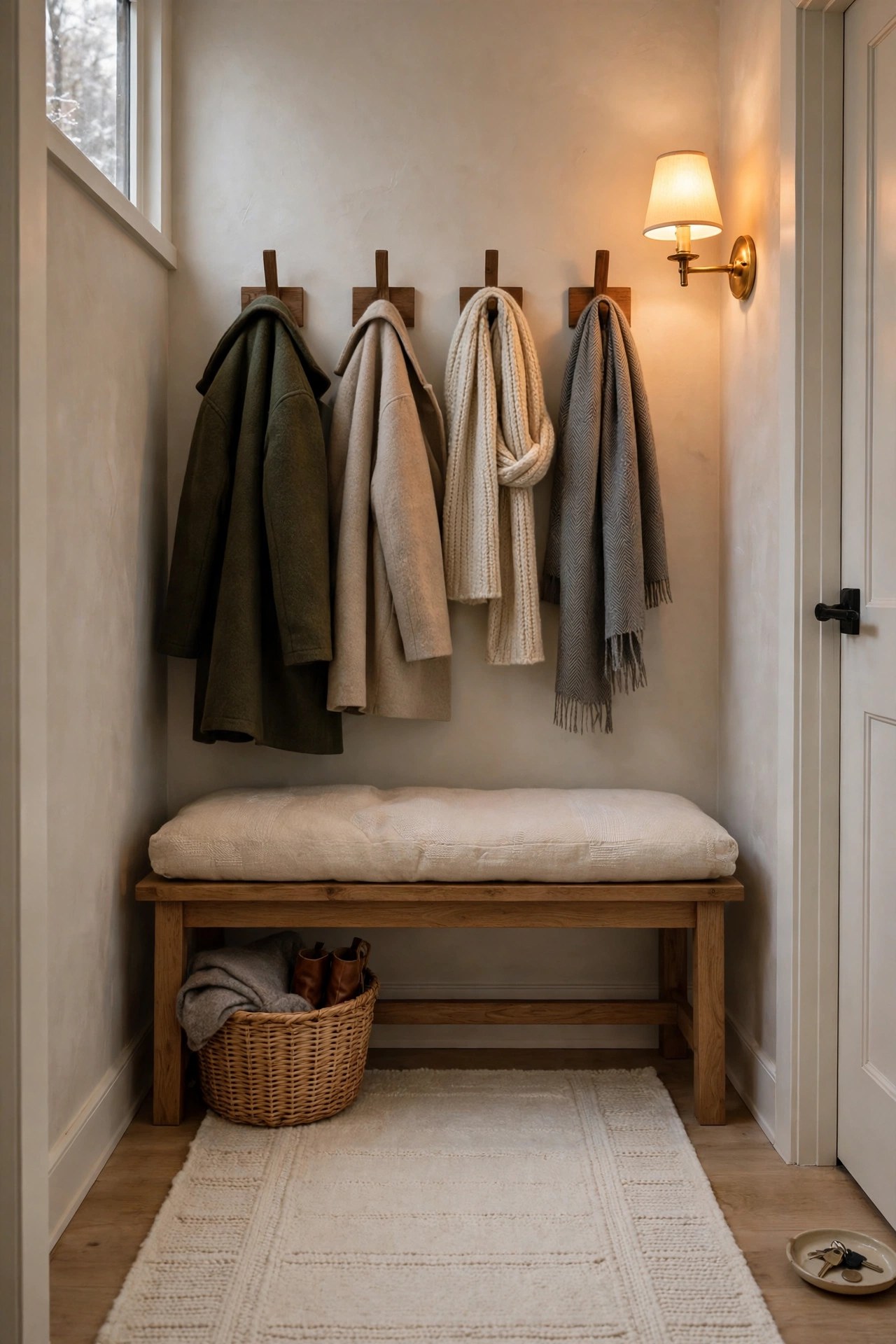
Start With Two Zones: The Core of All Winter Entryway Decor Ideas
Before you buy anything, draw an invisible line about 3 to 4 ft inside your front door. Everything on the door side of that line is the wet zone: boots come off there, coats drip there, and umbrellas stand there. Everything beyond it is the dry zone: the bench, the baskets, the mirror, and the spot where you set down keys and mail without tracking slush across the floor.
This one decision organises every other idea in this guide. The boot tray and the tough mat live in the wet zone. The soft runner, the bench cushion, and the baskets live in the dry zone. When guests arrive, the zones quietly direct them too: wet things stay by the door, and nobody has to be told. If your entry is very small, the zones can be as simple as a tray and a mat on one side, and a bench or shelf on the other, but keep the split.
1. Set a Boot Tray With a Real Raised Lip in the Wet Zone
A boot tray is the hardest-working $15 to $30 you will spend this winter, but only if it has a real raised lip, ideally 1 to 2 in high. A flat mat lets meltwater run straight off the edge onto your floor. A lipped tray holds the puddle from four pairs of snowy boots until you tip it into a sink or shake it outside.
Size it honestly. Measure your household's largest boots and buy a tray that fits at least two pairs side by side; a common family size is around 28 to 30 in long. Rubber and heavy recycled plastic rinse clean in seconds and do not rust, unlike some thin metal trays. Add a layer of smooth pebbles or a washable absorbent insert if you like the look, but the lip is non-negotiable. This tray does the same protective job as the mudroom staples in our guide to small apartment fall entryway ideas for tight spaces, updated here for snow and slush instead of autumn rain.
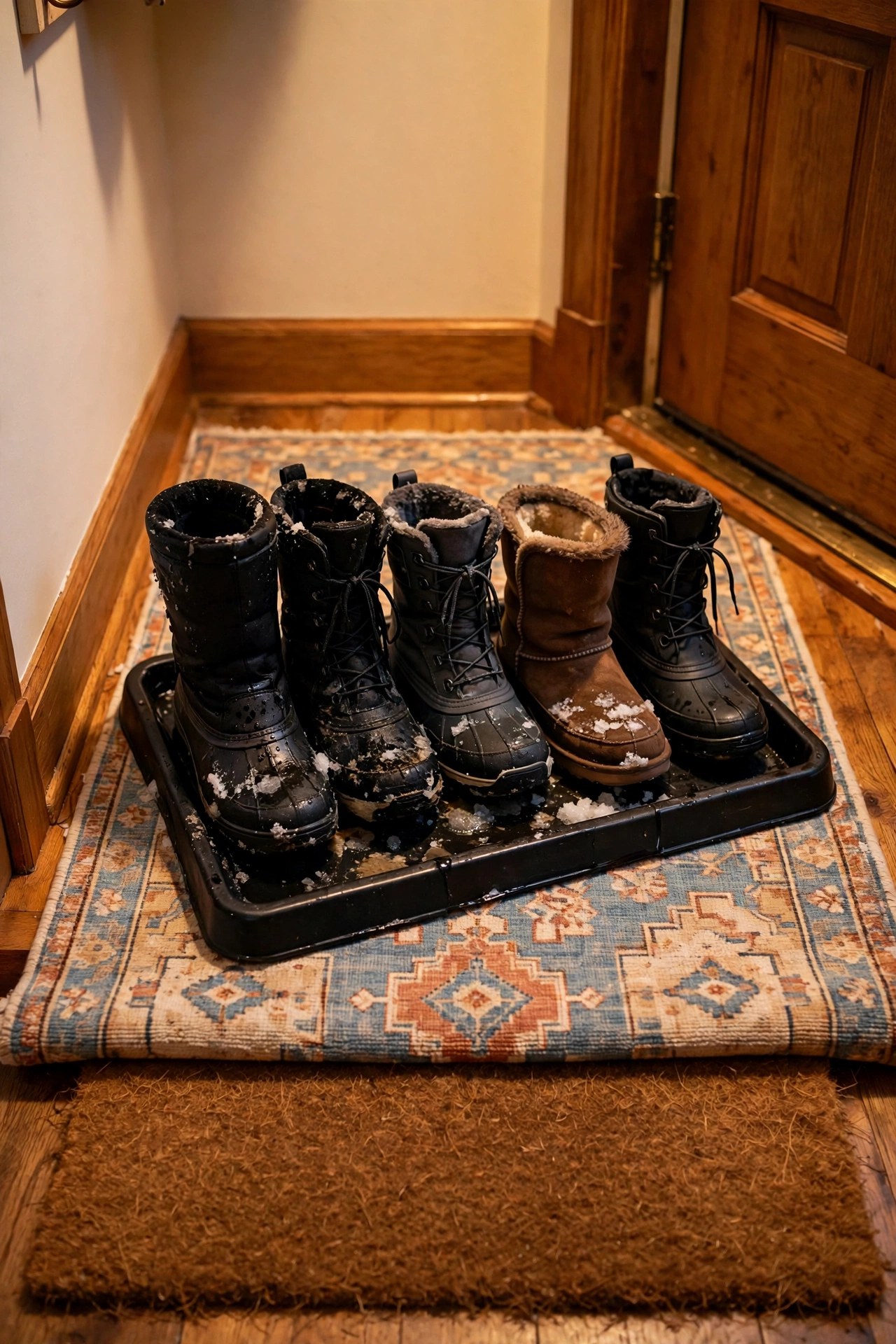
2. Layer Your Mats: Tough Coir Below, Washable Rug Inside
One mat cannot do both winter jobs: scraping grit and soaking up water. Layer two instead. Outside the door, or as the bottom layer inside it, put a tough coir mat that scrubs soles clean. On top of the wet-zone floor inside, place a washable patterned rug that traps the meltwater the coir missed and goes straight into the machine when it gets grubby.
The pattern is practical, not just decorative. A small-scale pattern in mid tones hides salt stains, grit, and mud between washes far better than a plain pale rug. Choose low pile so the door still swings clear; check that clearance before ordering, because a thick rug plus a draught is a daily annoyance. Rubber backing keeps the layers from skating on tile or wood.
3. Roll Out a Low-Pile Wool Runner in Cream or Oatmeal
Cold tile or stone under stocking feet is the moment a house feels unwelcoming in winter. A low-pile wool runner in a warm neutral, cream, oatmeal, or a soft heathered beige, changes that instantly in the dry zone. Wool is naturally warm, resilient, and better at hiding winter dust than synthetic pile, and low pile keeps it easy to vacuum and safe under a swinging door.
Leave a border of floor showing on each side, around 3 to 5 in, so the runner looks fitted rather than wall-to-wall. If real wool is beyond budget, at $60 to $120 for a runner, a wool-look washable runner at $30 to $60 is a fair compromise for a high-traffic entry. Add a non-slip pad underneath; runners on hard floors drift, and a drifting runner at the front door is a trip risk in the dark.
4. Hang Hooks at Two Heights, One Hook Per Person
Coat chaos in winter usually comes from one cause: too many coats chasing too few hooks. The fix is a simple rule, one hook per person, for the everyday coat only. Mount the main row at a comfortable adult shoulder height, around 60 to 66 in, and a second lower row at about 36 to 42 in for children, shorter guests, or bags and scarves.
Sturdy individual hooks beat a long coat rack rail in a small entry because each coat gets its own defined spot and wet sleeves are not pressed against dry ones. Space hooks 8 to 10 in apart so bulky winter coats can hang without bunching. Renters can use a row of heavy-duty adhesive hooks rated for at least 7 to 10 lb each, or a freestanding rack covered in idea 11, and get the same system with no holes.
5. Add a Bench You Can Sit On, With Storage Hidden Under It
Nobody balances happily on one leg while pulling off a wet boot. A bench you can actually sit on, sturdy, around 17 to 19 in high, and long enough for one person plus a bag, turns the daily boot struggle into a calm sit-down moment. It is also the piece that makes an entry feel furnished rather than improvised.
Choose a bench with hidden storage under the seat or beneath it: a lift-up lid, a low shelf for baskets, or space for two bins underneath. That hidden volume is where out-of-season shoes, the dog lead, or spare scarves live without being seen. Ready-made benches run $50 to $120; a simple DIY version can cost far less, and our step-by-step easy DIY entryway bench ideas with storage shows several builds that fit narrow halls. Top the bench with one washable cushion or a folded throw in a warm neutral so sitting down in January does not mean landing on cold wood.
6. Create a Slim Landing Spot for Keys and Mail
Every entry needs one obvious place where keys, wallet, and mail land, or they will land everywhere. In a small winter entryway, the answer is slim: a console table under 10 in deep, or even slimmer, a wall-mounted floating shelf at about 36 in high with a small tray or bowl on it.
Keep this landing spot in the dry zone, a step or two inside the door, so you set things down after the boots and coat are off, not while you are still dripping. One tray, one small dish for keys, and a letter holder are enough. When the tray is full, that is the signal to sort it, which keeps the surface from becoming a paper mountain by February. A floating shelf suits renters who can use two small screws, and a narrow freestanding console suits anyone who cannot drill at all.
7. Hang an Oversized Mirror to Bounce Short Winter Daylight
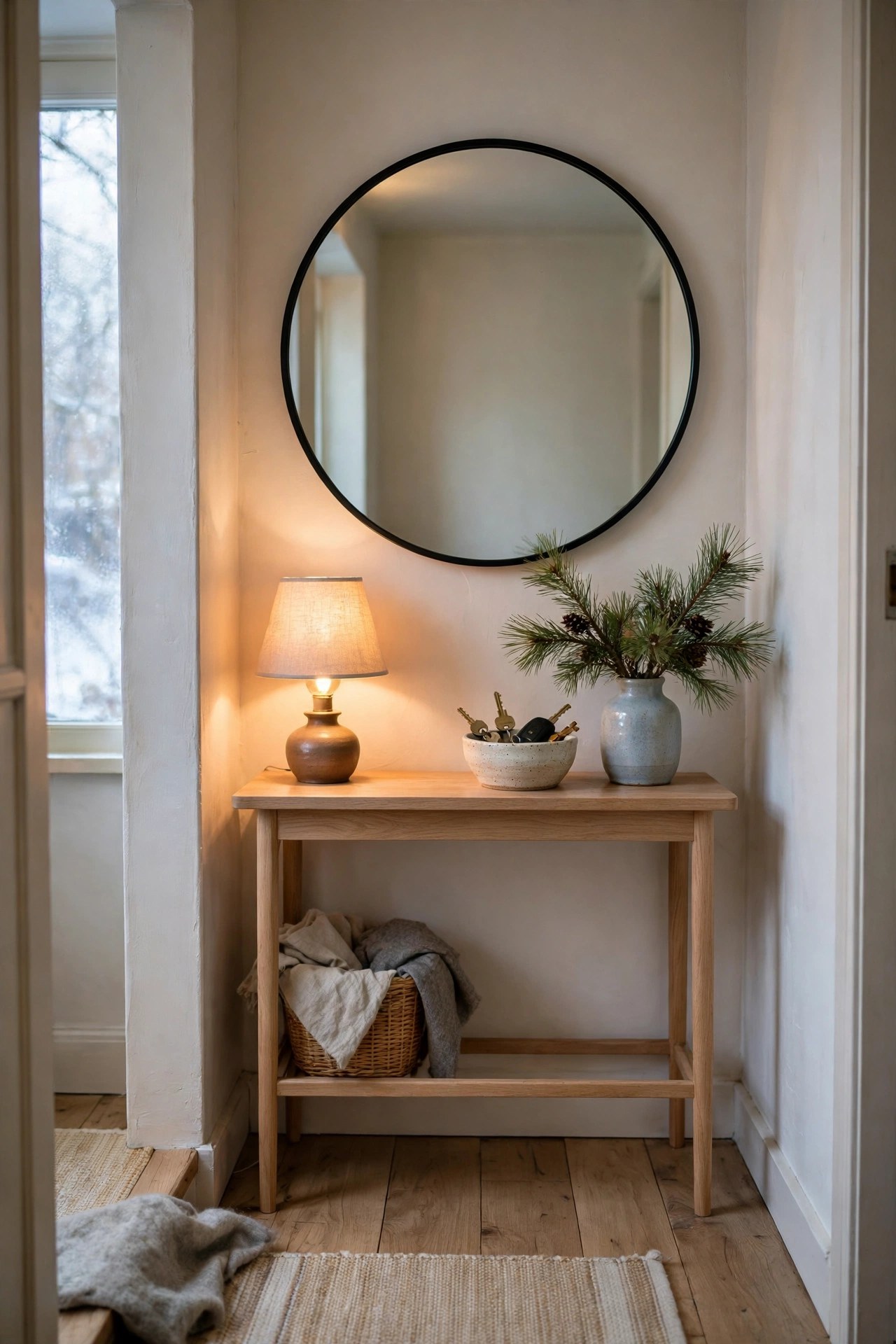
Winter daylight is short and weak, and many entries have no window at all. An oversized mirror, 24 to 36 in wide if your wall allows, catches whatever light exists from a hallway window, a glass door panel, or your entry lamp, and throws it back into the space. The entry feels brighter at 4 p.m. in December, which is exactly when it usually feels gloomiest.
The mirror earns its place practically too: it is the last check for hat hair, scarves, and collars before you leave. Hang it so its centre sits around 57 to 60 in from the floor, opposite or at an angle to the light source rather than flat beside it. A simple wood, black metal, or woven frame warms the look; avoid anything so ornate that wiping winter fingerprints becomes a chore. If your entry mirror inspires a bigger refresh, the same light-bouncing logic works outside too, as shown in our winter porch decor ideas that feel warm from the street.
8. Warm the Light: A Small Lamp or Plug-In Sconce at 2700K
Overhead light alone makes a winter entry feel stark, like a corridor in an office. A second, lower light source changes the mood completely: a small lamp on the console, a plug-in wall sconce beside the mirror, or even a battery picture light above it. Choose a warm bulb around 2700K, the colour of a cosy living room, not the blue-white 4000K-plus bulbs that make everyone look tired.
Plug-in sconces are the renter's friend here, since they mount with a small bracket or adhesive and run on a cord, no electrician needed, typically $20 to $45 for a pair. Put the lamp or sconce on a timer or a smart plug set for your usual arrival time, and you will come home to a lit, warm-looking entry instead of fumbling for a switch with full hands and wet gloves.
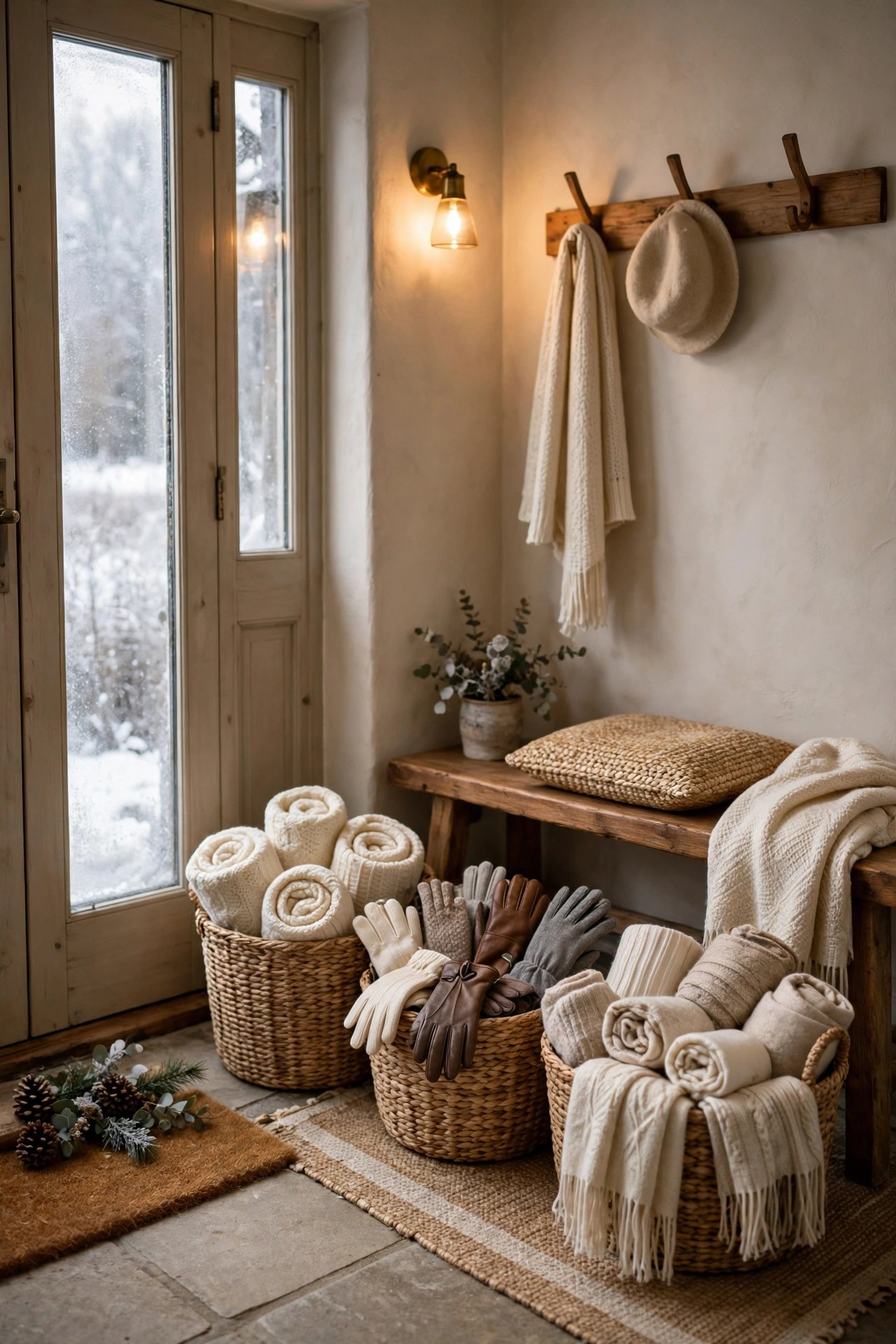
9. Give Baskets Single Jobs: Gloves, Hats, Throws
Baskets bring the soft, warm texture winter entries need, but they only stay tidy if each one has a single job. One basket for gloves and hats by the bench. One for throws and a spare scarf. One, if you need it, for the dog's towel and lead. The moment a basket becomes the place for everything, it becomes a rummage pit with a mitten lost at the bottom since November.
Label them if your household needs the nudge, or use different sizes and materials so the jobs are obvious at a glance. Seagrass, woven cotton, and felt all add warmth; choose washable or wipeable versions near the wet zone. Three good baskets usually cost $10 to $35 total and corral the small items that otherwise spread across every surface. For more seasonal styling combinations that stay neutral and calm, this roundup of winter entryway decor ideas for small spaces offers extra layout inspiration.
10. Rotate Coats So Only This Week's Coats Live at the Door
Even the best hook row fails if every coat you own migrates to it. Winter coats are bulky, and five of them will swallow a small entry whole. Set a rotation rule: only the coat each person is actually wearing this week lives at the door. Everything else, the spare parka, the dress coat, the just-in-case jacket, goes to a bedroom wardrobe or a hallway cupboard.
Do a five-minute coat check on Sunday. Move the extras out, bring in anything the forecast demands, and shake out and hang up what stays so damp coats dry properly between wears. This one habit keeps hooks usable, lets air circulate so coats do not smell musty, and preserves the calm first impression you built with the mirror, runner, and baskets.
11. Use Renter-Friendly Swaps: Freestanding Bench, Leaning Coat Rack
Almost every idea in this guide has a no-drill version, so renting is no excuse for a chaotic entry. A freestanding bench replaces the built-in. A leaning or standing coat rack replaces wall hooks; choose one with a heavy, wide base, because top-heavy racks loaded with wet parkas tip. A floating shelf can become a slim freestanding console or a tray on top of a shoe cabinet.
Adhesive hooks and picture strips handle the mirror and light art if you pick versions rated well above the object's weight, and plug-in sconces need no wiring. Keep a small file of the wall condition with photos when you move in, use the least invasive option that is genuinely safe, and your winter entry can look fully finished while leaving the walls exactly as you found them.
12. Finish With Texture, One Green Touch, and a 5-Minute Nightly Reset
The final layer is what makes people call an entry cosy. Add texture where hands and eyes land: a chunky knit throw folded on the bench, a woven basket, the wool runner underfoot. Keep the palette to warm neutrals with one deeper accent, charcoal, walnut, or deep forest, so it feels calm rather than busy. If you want a hint of the season, a single small sprig of pine in a plain vase or tucked into a basket reads as fresh winter greenery, nothing more, and that restraint suits the neutral scheme.
Then protect it all with the habit that keeps winter entries working: a 5-minute nightly reset. Shake the mat or empty the boot tray if it is full, hang stray gloves in their basket, return shoes to their spots, and clear the key tray. Five minutes at night is the difference between an entry that welcomes you home warm and one that greets you with yesterday's puddle.
Common Winter Entryway Mistakes to Avoid
- One flat mat for everything, so meltwater runs off its edge and soaks the floorboards or rug beneath.
- No wet and dry zones, which means slush gets tracked past the door to the bench, the runner, and beyond.
- Every coat at the door at once, burying the hooks, blocking the mirror, and making the space feel half its size.
- Only overhead lighting, especially with a cool bulb, which leaves the entry feeling stark on dark afternoons.
- One basket for all small items, guaranteeing lost gloves and a daily rummage.
- A thick, high-pile rug under the door swing, which jams the door and traps grit where you can least clean it.
- Skipping the nightly reset, so small messes compound into a full Saturday of sorting wet, muddy gear.
A Simple Budget Plan: $10 to $120, Spent in the Right Order
If you are starting from an empty entry, spend in this order. First, the lipped boot tray and layered mats, about $25 to $50 together, because they protect your floors from day one. Second, hooks and baskets, about $20 to $45, because they end the coat and glove chaos. Third, warmth: a runner and a warm plug-in light, $40 to $90 depending on size and materials. Last, the mirror and the bench, which you can add over time or source second-hand; a good mirror often costs $25 to $60 used, and a sturdy bench $50 to $120 new.
Many homes will not need all of it. If you already own a bench and a mirror, your whole winter reset might be a tray, a washable rug, and a warm bulb for under $50. The goal is not to buy twelve things; it is to make the twelve jobs, drying, storing, sitting, landing, lighting, and welcoming, happen in the space you have.
Welcome Home Warm, Every Single Day
The winter entryway decor ideas that last are never just decorative. A lipped boot tray and a split wet and dry zone handle the weather. One hook per person, single-job baskets, and a coat rotation handle the clutter. A wool runner, a 2700K lamp, and an oversized mirror handle the cold and the dark. And a five-minute reset each night keeps the whole system working until spring.
Start at the door this weekend with the tray and the mats, the least glamorous and most important step. Then add warmth layer by layer. By next week, coming home on a dark, wet evening will feel different: boots off, coat up, keys down, warm light on, and a calm, tidy space that genuinely welcomes you home.


Comments
Post a Comment