
12 Winter Porch Decor Ideas That Feel Cozy All Season Long
The best winter porch decor ideas do not fight the season — they work with it. Short days, bare branches, and cold air become the backdrop, and your porch becomes the warm, lit, layered spot that makes coming home feel good, from the first frost right through to late winter.
That long season needs a different plan from a quick refresh. Anything put out in November may still be there in February, through wind, rain, and frost. So every idea here rests on three things: greenery that stays green, light that comes on early, and textures that handle real weather.
You do not need a big porch or a big budget. Some of the strongest looks cost nothing, starting with clippings, pinecones, and logs from your own yard. Others are small buys — a pair of planters, a set of lanterns — you will reuse winter after winter. Pick four or five ideas that fit your space, and layer them.
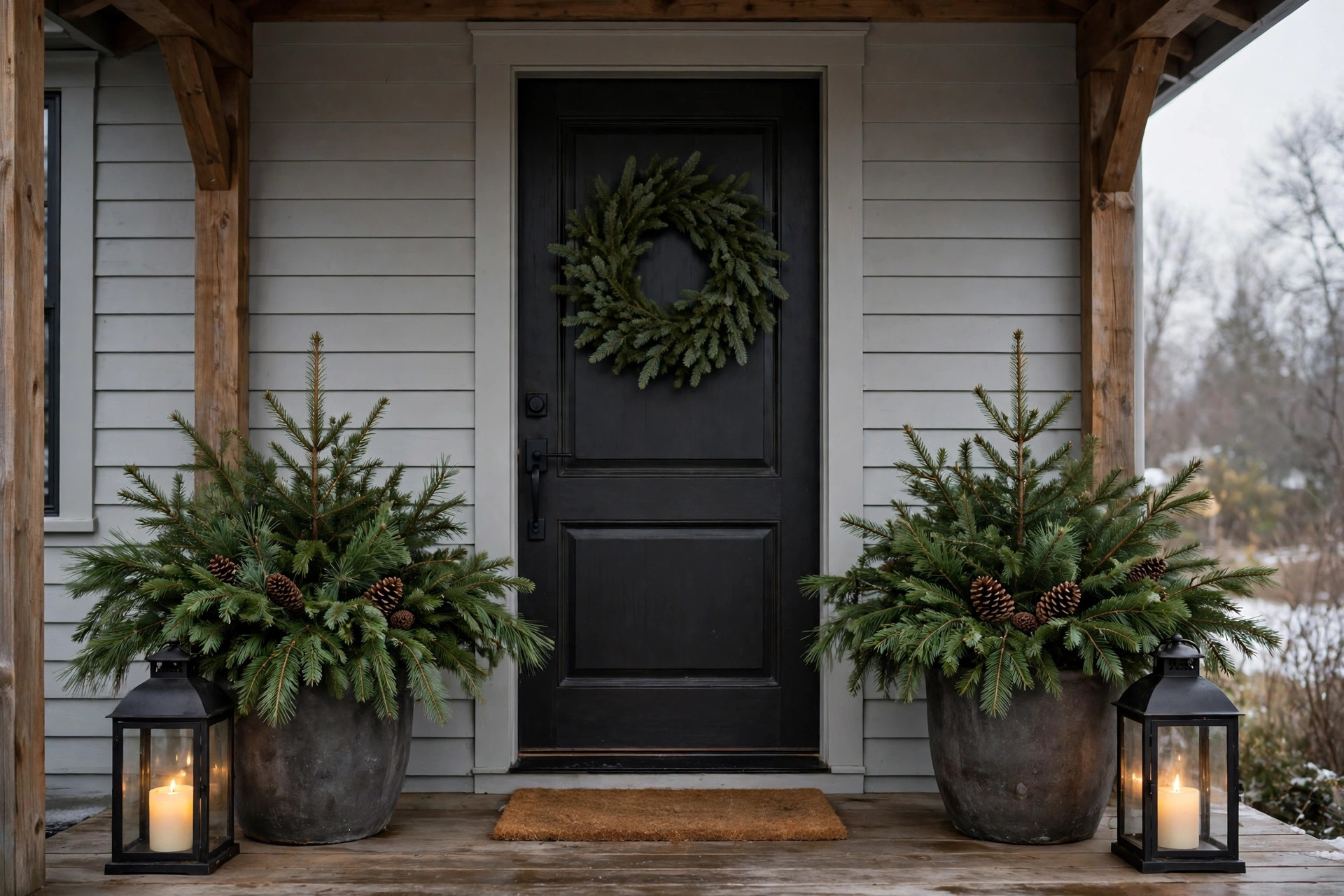
Start With the Foundation: Greenery, Light, and Texture
Think of your porch in three layers — they matter more than any single item.
Greenery is the foundation. In midwinter, green is the colour the landscape takes away, so bringing it back makes a porch feel alive. Pine and cedar hold their colour in cold weather. Boxwood keeps its shape and deep green leaves all winter. Eucalyptus adds a softer, silvery tone that mixes beautifully with darker evergreens.
Light is the mood. Winter days are short, so your porch is seen in the dark more than in daylight. A porch that glows at 5 p.m. feels welcoming; a dark one disappears. Plan lighting first, not last.
Texture is the coziness. Rough birch bark, chunky knit, woven baskets, smooth metal, and spiky pinecones give your eyes something to rest on in a flat, grey season. And if styling ever feels unfinished, smart small front porch lighting ideas are usually the fastest fix.
12 Winter Porch Decor Ideas That Last All Season
Build in this order: structure first, then light, then soft finishing layers. Each idea includes what you need, typical cost, and the weather rule that keeps it looking good in February.
1. Drape Evergreen Garland Over Railings and the Door Frame
Garland is the fastest way to change a whole porch. Draped along a railing, it softens hard lines. Framed around a door, it creates a focal point you can see from the street. Use real pine or cedar for scent if you do not mind a mid-season refresh, good faux garland for a set-and-forget season, or a mix of both — faux as the lasting base, real clippings tucked in for natural variation.
Fix it with soft ties, floral wire, or removable outdoor hooks, never nails in the door frame. Let it swag gently between fixing points instead of pulling it tight; that relaxed curve looks generous rather than strained.
Materials: 2–3 lengths of pine or cedar garland, floral wire or soft ties, removable hooks. Cost: $15–$40 for reusable faux; $10–$25 fresh. Weather rule: fresh garland dries from the cut ends first — mist it on mild days and refresh it if it thins.
2. Flank the Door With Matching Evergreen Planters
Symmetry is the oldest trick in porch styling, and it works every time. Two matching planters, one each side of the door, make an entry look intentional even if nothing else changes. Fill them with plants that genuinely stay green all winter — small boxwood or dwarf conifers — then add height and texture: a few birch poles in the centre and pinecones at the soil line.
Choose planters with drainage, and raise them on pot feet or small blocks so they never sit in standing water that can freeze and crack the pot.
Materials: 2 matching weatherproof planters, 2 boxwood or dwarf conifers, birch poles, pinecones, potting mix. Cost: $40–$60 for the pair with plants; less if you own the pots. Weather rule: water potted evergreens on mild days — dry roots in frozen soil are the main reason they fail.
3. Cluster Lanterns in Three Heights by the Door
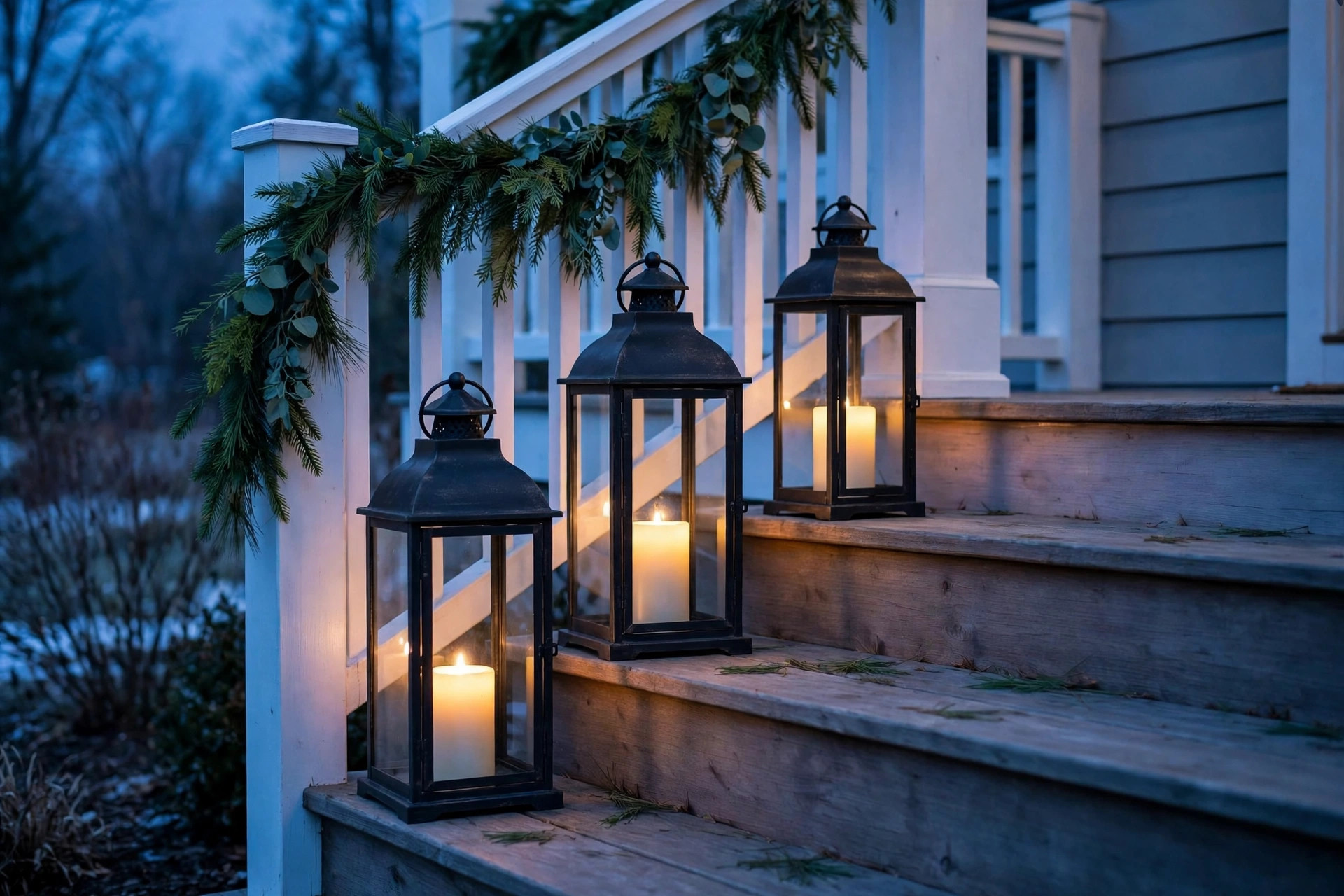
One lantern looks like an afterthought. A cluster of three, in three heights, looks like a design decision. Group them beside the door or on the steps, tallest at the back. Inside, use flameless LED candles on timers: they switch on at dusk by themselves, need no trips out in the cold, and keep open flame away from dry greenery, garland, and throws — a real safety point, not a small one.
Mix finishes if you like — black metal with one galvanised or wooden lantern looks collected, not boxed-set — but keep every candle the same warm white.
Materials: 3 lanterns in small, medium, and large heights, flameless LED timer candles, batteries. Cost: $25–$50 for the set. Weather rule: use outdoor-rated lanterns and bring battery candles in during heavy storms so compartments stay dry.
4. Weave Warm-White String Lights Through the Garland
String lights alone can look sparse. Woven through garland, they look rich: the greenery hides the wire, softens the glow, and gives each bulb something to reflect off. Always choose warm white, which reads as candlelight. Cool, blue-white light reads as office lighting and flattens greenery. If you use lights in more than one place, check the tones match before hanging — two slightly different whites side by side look like a mistake.
Weave the strand through the garland on the ground, before hanging it. Threading lights into fixed garland, outdoors, in the cold, is nobody's favourite job.
Materials: 1–2 strands of warm-white outdoor string lights, timer plug, outdoor extension lead if needed. Cost: $12–$30. Weather rule: outdoor-rated lights only, with plugs kept off the ground and out of puddles.
5. Hang a Simple, Natural Winter Wreath
A winter wreath does not need to be busy to be beautiful — the simplest ones last longest visually, because nothing on them can date or fall off. Start with one honest base: grapevine with its twisted texture, plain evergreen, soft grey-green eucalyptus, or a full pinecone wreath. Finish with a single length of linen or burlap ribbon, in a simple bow or long, loose tails. That one soft detail is enough.
Hang it on a proper wreath hanger, centred at eye level — about 57 inches from the porch floor to the wreath's centre suits most viewers.
Materials: wreath base, linen or burlap ribbon, wreath hanger. Cost: $10–$35, or near $0 wiring your own pinecones and clippings onto grapevine. Weather rule: fresh wreaths last longest on a shaded, sheltered door; sun and wind dry them weeks earlier.
6. Fill a Woven Basket With Birch Logs and Pinecones
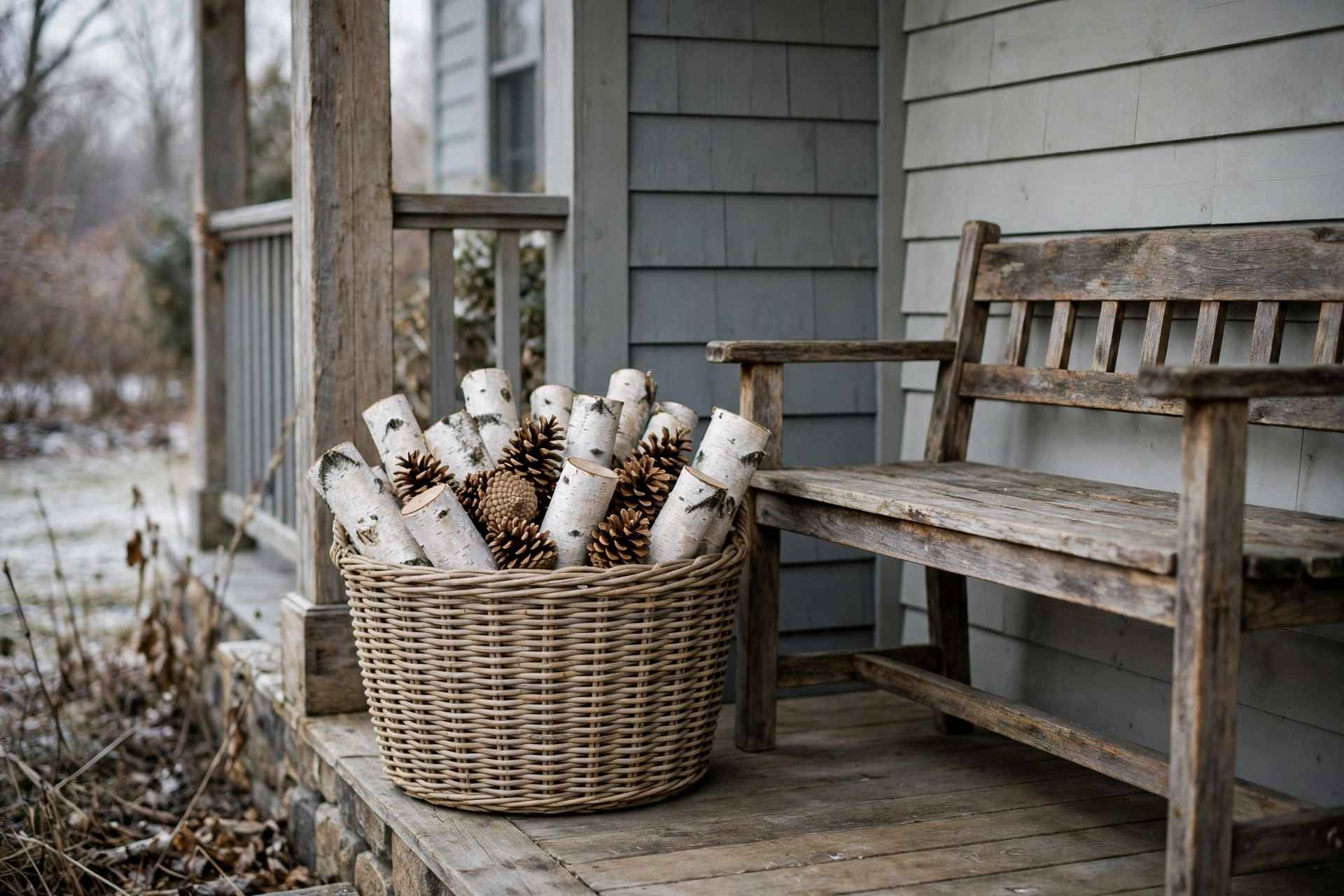
This gives a porch instant woodland texture for very little money. Stand three to five birch logs upright in a woven crate or sturdy basket — the pale bark is beautiful against dark greenery — and fill the gaps with pinecones. Cut or choose logs at slightly different lengths; a perfectly level row looks like shop stock, while varied heights look gathered and natural.
Set the basket beside the door, next to a planter, or at the foot of a bench. It fills that awkward empty corner almost every porch has, and balances softer elements with something solid.
Materials: woven basket or wooden crate, 3–5 birch logs, a handful of pinecones. Cost: $10–$25 bought; $0 with fallen branches and gathered cones. Weather rule: keep it under the porch roof — constant soaking softens woven fibres and grows mould at the log bases.
7. Make a Bench Cozy With a Plaid Throw and Knit Cushion
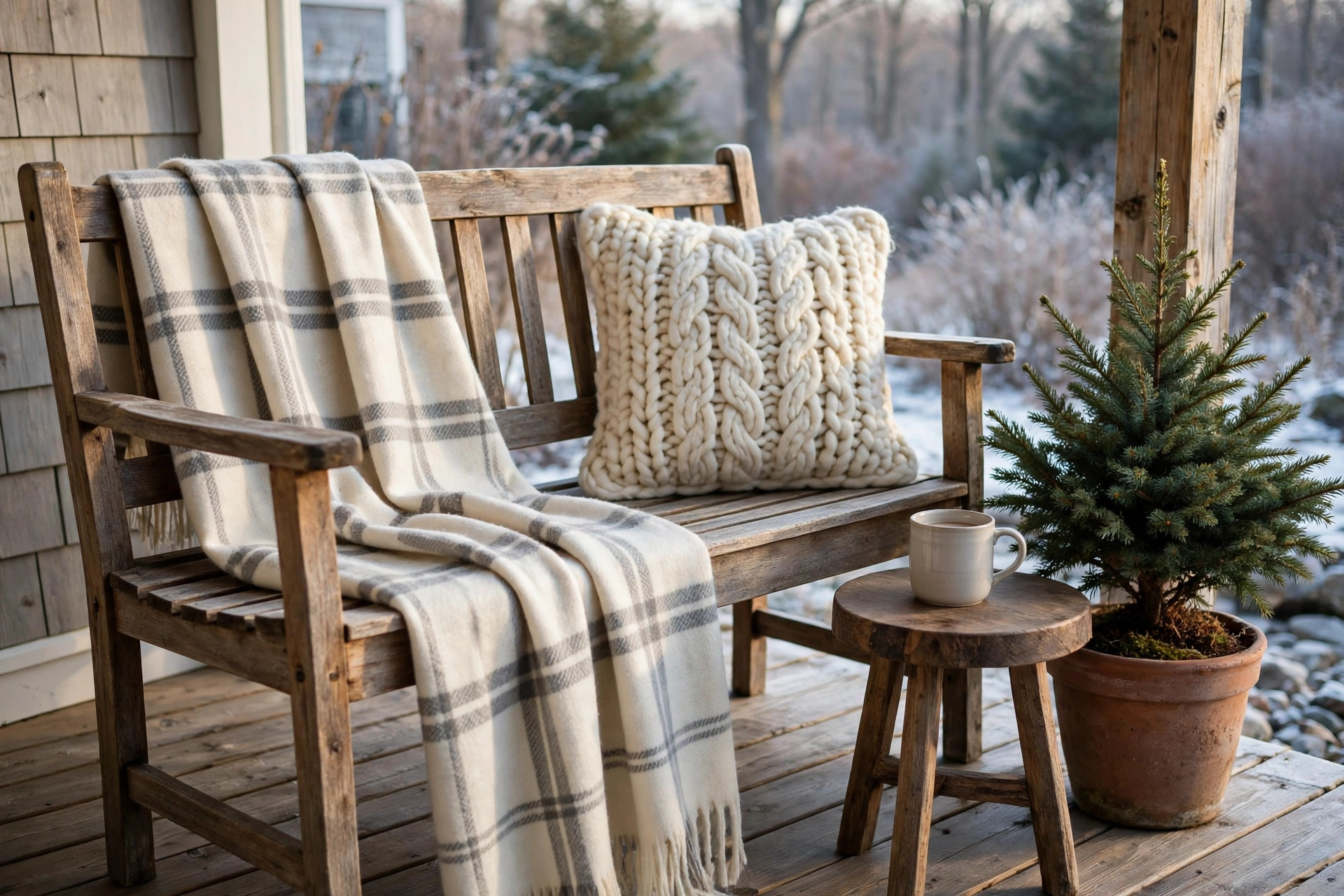
A bare bench looks cold just to look at. One plaid throw draped over the back and one chunky-knit cushion turn it into an invitation — a spot for morning coffee in a warm coat. Plaid is the classic winter pattern because it carries several colours at once, tying your greenery, door colour, and planters together without exact matching. Keep it simple: one throw and one or two cushions read as cozy; five read as storage. No bench? Use a rocking chair, swing, or crate.
Materials: 1 plaid or chunky-knit throw, 1–2 outdoor cushions, bench, chair, or swing. Cost: $20–$45. Weather rule: choose weather-resistant textiles, and bring throws in during storms — a soaked throw left out smells musty and fades fast.
8. Layer Your Doormats: A Larger Rug Under a Coir Mat
Layered doormats are a small detail with an outsized effect. Place a larger flat-weave rug in a neutral shade or muted plaid underneath, then centre a smaller coir mat on top where feet land. The rug's border frames the mat, and the entry looks finished instead of purely functional. It is practical too: coir scrapes wet boots, mud, and grit, the rug catches the rest, and both lift out easily to shake or hose down. Measure first — the under-rug should extend 3 to 4 inches beyond the coir mat, sit flat, and clear the door's swing.
Materials: 1 larger flat-weave outdoor rug, 1 coir doormat. Cost: $18–$35 for both. Weather rule: lift both after heavy rain and dry fully underneath — trapped moisture can mark decking and freeze into a slip hazard.
9. Lean a Vintage Wooden Sled or Old Skis by the Door
Every porch benefits from one tall, characterful accent — something with a past. A vintage wooden sled leaned by the door does that job perfectly; old wooden skis do the same in a narrower space. Winter porches are mostly soft shapes, so a long, weathered piece of wood adds contrast and height, making a low porch feel taller. Dress it lightly or not at all — a small wreath on the sled is plenty — and sand any rough edges on second-hand finds.
Materials: vintage sled or old skis, optional small wreath or garland, soft tie to protect paint. Cost: $15–$40 second-hand. Weather rule: keep old wood under cover, raised off wet boards, and store it dry at season's end.
10. Stack Firewood in a Metal Log Holder
If you burn wood, this decor idea earns its place twice. A tidy stack in a black metal log holder looks warm, rustic, and honest — and saves trips to a cold woodpile in the dark. Stack with cut ends facing outward, mix sizes slightly for a natural rhythm, and stop at a height that looks full but stable. A few pale birch pieces among darker logs tie this corner to your basket display. Place the holder on the driest side of the porch, away from the walking path, with a clear gap from lanterns.
Materials: metal log holder or ring, seasoned firewood, optional birch pieces. Cost: $25–$50 for the holder. Weather rule: seasoned, dry wood only, kept off the floor with airflow behind it — never stacked tight against the house wall.
11. Tuck Evergreen Clippings Into Baskets, Buckets, and Window Boxes
The zero-budget idea that ties a whole porch together. When you trim a hedge or tidy an evergreen, keep the clippings. Pine, cedar, boxwood, and fir, tucked into baskets, metal buckets, window boxes, and planter gaps, give you a full, layered look for free. Work in odd numbers and mixed lengths: taller clippings upright at the back, shorter at the front, a few spilling over the edge. Mix two greens — dark pine with silvery eucalyptus — and it looks designed, not just gathered.
For more ways to stretch this one free material, these winter greenery decor ideas build beautifully on the same clippings. Set stems in damp soil or sand, not loose — clippings with moist cut ends last far longer, often most of the season.
Materials: evergreen clippings from your yard, baskets, buckets, or window boxes, soil or sand. Cost: $0 shopping your yard; $5–$15 for a thrifted container. Weather rule: wind dries clippings, so group containers in sheltered spots and refresh any that brown.
12. Add Frosted Pinecones and Other Honest Winter Texture
Finish with texture you can gather. Pinecones are free, last all winter, shrug off wet weather, and look right almost anywhere: at planter bases, piled in a crate by the firewood, filling a lantern's base, or wired along garland. For a frosted look, dry-brush just the tips and ridges with white paint using a nearly dry brush. That light touch reads as frost; solid white reads as paint. A mix of frosted and plain cones in one basket looks most natural.
Round it out sparingly — a wooden crate, a galvanised bucket, a coil of thick rope. Texture is the seasoning, not the meal. For more simple all-season styling in one place, this guide to winter porch decor that works all season is a useful companion read.
Materials: gathered pinecones, optional white paint and dry brush, crates or baskets. Cost: $0–$8. Weather rule: bake gathered cones at a low temperature for 30 minutes before close-to-home use, to remove sap and insects.
How to Scale These Ideas for a Small Porch or Stoop
A small porch does not need smaller ambitions — it needs editing. The same three layers work on a stoop; you just choose fewer, stronger pieces and use vertical space instead of floor space.
Start with the door: a simple wreath and a short garland swag over the frame give you the green layer without taking an inch of floor. Add light in one place only — a single medium lantern, or string lights woven into that garland. One good light source beats three small ones in a tight space.
For planters, go tall and narrow. One slim planter on the side with most room, balanced by the lantern on the other side, gives the feeling of symmetry without a wide matching pair. Layered doormats still work beautifully, and may be the highest-impact change of all, because on a small entry the mat is most of what a visitor sees. Finally, borrow height: lean the skis or hang a basket of clippings on the wall — every wall item is floor space saved for feet and wet boots.
- Small-porch shortlist: wreath, door garland with lights, one tall planter, one lantern, layered mats
- Skip on a tiny stoop: a bench, a firewood stack, and wide planter pairs — they crowd the path and quickly look like clutter
- Rule of thumb: if a visitor has to step around it, it is too big or in the wrong place
Winter Porch Mistakes That Make a Porch Look Tired
Using real candles near dry greenery. Garland, clippings, throws, and firewood are all dry materials in one small space. Flameless LED candles give the same glow with none of the risk, and timers make them easier, too.
Mixing light colours. Warm-white string lights beside a cool-white lantern look like two porches collided. Pick one warm tone for the whole porch, and test new bulbs against existing ones before hanging them.
Leaving textiles out through every storm. Throws and cushions only feel cozy when they are dry and clean. Weather-resistant fabrics help, but even they need shelter in heavy weather. A faded, musty throw does the opposite of cozy.
Forgetting that pots need water in winter. Potted evergreens keep losing moisture through their leaves while frozen or dry soil gives nothing back. A drink on a mild day keeps planters green instead of bronzed and dropping needles by late winter.
Decorating once and never looking again. A winter display is out for months: garland thins, clippings brown, batteries fade. A ten-minute tidy every couple of weeks — shake the mats, swap tired clippings, wipe the lanterns — keeps it looking freshly done.
Frequently Asked Questions
How long can winter porch decor stay up?
That is the beauty of neutral winter decor: it works from the first frost through late winter, often three to four months. Evergreen, birch, pinecones, lanterns, and plaid belong to the cold season itself, not to any single date, so nothing looks left over. Refresh fresh greenery once mid-season, and it carries through.
What greenery lasts longest outdoors in winter?
Boxwood and pine are most reliable, holding colour and shape for months in cold weather. Cedar looks and smells wonderful but dries sooner, and eucalyptus is best faux outdoors or refreshed regularly. Potted plants outlast cut greenery, and cut clippings last longest with stems in damp soil or sand.
How can I decorate a winter porch on a small budget?
Start free: evergreen clippings in baskets, gathered pinecones, and stacked logs. Then add one bought item at a time, starting with light — a single timer lantern changes a porch more than any other purchase. A plaid throw from indoors, used on dry days and brought in at night, costs nothing and adds the cozy layer instantly.
Are flameless candles better than real ones on a porch?
For winter, yes. The porch is full of dry greenery, wood, and fabric, and wind can carry a real flame where you do not want it. Timer candles also come on at dusk by themselves, so the porch glows when people arrive home.
How do I keep porch textiles from getting ruined?
Choose weather-resistant fabrics, store cushions upright so water runs off, and bring throws and cushions in during storms and long wet spells. A small covered storage box on the porch makes it a ten-second job — which means you will actually do it.
A Porch That Welcomes You Home All Winter
A good winter porch is not about having the most decor. It is a few honest layers done well: greenery that stays green, warm light that comes on as the day fades, and textures — birch, pinecone, woven basket, plaid — that make a cold space feel warm and held.
Start with the foundation, add the ideas that fit your space and budget, and give the porch a quick tidy every couple of weeks. Pick your first three ideas today — garland, lanterns, and a basket of clippings is a perfect start — and build from there.


Comments
Post a Comment