
12 Small Bathroom Window Privacy Ideas That Keep the Light In
A small bathroom window is a gift and a problem at the same time. You want the daylight — it makes a tiny room feel twice as big — but you do not want the neighbours joining your morning shower. The good news is that the best small bathroom window privacy ideas do not force you to choose. You can block the view in, keep most of the light, and still open the window for steam.
This guide is honest about the part most lists skip: privacy changes after dark. A covering that works at noon can fail at 9 p.m., when your light is on and the street is dark. So every idea below gets separate day and night ratings, plus notes on light, humidity and real cost.
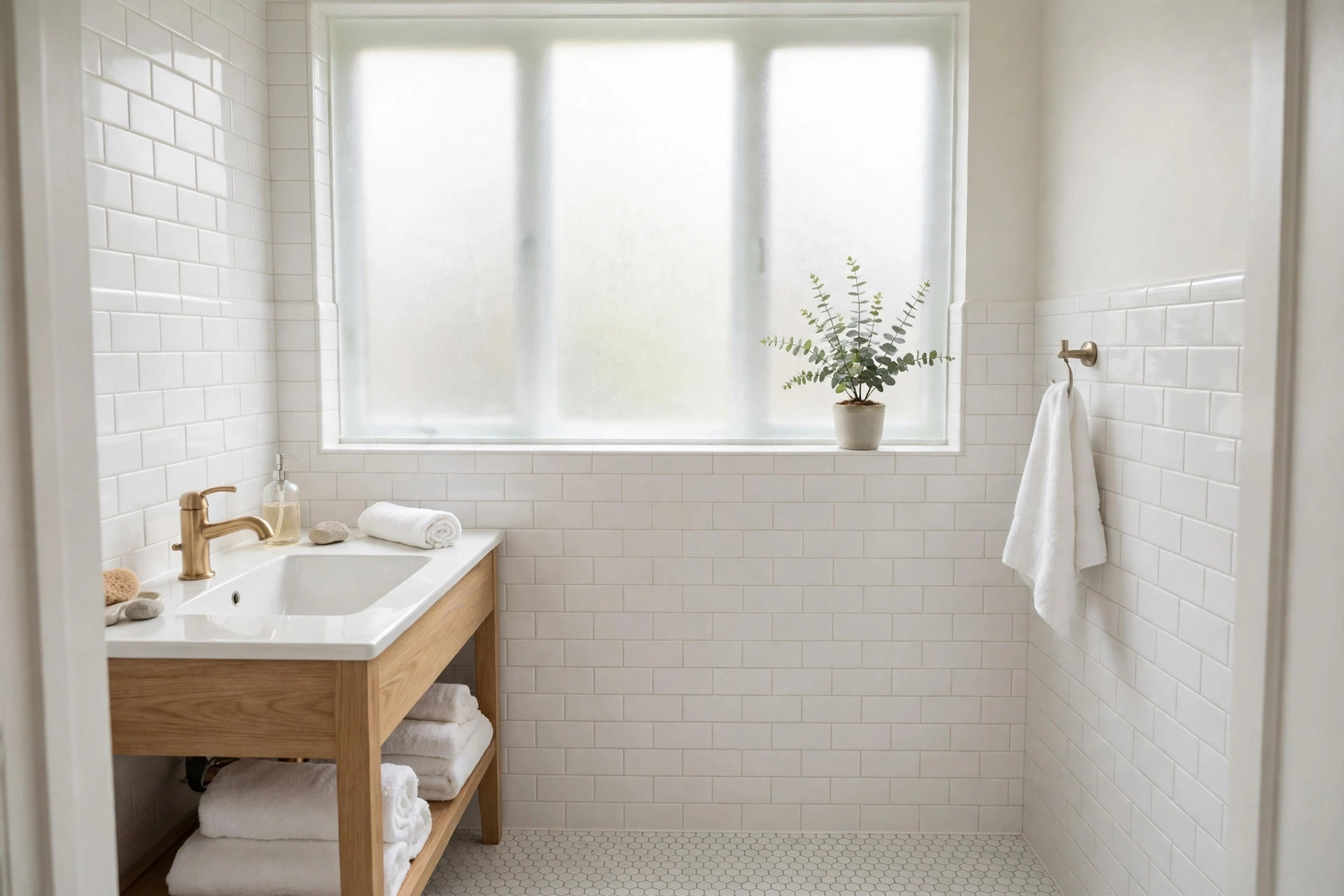
How Bathroom Window Privacy Actually Works, Day and Night
Privacy is about which side of the glass is brighter. In daylight, the outside is brighter, so frosted and reflective surfaces hide you well. At night the balance flips: your lit bathroom becomes the bright side, and shapes close to the glass can show as soft silhouettes through many films and fabrics.
That is why the reliable stack is simple: bathroom-grade frosted film as the permanent base layer, plus a blind or shade to drop at night if your window faces a close neighbour or a house at the same height. The film handles everyday privacy; the second layer handles the close-up night silhouette.
Light matters too. Good frosted films transmit roughly 70 to 85 percent of visible light (often listed as VLT), so the room stays bright while the view turns to a soft blur. If your bathroom still feels dim, pair the window fix with the right bulbs and placement from our guide to small bathroom lighting ideas that make a tiny room feel bigger — privacy should never come at the cost of a gloomy room. Our guide to small bathroom mirror ideas that beat fog and clutter covers the steam side of the room.
1. Cover the Whole Window With Frosted Static-Cling Film
This is the default answer for most small bathrooms. Static-cling frosted film sticks with water and static, not glue, so it goes up in under an hour and peels off cleanly when you move. It is the true renter option: no adhesive, no residue, no lost deposit.
Cut it slightly oversized, spray the glass with soapy water, smooth it down and trim the edges. Specialist guides such as Purlfrost's bathroom window privacy tips make the same point: film blurs shapes rather than blocking the window, so the room stays feeling open.
- Day privacy: 5/5 — shapes blur completely a step or two from the glass.
- Night privacy: 4/5 — private, but a person standing right against the glass can cast a soft shadow.
- Light kept: Excellent — most quality films keep about 70–85% of the light.
- Humidity: Excellent — bathroom-grade vinyl shrugs off steam and splashes.
- Price: About $10–$30 per window, depending on size and pattern.
2. Frost Only the Lower Half and Keep the Sky
If your window is tall, you rarely need privacy at the top. Neighbours see in at eye level, not through the upper pane. Applying film to the lower half only blocks the sightline that matters and leaves clear glass above, so you keep blue sky, tree tops and the full brightness of the upper window.
It is also the cheapest way to test film — one small roll often covers two windows. Leave a clean, straight top edge, cut with a ruler and a fresh blade, so the line looks like a design choice.
- Day privacy: 5/5 on the covered half; the top stays open by design.
- Night privacy: 4/5 on the covered half — same close-up silhouette caveat as full film.
- Light kept: The best of any film option — the clear top pane loses nothing.
- Humidity: Excellent — same steam-proof vinyl, just less of it.
- Price: About $10–$20, since you use roughly half a roll.
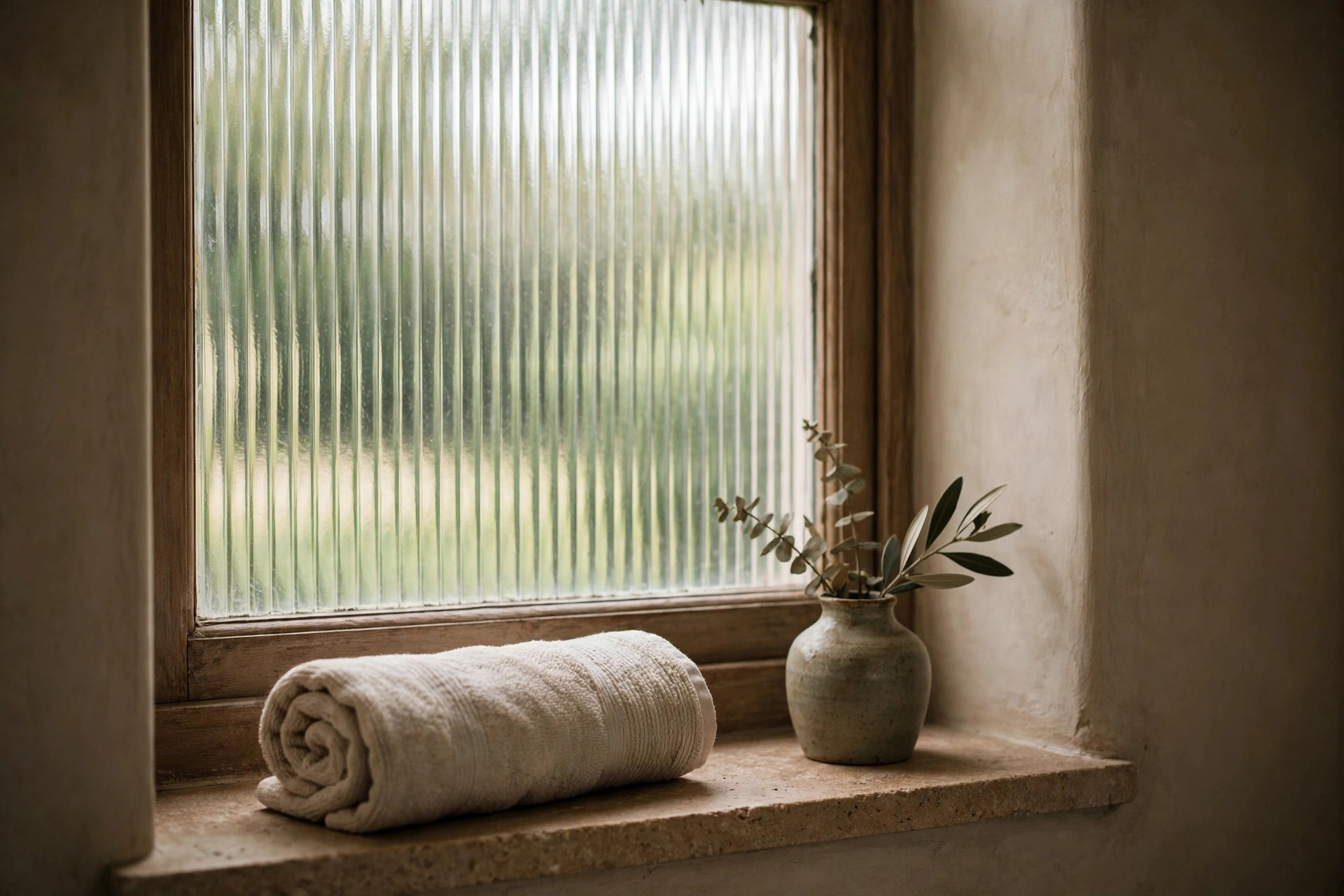
3. Choose Reeded or Fluted Film for a Vintage Look
Reeded film copies fluted glass: fine vertical ridges that stretch the view into soft stripes. It suits period homes and anyone who finds plain frost a little flat, and in sunlight it throws gentle lines of light across the room.
Because the ridges bend light rather than fully frosting it, reeded film is a notch less private than true frost, especially straight-on and at night. Many people run it on the lower half only, or pair it with a shade.
- Day privacy: 4/5 — strong blur, with faint movement visible straight-on.
- Night privacy: 3/5 — silhouettes show more easily; add a night layer if neighbours are close.
- Light kept: Very good — most light passes, with a striped glow.
- Humidity: Excellent in vinyl versions; confirm the film is rated for bathrooms.
- Price: About $15–$30 per window — a small premium over plain frost.
4. Spray It: Frosted Spray Is the Budget DIY Option
Frosted spray paint does the same job as film for the price of a single can. Mask the frame carefully, spray two or three light, even coats from about 25–30 cm away, and let each coat dry before the next. Thin coats are the whole secret: one heavy coat runs, streaks and looks patchy against the light.
Spray is harder to remove than cling film — it needs a razor blade and patience — and a rushed job can look patchy. In return you get a seamless finish with no edges to peel in steamy air.
- Day privacy: 4/5 with two or three even coats.
- Night privacy: 4/5 — similar to film, with the same close-up shadow caveat.
- Light kept: Good — roughly like film, and heavier coats block more light.
- Humidity: Good once fully cured; follow the can's curing time before steamy showers.
- Price: About $12 for a can that covers one to two small windows.
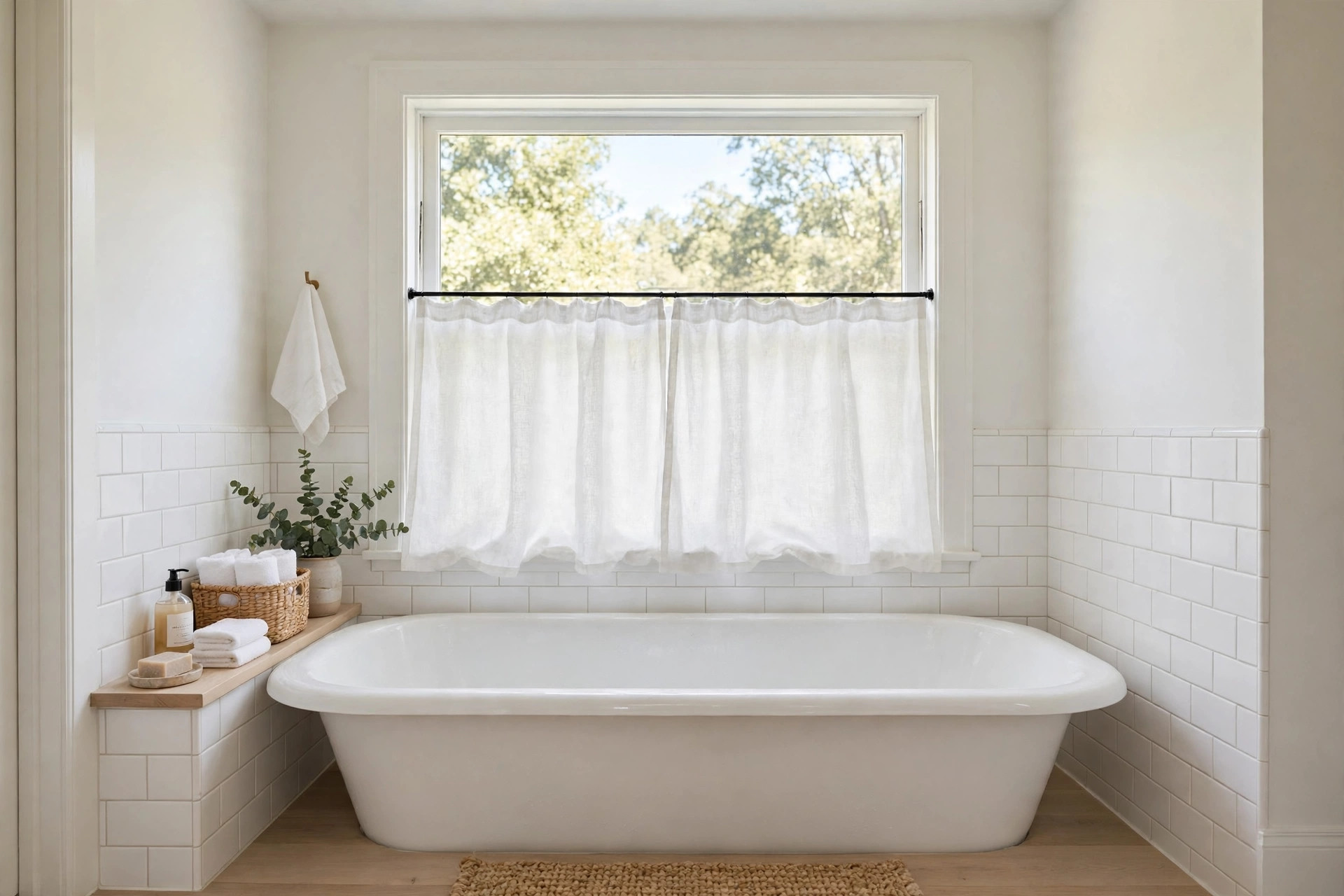
5. Hang Cafe Curtains on a Tension Rod
Cafe curtains cover the lower half of the window and leave the top open — the fabric version of the half-film idea. A spring tension rod sits inside the frame with no screws and no drilling, so this is another fully renter-safe option, and the look is softer and more traditional than film.
Fabric choice decides whether this works. Pick a mildew-resistant fabric — polyester, a cotton-poly blend or outdoor fabric — thick enough not to turn transparent when backlit, and machine-washable, because bathroom curtains earn a wash every month or two.
- Day privacy: 4/5 on the covered half with a medium-weight fabric.
- Night privacy: 3/5 — fabric can glow and show shapes; choose a lined or denser weave for night use.
- Light kept: Very good — the open top pane keeps the room bright.
- Humidity: Good with mildew-resistant, washable fabric; poor with heavy natural fibres that stay damp.
- Price: About $15–$40 for rod and curtains together.
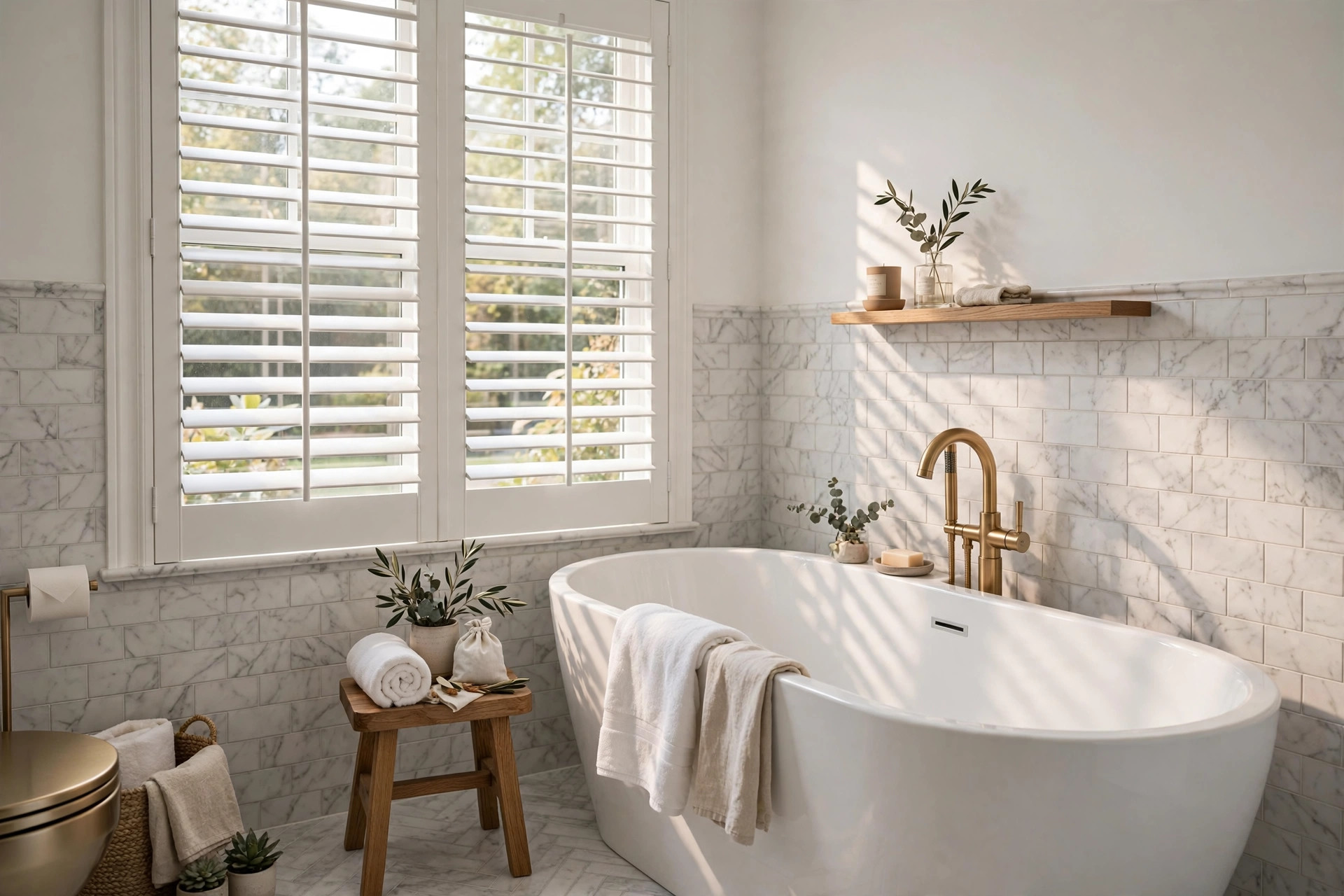
6. Fit Vinyl Plantation Shutters
Shutters are the most finished-looking option on this list, and the most controllable. Tilt the louvres and you can angle daylight up to the ceiling while blocking the view from the street completely. Close them and the window is, for privacy purposes, a wall.
Material is everything here. Choose vinyl or PVC shutters made for wet rooms, and avoid untreated wood near a shower — steam and splashes will swell and warp it. Vinyl wipes clean and never needs repainting. Measure carefully: shutters are the least forgiving option to fit, and the most expensive to get wrong.
- Day privacy: 5/5 — angle the louvres to block any sightline.
- Night privacy: 5/5 with louvres closed — no silhouettes, no glow.
- Light kept: Adjustable — from soft filtered light to near-dark, your choice.
- Humidity: Excellent in vinyl or PVC; avoid untreated wood.
- Price: From about $80 per small window, rising with size and fitting.
7. Use the Reliable Stack: Frosted Film Plus a Roller Shade
If your window faces a pavement, a close neighbour or a house at exactly your level, do not ask one product to do everything. Fit frosted film first for all-day privacy, then add a simple roller shade you pull down only at night. This two-layer stack is the combination professionals fall back on, because it has no weak hour.
Choose a moisture-resistant roller fabric that wipes clean, and mount it outside the direct spray zone. By day it rolls away invisibly, so the bathroom keeps the soft light the film gives it.
- Day privacy: 5/5 from the film alone.
- Night privacy: 5/5 with the shade down — the silhouette problem disappears.
- Light kept: Excellent by day; the shade is only down after dark.
- Humidity: Very good — film is steam-proof; keep the shade out of direct spray.
- Price: About $35–$90 total — $10–$30 for film plus $25–$60 for the shade.
8. Try a Woven or Bamboo Shade — With a Liner or Film Beneath
Woven and bamboo shades bring the warmth a hard-surfaced bathroom often lacks. The honest warning: a woven shade is a filter, not a wall. Its tiny gaps soften the view by day, but at night, with your light on, they can reveal far more than you would like.
Use one properly and it works beautifully: add a privacy liner behind it, or put frosted film on the glass first and let the shade be the decorative layer. Keep woven shades out of direct spray and ventilate well — natural fibres held damp can mildew.
- Day privacy: 3/5 alone; 5/5 over frosted film.
- Night privacy: 2/5 alone — do not rely on it by itself after dark; 5/5 over film.
- Light kept: Good — a warm, dappled glow, slightly dimmer than film.
- Humidity: Fair — fine in a ventilated bathroom, risky in direct spray.
- Price: About $30–$70 for a small window, plus film if you layer it.
9. Layer Sheer Curtains Over Film for the Softest Light
Sheers give the gentlest light of any option — and on their own they are the most oversold. A sheer alone is a daytime courtesy, not real privacy: it blurs the view in daylight, but at night it can become almost transparent from outside. Never let a sheer be your only layer.
As a second layer, sheers earn their place. Hang one over a lower half already frosted with film and it hides the film's edge and softens the light further. Synthetic sheers handle bathroom air well and wash in minutes.
- Day privacy: 3/5 alone; 5/5 layered over film.
- Night privacy: 1/5 alone — this is the option that fails after dark; 4/5 over film.
- Light kept: The softest and most diffused on this list.
- Humidity: Good in synthetic fabrics; wash regularly to prevent mildew spots.
- Price: About $12–$30 for a small panel and a tension rod.
10. Be Careful With Mirror Film: It Reverses at Night
Mirror or reflective film looks like a clever trick. By day it works exactly as promised: people outside see a mirror, you see out, and privacy feels total. It is also the one product on this list that can leave you fully exposed without you realising it.
Reflective film works for whichever side is brighter — and at night, that side is yours. Switch the bathroom light on and the effect reverses: you see a mirror, and the street can see in. Treat it as a daylight layer only, paired with a shade or curtain for the evening.
- Day privacy: 5/5 — a true mirror effect in bright daylight.
- Night privacy: 1/5 — the effect reverses; never use it as your only layer.
- Light kept: Moderate — reflective films usually darken a room more than frost does.
- Humidity: Excellent — it is a film, so steam and splashes are no problem.
- Price: About $15–$35 per window, plus the cost of a night layer.
11. Use Plants on the Sill as a Soft Screen Layer
A row of plants on a deep sill will never be a complete privacy solution, and this guide will not pretend otherwise. What plants do well is break up a sightline. Trailing pothos, a bushy fern or a few humidity-loving herbs blur the lower part of the window, distract the eye and make the bathroom feel calmer while they do it.
Think of plants as a finishing layer over film or a cafe curtain, not a replacement. Choose plants that enjoy steam and indirect light, keep pots small enough that the window still opens, and rotate them weekly so they grow evenly.
- Day privacy: 2/5 alone — a soft screen that breaks up the view.
- Night privacy: 1/5 alone — shapes show clearly between leaves after dark.
- Light kept: Very good — only a small strip of the window is shaded.
- Humidity: Excellent for the right plants — bathroom steam is a bonus, not a risk.
- Price: About $10–$30 for two or three small plants and pots.
12. Replace the Glass: Textured or Frosted Glass Is the Permanent Fix
If you own the home and the window is due for replacement anyway, build the privacy into the glass itself. Textured, patterned or factory-frosted glass has no edges to peel, no fabric to wash and nothing to pull down at night. It simply works, every hour, for the life of the window.
Choose the pattern with the night test in mind: deep textures and true frosts blur shapes well, while very light patterns can still show a close silhouette after dark. It is the most expensive route, but it is also the only option with genuinely zero upkeep.
- Day privacy: 5/5 with a proper frost or deep texture.
- Night privacy: 4/5 — strong, with the familiar close-up shadow on lighter patterns.
- Light kept: Very good — similar to film, around 70–85% for most frosts.
- Humidity: Perfect — it is glass; steam and spray change nothing.
- Price: From about $150 for a small replacement unit, fitted costs vary widely.
Which One Should You Pick?
Match the option to your situation, not to the prettiest photo:
- You rent: Start with static-cling frosted film (Idea 1) or cafe curtains on a tension rod (Idea 5). Both leave without a trace.
- Your budget is under $15: Frosted spray (Idea 4) or lower-half film (Idea 2). Both cost little and work around the clock.
- Neighbours are close or at your level: Use the stack (Idea 7) — film plus a roller shade. It is the only budget setup with no weak hour.
- You want maximum light: Lower-half film (Idea 2) or cafe curtains (Idea 5). Leaving the top pane clear changes everything.
- The window sits inside the shower zone: Film, frosted spray or textured glass. Keep fabric and woven shades out of direct spray.
- You own the home and want a finished look: Vinyl shutters (Idea 6) for control, or textured glass (Idea 12) for zero upkeep.
- You love a decorative layer: Woven shades (Idea 8) or sheers (Idea 9) — always over film, never instead of it.
Mistakes That Ruin Bathroom Window Privacy
- Trusting mirror film at night. The effect reverses when your light is brighter than the street.
- Using sheers alone. A sheer that looks private at noon can be nearly see-through from outside at night.
- Putting untreated wood in a steamy room. Wooden shutters and blinds near a shower swell and warp. Choose vinyl, PVC or film in wet zones.
- Covering the whole window when half would do. Most sightlines only cross the lower pane. Frosting everything costs you sky, light and the feeling of space.
- Skipping the night test. Turn the bathroom light on, go outside after dark and look back at your own window. Two minutes tells you the truth no product photo will.
- Blocking the opener. Make sure your film edge, rod or shade still lets the window open fully to clear steam, or mildew will move in.
Frequently Asked Questions
Does frosted film really work at night?
Mostly, yes. Frosted film blurs shapes day and night, so nobody can see detail. The one exception is a person standing very close to the glass under a bright bathroom light, whose outline can appear as a soft shadow. If your window faces someone close by, add a roller shade at night and the problem is gone.
How much light does frosted film block?
Less than most people fear. Good films transmit about 70 to 85 percent of visible light, so the room stays bright and the light turns soft and even — which often makes a small bathroom feel better lit, not worse.
What is the best renter-friendly option?
Static-cling film. It holds with water and static rather than glue, applies in under an hour and peels off cleanly with no residue. Cafe curtains on a tension rod are the other fully reversible choice — no screws and no drilling.
What works best for a window inside the shower?
Stay with surfaces water cannot hurt: frosted film, frosted spray once cured, vinyl shutters or textured glass. Keep curtains, sheers and woven shades out of the direct spray zone, where they stay damp, harbour mildew and age quickly.
Why can people see in through mirror film at night?
Because reflective film always mirrors on the brighter side. In daylight the street is brighter, so the mirror faces out. At night your lit bathroom is brighter, the mirror flips to face you, and the window becomes clear for anyone outside. Pair it with a shade or curtain, or choose frost instead.
The Bottom Line
Start simple: frosted film — full window or lower half — solves most small bathrooms for under $30 while keeping 70 to 85 percent of the light. Add a shade only if the night test says you need one, and never trust mirror film or a sheer alone after dark. Do the two-minute night check, and you will know your window truly works — morning and midnight.


Comments
Post a Comment