
12 Small Home Office Desk Organizer Ideas That Clear Your Workspace
If you are searching for small home office desk organizer ideas, your desk is probably not too small. It is carrying too many things that do not earn a place on it. On a small desk, every stray charger, stack of paper and second pen pot steals inches from the area your keyboard, notebook and coffee actually need — and the desk feels chaotic long before it is technically full.
The fix is not buying a bigger organizer. It is clearing the surface properly once, then giving the few things that remain a specific home: on the desk, in a drawer, on the wall, or in a paper system. An organizer bought before that clear-out just arranges the clutter more neatly.
This guide starts with the clear-the-surface method that makes everything else stick, then covers 12 organizer ideas grouped the way a small desk actually works — on-desk, drawers, vertical and paper — each with real sizes, honest prices, and who it suits. By the end your desk should hold only what you use every day, with everything else within arm's reach but out of sight.
First, Clear the Surface: The 20-Minute Method
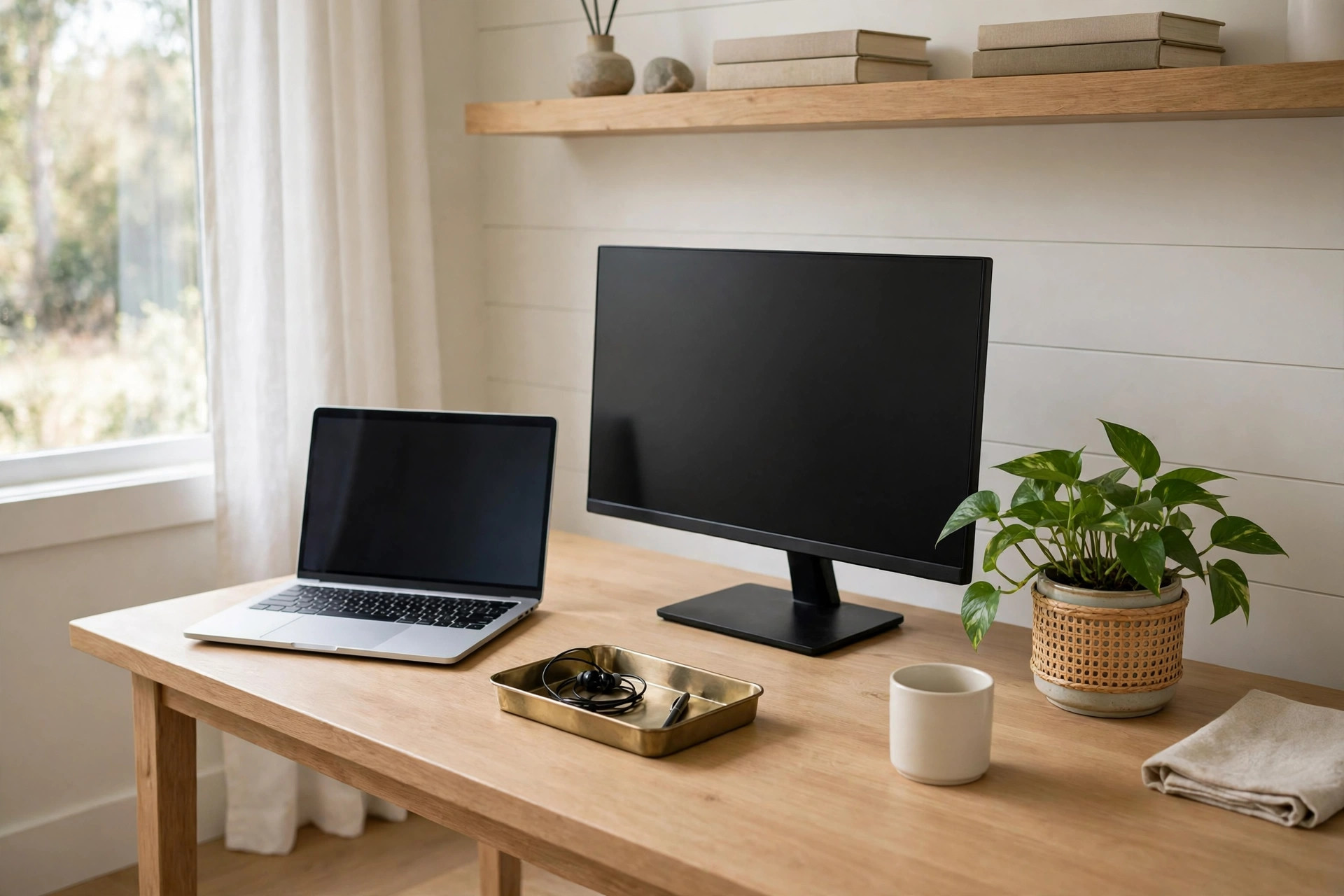
Step 1 — take everything off. Everything: monitor, laptop, papers, mugs, cables, the lot. Wipe the desk. A clear desk resets your sense of how much space you actually have, which on a small desk is usually more than the clutter suggested.
Step 2 — sort into four piles. Daily (used every workday), weekly, rarely, and not-desk-at-all. Be strict: most people find the daily pile is only five to eight items — screen, keyboard, mouse, notebook, pen, phone, water or coffee, and one personal item.
Step 3 — only the daily pile goes back on the desk. Weekly items go in a drawer or on a shelf. Rarely items leave the desk area entirely. Not-desk items go back to the room they belong in. This is the step most tidying attempts skip, and it is why their desks re-clutter within a week.
Step 4 — give every returning item a home position. Not roughly on the desk — a position. The tray lives at the back left, the notebook to the right of the keyboard. When everything has a position, resetting the desk at the end of the day takes two minutes instead of twenty. If cables are half your mess, fix them alongside this clear-out with our guide to home office cable management ideas to hide every cord — organizers cannot compensate for a cable nest.
On-Desk Organizers: What Earns a Place on the Surface
1. Monitor Riser or Desk Shelf That Creates a Second Level
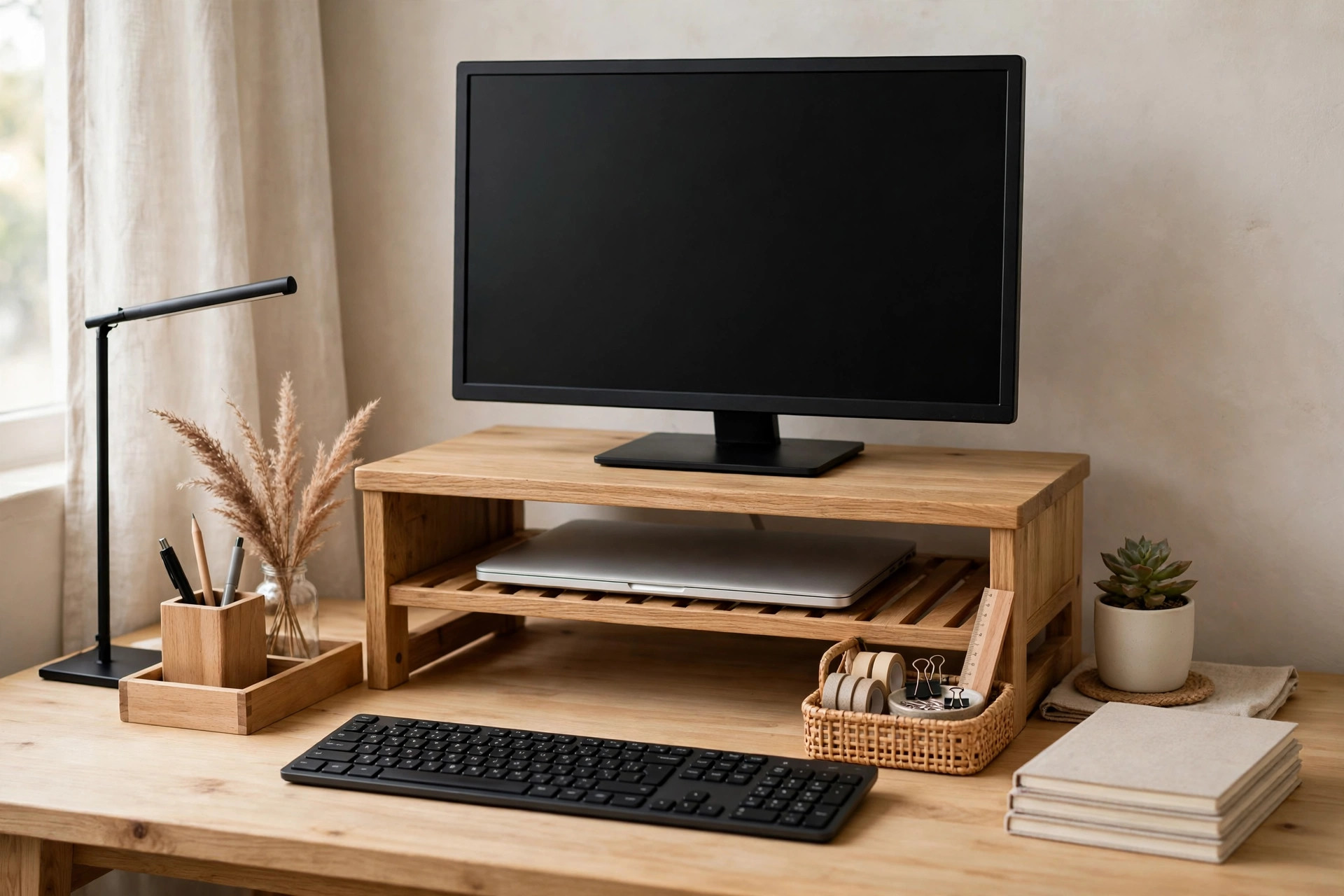
A monitor riser is the single highest-value organizer on a small desk. It lifts your screen 4 to 5 inches — to eye level, which your neck will notice within a day — and creates a storage slot underneath roughly the width of a laptop, perfect for a closed laptop, keyboard at the end of the day, or a notebook.
Look for: a riser 20 to 24 inches wide on a small desk, sturdy enough for your monitor's weight, with an open front so the space underneath stays usable. Wood and bamboo versions double as a desk shelf for a plant or speaker. Price: $25–$70. Best for: almost every small desk — start here.
2. One Single Catch-All Tray — And Only One
A tray does not organize by itself; it organizes by setting a boundary. Everything small that lives on your desk — earbuds, lip balm, keys, a watch, sticky notes — must fit inside one tray about 10 to 12 inches long. If it does not fit, something leaves. That rule is the whole system.
Look for: a low tray with a rim, in metal, leather-look or wood — something that looks intentional, because it sits in view all day. One tray, not a tray plus a pot plus a dish. Price: $10–$25. Best for: desks that collect small random items.
3. Monitor Arm That Gives the Desk Its Corners Back
A monitor's own stand wastes the most valuable real estate on a small desk: the space directly in front of you. A clamp-on monitor arm lifts the screen off the surface entirely, frees the area underneath for a notebook, and lets you push the screen back further than most stands allow — which matters when a small desk is only 20 to 24 inches deep.
Look for: an arm rated for your screen's weight and size, with a clamp that fits your desk edge thickness. Check the back of your desk has clearance for the clamp before ordering. Price: $30–$90. Best for: shallow desks and dual-purpose setups. It also pairs well with the setups in our small home office standing desk ideas that fit tight rooms, where every inch of depth counts.
4. Laptop Stand That Doubles as Docking Space
If you work from a laptop, a stand lifts it to a usable screen height and — just as important — creates a defined parking spot. Under and around most stands there is room for an external drive, a dock, or the laptop's own charger, corralled in one place instead of spreading across the desk.
Look for: a fixed stand at about 6 inches high for use with an external keyboard, or an adjustable one if you type on the laptop itself. Aluminium stands dissipate heat best. Price: $20–$45. Best for: laptop-only workers.
5. Cable Anchors That Stop Cords Sliding Away
Half of desk mess is cables that will not stay where you put them. Small weighted or adhesive cable anchors along the back edge of the desk hold your charging cable, monitor lead and lamp cord in fixed slots, so they stay reachable but never pool on the surface or slide to the floor.
Look for: a strip or a set of individual clips in a colour close to your desk, placed along the back edge where your hand naturally reaches. Combine them with one cable run under the desk, not three separate ones. Price: $8–$18. Best for: anyone with more than two cables — which is everyone.
Drawer Organizers: The Storage You Cannot See
6. Drawer Dividers That End the Junk Drawer
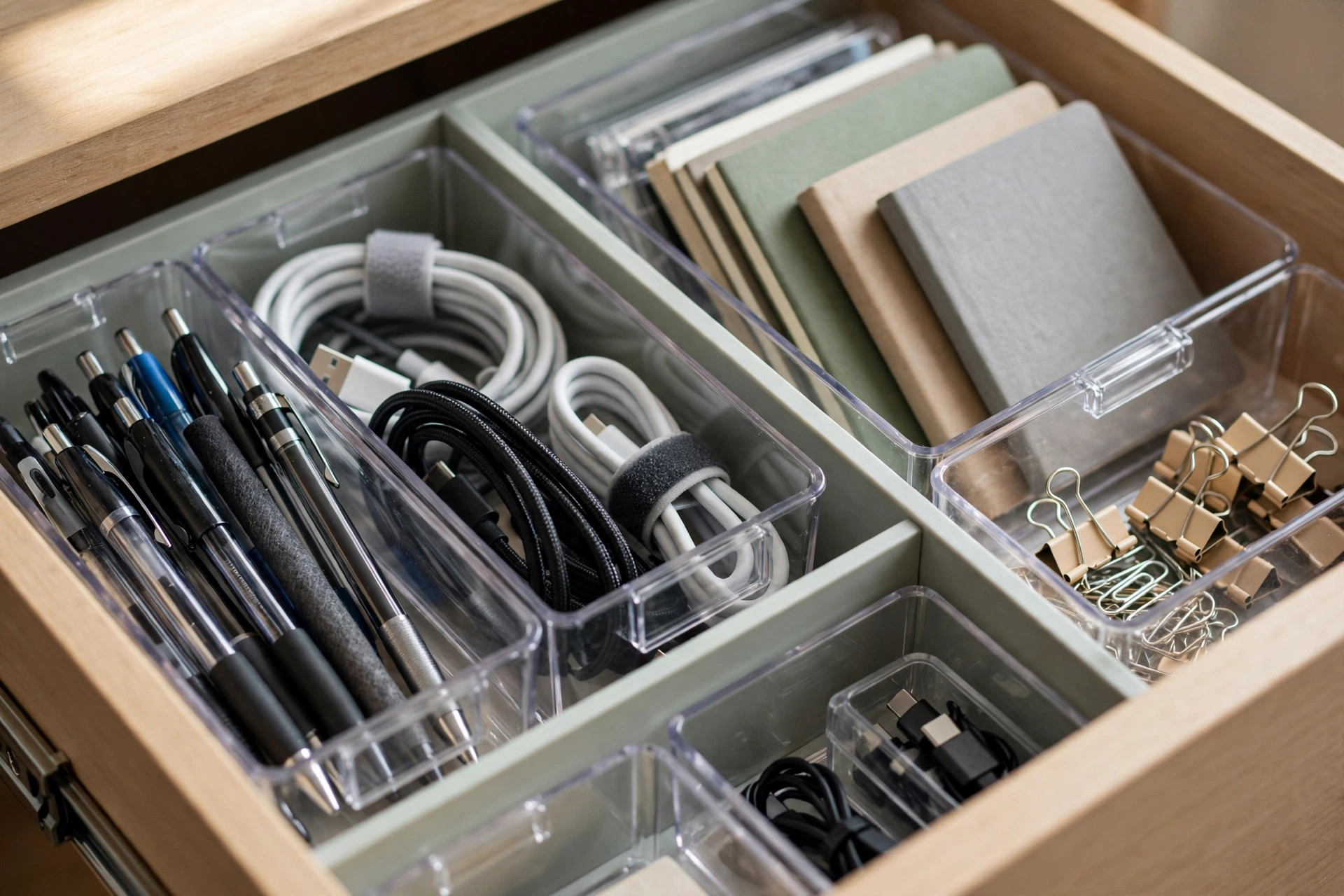
A desk drawer without dividers becomes a junk drawer within a month — not because you are untidy, but because loose items migrate and bury each other. Simple adjustable dividers or a set of small trays split one drawer into zones: pens, tech, tools, personal. You can find anything in two seconds, and — more important — putting things back is effortless.
Look for: dividers that adjust to your drawer's exact width, and measure the drawer depth before buying tray sets — many desk drawers are only 2 to 3 inches deep inside. Price: $12–$28. Best for: every desk with at least one drawer.
7. Clear Bins So You Can See What You Own
Clear bins beat pretty opaque boxes for one reason: you can see the contents without opening anything, so you stop buying duplicates of tape, batteries and cables you already own. Use them inside drawers and on shelves for grouped categories — one bin for cables and adapters, one for stationery refills, one for printer supplies.
Look for: stackable bins sized to your drawer or shelf depth, bought as a matching set so they tile neatly instead of wasting gaps. Price: $12–$30 for a set. Best for: supply hoards and shared desks.
Vertical Organizers: Use the Wall, Free the Desk
8. Pegboard Above the Desk for Tools You Use Daily
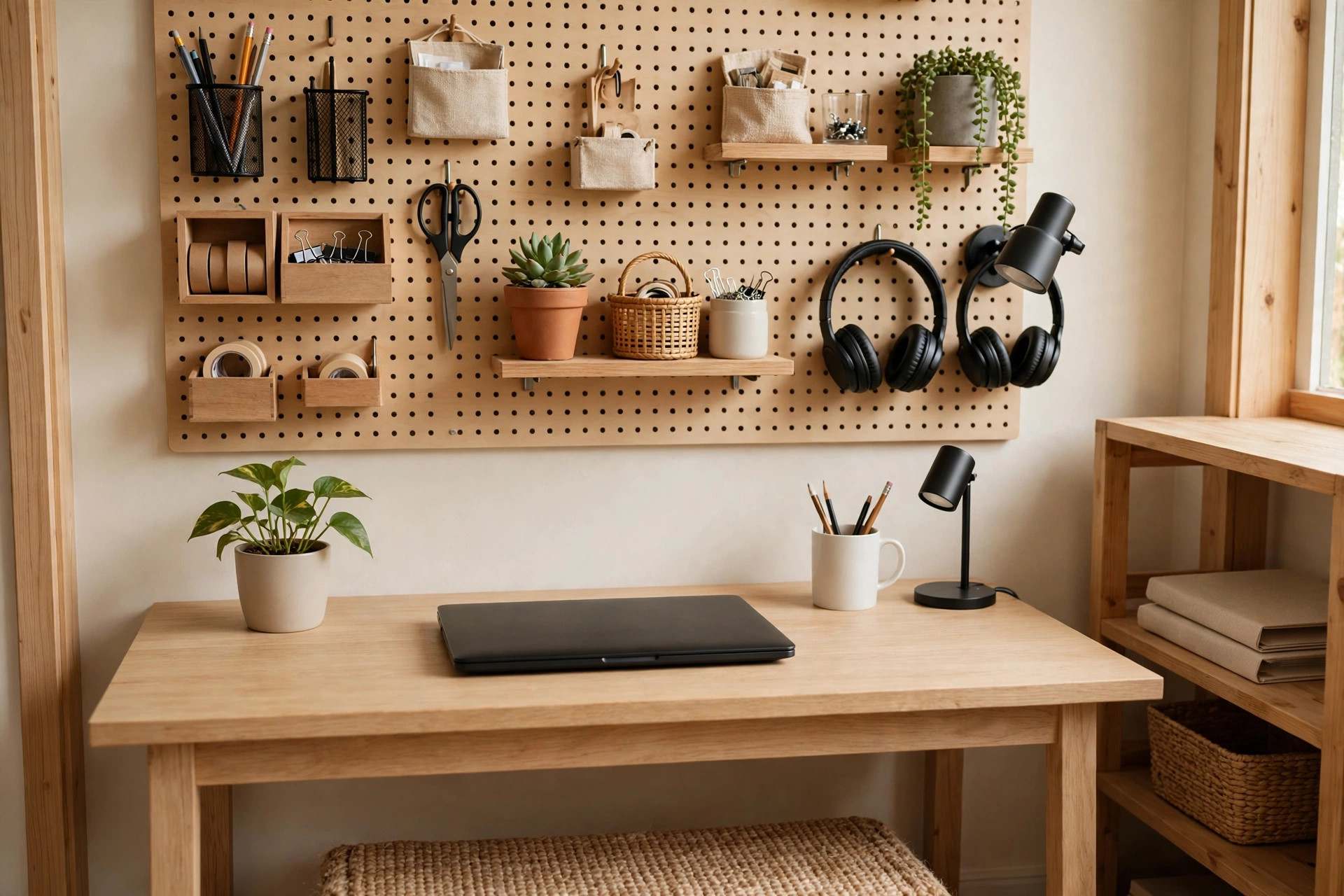
A pegboard turns the dead wall above your desk into storage for scissors, headphones, cables, tape and small baskets — visible, reachable, and completely off the surface. Mount it so its bottom edge sits about 18 to 24 inches above the desk: close enough to reach seated, high enough that nothing on it crowds your screen.
Look for: a board at least as wide as your monitor zone, typically 24 to 36 inches, with a mix of hooks, small shelves and cups. Keep it to daily and weekly tools only — a pegboard stuffed with rarely used items is just wall clutter instead. Price: $20–$50 plus accessories. Best for: desks with no drawers, craft and maker work.
9. Floating Shelves for the Weekly Pile
One or two floating shelves above or beside the desk hold the weekly pile — reference books, a printer-adjacent paper stack, a plant, headphones on a hook underneath — at eye level but off the work surface. On a small desk this is often the difference between a clear desk and a permanently half-buried one.
Look for: shelves 24 to 36 inches long and 6 to 8 inches deep — deep enough for books, shallow enough not to loom over you. Fix into studs or use proper wall anchors; a shelf of books is heavier than it looks. Price: $25–$60 per pair. Best for: book and reference-heavy work.
Paper Organizers: Stop the Pile Before It Starts
10. Vertical File Holder Instead of a Flat Stack
Paper stored flat becomes a pile; paper stored vertically becomes a file you can flip through. A simple vertical file holder or letter sorter on the desk — or better, on a shelf — holds current projects upright, visible and separate, in about 4 inches of desk width instead of a spreading stack.
Look for: 3 to 5 sections, sturdy dividers, and a footprint you have actually measured against your remaining desk space. If paper is your main battle, our full guide to small home office paper organization ideas that end desk piles goes deeper on sorting and filing routines. Price: $12–$28. Best for: anyone whose desk grows paper stacks.
11. The 3-Folder System That Keeps Paper Moving
Three folders, labelled Act, File and Waiting, handle almost all incoming paper for a home worker. Act: needs something from you this week. File: keep, but nothing to do. Waiting: blocked on someone else. Every sheet that arrives goes into one folder the day it arrives — no fourth category, no desk stack "to sort later". Review Act every Monday, empty File into your real filing monthly.
Look for: three distinct colours so you can grab the right folder without reading labels, kept in your vertical holder, not flat on the desk. Price: $5–$12. Best for: paper that arrives faster than you process it. For broader desk-styling inspiration alongside systems like this, the EffyDesk guide to creative desk organization ideas is a useful companion read.
12. An End-of-Day Reset Tray by the Door Side of the Desk
The last organizer is a habit disguised as an object: one small tray or basket at the edge of the desk where everything that must leave the desk — post to send, items to return, tomorrow's bag contents — collects during the day. It stops exit items from colonising the work surface, and it gives your two-minute end-of-day reset a destination: desk items to their home positions, exit items to the tray, done.
Look for: nothing special — a tray about 8 to 10 inches across you already own works. Its power is the routine, not the product. Price: $0–$15. Best for: desks that look fine at 9am and feral by 5pm.
What to Buy First: A Small-Desk Priority Order
- Under $25 total: one catch-all tray, cable anchors, and the 3-folder system. This alone clears most small desks.
- Around $50–$80: add a monitor riser or laptop stand — the biggest single space and posture win.
- Around $100–$150: add drawer dividers and clear bins, then a vertical file holder.
- If you have wall space: a pegboard or floating shelves before any more on-desk storage — vertical always beats surface on a small desk.
- Skip for now: multi-piece desk organizer sets with a dozen compartments. Most compartments end up holding things that should not be on the desk at all.
5 Mistakes That Keep a Small Desk Cluttered
- Buying organizers before clearing. You end up organizing items that should have left the desk entirely. Clear first, measure second, buy third.
- Too many small containers. Five tiny pots hold less, and look busier, than one tray with a strict boundary. Fewer, bigger homes beat many small ones.
- Storing paper flat. Flat stacks grow and hide each other. Vertical storage — holder, folders, shelves — is the single change paper-heavy desks need most.
- Ignoring the wall. If everything must live on a 40-inch desk, it will not fit, however clever the tray. Pegboards and shelves are desk space you have not used yet.
- No reset routine. Any system re-clutters without a two-minute end-of-day reset. The routine, not the product, is what keeps a desk clear in month three.
Frequently Asked Questions
How do I organize a very small desk with no drawers?
Go vertical and go up. A monitor riser creates storage underneath the screen, a pegboard or floating shelf replaces the missing drawers, and one tray plus a vertical file holder handle the small and paper categories. A rolling cart beside the desk is the other classic answer — it acts as drawers you can move away when you need leg room.
What should actually stay on my desk?
Only what you use every workday: your screen and keyboard setup, a notebook and pen, your phone, a drink, and one or two personal items at most. If an item has not been touched in a full work week, it belongs in a drawer, on a shelf, or out of the office area entirely.
Is a monitor riser or a monitor arm better for a small desk?
An arm frees more surface and suits shallow desks, but costs more and needs a clampable desk edge. A riser is cheaper, needs no installation, and gives you a storage slot underneath — for most small desks, the riser is the better first buy, and the arm is the upgrade.
How do I stop my desk getting cluttered again?
Three habits: everything has one home position, a two-minute reset at the end of each day, and a one-in-one-out rule — a new item on the desk means an old one leaves. Organizers support those habits; they cannot replace them.
How much should I spend organizing a small desk?
Most small desks are transformed for $50 to $100: a tray, cable anchors, folders, and one riser or stand. Spend on the riser or arm first — posture and surface in one purchase — and buy containers last, sized to what survived your clear-out.
The Bottom Line
A clear small desk is not about owning the right organizer set. It is about a surface that holds only daily tools, drawers that are divided instead of dumped in, a wall that does storage work, and paper that moves through three folders instead of settling in piles.
Clear the desk first. Buy one tray and one riser before anything else. Give paper a vertical home. Then stop — and spend the two minutes a day that keep it that way.


Comments
Post a Comment