
12 Small Living Room Coffee Table Ideas That Fit Tiny Spaces
If you are hunting for small living room coffee table ideas, you have probably already bumped your shins on a table that was too big, or stared at a tiny one that held exactly one mug. In a small living room, the coffee table is the piece you walk around, reach across, and look at every day, so getting its size and shape right changes how the whole room feels.
A small room does not mean skipping a coffee table. It means choosing the right one. A well-chosen table holds drinks, books, and remotes without stealing the floor space you need to move. A badly chosen one makes even a tidy room feel cramped.
This guide covers the simple sizing rules designers use, a quick cheat sheet to check against your own sofa, and 12 practical ideas for real tiny spaces — from nesting sets and lift-top tables to glass, drum, and C-shaped designs. Every idea includes honest sizes and price ranges, so you can shortlist what fits your room and budget before you buy.
Before you start, measure your sofa's length, its seat height, and the clear floor in front of it. Those numbers prevent the most common mistake — a table that looked perfect online and is wrong in person.
The Golden Rules for Sizing a Coffee Table in a Small Living Room
Lock in the measurements before you look at styles. These four rules come up again and again in designer buying guides because they are based on how people actually sit, stand, and walk.
Height: match the sofa seat. Your table should be the same height as your sofa seat, or up to 2 inches lower. Most seats sit 17 to 19 inches high, which is why most coffee tables are 16 to 18 inches tall. Much higher feels like a counter; much lower means bending double for every drink. Measure from the floor to the top of your seat cushion and stay at or just below that number.
Length: one-half to two-thirds of the sofa. For an 84-inch sofa, that is roughly 42 to 56 inches at most — and in a small room you will usually land at the shorter end. A table running the full length of the sofa looks heavy and leaves no room at the ends. One far shorter than half looks lost, and the people at the ends have nowhere to set anything down.
Gap: leave 14 to 18 inches. Leave 14 to 18 inches between the sofa edge and the table edge. Less than 14 and you cannot get your legs in and out comfortably. More than 18 and you are leaning and stretching for your cup. People often push the table right against the sofa to "save space" and end up with a room that is harder to use, not easier.
Walkways: keep 24 to 30 inches clear. Main walkways need 24 to 30 inches of clear space. If the table blocks the path from the door to the kitchen, the room will feel cramped however pretty it is. In a tight layout, this rule often decides the shape for you — a round or narrow table that preserves the walkway beats a wide rectangle that cuts it off.
Keep these numbers beside you as you read the ideas below. If a table you love breaks one of them badly, it is probably not right for your room, however good it looks in the listing.
Quick Size Cheat Sheet: Match the Table to Your Sofa
Use this as a starting point, then adjust for your own measurements.
| Your setup | Best shapes | Table size to look for |
|---|---|---|
| 10 x 12 ft room with a standard sofa | Rectangle | 36–44 in long x 18–22 in wide x 16–18 in high |
| Loveseat plus one chair | Oval or square | Oval 28–34 in long, or square 24–28 in |
| Small sectional | Oval or square | 32–40 in long x 20–24 in wide |
| Micro studio or single-sofa nook | Nesting set or lift-top | 24–32 in long x 16–20 in wide |
Two notes. Width matters more than length: shaving 4 inches off the width often frees the walkway. And if you are between sizes, choose the smaller one — a slightly small table is a minor inconvenience; a slightly big one is a daily frustration. Tape the footprint on the floor before ordering and live with it for a day.
If your rug is already in place, the table should sit comfortably inside its borders. Still choosing one? Our guide to small living room rug ideas that make a tiny room feel bigger covers the sizes that pair best with compact tables, so the two pieces work together instead of fighting.
12 Small Living Room Coffee Table Ideas That Actually Fit
1. Round Wooden Coffee Table for Better Flow
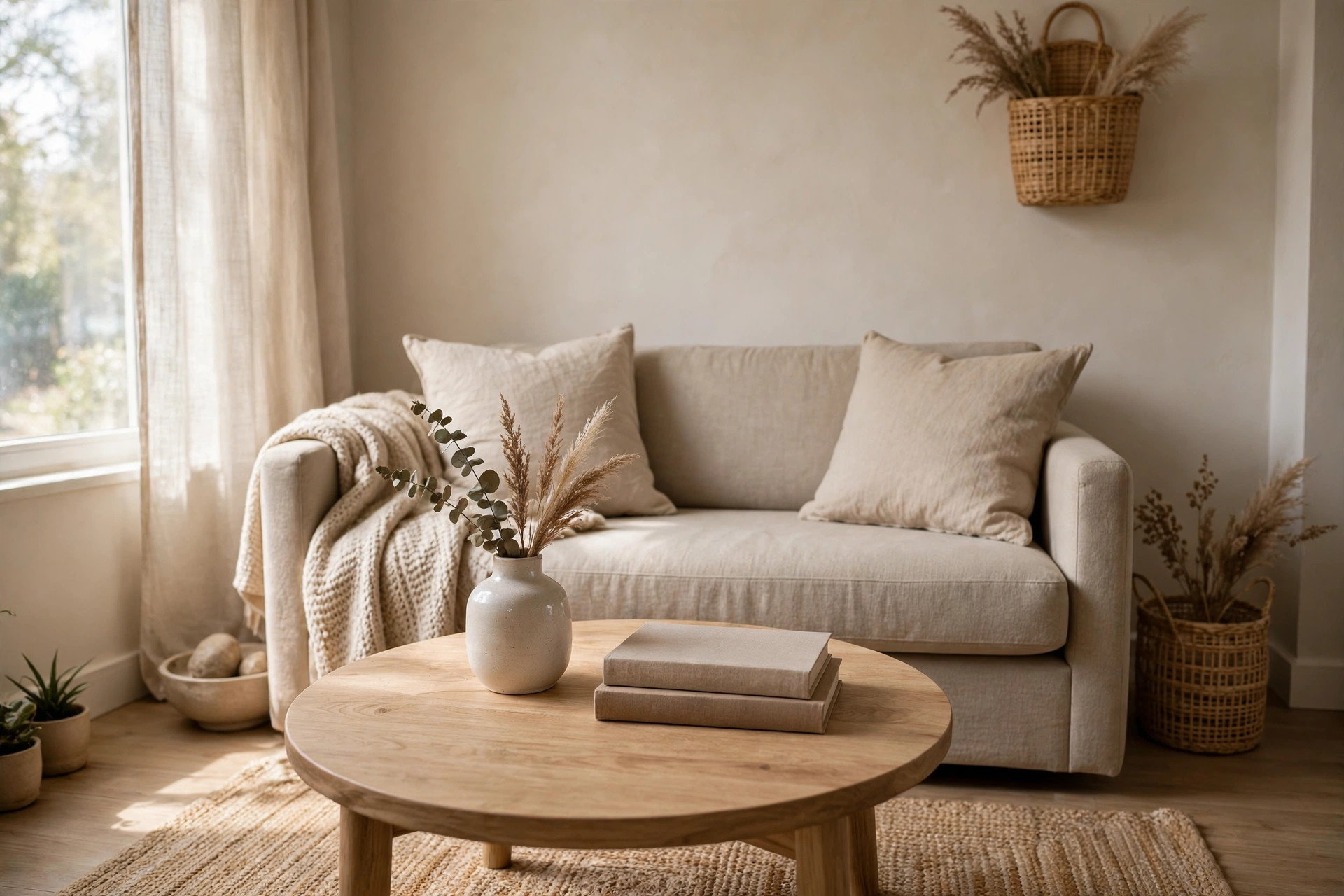
A round table is the classic small-room answer. With no corners, you can walk around it in any direction, which matters when the walkway passes right by the sofa. It is also the safest choice with toddlers or anyone who catches their hip on corners.
Look for: 28 to 36 inches in diameter, 16 to 18 inches high. A 28-inch round still holds a tray, two mugs, and a book stack. Keep the 14 to 18 inch gap all the way around, measuring from the closest edge. Price: $70–$220 for wood and veneer options. Best for: busy walkways, and a loveseat or sofa-plus-chair layout.
2. Oval Coffee Table for Sofas and Sectionals
An oval gives you most of a rectangle's surface with a round table's easy movement. The long, soft shape follows the line of the sofa, so everyone seated can reach it, and the curved ends keep the walkway smooth.
Look for: 32 to 40 inches long and 20 to 24 inches wide for a small sectional, or 28 to 34 inches long in front of a loveseat, at 16 to 18 inches high. Price: $90–$260 — oval tops cost a little more to make than rectangles. Best for: small sectionals and narrow rooms where a rectangle feels boxy.
3. Nesting Tables You Can Tuck Away
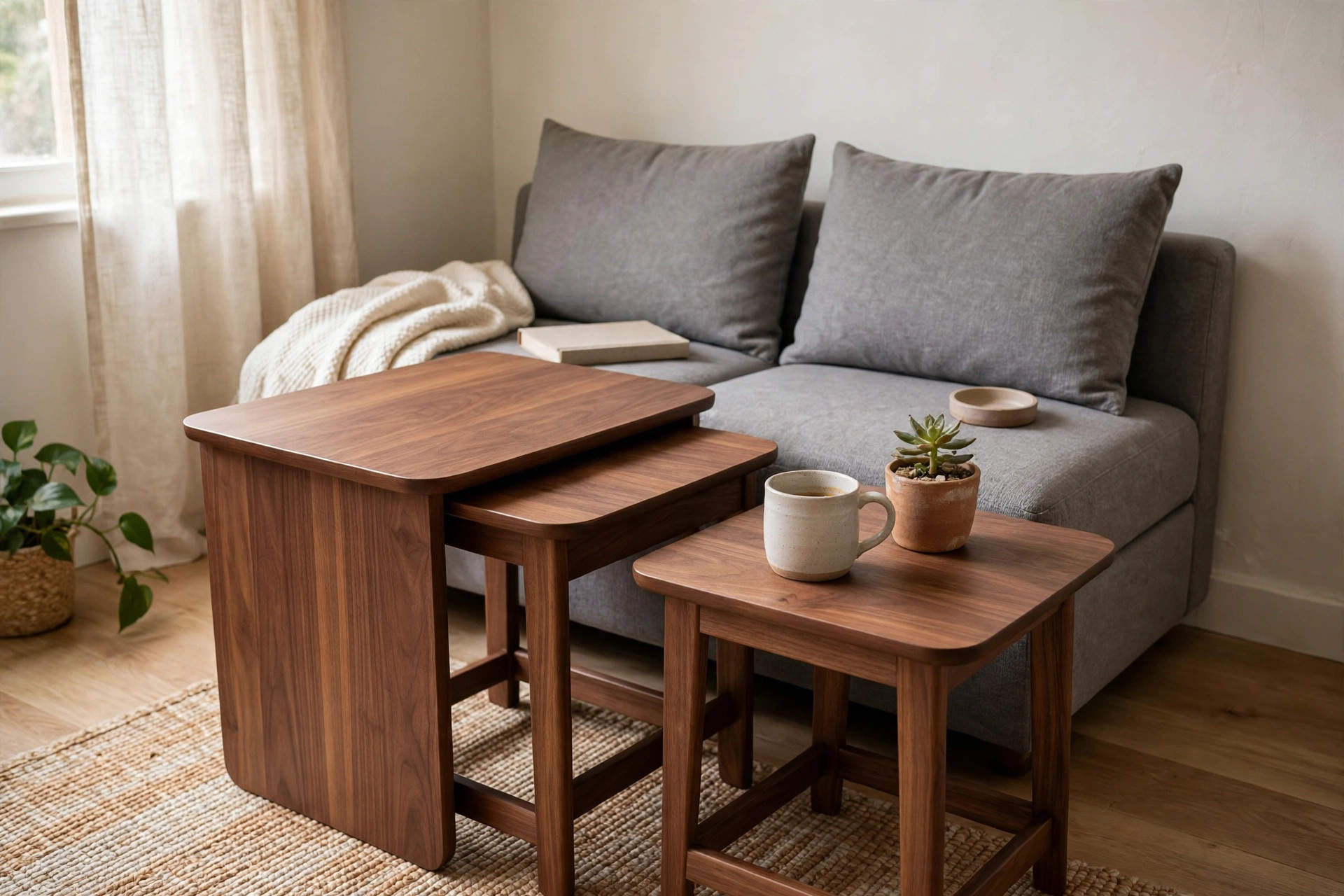
Nesting tables are two or three small tables that slide under one another. Day to day you use the largest as your coffee table. When guests arrive, you pull the others out as extra surfaces, then tuck them away again.
Look for: a set spanning 24 to 32 inches long and 16 to 20 inches wide overall, per the micro-studio sizing above. Check that the smaller tables slide fully under the big one — some sets only overlap halfway and waste the space you were saving. Price: $60–$200 for a set of two or three. Best for: micro studios and renters who host occasionally.
4. Glass Coffee Table That Visually Disappears
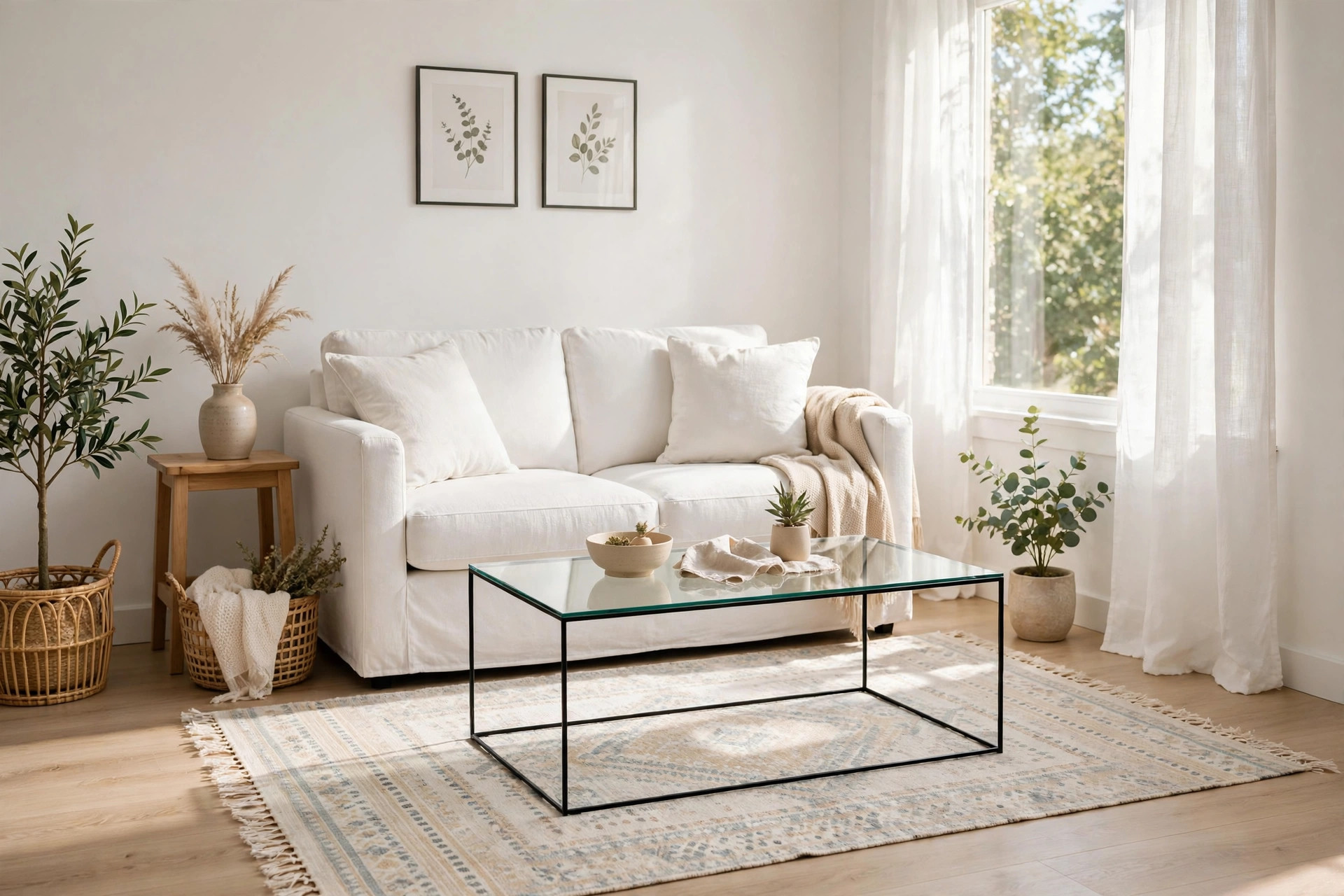
Glass does not make a table smaller, but it makes it look smaller — and in a tiny room that is real. You can see the floor and rug through it, so the space reads as one open area instead of a floor plus an obstacle.
Look for: 32 to 40 inches long and 18 to 22 inches wide, or 30 to 34 inches round. Choose tempered glass, 8 to 10 mm thick, on a slim metal or light wood frame — a chunky dark frame defeats the purpose. Price: $80–$280. Fingerprints show quickly, so expect a quick weekly wipe-down. Best for: dark small rooms and rugs you want to show off.
5. Clear Acrylic Table for the Lightest Look of All
Acrylic goes a step further than glass. A clear acrylic table is almost invisible from across the room, which helps in very small apartments and in rooms already full of pattern and colour.
Look for: 30 to 36 inches long and 16 to 20 inches wide. Acrylic can flex under heavy loads, so check the weight limit if you stack books — many are rated for decor and drinks, not a tower of hardbacks. The one-piece waterfall style is the sturdiest common design. Price: $90–$300; thick, polished-edge acrylic costs more but avoids the cloudy look of the cheapest versions. Best for: the very smallest rooms.
6. Lift-Top Coffee Table With Hidden Storage
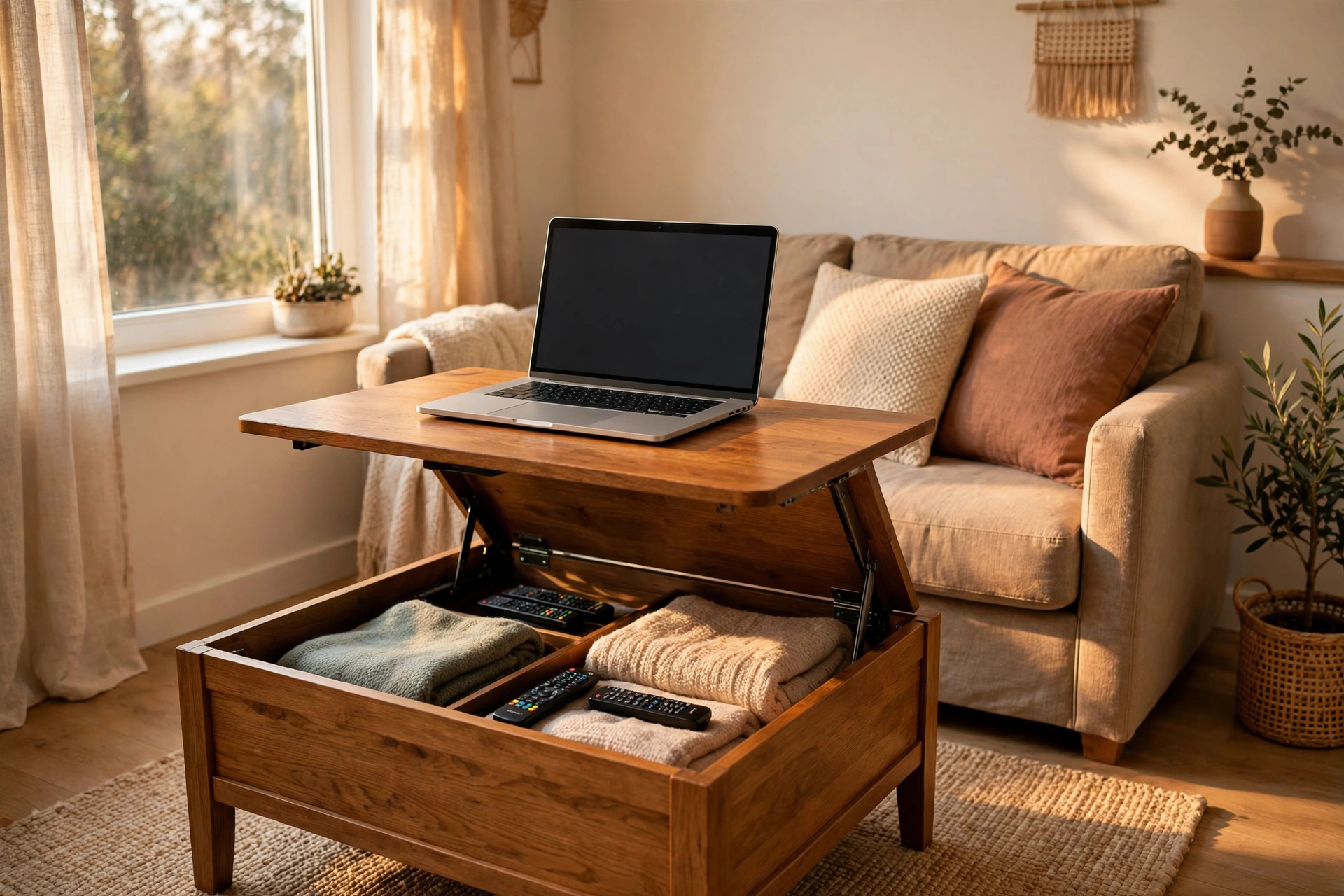
A lift-top looks like a normal table until you lift the top, which rises toward you to become a work or dining surface at sofa height — and reveals storage underneath for remotes, chargers, blankets, and a laptop.
Look for: 24 to 32 inches long and 16 to 20 inches wide for a micro studio, or up to 40 inches long if your sofa allows. The mechanism should rise smoothly and hold without wobbling, the closed height should still be at or up to 2 inches below seat height, and the raised height should let your wrists sit comfortably if you type on it. Price: $110–$350. Best for: studios and anyone who works or eats on the sofa.
7. Storage Ottoman With a Tray on Top
An ottoman is the softest coffee table substitute. Add a firm tray and it holds drinks safely; remove the tray and it is extra seating or a footrest. Many small ottomans are hollow, adding hidden storage for throws and games.
Look for: 28 to 36 inches long and 18 to 22 inches wide, close to sofa seat height so feet and trays sit level. Choose a tray with raised edges and handles, slightly smaller than the top, so it does not slide — on textured fabric, a tray is not optional. Price: $60–$200, plus $15–$40 for a tray if one is not included. Best for: families and flexible extra seating.
8. Open-Shelf Coffee Table That Stores Without Bulk
An open lower shelf gives you a second surface for books, baskets, and a laptop, without the visual weight of drawers or a solid box base. You can see through the open sides, so the table still feels light, but everyday clutter has a home that is not the tabletop.
Look for: 36 to 44 inches long and 18 to 22 inches wide for a standard sofa in a 10 x 12 ft room, 16 to 18 inches high. If you plan to store baskets, check for 8 to 10 inches of shelf clearance. Price: $70–$240 — one of the best-value styles. Best for: book lovers and rooms with almost no other storage.
9. Drum Table for a Small but Solid Footprint
A drum table is a short cylinder that works like a large side table placed centrally. It takes little width while offering a complete round top, and hollow lidded designs hide a surprising amount inside.
Look for: 24 to 30 inches in diameter, 16 to 18 inches high. A drum reads heavier than a leggy table of the same size, so stay at the smaller end unless your room is very light elsewhere. Rattan and light metal feel lighter than dark solid wood. Price: $60–$220. Best for: a single statement piece in a tiny seating area, and sectional corners where a rectangle will not fit.
10. C-Table That Slides Over the Sofa
A C-table's base slides under the sofa and its top cantilevers over the seat or arm, borrowing space above the sofa instead of floor space in front of it. One will not replace a full table for a family, but as a personal surface for a laptop, drink, and phone it is unmatched — and a pair can serve a loveseat with no central table at all.
Look for: a top about 16 to 24 inches long and 10 to 16 inches wide. Measure the gap under your sofa first: most C-tables need 1 to 2 inches of clearance and a top height of about 24 to 28 inches to clear the arm. A weighted, wide flat base wobbles least. Price: $40–$120 each. Best for: sofa laptop work and rooms where even a 24-inch central table blocks the walkway.
11. Two Small Tables Instead of One Big One
Splitting one table into two gives you options no single table can. Push them together for movie night, separate them so each seat has its own surface, or move one across the room. Two small tables, each 18 to 24 inches across, are also easier to carry and to fit through narrow doors than one large table.
Look for: matching heights — both at sofa seat height or up to 2 inches lower, and exactly equal to each other so a tray sits level across both. Pushed together, aim for a combined footprint of about 36 to 44 inches, mirroring the standard rectangle in the cheat sheet. Price: $50–$180 for a designed pair. Best for: awkwardly shaped rooms and renters who move often.
12. Narrow Rectangle for the Tightest Rooms
Sometimes you need a proper rectangular table but the standard width will not work. A narrow rectangle keeps the familiar look and full reach along the sofa, while giving the walkway its inches back.
Look for: 36 to 44 inches long but only 16 to 18 inches wide, 16 to 18 inches high. That slim width is the whole point — do not accept a "close enough" 22-inch version, because those extra inches are exactly the clearance your 24 to 30 inch walkway needs. A lower shelf adds storage without adding width. Price: $60–$230. The same depth-first logic shapes our roundup of small living room console table ideas for the wall behind the sofa. Best for: long, narrow rooms and sofa-against-the-wall layouts.
How to Style a Small Coffee Table Without Cluttering It
A small tabletop fills fast, so use a formula. Start with a tray: it groups small items into one tidy zone and makes the surface look intentional. Inside it, place one practical stack — two or three books, or a small box for remotes. Add one natural element, like a small plant or a bowl of pinecones in autumn, and one taller item, such as a candle, for height.
Leave at least a third of the surface empty. That is where cups and laptops actually go, and it keeps the table calm instead of crowded.
Seasonal touches should swap, not stack — when you add fall pieces, remove something else. For ready-made combinations scaled to small tables, see our fall coffee table decor ideas. For more measurement examples behind this guide, the Povison coffee table buying guide for small living rooms is a useful companion read.
5 Styling and Buying Mistakes That Make a Small Room Feel Smaller
- Buying by photo instead of by tape measure. Product photos are shot in large studio sets. Always compare listed dimensions against your sofa length, seat height, and the 14 to 18 inch gap rule before ordering.
- Choosing a table taller than the sofa seat. Even 3 inches too high makes the table feel like a barrier. It is the fastest way to box in a small space, and no styling fixes it.
- Filling every inch of the top. If you cannot set down a mug without moving something, the styling has gone too far. Edit back to the tray formula above.
- Ignoring the walkway. If people turn sideways to pass, the table is the wrong shape or in the wrong place. Switch to a round, oval, or narrower option instead of training everyone to squeeze.
- Matching everything to the sofa. The same wood tone everywhere can make a small room feel flat and heavy. One contrast — glass against wood, a black metal frame against a light sofa — adds definition without adding an inch of furniture.
Frequently Asked Questions
How far should a coffee table be from the sofa?
Leave 14 to 18 inches between the sofa edge and the table edge — enough to sit and stand comfortably, with everything still in easy reach. If people in your home are tall, aim for the 18-inch end.
What is the best coffee table shape for a small living room?
Round and oval are usually best: curved edges keep walkways smooth and remove sharp corners. Glass, acrylic, and narrow rectangles are close seconds — the first two reduce visual bulk, the last suits long, slim rooms. A rectangle wider than 22 inches is rarely right for a truly small room.
How tall should a coffee table be?
The same height as your sofa seat, or up to 2 inches lower. For most sofas that is 16 to 18 inches. Measure from the floor to the top of your seat cushion and use it as your ceiling when shopping.
Can I skip a coffee table in a very small living room?
Yes, and sometimes you should. If even a 24-inch table would block a 24 to 30 inch walkway, use C-tables that slide over the sofa, a storage ottoman that doubles as seating, or nesting side tables you pull out only when needed. You still get a surface for drinks without giving up permanent floor space.
How much should I expect to spend on a small coffee table?
About $40 for a simple C-table up to around $350 for a quality lift-top with storage. Most good small tables — round wood, glass, nesting sets, open-shelf designs — sit between $60 and $260. In this size, the right dimensions and a sturdy build matter more than a premium material.
The Bottom Line
A small living room does not need a compromise coffee table — it needs a correctly sized one. Match the height to your sofa seat, keep the length between one-half and two-thirds of the sofa, protect the 14 to 18 inch gap and your walkways, then choose the shape that solves your room's problem: nesting tables for flexibility, glass or acrylic for visual space, a lift-top for storage and sofa-working, or a narrow rectangle when every inch of width counts.
Measure first, tape the footprint, and buy once. The right small table makes the room calmer and easier to live in every day.


Comments
Post a Comment