
12 Home Office Guest Room Combo Ideas That Work Both Ways
Most spare rooms do two jobs and end up doing neither well: the desk creeps, the bed eats the floor, and a guest visit means a frantic clear-up. Good home office guest room combo ideas solve that conflict first. It works as a calm office most days, then converts to a guest room in about 10 minutes — without moving the desk.
Most layouts below work in a 10 by 11 or 10 by 12 foot room. You need one honest sleeping solution, one compact desk, and a clear rule for what moves on guest night.
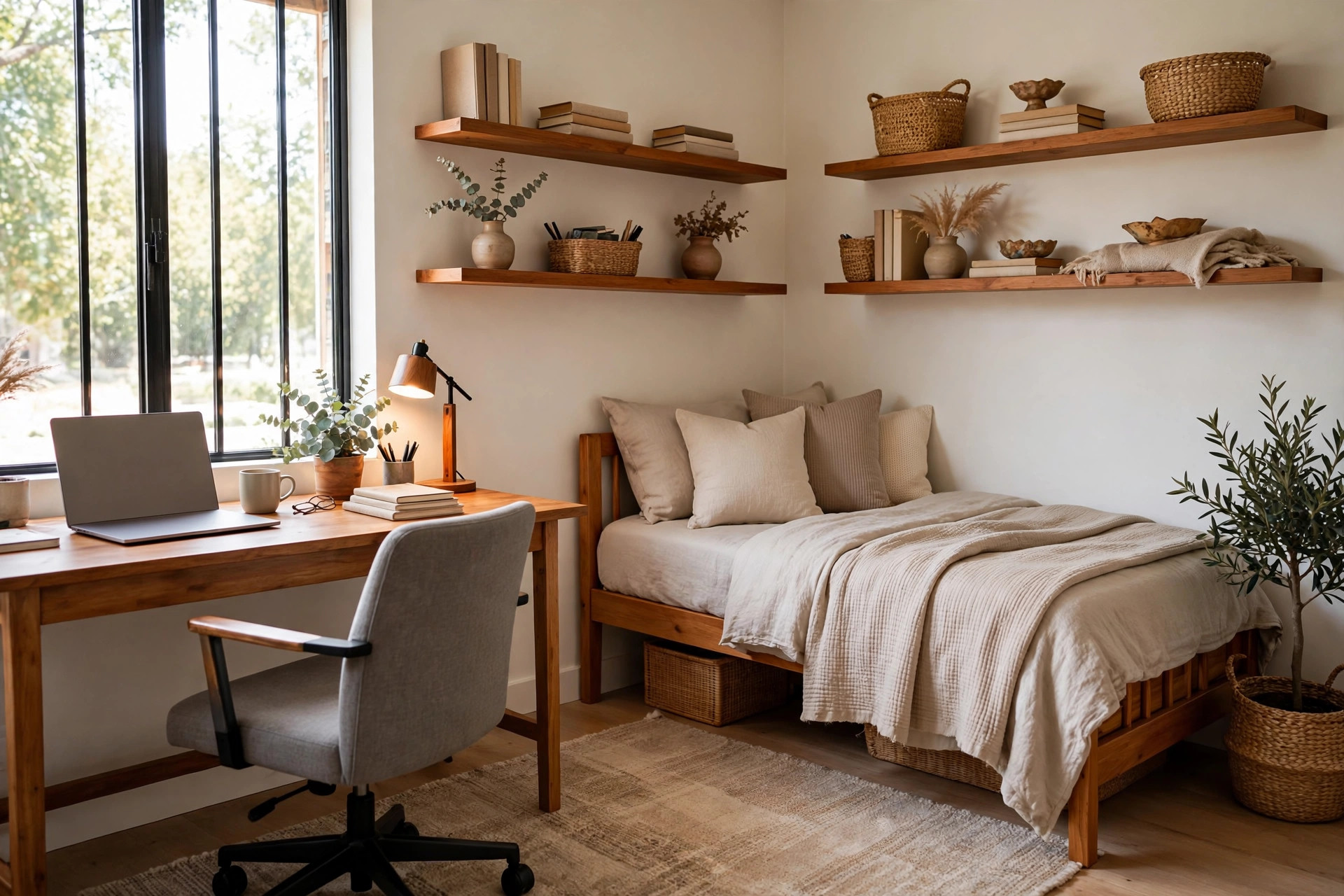
If desk placement and chair clearance are still a guess, read our guide to small home office layout ideas first, then choose a bed for the space actually left.
Plan First: Tape the Bed Open, Protect the Walkway, Fix the Desk
Measure wall to wall, then do the tape test: mark the bed fully open with painter's tape — a queen needs about 60 by 80 inches, a full 54 by 75 inches, a twin daybed 39 by 75 inches. Walk from the door to the desk, pull the chair back, and open every door and drawer with the tape down — if you clip a corner now, you will clip it worse with bedding on.
Keep 30 to 36 inches of walkway between the open bed and the desk, 24 inches beside the bed, and 30 inches behind your chair. Check ceiling height for a vertical Murphy — most queen cabinets stand 82 to 90 inches tall — and check door swings against the open bed.
Fix the desk before you buy the bed. A 48 by 24 inch desk at 29 to 30 inches high holds a laptop, a 27 inch monitor, and a notebook — enough for most people. See also Homelization on home office guest combo ideas and Handwriting With Katherine on office spare bedroom combos: pick a convertible bed first, zone the room, and let everything else support those two jobs. On guest night only three things should move: your chair, one box of desk items, and the bed itself.
12 Home Office Guest Room Combo Ideas That Work Both Ways
Match the idea to how often guests stay. Weekly guests deserve a real mattress; twice-a-year guests should not own your floor plan all year.
1. A Vertical Murphy Bed for a Real Mattress and a Clear Floor
The strongest option if guests stay often. A queen vertical cabinet is about 65 to 68 inches wide and 15 to 18 inches deep closed, opening roughly 85 to 90 inches into the room, with a real 10 to 12 inch mattress. Units run about $1,200 to $2,800; built-ins $3,000 to $6,000 installed. Watch-out: anchor into studs, keep the floor in front clear, and put the desk on a side wall, never in the drop zone.
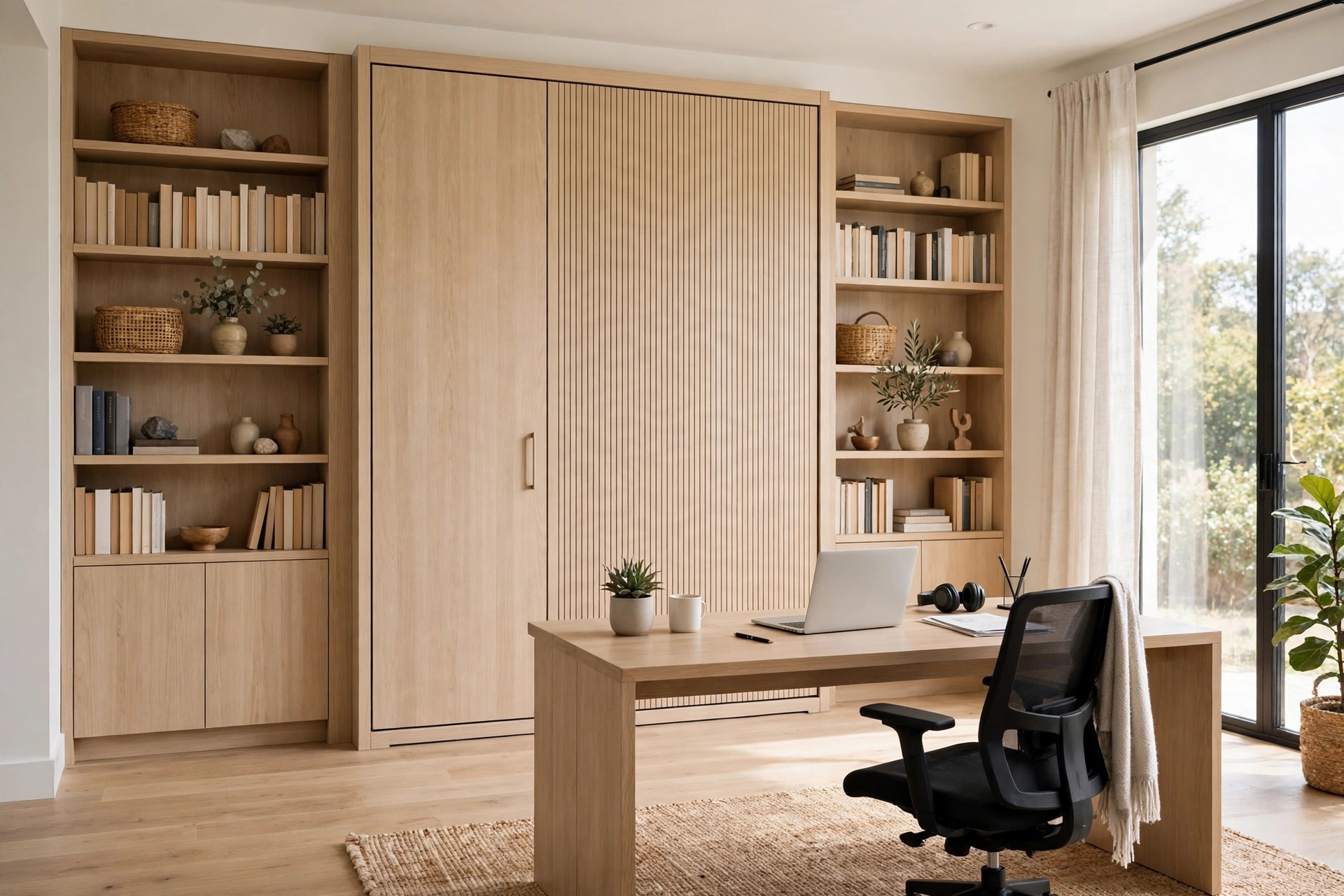
2. A Horizontal Murphy or Cabinet Bed When Ceilings Block You
A horizontal queen opens sideways: wider, about 82 to 88 inches, but only about 65 inches tall, so it fits under a window or sloped ceiling. A cabinet bed is the freestanding cousin — a credenza about 64 inches wide and 23 to 26 inches deep with a tri-fold mattress inside, about $900 to $1,800. Watch-out: tri-fold mattresses are only 5 to 6 inches thick — add a 2 inch topper if it fits, and note this suits two or three nights best.
3. A Daybed With a Trundle for Singles, Kids, and Two Guests
A twin daybed is 39 by 75 inches and, dressed with firm back cushions, sits about as deep as a sofa — seating by day, a proper twin bed by night. Add a trundle and you sleep a second guest without a bigger bed. Daybeds run $300 to $800, a trundle $150 to $350, twin mattresses $120 to $250 each. Watch-out: a low trundle is hard for older guests — choose a pop-up trundle that rises to daybed height.
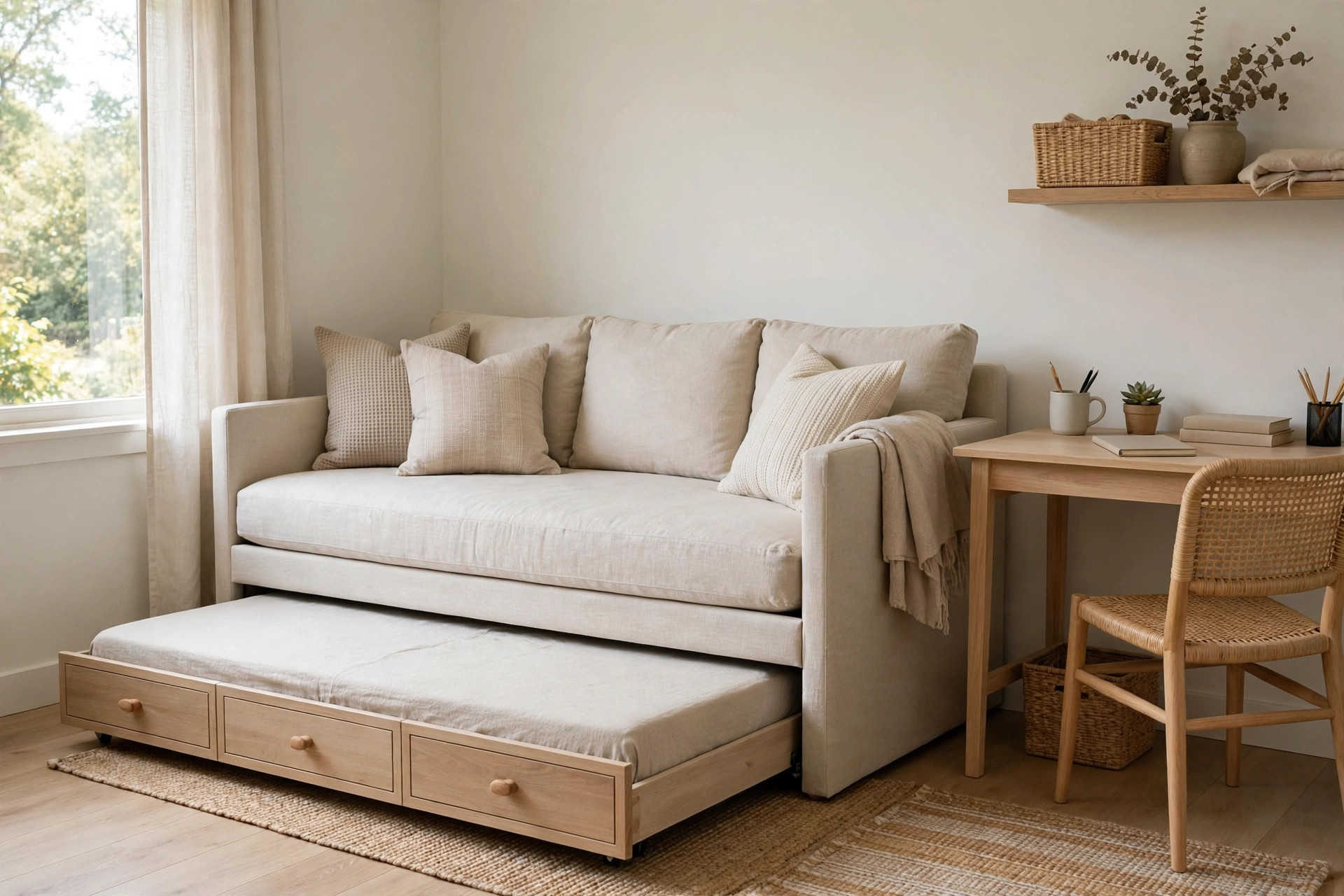
4. A Sleeper Sofa When the Room Must Look Like a Sitting Room
A full sleeper is typically 72 to 82 inches wide and 36 to 38 inches deep closed, opening to about 85 to 90 inches long; a queen sleeper gives couples a 60 by 72 inch mattress. Good sleepers cost about $800 to $2,000. Test the mattress, not just the sofa: 4 to 5 inches, no bar you can feel, and lie on it for five minutes. Watch-out: sleepers weigh 180 to 250 pounds, so measure doorways first. A 2 to 3 inch topper in the closet, about $50 to $90, fixes most complaints.
5. A Sleeper Loveseat or Two Convertible Chairs for Rare Guests
If guests come two or three times a year, do not give them the whole room. A twin sleeper loveseat, about 54 to 64 inches wide, opens to a 39 inch bed and leaves far more desk space. Two sleeper chairs, each 29 to 33 inches wide, sit apart as reading chairs and push together for a wider bed. Loveseats run $600 to $1,400; chairs $250 to $500 each. Watch-out: this is a one-guest, short-stay answer — do not promise a couple a comfortable week on a twin.
6. A Murphy Desk or Fold-Down Desk When the Bed Must Stay
Sometimes the bed is fixed and the office must disappear instead. A fold-down desk, commonly 36 to 48 inches wide and 20 to 24 inches deep open, folds to 4 to 6 inches from the wall; a cabinet version adds storage. Simple tops cost $80 to $250; cabinets $300 to $700. Watch-out: anchor into studs and respect the weight limit, usually 50 to 100 pounds. This suits a laptop worker, not a dual-monitor setup.
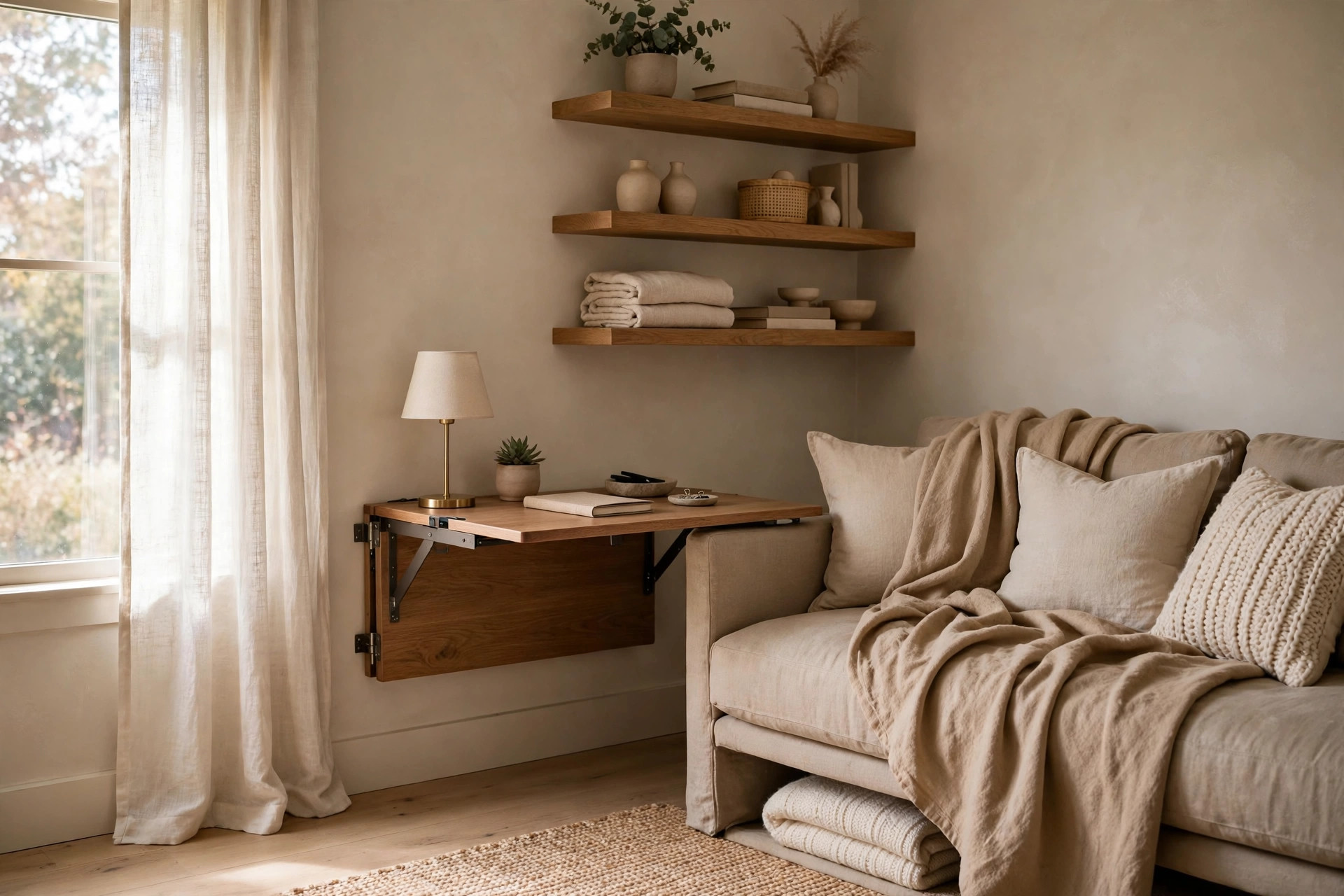
7. A Desk That Doubles as the Guest Nightstand
Place a desk beside the daybed or sleeper so one end becomes the guest's nightstand: clear the last 18 inches for a lamp, carafe, and phone. Keep one drawer permanently empty for chargers, and say so on arrival — that drawer makes the room feel ready. For drawers that stay yours, use the system in our small home office desk storage ideas. Cost is near zero; an organizer is $10 to $20.
8. Work in the Closet, Sleep in the Room
If the closet is 24 inches deep and 48 to 60 inches wide, put the desk inside it and leave the floor for a daybed or sleeper. Close the doors at night and the office vanishes — the cleanest separation on this list. See our step-by-step small closet office ideas covers desk depth, lighting, and power, for about $100 to $300 fitted out yourself. Watch-out: plan an LED strip and leave the doors open while you work.
9. Zone the Room With a Bookshelf, Screen, or Curtain
In a room 12 feet or longer, a low bookshelf — 30 to 36 inches tall, 12 inches deep — placed perpendicular to the wall marks work from sleep without blocking light. A folding screen folds to 4 to 6 inches for storage. A ceiling-track curtain, about $40 to $120, gives a guest real privacy to change. Watch-out: keep dividers low, stable, and out of the 30 inch night path to the door.
10. A Rolling Desk and a Chair That Leaves Easily
Choose a desk on lockable casters, or a light desk under 40 pounds, and a chair that fits through the door easily. On guest night the chair rolls to a hallway corner, the desk slides 12 inches to the wall, and the bed opens — the whole swap should take under 10 minutes. Rolling desks run about $120 to $300. Watch-out: use a low-pile rug in the desk zone and lock the wheels while you work.
11. A Guest Comfort Kit: Blackout, Light, Power, and a Bag Place
Guests judge the room at night, not on your video call. Add blackout curtains, about $25 to $70 per window, a reading lamp, a power strip with USB ports by the pillow, and a folding luggage rack — 24 by 16 inches open, $30 to $60 — so a suitcase never lands on your desk chair. Leave two hangers free. Under $150 total, and it is what guests remember.
12. One Palette, Two Rugs, and a Clean Camera Background
A combo room looks confused when its two halves were decorated in different years. Pick one palette — warm white, one wood tone, one accent color — and repeat it in the chair fabric, daybed cushions, and guest throw. Use two small rugs: low-pile under the desk chair so it rolls, softer beside the bed. Check your video-call background from the chair: a made daybed reads as a sofa on camera; an unmade sleeper reads as a bedroom, and clients notice.
Quick Picks: What to Buy for Your Guest Pattern
- Guests most weekends: vertical Murphy bed, desk on the side wall, blackout curtains. Roughly $1,400 to $3,000.
- Guests once a month: daybed with pop-up trundle, or a tested full sleeper plus a topper. Roughly $600 to $1,500.
- Guests a few times a year: sleeper loveseat or convertible chairs, fold-down desk, luggage rack. Roughly $400 to $900.
- Renters, no wall anchoring: cabinet bed or daybed, rolling desk, curtain divider — no Murphy, it needs studs and permission.
Mistakes That Make a Combo Room Fail
The biggest mistake is buying a queen bed first and fitting an office around it. Next: trusting closed measurements — always tape the bed open. Third: a sleeper bought by sitting, never lying, on it. Fourth: skipping basics — no blackout, no power by the pillow, nowhere for a bag. Last: a 30-minute conversion. If hosting feels like hard work, the room becomes storage.
Frequently Asked Questions
What size room do I need for a home office guest room combo?
A 10 by 10 foot room works with a daybed or twin sleeper and a 48 inch desk. A 10 by 12 is the comfort point for a queen Murphy or sleeper with a 30 to 36 inch walkway. Below 9 by 10, use a closet or fold-down desk with a sleeper chair.
Which is better, a Murphy bed, a daybed, or a sleeper sofa?
A Murphy bed gives the best sleep and clearest workday floor, at the highest price. A daybed gives good sleep for one and doubles as seating, at a mid price. A sleeper sofa suits couples and looks most like living furniture, but sleep quality varies most — test it and budget for a topper.
Can a guest sleep on a sleeper sofa for a week?
On a good sleeper with a 5 inch mattress plus a topper, most guests manage three to five nights well. For week-long stays, especially for older guests, a Murphy or daybed with a real mattress is kinder.
How do I keep the room looking professional on video calls?
Sit with the neatest wall behind you, keep the bed made as seating if it is in frame, and clear the desk except laptop and lamp. Close closet-office doors before a call if the bed is unmade.
Choose the bed for how guests really stay, fix the desk to a size the room can carry, and keep the swap to three moves. Browse our Home Office collection and build the version your room can hold — works hard on Monday, welcomes people on Friday.


Comments
Post a Comment