
13 Small Closet Office Ideas That Feel Like a Real Office
13 Small Closet Office Ideas That Feel Like a Real Office
Small closet office ideas are the difference between a nook you avoid and a workspace you actually want to sit at. A closet that is only 24 inches deep and four feet wide can hold a full workday — laptop, monitor, lighting, and storage — if you get five measurements right. These 13 small closet office ideas start with those numbers, then walk through the desks, lighting, doors, and styling decisions that turn a clothes closet into a cloffice that feels like a real office.
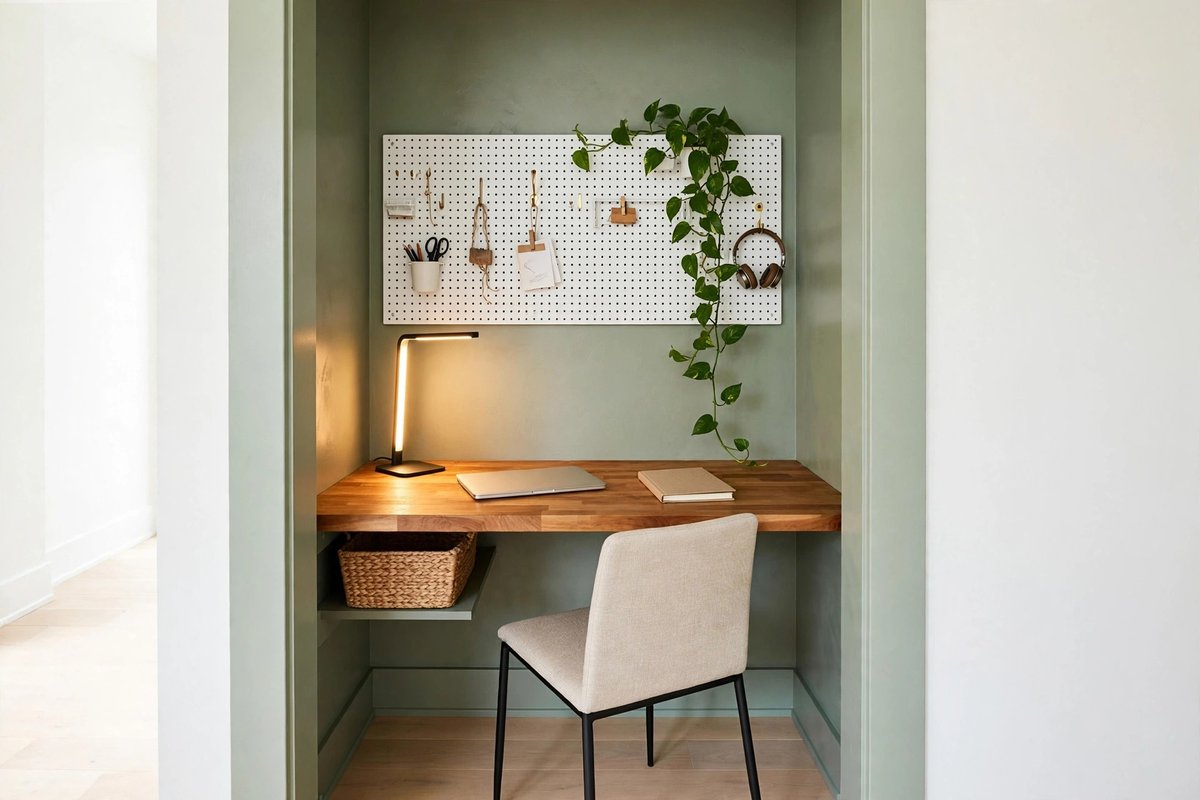
The 5 Numbers That Make or Break a Cloffice
Before you buy a single bracket, write down five numbers. Get them right and the build is painless; skip them and you will be rebuilding in a month.
- 24 inches — the depth of a standard reach-in closet. It is enough for a laptop and keyboard, but not for a deep monitor stand. Plan for shallow furniture and a monitor arm if you need a bigger screen.
- 29–30 inches — standard desk height from the floor. Sit in the chair you will actually use, hold your arms at your sides, and mark the wall at elbow height. That mark is your desk height; it beats any generic number.
- 18–22 inches — the clearance you want between the desk surface and the first shelf above it, so a monitor or laptop screen fits without craning.
- 50 inches — roughly how much vertical wall is left above the desk in a standard 80-inch-tall closet. That is two or three shelves of storage you already own.
- 300 lux — the minimum light target on the desk surface for comfortable office work. A closet's single bulb will not get you there; the lighting ideas below will.
13 Small Closet Office Ideas That Actually Work
1. A Butcher-Block Desktop Cut to Fit Your Closet
The classic cloffice desk is a piece of butcher block or a laminate countertop cut to your closet's exact width, supported by L-brackets on the side walls. For a 48-to-55-inch-wide reach-in, a standard 47¼-inch tabletop fits nearly flush with no cutting at all. The wall-mounted approach costs $30–$90 and leaves the floor completely open, which is exactly what a shallow closet needs.
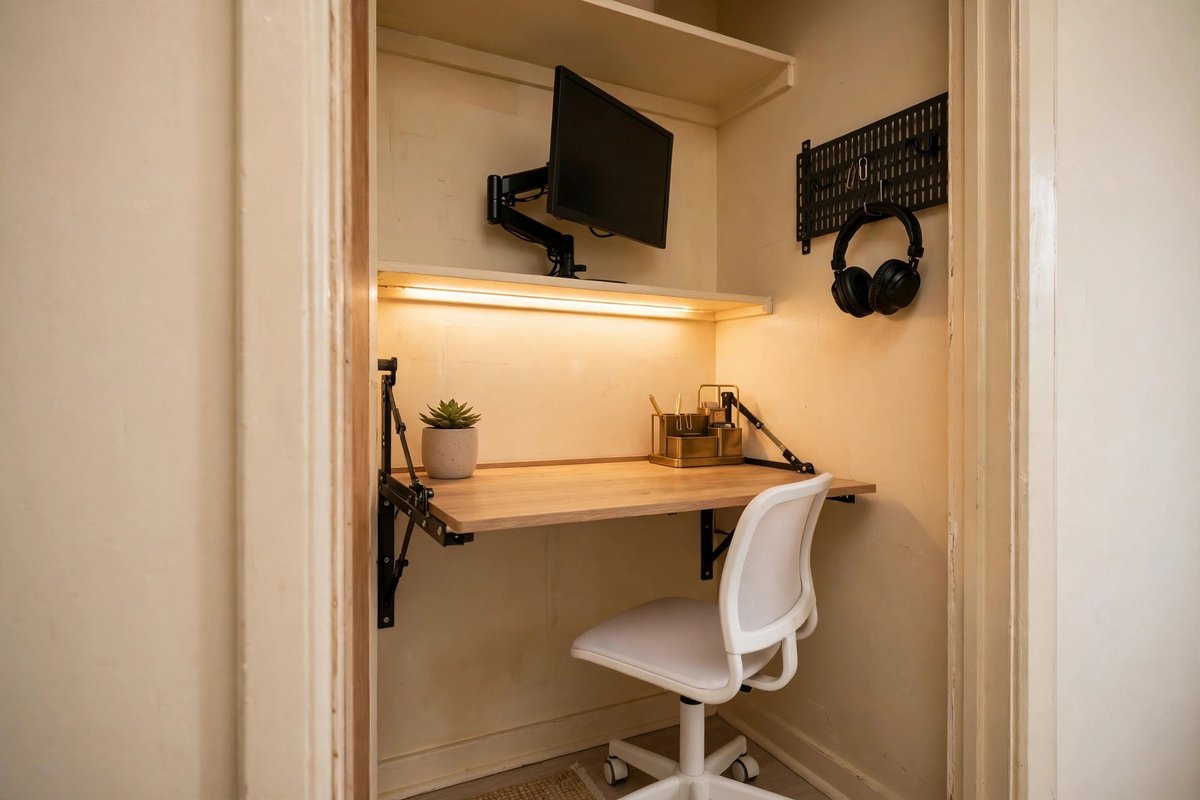
2. A Fold-Down Wall Desk for Narrow Reach-Ins
If your closet is too narrow for comfortable chair clearance, a fold-down desk is the move. Mount it at your 29-inch mark and fold it flat against the wall when the workday ends — the room goes back to being a bedroom in seconds. Choose one with a slim profile (under 3 inches when closed) so it clears hanging organizers beside it.
3. Two Drawer Units as Freestanding Desk Bases
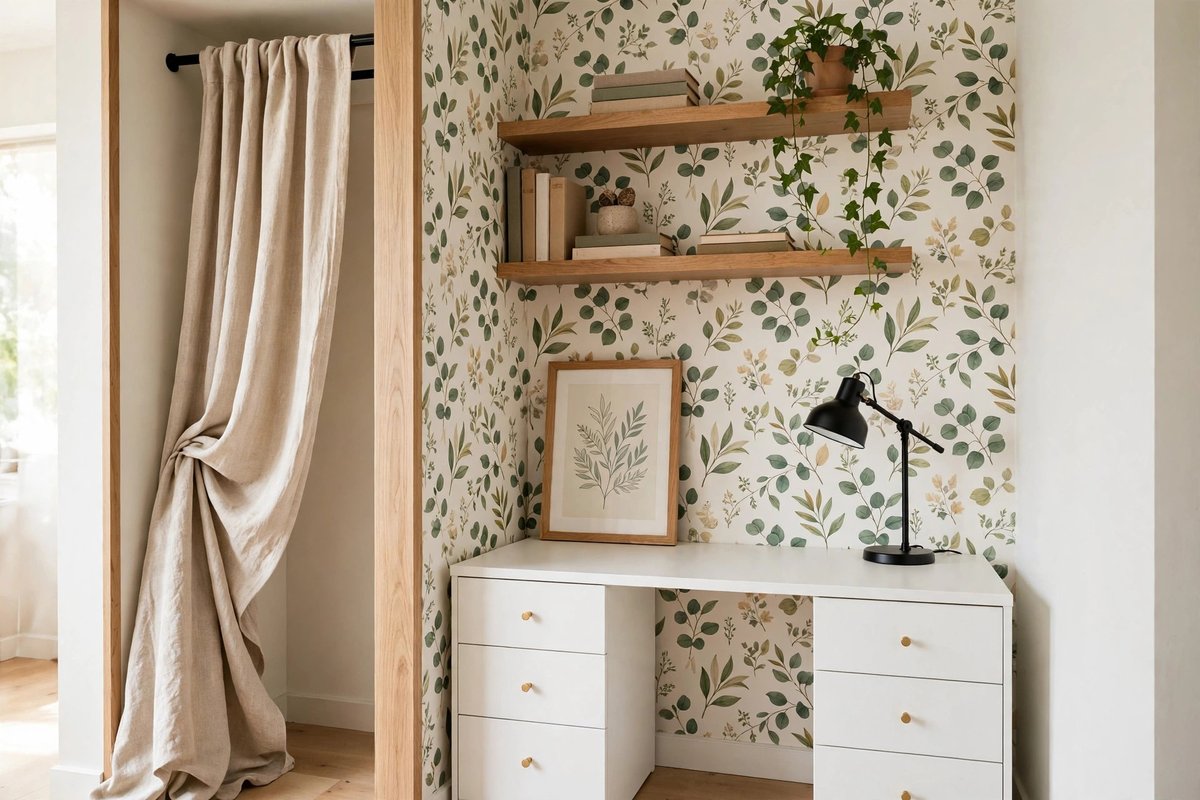
A tabletop resting on two drawer units is the fastest permanent-looking cloffice desk that touches no wall at all. A standard 14-inch-wide drawer unit is almost exactly desk height, so one on each side of a 4-foot closet gives you a rock-solid desk plus four to six drawers of file and supply storage. Renters love this one: it disassembles in minutes.
4. A Pegboard Command Wall on the Back Wall
A 22-by-22-inch pegboard holds scissors, headphones, a small basket of pens, chargers, and notes with just two mounting points — the highest-impact storage in the smallest footprint. Mount it centered over the desk so your everyday tools are at eye level and arm's reach. Small storage cubes for tiny supplies live here rather than in a drawer you'll never open.
5. An Over-Door Organizer on the Inside of the Closet Door
If your closet still has a door, its inside face is free real estate. A clear-pocket over-door organizer holds mail, sticky notes, charging cables, and the manuals you reference twice a year. For bifold doors, adhesive hooks and a magnetic strip on the inside face do the same job without swinging pockets.
6. An Under-Shelf LED Bar Set to 300 Lux
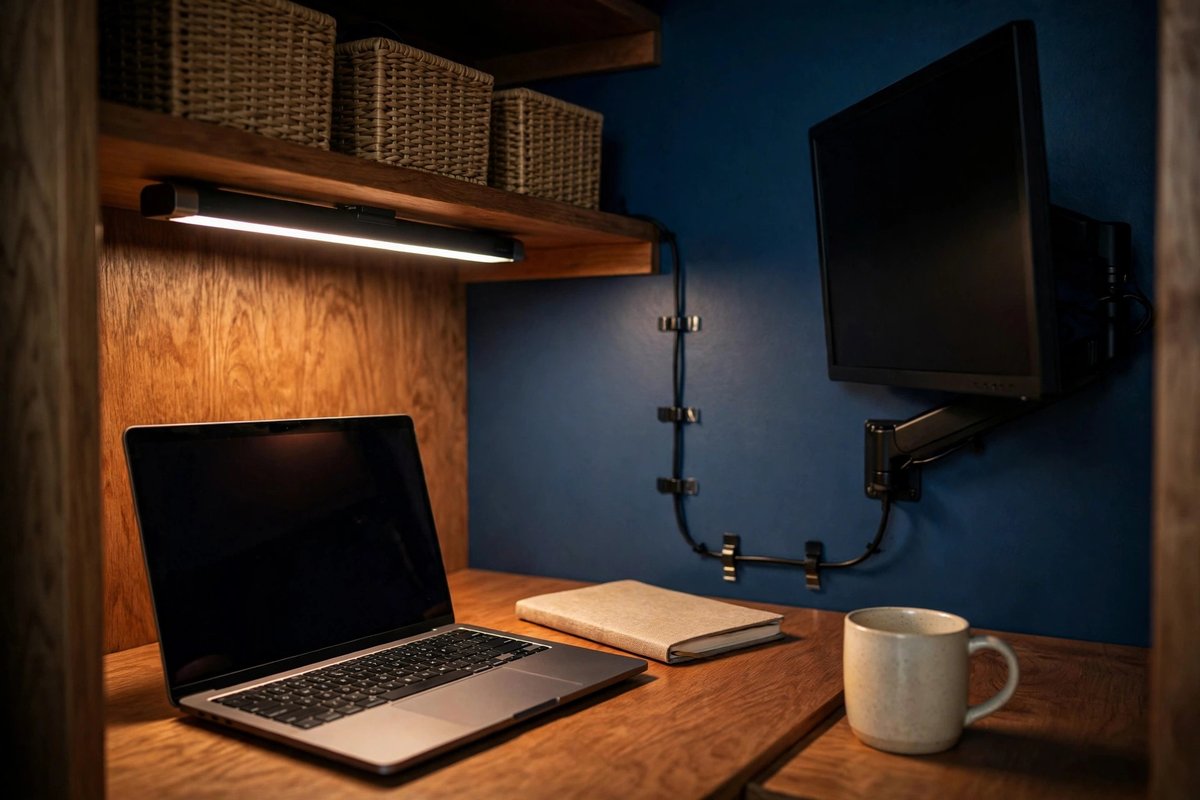
Closets almost never have adequate overhead light, and a desk lamp alone leaves the wall above the desk in shadow. An LED light bar mounted under the shelf above the desk washes the whole work surface in even light — aim for at least 300 lux at the desk. Pick a bar with adjustable color temperature: cooler light (4000K) for focus hours, warmer light in the evening.
7. A Flat-Plug Power Strip and Adhesive Cable Clips
Cables are the fastest way a cloffice turns into a tech disaster. Run a single slim power strip along the back wall at desk level, route cords up to it with adhesive cable clips, and use a flat-profile plug so the desk can push fully back against the wall without leaving a pen-swallowing gap. One clean vertical line of cables reads as intentional; a tangle reads as temporary.
8. A Statement Back Wall in Your 15 Square Feet
The back wall of the closet is your biggest design opportunity, because the space is small enough that one bold move reads as a whole design. Peel-and-stick wallpaper, a single accent color, or even a fabric panel applied with liquid starch transforms the interior from "storage" to "studio." Keep accessories in natural wood and white when the wall is bold — the contrast is what makes it look designed.
9. Make the Door Decision Deliberately
You have three good options, and each one changes how the cloffice feels:
- Remove the door entirely. Take it off the hinges and live with the opening for a week first. Many people discover they never miss the door — and the open connection to the room borrows natural light.
- Hang a curtain on a tension rod. A gathered linen panel closes off the office in seconds at 5 p.m., keeps air moving, and hides work chaos from guests. No drilling, no damage.
- Keep the doors. Closing real doors at the end of the day is the single strongest work-life boundary a home office can offer. If you keep them, add the over-door organizer from idea 5.
10. A Slim Rolling Cart That Parks Beside the Chair
A 15-inch-wide, three-tier rolling cart holds the printer paper, reference binders, and project files that don't earn desk space. Roll it beside the chair while you work, then park it at the back of the closet (or in the room) when you need legroom. It is the cloffice's version of a filing cabinet without the footprint.
11. The 5-Minute Reset Basket on the Lowest Shelf
Place one beautiful basket on the lowest shelf and sweep stray papers, cables, and sticky notes into it at the end of every workday. Sort it once a week instead of letting the mess colonize the desk. Choose something you like touching — a woven seagrass bowl or a heavy ceramic dish — so the reset feels like a small ritual, not a chore.
12. A USB-Powered Fan for the 3 P.M. Stuffiness
Closets heat up fast with a laptop and a person inside, and stale air makes the afternoon slump harder to fight. Clip a small, quiet USB fan to a shelf edge and aim it at the top of the opening. Gentle circulation keeps the space breathable, and it is cheaper and quieter than a purifier in a space this tight. If the closet has an HVAC vent, do not block it — keep that shelf zone clear.
13. A Lightweight Mirror to Double the Light
Mount a lightweight mirror on the inside side wall and it bounces your desk lamp and LED bar back across the work surface, effectively doubling the light you paid for. It also opens the space visually — a 12-by-36-inch mirror makes a 4-foot closet feel like a real room. Hang it with removable strips so renters can take it down clean.
The Renter Cloffice: Reverse Every Change in Under an Hour
If your lease forbids drilling and painting, the cloffice is still fully yours. The rule is simple: furniture that stands on its own, accessories that adhere temporarily. A tabletop on two drawer units instead of wall brackets. Large-format removable strips instead of screws for the pegboard and mirror. A tension rod for the curtain. Peel-and-stick wallpaper that peels off clean from smooth, painted drywall (test a swatch first on textured paint). A clamp-on LED lamp instead of a ceiling fixture, or battery-powered puck lights under the shelf. Keep the closet rod and its hardware in a labeled bag so reinstallation at move-out takes ten minutes. If you are furnishing the rest of a small workspace on the same no-drill principle, our Home Office collection covers storage ideas that work in tight rooms without touching the walls.
Prices and the fit-check numbers
Per-piece prices. Cut-to-fit desktop (idea 1): butcher block runs $40–$90 for a 48–60-inch length, laminate countertop $30–$60; heavy-duty L-brackets $8–$15 a pair, rated about 75–100 lb per pair when screwed into studs — which is the only way to mount them. Fold-down desk (idea 2): $70–$140. Drawer units (idea 3): $40–$80 each at 14 inches wide × about 28 inches tall. Pegboard (idea 4): $15–$30 for the 22×22 panel plus $10 of hooks and baskets. LED bar (idea 6): $15–$30 for a 12–24-inch bar rated 400–800 lumens — at the 12–18 inches above the desk that the shelf clearance gives you, that output lands in the 300-lux zone the opening numbers demand. Power strip with flat plug (idea 7): $15–$25. Rolling cart (idea 10): $25–$45. Mirror (idea 13): $15–$35. Fit checks. Chair: in a 48-inch-wide closet, choose a chair 20–22 inches wide maximum, armless or with arms under 25 inches total width, so it slides fully in and the doors or curtain close. Knee depth: with a 20–22-inch-deep desktop in a 24-inch closet, your knees go under the desk and your chair's front half lives in the room — plan the room-side footprint as roughly 24×24 inches of chair zone. Shelves above the desk: 10–12 inches deep (deeper eats the head clearance the 18–22-inch rule protects), spaced 12–14 inches apart for binders and boxes. Monitor: a 24-inch monitor is about 21.5 inches wide and on an arm sits 4–6 inches off the back wall — the only way it fits a 24-inch-deep closet with a keyboard in front; a 27-inch (24.5 inches wide) fits width-wise in a 48-inch closet but leaves no side room for speakers or a lamp, so the shelf and wall ideas above have to carry them.
Small Closet Office FAQ
Can I really work full-time from a closet office?
Yes, if three things check out: the chair fits and rolls without hitting the door frame (a backless stool or armless task chair solves tight clearances), the desk light reaches 300 lux, and the space ventilates. Thousands of people work full-time from 24-inch-deep reach-ins; the difference between miserable and comfortable is those three checks, not square footage.
How deep does a closet need to be for a cloffice?
A standard 24-inch-deep reach-in works for laptop work, a 24-inch monitor on an arm, and a keyboard. Below that depth, mount a monitor on an arm or use a laptop on a stand with an external keyboard — the arm buys back the inches a monitor stand would eat.
How much does a small closet office cost to build?
Under $100 if you use a reclaimed plank, two heavy-duty L-brackets, a USB LED bar, and a thrift-store lamp. The $100–$500 range is the sweet spot: a proper cut-to-fit desktop, one drawer unit, a pegboard, a quality task lamp, and peel-and-stick wallpaper. Real project walkthroughs like this 4.5-foot closet conversion show how far a modest budget goes.
Should I paint the inside of the closet?
If you own the home, yes — a light color (or one bold accent) makes the space feel deliberate rather than improvised. If you rent, peel-and-stick wallpaper or a fabric panel gives the same effect and reverses cleanly. Either way, paint or cover the ceiling a bright white: it bounces light downward onto your desk.
Three companion guides round out a cloffice build: small desk storage ideas for the drawers and cubbies, our home office cable management guide for the cords, and small home office layout ideas for arranging the nook itself.
A cloffice works because the enclosure is a feature, not a limitation — three walls around you mean fewer distractions and a door (or curtain) you can close on the workday. Once the five numbers are set, the rest is styling. For more compact workspace thinking, from desk-side storage to light plans, browse our full Home Office collection. And if you want the deep-dive companion to this guide — closet-type dimension tables, full budget tiers, and IKEA hacks for every budget — this complete cloffice guide covers what we only had room to summarize.


Comments
Post a Comment