
12 Small Patio Herb Garden Ideas for Fresh Herbs in Tiny Spaces
A small patio is not a reason to buy herbs in plastic packets all year. A few pots, six hours of sun and the right grouping will keep basil, thyme, parsley and rosemary within arm's reach of the kitchen door. The best small patio herb garden ideas work vertically and in clusters — tiered stands, railing planters and wall pockets — so a patio of any size can grow a dozen herbs without giving up its seating, its grill or its walkway.
You do not need a garden bed, a greenhouse or a green thumb with years of experience. You need a sunny spot, containers with drainage, and herbs grouped by how thirsty they are. Below are twelve ideas with real sizes, sun hours, soil temperatures, costs and watch-outs, so your first small herb garden thrives instead of quietly drying out by the second week.
Before you plant, check what your patio already has to hold. Our guide to small patio storage ideas covers the benches and boxes that can double as potting space and tool storage — an herb garden with nowhere to keep its watering can and spare pots gets messy fast.
Plan First: Six Hours of Sun, Drainage and Thirsty-Neighbour Grouping
Rule one: find your sun before you buy a single plant. Most herbs need at least 6 hours of direct sunlight a day, so watch your patio for a day and note which corner actually gets it — on many patios it is one railing or one end of the deck, not the whole space. If your best spot gets less, choose the shade-tolerant herbs: mint, chives and parsley cope where basil will sulk. Small-space herb guides such as Natalie Linda on creating a beautiful herb garden in a small space and Environment.co on herb garden ideas for small spaces start from the same two facts: sun first, and containers with drainage holes, always, because roots sitting in water rot.
Rule two: group by thirst. Mediterranean herbs — rosemary, thyme, sage, oregano — want sun and soil that dries between waterings. The thirstier herbs — mint, parsley, cilantro — want consistently moist soil. Plant them together and one group always loses. Keep each group in its own containers so you can water differently, and always, always give mint a pot of its own: it spreads aggressively and will take over any shared planter within a season.
Rule three: use potting mix, not garden soil, and water by touch. Herbs in small containers dry out quickly, so water when the top inch of soil feels dry rather than by a fixed schedule. Basil is the fussiest starter herb about temperature: it wants soil around 60 degrees Fahrenheit, so on a late-fall patio bring basil pots in on cold nights or treat basil as the first herb to finish when nights turn cold, while rosemary, thyme, sage and parsley carry on much longer.
12 Small Patio Herb Garden Ideas for Fresh Herbs in Tiny Spaces
Work in order: map your sun, pick one structure — tier, trug, railing or wall — then plant in thirst groups with mint alone. Start with four to six herbs you actually cook with, not twelve you admire.
1. Start With a Terracotta Cluster of the Herbs You Actually Cook
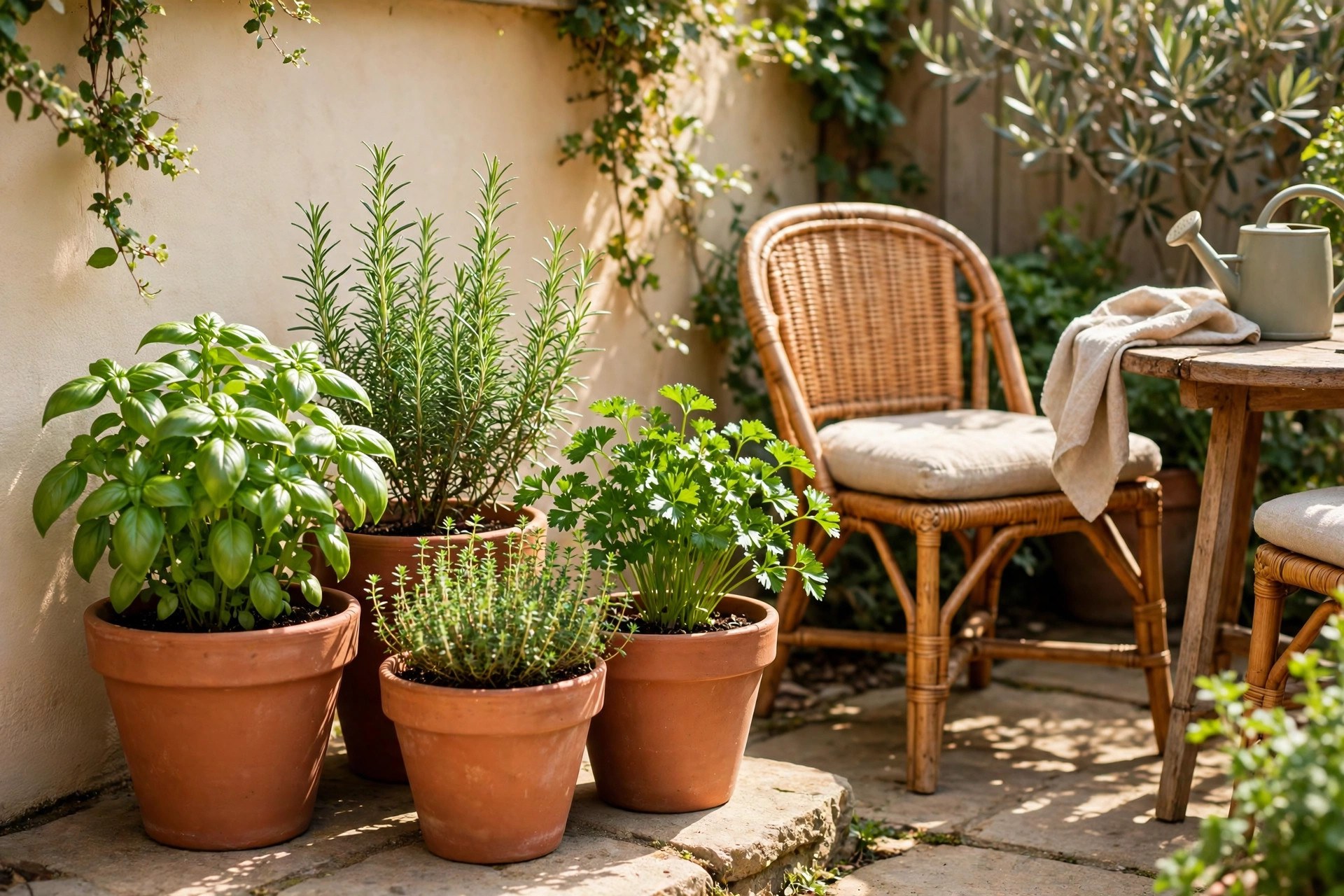
The best first herb garden is embarrassingly simple: five to seven terracotta pots, one herb per pot, grouped in your sunniest patio corner. Terracotta breathes, which helps prevent the swampy soil that kills potted herbs, and a one-herb-per-pot cluster lets you move each plant to better sun, bring the tender ones indoors, and replace a failure without disturbing the rest. Start with the forgiving set — parsley, chives, thyme and oregano — plus basil in warm weather. Pots of 6 to 8 inches suit most starter herbs; rosemary will want 10 to 12 inches as it grows. A starter cluster costs about $25 to $50 including plants. Watch-out: small terracotta pots dry out fastest of all, so in hot spells this cluster may need water daily — group the pots close together so they shade each other's soil and share humidity.
2. Stack a Tiered Ladder Planter Against the Sunniest Wall
A leaning ladder planter or tiered stand turns one square yard of patio into three or four shelves of herbs. Put the sun-hungriest, driest herbs at the top — basil in full sun, then rosemary and thyme — and the shade-tolerant, thirstier ones lower down: parsley, chives and mint at the base, remembering mint still gets its own pot on the bottom step. Untreated cedar tiered planters cost about $40 to $60, and a simple DIY ladder version can be built from under $10 of basic lumber and screws. Water from the top and let it trickle down, but check the bottom tier by touch: trickle-down watering can leave the lowest pots soggy while the top stays dry. Watch-out: a loaded ladder planter is top-heavy in wind — stand it against a wall or railing, never free-standing in the middle of an exposed patio.
3. Use an Eight-Pocket Raised Trug as a Whole Garden in One Box
If you want a real garden bed in miniature, a raised herb trug is the most garden-like option that fits a patio. The eight-pocket VegTrug, for example, holds eight herbs with dividers for soil health and aeration in a footprint of only about 31 inches wide by 31 inches deep by 23 inches high — smaller than a patio chair. The raised height is kind to backs and keeps the soil warmer and better drained than ground level. Cedar versions insulate roots, which helps warmth-loving basil. Expect about $90 to $150 for a quality trug. Plant the Mediterranean group along one side and the thirsty group along the other so your watering can respects the divide. Watch-out: a trug is a commitment piece — fill it where it will stand, because full of wet soil it is far too heavy to move.
4. Hang Railing Planters and Free the Whole Floor
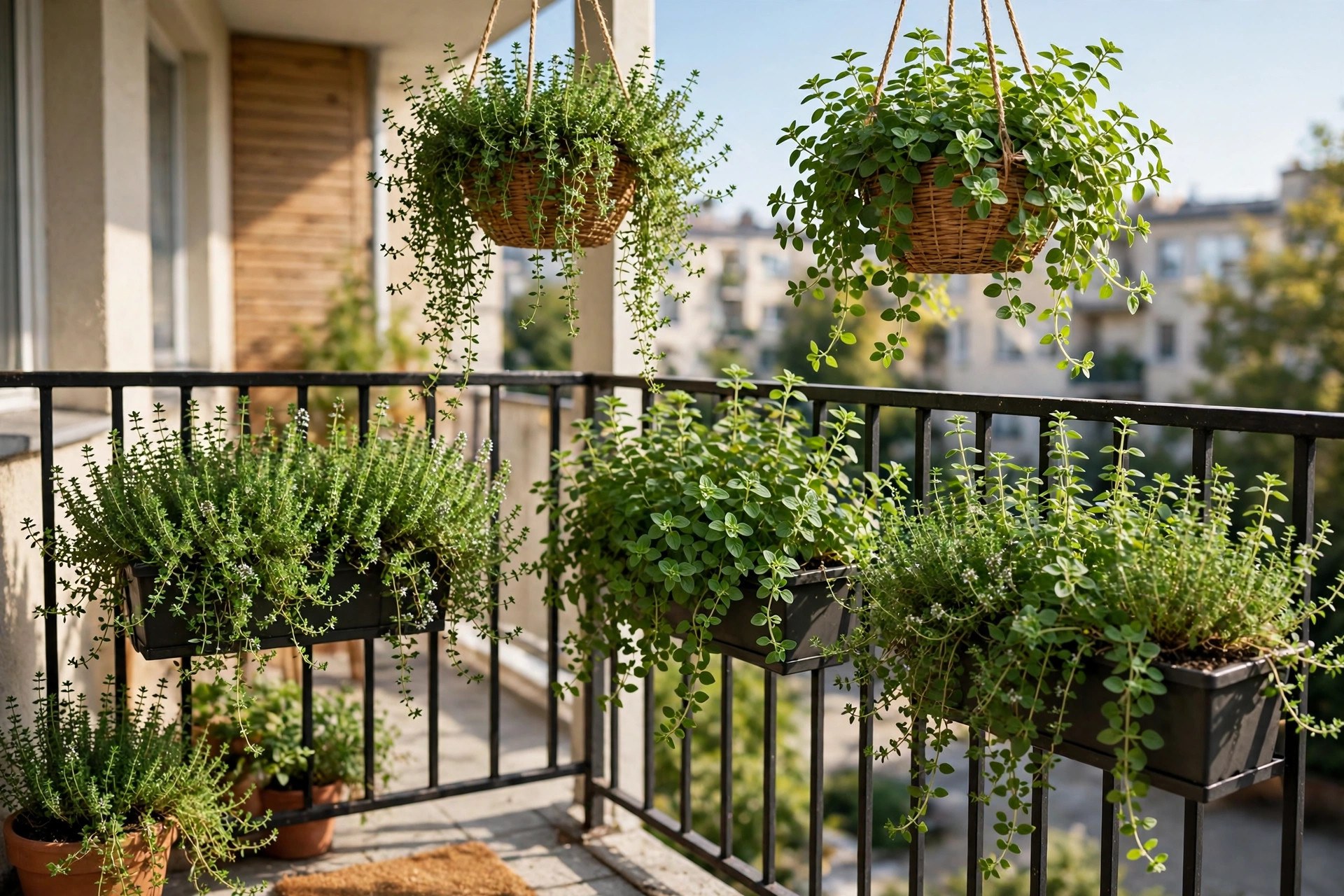
On a small patio or balcony, the railing is your biggest unused planting surface. Railing planters hook or bracket over the rail and hold a row of herbs in the best sun the patio gets — which is usually at the railing, above the shadows of furniture. A 24-inch railing planter holds three standard herb pots comfortably. Trailing thyme and oregano spill beautifully over the edges, while upright rosemary and sage sit well at the ends. Railing planters cost about $12 to $25 each. This is also the easiest garden to water evenly, because every pot sits at the same height in the same light. Watch-out: check your building or rental rules on railing planters first, secure them with both the hooks and a strap in windy spots, and always hang them on the inside face of the railing where a falling pot lands on your patio, not below it.
5. Go Vertical With a Wall Pocket or Pallet Garden
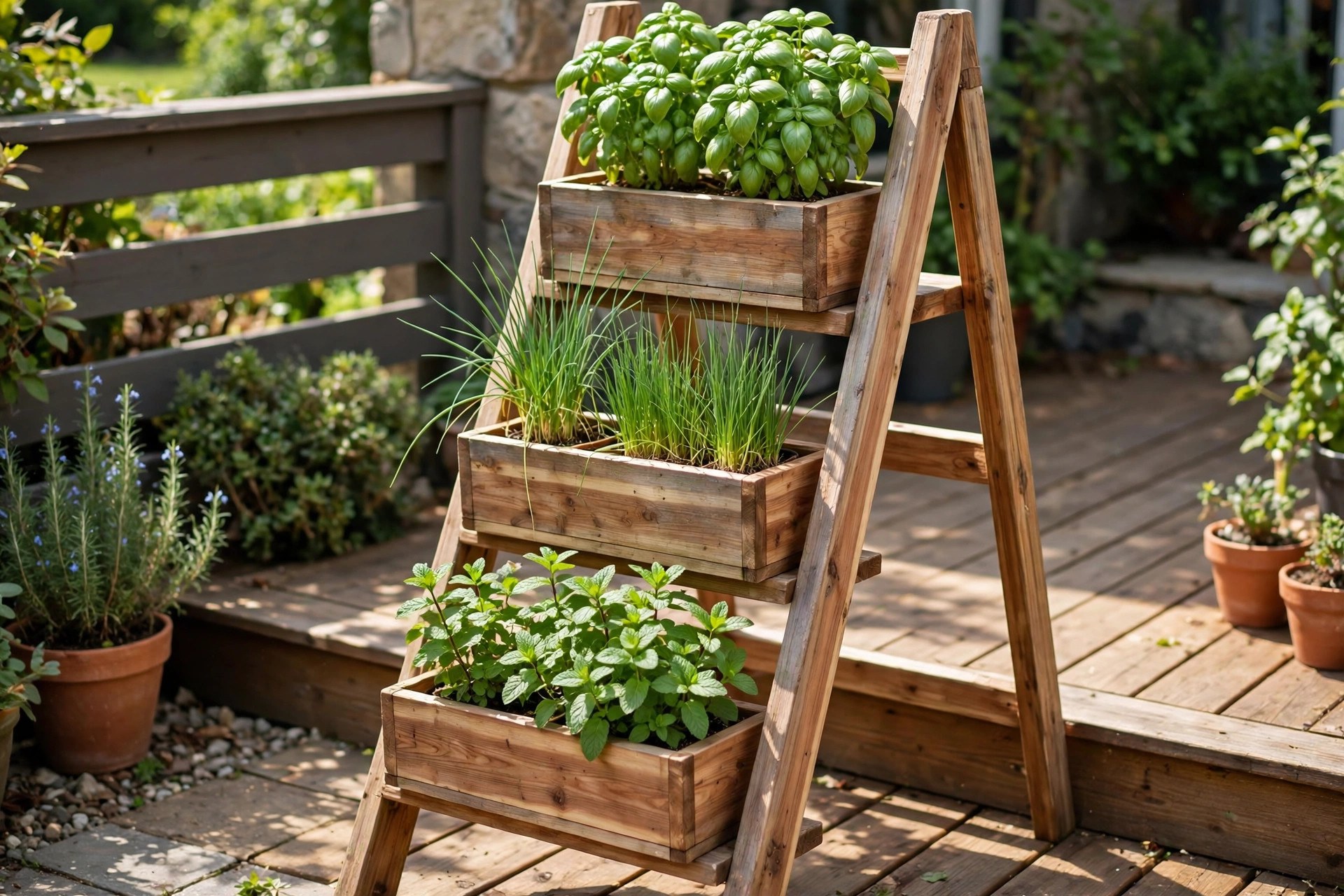
When the floor and the railing are full, the wall is next. A heat-treated wooden pallet leaned against a sunny fence, lined with landscape fabric stapled to the back and filled pocket by pocket with soil, makes a vertical garden for shallow-rooted herbs — thyme, dwarf basil, chives, oregano — for little more than the cost of soil and plants. Wall pocket panels do the same job more neatly for about $20 to $40. Vertical gardens dry out faster than pots at ground level because every pocket is small and exposed, so they suit a daily-quick-water routine. Our small backyard garden path ideas show how a vertical green wall can double as the backdrop that makes a small yard feel finished. Watch-out: only use heat-treated pallets, never chemically treated ones, for anything edible, and fix a leaning pallet so it cannot tip forward when the soil is wet and heavy.
6. Build a Five-Tier Stackable Tower for Fifteen Herbs in One Square Foot
The most herbs per inch of patio comes from a stackable tower planter: five tiers of connected pots, each tier holding about three herbs, for roughly fifteen plants in a footprint of about 16 to 18 inches across. Towers suit small herbs and leafy ones — parsley, cilantro, chives, lettuces among the herbs — and the central watering system on many models feeds every tier from the top. A tower costs about $35 to $60. Rotate the tower a quarter turn every few days so all sides get equal sun, or the back herbs will lean and pale. Keep mint out of the shared tower unless it has a tier entirely to itself. Watch-out: towers are thirsty at the top and can be soggy at the bottom; check moisture tier by tier for the first two weeks until you learn your tower's pattern.
7. Group by Thirst, Not by Looks, and Label the Two Zones
This idea costs two plant labels and saves more herbs than any product. Physically separate your patio into a dry zone and a moist zone: rosemary, thyme, sage and oregano together in the sunniest, fastest-draining spot, in terracotta; mint, parsley and cilantro together in the slightly shadier or lower spot, in glazed or plastic pots that hold moisture longer. Water the dry zone deeply but less often; water the moist zone lightly and more often. Most beginner herb losses come from one watering routine forced on both groups. Even the arrangement inside a shared trug or tier should follow the divide, dry at the top, thirsty at the base. Watch-out: cilantro bolts fast in heat and is short-lived by nature — sow a small fresh pot every few weeks rather than blaming your care when the first one flowers.
8. Add Hanging Baskets for Trailing Herbs Above the Seating
Hanging baskets use the air above your patio chairs, the last truly free space on a small patio. Trailing thyme and oregano cascade from baskets, and a basket of mint — safely alone in its own container, as it must be — hangs happily where its spread harms nothing. Baskets of 10 to 12 inches hold one good herb plant each and cost about $10 to $20 with a liner. Hang them at the patio's sunny edge where they get their six hours but do not drip on the seating below after watering. A row of three baskets also makes a soft green screen, which pairs beautifully with the glow in our patio string light ideas for small backyards. Watch-out: baskets dry out faster than any other container — in summer they can need water twice a day, so if you travel often, baskets are the first idea to skip.
9. Upcycle Crates, Tins and Basins for a Collected, Budget Garden
A wooden crate, a row of large tins or a vintage-style enamel basin gives a small herb garden its charm for almost no money — the main cost is plants and potting mix. Shallow containers suit shallow roots: thyme, chives and baby basil thrive in basins and crates that would stunt a rosemary. Whatever you upcycle, drainage is non-negotiable: drill holes in crate bases and tins, line crates with landscape fabric to hold the soil, and stand everything on small feet or bricks so water escapes freely. A crate garden costs about $10 to $30 all-in. Watch-out: metal tins heat up fast in full sun and can cook roots on a very hot patio; on scorching patios keep tins in the spot that gets morning sun and afternoon shade, or double-pot them inside a larger terracotta pot as insulation.
10. Try a Spiral Layout When You Have One Sunny Corner of Ground
If your patio borders even a small patch of ground, a spiral herb garden is the showpiece option: a low spiral mound edged with dry-stacked stone, about 4 to 6 feet across, rising to a small peak in the centre. The spiral builds microclimates into one structure — the top drains fast and bakes in the sun, perfect for rosemary, thyme and oregano, while the lower coils hold more moisture and a little more shade for parsley, chives and mint near the base (mint still in a sunk pot, even here). Dry-stacked stone needs no mortar and can be adjusted as you learn. Stone and soil for a small spiral cost about $40 to $80. Watch-out: a spiral is permanent in a way pots are not, so live with pots for a season first and build the spiral only where you have watched the sun prove itself for a full year.
11. Keep a Windowsill Backup Set for Winter and Cold Snaps
A patio garden needs an indoor lifeboat. Keep a small backup set — one pot each of parsley, chives and a young basil or mint — on your sunniest kitchen windowsill, in 4 to 5 inch terracotta pots. When late-fall nights turn cold, the patio's tender herbs either come inside to join the windowsill or finish gracefully, while the hardy rosemary, sage and thyme stay out in their sheltered corner. A windowsill set costs about $12 to $20 and doubles as your winter supply when the patio garden sleeps. Grouped together, the pots share humidity and grow better than a lone pot. Watch-out: windowsill light is weaker than it looks — rotate the pots every few days and accept slower, leggier growth indoors, then harden the plants off gradually over a week before they move back out in spring.
12. Harvest Little and Often, and Feed the Soil, Not the Leaves
The last idea is the routine that keeps the other eleven alive. Harvest little and often: pinch basil from the top to make it bush out, snip chives and parsley from the outer stems at the base, and never take more than a third of any plant at once. Feeding is light work — a half-strength liquid feed every few weeks in the growing season is plenty for container herbs, and overfeeding makes leafy herbs taste worse, not better. Refresh the top inch of potting mix in spring, and repot anything whose roots circle the drainage hole. Keep a simple rhythm: touch the soil daily, water when the top inch is dry, harvest weekly. Cost: a $8 bottle of feed for the year. Watch-out: the two classic killers are kindness errors — watering on a schedule instead of by touch, and fertilising a dry plant; always water first, feed second, and only onto moist soil.
Mistakes That Kill a Small Herb Garden
Planting mint in shared soil. It is the most repeated beginner loss in the research and the easiest to prevent: mint always gets its own pot, no exceptions, however small and innocent the plant looks in spring. The second killer is no drainage — a pretty pot without holes is a slow drowning, whatever the plant. Drill it, or use it as a cachepot with a drained nursery pot inside.
One watering routine for every herb. Dry-group and thirsty-group herbs planted and watered as one will always lose one group. Separate the zones, water by touch, and use the storage and layout thinking in our patio storage guide to keep a watering can and feed within reach of the garden itself — a routine that lives where the plants are is a routine that happens. Browse the rest of the Outdoor & Porch collection for more small-patio layouts that leave room to grow.
Questions People Ask
How much sun do patio herbs actually need?
Most herbs need at least 6 hours of direct sun a day. If your patio gets less, grow the shade-tolerant set — mint, chives and parsley — and put only those in the dimmer corners, keeping the sunniest spot for basil, rosemary and thyme.
Which herbs are easiest for a first small patio garden?
Parsley, chives, thyme and oregano are the most forgiving in containers. Add basil in warm weather — it wants soil around 60 degrees Fahrenheit — and mint only in a pot of its own, because it spreads aggressively.
How often should I water herbs in small pots?
Water by touch, not by schedule: when the top inch of soil feels dry. Small containers dry out quickly, hanging baskets fastest of all, so in hot weather some pots need water daily while a large trug may need it twice a week.
Can I grow herbs on a patio with no floor space at all?
Yes. Railing planters, hanging baskets and wall pocket or pallet gardens use no floor — a five-tier stackable tower also grows about fifteen herbs in roughly a square foot. Just remember vertical plantings dry out faster and need the most faithful watering.
Map your six hours of sun, group the dry herbs apart from the thirsty ones, give mint a pot of its own — and even the smallest patio will keep your kitchen in fresh herbs for most of the year.


Comments
Post a Comment