
12 Small Bathroom Shower Curtain Ideas That Make a Tiny Bath Feel Bigger
In a tiny bathroom, the shower curtain is not a small detail. It is the largest piece of fabric in the room, and in most small bathrooms it covers more visual space than the vanity, the mirror, and the floor combined. That is why the best small bathroom shower curtain ideas treat the curtain like a fourth wall. Get the colour, height, and pattern right, and a 5 x 7 ft bathroom suddenly breathes. Get it wrong, with a dark, busy, or too-short curtain, and even a freshly cleaned room feels boxed in and smaller than it really is.
The good news is that this is one of the cheapest changes you can make. Most of the curtains in this guide cost between $15 and $45, an extra-long version runs $20 to $50, and even a curved rod upgrade is only $25 to $60. No tiles come off, no plumber is called, and most swaps take under twenty minutes. Below are twelve practical ideas that actually work in real small bathrooms, plus an honest measuring guide and the mistakes that quietly undo all of them.
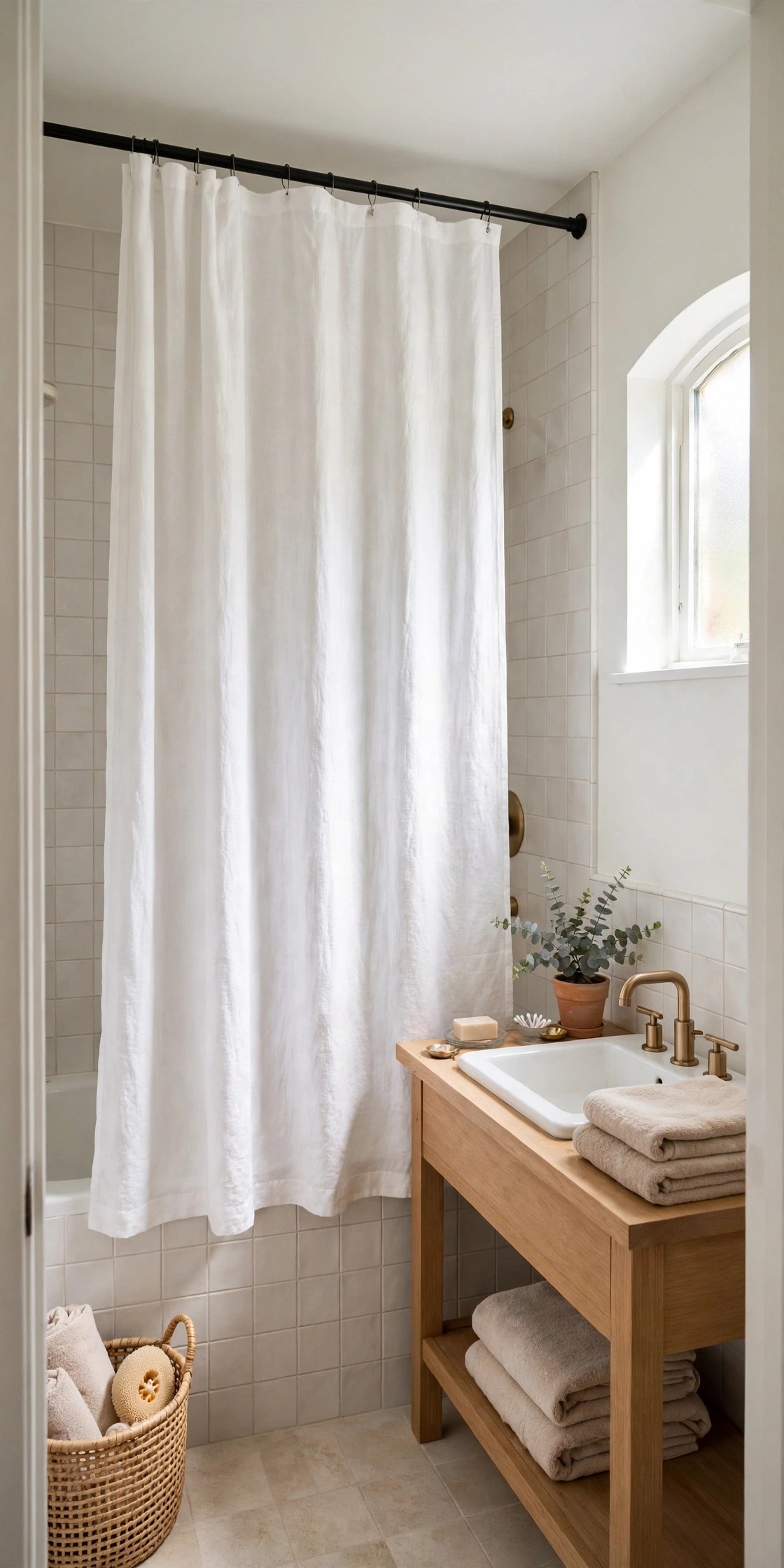
Why Small Bathroom Shower Curtain Ideas Start With Height, Not Pattern
Before you fall for a print, look up. In a standard bathroom the rod sits at shower-head height and a standard 72 x 72 in curtain stops well below the ceiling. That gap creates a hard horizontal line that chops the wall in two and reminds your eye exactly how low and small the room is. Raising the rod changes the proportions of the whole room before you have spent a dollar on pattern or colour.
How to Measure and Hang a Curtain in a Small Bathroom
Measure before you order, because extra-long curtains are the one size you cannot fake. Use this simple sequence:
- Width: Measure the inside width of the tub or shower opening, then add about 12 in of fullness. A flat curtain pulled tight looks cheap and lets water escape at the edges.
- Rod height: Mark a line 4 to 6 in below the ceiling. On an 8 ft ceiling, that usually puts the rod at around 90 to 92 in from the floor.
- Curtain length: Measure from your new rod line down to 1 to 2 in above the floor. Most high-mounted rods need an 84 in curtain instead of the standard 72 in length.
- Liner position: The liner always hangs inside the tub while you shower. The decorative curtain hangs outside. Mixing this up is the fastest way to flood a small floor.
- Hem clearance: Keep the hem hovering 1 to 2 in above the floor. Fabric that puddles or drags stays damp, smells musty, and grows mildew along the bottom edge.
If you rent, a tension rod mounted high gives you the same lift with zero drilling.
1. Hang It High With an Extra-Long 84-Inch Curtain
This is the foundation idea, and if you only do one thing from this list, do this one. Move the rod up to 4 to 6 in below the ceiling and switch to an extra-long 84 in curtain. The unbroken vertical sweep makes the ceiling feel higher and the whole room feel calmer, because there is no chopped-off band of wall above the shower.
Expect to pay $20 to $50 for a good extra-long curtain in cotton, linen-look polyester, or a waffle weave. Check the grommet or buttonhole spacing before you buy, and use smooth-gliding rings so the taller curtain does not drag or snag. In a bathroom with a window or a tall mirror, the effect doubles, since the curtain height starts to match the other tall elements instead of fighting them.
2. Choose Vertical Stripes That Pull the Eye Up
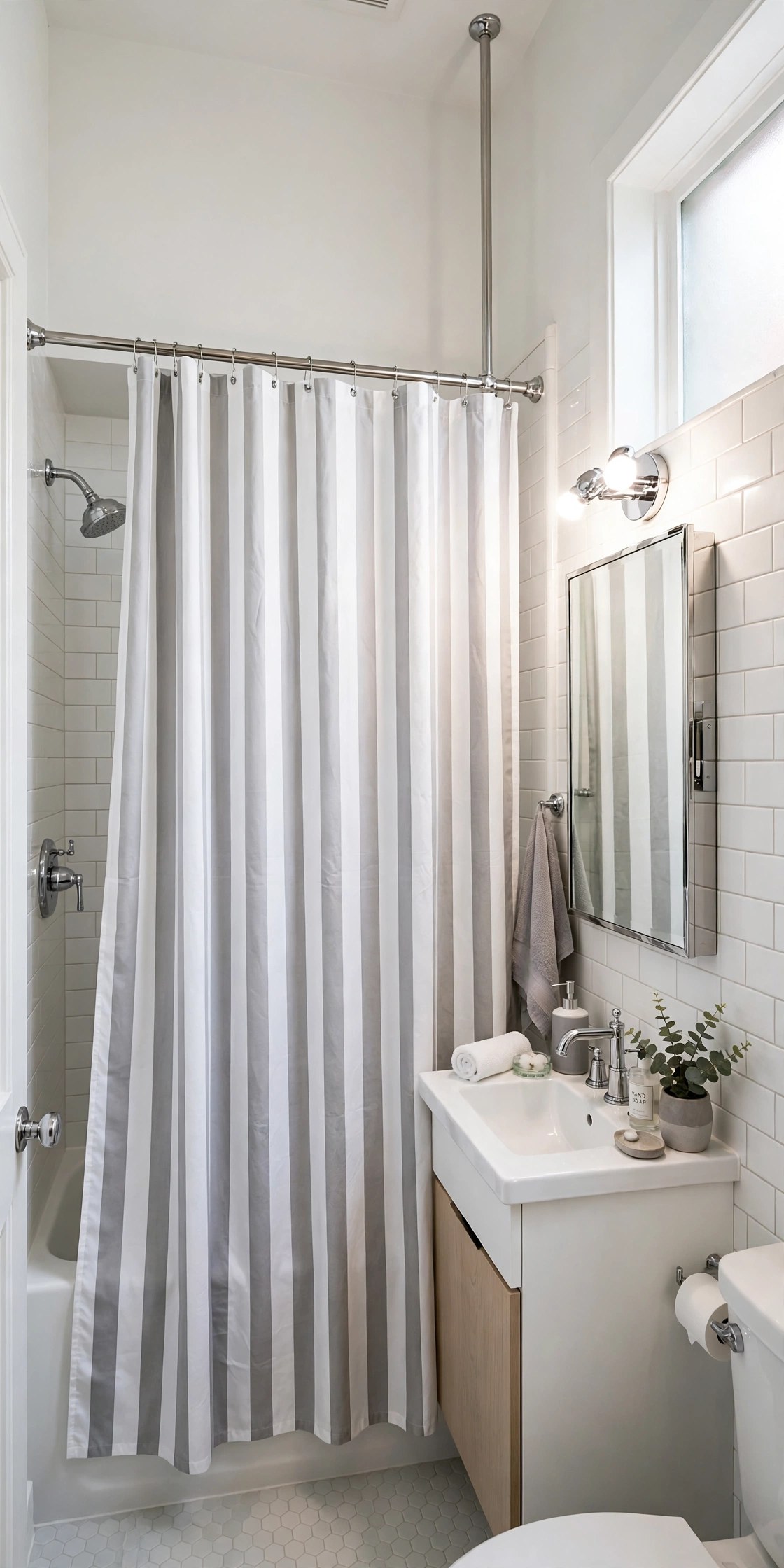
Vertical stripes are the oldest trick in the small-space book, and they earn their place here. Narrow or medium vertical stripes, especially in soft contrasts like white and pale grey, white and sand, or white and a faded blue, lead the eye upward and reinforce the tall-curtain effect. The room reads higher without you changing a single fixture.
Keep the contrast gentle. High-contrast black and white stripes can vibrate in a tiny room and feel busy from two feet away. Tonal stripes, where the stripe is just a shade deeper than the ground colour, give you the lift without the noise. If your towels or bath mat already have a pattern, let the striped curtain be the only pattern in the room so the stripes stay the clear focal point.
3. Go Clear or Frosted to Keep the Sightline Open
A solid curtain closes off roughly a third of a small bathroom the moment you pull it across. A clear or lightly frosted curtain does the opposite: your eye travels straight through to the back wall and the tile, so the room keeps its full depth even when the curtain is closed. For bathrooms under 40 sq ft, this can be the difference between feeling cramped and feeling fine.
Frosted is the practical middle ground for most homes. It blurs outlines for privacy, softens the look of bottles and pipes behind it, and still passes light. Fully clear curtains show everything, which works beautifully if your tub area is tidy and your tile is worth showing, and less well if the shower niche is crowded with bright plastic bottles.
Wipe a clear curtain down weekly and squeegee it after showers, because water spots show far more than on fabric.
4. Add a Curved Rod for Real Elbow Room
Some small bathroom shower curtain ideas change how the room looks. This one changes how it feels at 7 a.m. A curved rod bows out over the tub and adds roughly 3 to 6 in of extra space at shoulder and elbow height, right where you actually need it. The curtain stops clinging to your arms, and the shower feels noticeably less like a phone booth.
Curved rods cost about $25 to $60 and come in fixed-mount and tension versions. Fixed mounts are sturdier and worth it if you own your home; tension versions suit renters and guest baths. Because the curtain hangs further out at the middle, double-check your curtain width. You may need the next width up so the ends still tuck neatly inside the tub line and water stays where it belongs.
Combine a curved rod with the high-mount trick and you get both benefits at once: more physical room inside the shower and more visual height outside it. It is the best under-$100 upgrade pairing on this list.
5. Pick Light Solid Colours That Reflect Light
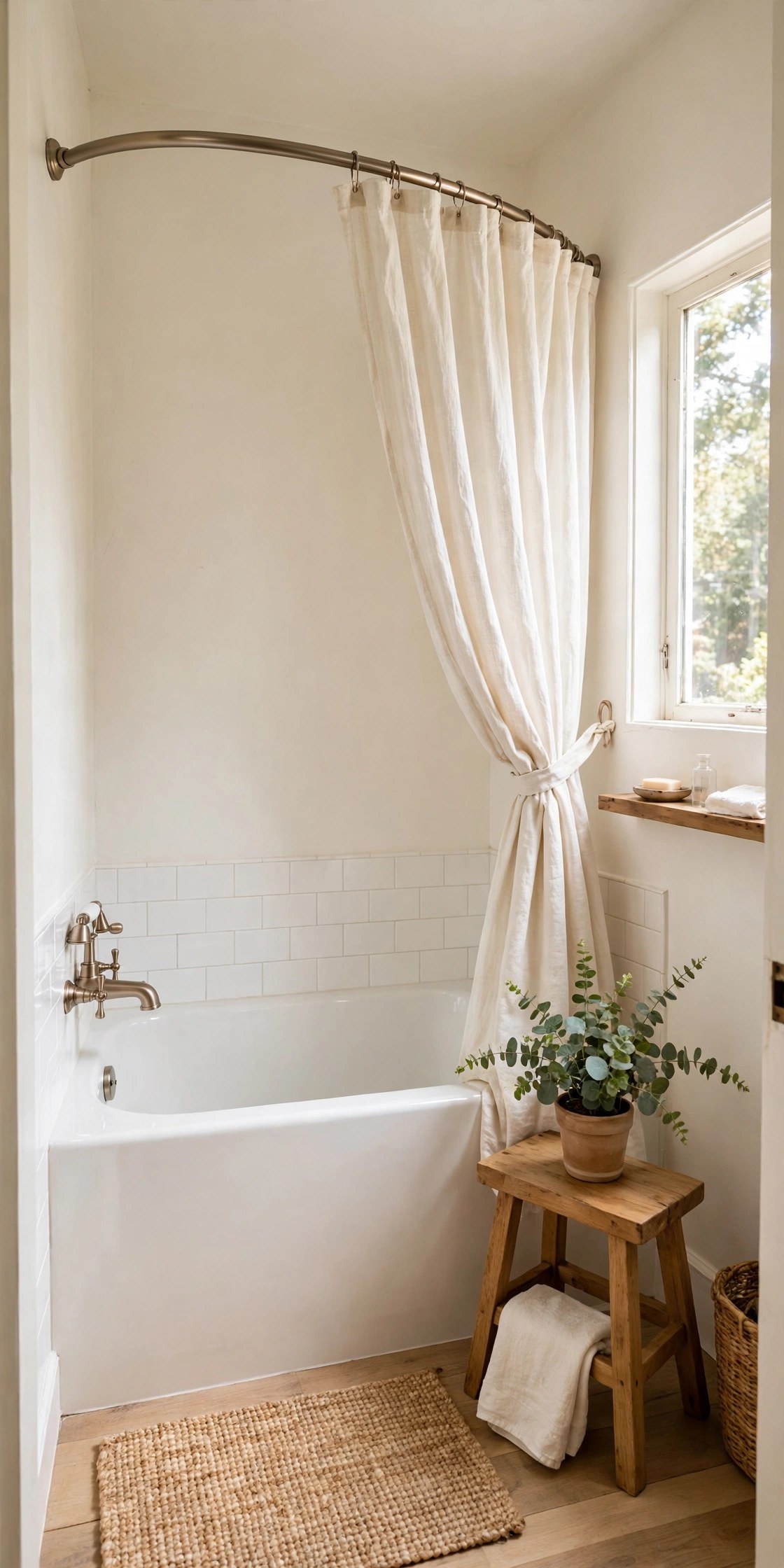
White, warm off-white, pale stone, soft sage, and the lightest blue-grey all bounce light around a small room instead of absorbing it. A light solid curtain acts almost like an extra light source, especially in a windowless bathroom where every surface has to work hard. It also gives you a calm backdrop, so a small room with lots of necessary clutter, from toothbrushes to skin-care bottles, still reads tidy.
Solid does not have to mean flat or boring. Look for interest in the weave instead of the print: a subtle waffle texture, a slubbed linen look, or a fine pinstripe woven into the fabric. You get depth up close without visual noise from across the room. This pairs especially well with the mirror and lighting upgrades in our guide to small bathroom mirror ideas that make a tiny bath feel bigger, because a light curtain and a well-placed mirror multiply each other's effect.
6. Try a Sheer Top Panel for Privacy Plus Light
Some curtains come with a sheer or mesh panel across the top third, and in a small bathroom that detail does two jobs at once. The solid lower section keeps full privacy, while the sheer top lets light pass over the curtain into the shower area. If your bathroom has one small window above the tub, this design lets that daylight reach the rest of the room instead of trapping it in the shower stall.
It also softens the high-mounted look. A full-height solid curtain can feel like a big blank sail in a very small room; the sheer band breaks it gently without adding pattern. Many versions include a snap-on liner, so the whole thing goes into the wash easily, which matters because the sheer section shows dust and humidity film faster than heavy fabric.
7. Split It Into Two Panels, Tied Back Like Window Curtains
Instead of one wide curtain sliding from a single side, hang two narrower panels that part in the middle and tie back to the walls like window drapes. Open, they frame the tub the way curtains frame a window, and the room instantly feels more designed and less utilitarian. The open centre also shows off nice tile or a clean tub you would otherwise hide all day.
Each panel should be wide enough to close fully across half the tub with some fullness, so measure the opening and divide generously rather than exactly. Simple fabric tiebacks, hook-and-loop straps, or magnetic ties all work; magnetic ties are the easiest for daily use because they snap together with wet hands.
This look suits bathrooms where the tub is mostly used for baths or where a glass-look liner does the real water work behind the panels. Keep a plain liner on its own rings behind the fabric panels, closed during showers, and let the decorative panels stay tied back the rest of the day.
8. Use a Textured White Linen Look for Quiet Depth
If light solids appeal to you but plain polyester feels flat, a textured white or natural linen-look curtain is the upgrade. The woven texture catches light and shadow in a way that reads rich up close, while from the doorway it still looks like one calm, unbroken expanse of light fabric. That is exactly the balance a small bathroom needs.
Real linen is beautiful but can mildew faster in a steamy room and usually costs more. Linen-look polyester gives you 90 percent of the appearance with far easier washing and quicker drying, typically for $18 to $40. Whichever you choose, keep the rest of the room's textiles simple so the texture stays the story. It sits beautifully next to the natural fibres discussed in our roundup of small bathroom rug ideas that stay put and dry fast, and the two together make a plain rental bath feel deliberately styled.
9. Match the Curtain to the Wall Colour for a Seamless Wall
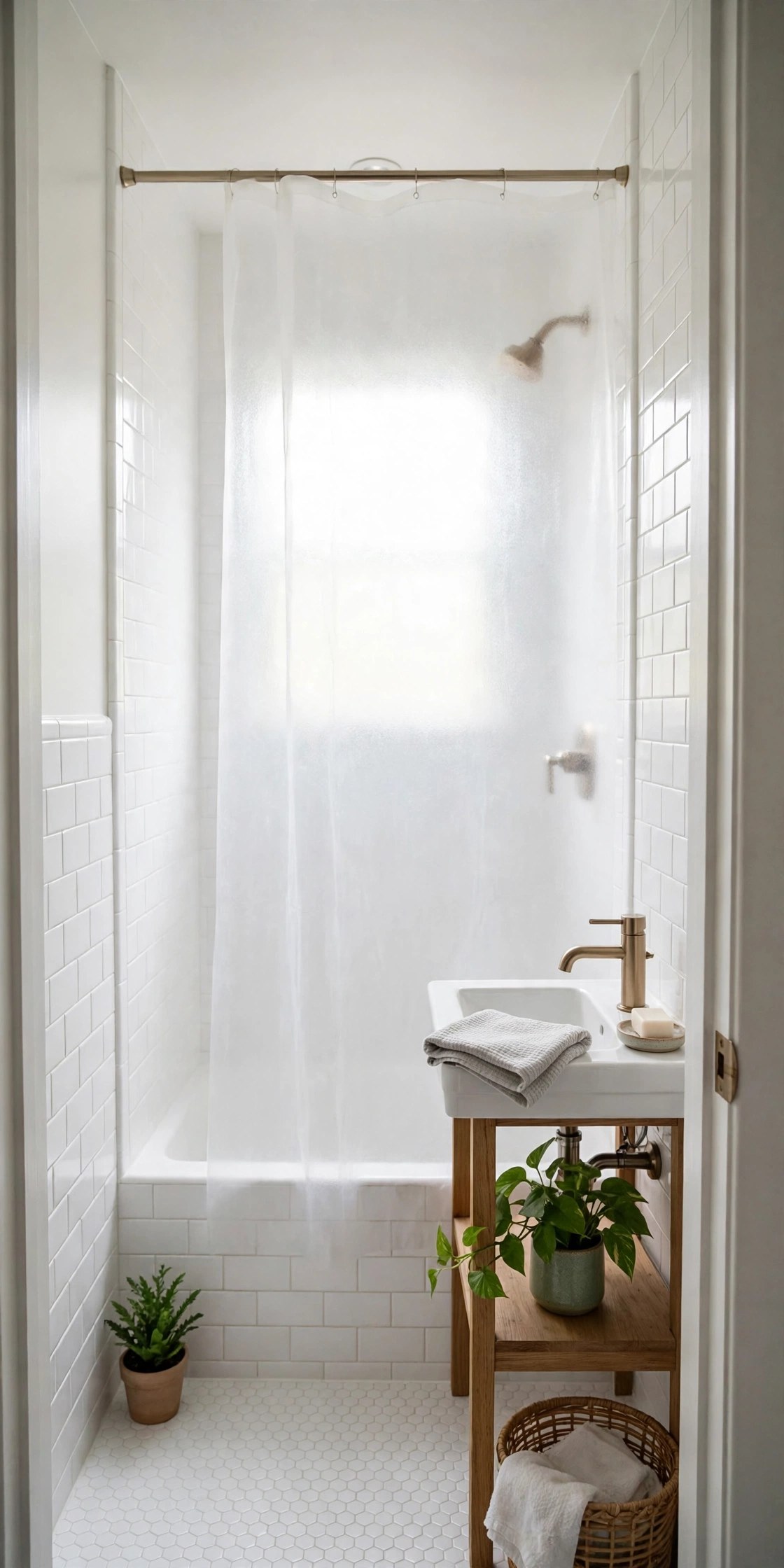
Every visual break in a small room reminds your brain to measure it. A curtain in the same colour family as the walls removes one of the biggest breaks of all. When wall, curtain, and ideally the tub surround sit in one monochrome family, say soft white on soft white, or pale greige on pale greige, the eye stops segmenting the room into pieces and simply reads one larger, calmer space.
You do not need an exact paint-chip match. Within a shade or two is enough, because fabric and painted drywall reflect light differently anyway. Take a paint swatch or a phone photo in daylight when you shop, and avoid buying under harsh store lighting, which shifts colours cooler than they will look at home.
10. Choose a Pocket Liner to Steal Back Storage
In a pedestal-sink bathroom there is often no vanity cabinet, no shelf, and nowhere for the shampoo except the edge of the tub. A curtain or liner with mesh storage pockets on the inside solves that without a single new piece of furniture. Bottles, razors, and bath toys sit in clear mesh pockets at easy reach, off the tub rim, and out of sight from the doorway.
Look for pockets in at least two sizes, with the largest pockets low enough for tall bottles. Mesh matters: it drains and dries, while solid plastic pockets hold water and go cloudy and slimy within weeks. Keep the heaviest bottles in the lowest row so the curtain hangs straight and the rod does not bow.
11. Let in More Light With Colour and Placement Together
A curtain does not work alone; it works with your lighting. A pale curtain pulled to one side during the day, stacked tightly so it covers as little wall as possible, lets your fixtures do their job across the whole room. If your curtain stack is wide and bunched, it can swallow 8 to 10 in of wall and shadow the corner beside the tub.
Choose rings or hooks that glide and stack neatly, and consider tying or clipping the curtain back during the day if the tub is not in use. Then look honestly at your bulbs. Warm, bright, well-placed light makes a light curtain glow; a single dim ceiling bulb makes even the best curtain look grey. For fixture placement and bulb choices that suit tiny rooms, see our guide to small bathroom lighting ideas that flatter a tiny space and tackle the curtain and the lighting in the same weekend.
For deeper research on how these tricks compare across dozens of real bathrooms, this detailed breakdown of small bathroom shower curtain ideas and sizing is a useful second read before you buy.
12. Keep the Hem Floating and the Fabric Easy to Wash
The last idea is unglamorous and it protects all the others. A curtain whose hem hovers 1 to 2 in above the floor stays drier, resists mildew, and keeps that clean horizontal line that makes the room look finished. A curtain that drags will discolour at the bottom no matter how pretty the top is, and a stained hem is the first thing guests notice.
Choose machine-washable fabric and actually wash it monthly in a steamy bathroom, every other month otherwise. Wash or replace the liner on the same schedule; liners are cheap, usually $8 to $15, and a fresh liner instantly brightens the whole shower area. If mildew spots appear along the bottom of a fabric curtain, a soak in warm water with oxygen-based cleaner usually saves it, as long as the fabric care label allows it.
Common Mistakes That Make a Small Bathroom Feel Smaller
- Mounting the rod at the old height with a longer curtain, so fabric pools on the floor and looks sloppy instead of tall.
- Choosing dark, heavy fabrics like deep navy canvas or black prints that absorb light and advance toward you, shrinking the room visually.
- Picking busy, large-scale patterns that fragment the biggest surface in the room into noisy pieces. Small rooms need calm at large scale.
- Hanging the liner outside the tub during showers, which sends water straight onto a small floor with nowhere to go.
- Letting the hem touch the floor, which guarantees dampness, mildew staining, and a permanently tired look.
- Buying the standard 72 in length for a high rod, leaving an awkward gap at the bottom that undoes the whole high-hanging effect.
- Forgetting fullness, so the curtain stretches flat and tight like a sheet, showing every bump of the tub behind it.
What to Spend and Where to Save
A realistic budget for a full curtain refresh in a small bathroom looks like this: $15 to $45 for a standard curtain, $20 to $50 for extra-long, $25 to $60 for a curved rod, $8 to $15 for a fresh liner, and a few dollars for smooth rings if yours squeak or snag. The whole transformation usually lands between $40 and $110, which is less than a single tile change and completely reversible if you rent.
Spend first on length and rod position, because proportion beats pattern every time. Save by remounting your existing rod higher and choosing linen-look polyester over real linen.
The Bottom Line for a Bigger-Feeling Small Bathroom
The best small bathroom shower curtain ideas all follow one principle: protect the longest, tallest, calmest sightlines you can. Hang high with an 84 in curtain, favour light solids, vertical stripes, sheer tops, or a clear panel that keeps the back wall visible, match the walls when in doubt, and keep the hem floating clean above the floor. Add a curved rod if your elbows need the room, and a pocket liner if your pedestal sink left you with no storage.
Start with the measuring tape, not the shopping cart. Ten minutes of measuring, one curtain in the right size, and a rod moved a foot higher will do more for a tiny bathroom than any accessory you can buy. Pick your favourite idea from this list, hang it this weekend, and enjoy stepping into a room that finally feels like it fits.


Comments
Post a Comment